Once upon a time, air defense meant watching for jets, missiles, and other expensive things that made generals sweat into very official-looking folders. Then small drones arrived, buzzing over bases, borders, battlefields, prisons, airports, and public events like flying lawnmowers with a grudge. Suddenly, a few hundred dollars’ worth of plastic, batteries, cameras, and software could create a million-dollar headache.
That is why America’s anti-drone weapons, also known as counter-UAS or C-UAS systems, have moved from “interesting defense technology” to “please solve this yesterday.” The United States is investing in layered defenses that can detect, track, identify, and defeat hostile or unauthorized drones without turning crowded airspace into a fireworks show. The challenge is not just shooting something down. The challenge is knowing what it is, where it is, who controls it, whether it is dangerous, and what response is legal, safe, and proportionate.
In plain English: anti-drone defense is not one magic zapper. It is a whole security ecosystem. Think radar, radio-frequency sensors, cameras, electronic warfare, interceptors, lasers, high-power microwaves, command software, trained operators, and enough paperwork to make a printer beg for retirement.
Why Drones Changed the Air Defense Game
Drones are not new, but the modern small drone problem is different. Commercial quadcopters, fixed-wing drones, and improvised unmanned aircraft are cheap, easy to modify, and widely available. Some are used for photography, agriculture, mapping, disaster response, and inspections. Others can be misused for surveillance, smuggling, harassment, or attacks. That mixed-use reality makes the defense problem tricky.
A fighter jet is obvious. A small drone near a stadium, airport, refinery, or military base is not always obvious. It might be a hobbyist who ignored the rules, a news crew, a security contractor, a lost delivery drone, or a hostile operator trying to collect information. Anti-drone systems must separate the clueless from the dangerous, which is harder than it sounds. A drone does not wear a little villain cape.
Modern conflicts have also made the drone threat impossible to ignore. In Ukraine, the Middle East, and other regions, drones have been used for reconnaissance, targeting, strike missions, and swarm-style pressure. U.S. defense planners now treat unmanned systems as an urgent and enduring challenge because they can threaten personnel, equipment, facilities, and operations at home and abroad.
What “Counter-Drone” Really Means
Counter-drone defense usually has two broad missions: detection and mitigation. Detection means finding and understanding the drone. Mitigation means stopping, redirecting, disabling, or otherwise reducing the threat. The best systems do both in a coordinated way, but the real world is rarely polite enough to follow a brochure.
1. Detect: Find the Flying Problem
Detection can involve radar, radio-frequency monitoring, electro-optical cameras, infrared sensors, acoustic sensors, and software that fuses multiple data streams. Radar may notice a moving object. Radio-frequency sensors may detect control signals. Cameras may help operators visually confirm what they are seeing. Infrared sensors can help in low-light conditions. Acoustic systems listen for drone-like sound patterns, though noisy urban areas can make that difficult.
Detection alone is not enough. A sensor might tell security teams that something is in the air, but it may not reveal intent. Is the drone dangerous? Is it authorized? Is it carrying anything? Is it hovering near a runway, a power substation, or a sensitive military site? The answer determines whether the response is a phone call, a warning, a temporary flight restriction, or a more serious action by authorized personnel.
2. Track and Identify: Don’t Swat the Wrong Mosquito
Tracking follows the drone over time. Identification tries to answer what type of drone it is and, when possible, where it came from. This is where command-and-control software matters. A modern counter-UAS system may combine sensor feeds into a single operating picture so defenders can make decisions faster.
That matters because the airspace over the United States is crowded and highly regulated. Airports, emergency helicopters, police aircraft, military aircraft, news helicopters, and legitimate drones may all operate near one another. A counter-drone response that creates a new aviation hazard is not a victory. It is just a different flavor of chaos.
3. Mitigate: Stop the Threat Safely
Mitigation includes several categories. Some systems use electronic warfare to interrupt or confuse a drone’s control links or navigation. Some use kinetic interceptors, meaning a physical object defeats the drone. Some use nets. Some use directed energy, such as lasers or high-power microwaves. Others focus on passive defenses, such as hardening facilities, using overhead cover, changing procedures, or improving surveillance.
The important point is that mitigation is tightly controlled in the United States. Private organizations cannot simply buy a jammer, point it at the sky, and declare themselves the neighborhood anti-drone sheriff. Interfering with aircraft, communications, or navigation can create serious safety and legal risks. Counter-drone tools are mainly used by federal agencies and authorized teams under specific authorities.
America’s Anti-Drone Toolkit
The U.S. approach is layered because drones vary widely in size, speed, autonomy, payload, and mission. A tiny quadcopter near a prison is not the same problem as a one-way attack drone near troops overseas. A single drone is not the same problem as a coordinated group. No single technology solves every scenario, despite what a dramatic trade-show video with thunderous music may suggest.
Electronic Warfare Systems
Electronic warfare is one of the most discussed counter-drone methods. At a high level, it targets the signals a drone may rely on, such as command links or navigation. When used by authorized teams, electronic effects can sometimes force a drone to land, return, drift away, or lose mission effectiveness.
The appeal is obvious: electronic warfare may stop a drone without firing a projectile. The limitation is just as obvious: not all drones rely on active radio control. Some can fly preplanned routes. Some may use hardened links. Some may operate with more autonomy. That is why electronic warfare is useful, but not a universal remote control for the sky.
Kinetic Interceptors
Kinetic interceptors physically engage the drone. The RTX Coyote interceptor is one public example associated with U.S. counter-UAS missions. The Army has also moved to procure Coyote interceptors to support counter-drone needs. These systems are designed for military environments where speed, reliability, and integration with sensors matter.
Kinetic defeat can be effective, but it raises practical questions. Where will debris fall? Is the drone over a battlefield, a base, a stadium, or a city street? Is the target alone or part of a larger group? Is a missile an economical answer to a cheap drone? These questions are why commanders want layered options rather than one very expensive hammer for every very cheap nail.
Lasers and Directed Energy
Lasers sound futuristic because, frankly, they are lasers. U.S. Army directed-energy efforts such as DE M-SHORAD show how the military is exploring high-energy laser systems mounted on mobile platforms. The attraction is cost-per-shot, precision, and deep magazines as long as power and cooling are available.
Lasers are not magic. Weather, dust, smoke, line of sight, tracking quality, safety procedures, and power demands all matter. A laser may be excellent in one scenario and less useful in another. Still, directed energy is a major part of America’s anti-drone future because it offers a way to engage certain threats without spending interceptor missiles like they are arcade tokens.
High-Power Microwave Systems
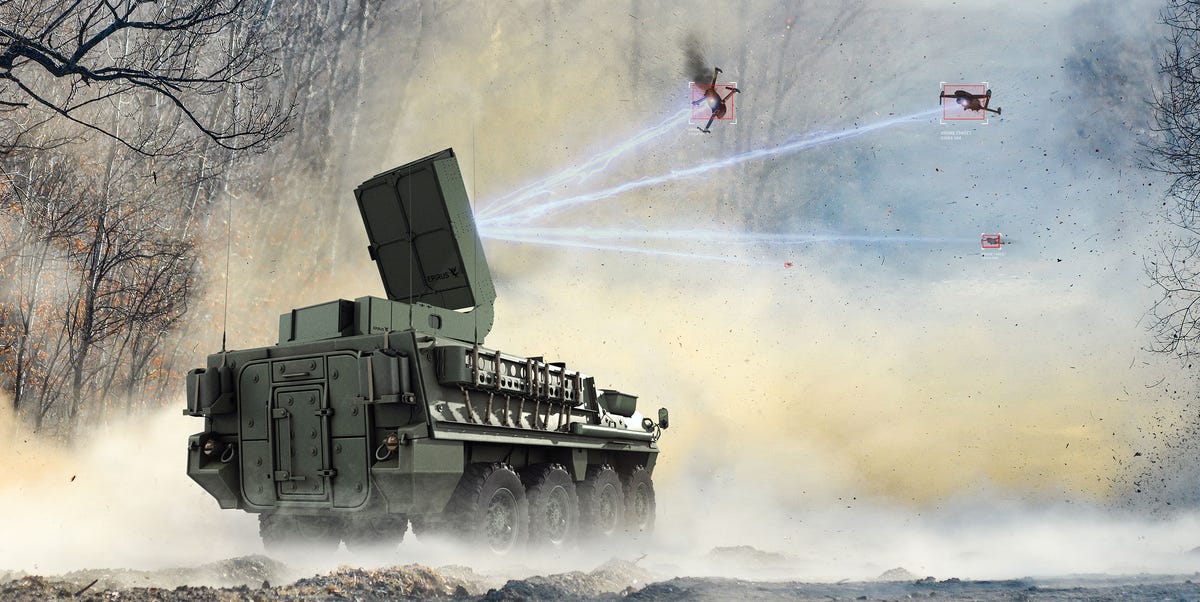
High-power microwave systems are another directed-energy category. Instead of focusing on one airframe the way a laser typically does, a microwave system may be designed to affect electronics over a wider area. That makes the concept especially interesting for drone swarms, where the problem is not one buzzing intruder but many small systems arriving together.
Publicly discussed systems such as Epirus Leonidas show how U.S. companies and defense agencies are exploring microwave-based counter-swarm tools. The promise is big: defeat multiple drones quickly. The challenge is equally serious: systems must be safe, controlled, tested, and integrated into military decision-making so they do not disrupt friendly equipment or civilian infrastructure.
Command-and-Control Software
Sensors and effectors are only useful if someone can make sense of them. That is why command-and-control platforms are becoming central to counter-UAS defense. Software can combine radar tracks, camera feeds, radio-frequency detections, alerts, maps, and operator decisions into a single view.
Anduril’s Lattice and similar platforms reflect a broader trend: anti-drone defense is becoming a data problem as much as a weapons problem. The goal is to shorten the time between detection and decision while reducing mistakes. In crowded airspace, speed without judgment is dangerous. Judgment without speed is also dangerous. The sweet spot is fast, informed, authorized action.
Passive Defenses
Passive defenses rarely get the spotlight, mostly because “better procedures and protective design” does not look as exciting on a poster. Yet passive measures matter. Facilities can improve observation points, adjust lighting, protect sensitive equipment, reduce exposed gatherings, plan safe shutdown procedures, and train staff to report suspicious drone activity.
Passive defense is not glamorous, but it is often the first layer. If a drone appears over a public event, the response may begin with observation, communication, crowd safety, and coordination with law enforcement. Not every drone incident should trigger a dramatic takedown. Sometimes the smartest defense is calm, structured, and deeply un-Hollywood.
Where Anti-Drone Defenses Matter Most
Military Bases
Military installations are a major focus because drones can watch training, map facilities, test security reactions, or threaten personnel and equipment. Recent U.S. exercises and policy changes show that base defense is not just a technology issue. It is an interagency issue involving the military, local authorities, federal agencies, airspace managers, and legal rules.
Airports
Airports are especially sensitive because even a small drone near flight paths can disrupt operations. A careless drone flight can delay landings, divert aircraft, and create safety risks. Airport counter-drone planning focuses heavily on detection, response plans, coordination with the FAA, and avoiding second-order effects that could endanger manned aircraft.
Borders and Critical Infrastructure
Border areas, power facilities, ports, refineries, communications sites, and government buildings are also part of the conversation. Drones can be used to scout routes, observe security, carry contraband, or create disruption. Critical infrastructure owners may not have authority to disable drones themselves, but they can improve detection partnerships, reporting procedures, and resilience planning.
Public Events
Major public gatherings, sports championships, political events, and national celebrations can attract unauthorized drone activity. Security planners must balance public safety, privacy, aviation law, and the possibility of accidental overreaction. The best counter-drone plan is not “panic, then improvise.” It is preparation, communication, and clear authority before the drone shows up like an uninvited mechanical pigeon.
The Legal Reality: You Cannot Just Jam the Sky
One of the biggest misunderstandings about anti-drone weapons is that anyone can use them. In the United States, counter-UAS mitigation is heavily restricted. Federal laws protect aircraft, communications, computer systems, and the safe use of the national airspace. The FAA has made clear that it does not support C-UAS use by entities other than federal departments with explicit statutory authority.
This matters for schools, stadiums, utilities, airports, businesses, and local governments. They may want protection, and in many cases they should improve drone awareness and response planning. But mitigation tools that disrupt, disable, seize control of, or destroy drones are not ordinary security gadgets. They involve public safety, aviation safety, privacy, and federal law.
Why There Is No Silver Bullet
The counter-drone problem is difficult because drones are cheap, varied, and rapidly evolving. A defense system that works well against a remote-controlled quadcopter may struggle against an autonomous fixed-wing drone. A method that works outdoors may be less effective in a dense urban environment. A tool that is perfect for a desert base may be inappropriate near an airport.
Cost is another major challenge. Using a high-end interceptor against a low-cost drone can be necessary in a serious threat scenario, but it is not economically ideal at scale. That is why the U.S. is interested in lower-cost interceptors, reusable systems, directed energy, better sensors, and smarter command software.
Swarms make the problem even harder. Defending against one drone is one chess move. Defending against many drones is chess while someone shakes the table. A swarm can overload sensors, confuse operators, and force defenders to choose which threats matter most. Future anti-drone defenses must handle volume, speed, autonomy, and deception.
The Future of America’s Anti-Drone Weapons
The future is layered, networked, and faster. The Department of Defense has emphasized detection, active defense, passive defense, rapid acquisition, and coordination across agencies. New organizations and initiatives are intended to move counter-UAS capabilities from experimental demonstrations into practical protection for forces and installations.
Expect more emphasis on artificial intelligence for detection and classification, but not as a replacement for human judgment. Expect more directed-energy testing. Expect more mobile systems that can protect troops on the move. Expect more software that connects sensors and effectors across locations. Also expect more debate about privacy, airspace rights, and who should be allowed to do what when a drone appears.
The most important shift may be cultural. For decades, the United States enjoyed air superiority in most conflicts. Small drones challenge that comfort zone. They bring the air threat down to parking-lot altitude, where a cheap device can create strategic consequences. America’s anti-drone weapons are not just new gadgets; they are part of a new way of thinking about security.
Experiences and Lessons From the Counter-Drone Era
The biggest experience from real-world counter-drone planning is that the first few minutes matter. When an unfamiliar drone appears near a sensitive site, people naturally want quick answers: Is it dangerous? Who owns it? Is it recording? Can it be stopped? The uncomfortable truth is that many organizations discover during an incident that they do not have a clean answer. That is why exercises, tabletop scenarios, and response plans are becoming as important as hardware.
One practical lesson is that detection without a response plan creates frustration. A sensor alert may tell a security team that a drone is nearby, but what happens next? Who calls the FAA? Who contacts local law enforcement? Who determines whether operations should pause? Who communicates with the public? Who preserves evidence? Without those answers, an expensive sensor can become a very sophisticated anxiety machine.
Another lesson is that coordination is everything. A military base, an airport, a city police department, and a federal agency may all care about the same drone, but they do not all have the same authority. They may also use different communication systems and different definitions of urgency. Counter-drone defense works best when relationships exist before the incident. Waiting until a drone is already overhead to exchange business cards is, technically speaking, not elite planning.
Training also matters more than many people expect. Operators need to understand what sensors can and cannot prove. A radar track is not the same as confirmed hostile intent. A camera image may be unclear. A radio-frequency detection may not identify every drone. Good training helps teams avoid both underreaction and overreaction. In counter-UAS work, the wrong response can be almost as damaging as no response.
The final experience is that simple preparation pays off. Clear reporting channels, posted drone policies, staff awareness, safe shelter procedures, evidence collection, and coordination with authorized agencies can improve outcomes even when an organization cannot legally use mitigation tools. The future may bring lasers, microwave systems, smart interceptors, and AI-powered detection, but the foundation remains boring in the best possible way: know your site, know your authorities, know your partners, and practice before the sky gets weird.
Conclusion
America’s anti-drone weapons are evolving because the drone threat is evolving. The country is moving toward layered counter-UAS defense that combines sensors, software, electronic warfare, interceptors, directed energy, passive protection, and legal coordination. The goal is not simply to knock drones out of the air. The goal is to protect people, facilities, and operations while keeping the national airspace safe.
The best way to understand counter-drone defense is to think in layers. First, see the drone. Then understand it. Then decide what response is legal and safe. Then act with the right tool for the situation. That may not sound as flashy as a laser cannon in a movie trailer, but in real security work, boringly correct beats dramatically wrong every time.
Note: This article is for informational publishing purposes only. It does not provide operational instructions for acquiring, deploying, modifying, or using counter-drone weapons or restricted mitigation systems.