The Nordic region has a talent for burying history in the most dramatic ways possible: under mounds, inside bogs, beneath fjords, under city streets, and occasionally at the bottom of the sea after a royal engineering decision went spectacularly sideways. From Denmark’s Bronze Age treasures to Norway’s Viking ship burials, Sweden’s warrior graves, and Finland’s mysterious stone cairns, Nordic archaeology is basically a very old, very muddy detective series.
What makes these archaeological discoveries so powerful is not just their age. It is how vividly they bring people back into focus. We meet travelers, rulers, sailors, craftworkers, warriors, farmers, and teenagers from thousands of years ago. Some left behind gold-covered symbols of the sun. Others left ships big enough to make modern museums sweat. A few were preserved so well that when they were found, people called the police before calling archaeologists. Fair enough. Nobody expects an Iron Age face to appear during an ordinary day of peat cutting.
This list highlights ten of the most important archaeological discoveries from the Nordic region, chosen for their historical impact, preservation, mystery, and ability to make even casual readers say, “Wait, they found what?”
1. The Oseberg Ship Burial, Norway
The Oseberg ship is one of the crown jewels of Viking archaeology. Excavated in 1904 from a burial mound in Vestfold, Norway, the ship dates to the early 9th century and was used as a grave for two high-status women. That alone makes it extraordinary, but the grave goods make it unforgettable.
Inside the burial, archaeologists found carved wooden sledges, textiles, animal remains, household items, and richly decorated objects that reveal a world of wealth, ritual, craftsmanship, and elite identity. The ship itself is elegant, with a high prow, carved details, and a design that demonstrates the shipbuilding skills that helped make the Viking Age possible.
The Oseberg discovery matters because it complicates the old “Vikings equal warriors with axes” stereotype. Here, the archaeological record tells a broader story. Elite women could be central to political, religious, and social life. The burial also shows that a ship could be more than transportation. It could be a symbol of status, a vehicle to the afterlife, and, apparently, the most impressive funeral accessory ever invented.
2. Tollund Man, Denmark
Discovered in 1950 in a peat bog near Silkeborg, Denmark, Tollund Man is one of the most famous bog bodies in the world. At first, the find looked like a modern crime scene. His face was so well preserved that local authorities were contacted. Then came the twist: he was not a recent victim at all, but an Iron Age man who had died more than 2,000 years earlier.
The bog’s unique chemistry preserved his skin, facial features, hair, and even the calm expression that has made him internationally recognizable. Studies of Tollund Man have offered insights into Iron Age diet, burial customs, violence, ritual practice, and the natural preservation power of peat wetlands.
Why he died remains debated. Many researchers interpret his death as connected to ritual sacrifice, while others caution that ancient violence is not always easy to categorize. Either way, Tollund Man forces us to look directly into the human past. Not at a sword. Not at a palace. At a face. Archaeology rarely gets more intimate than that.
3. The Egtved Girl, Denmark
The Egtved Girl was discovered in 1921 inside an oak coffin beneath a Bronze Age burial mound near Egtved, Denmark. Dated to around 1370 BC, she was only about 16 to 18 years old when she died. Although little of her body survived, her hair, nails, clothing, and grave goods were preserved well enough to create one of the most vivid portraits of Nordic Bronze Age life.
She wore a short woolen tunic, a corded skirt, bronze ornaments, and a belt plate decorated with spirals. Her clothing has become iconic because it reveals textile skill, fashion, social identity, and ritual symbolism from more than three thousand years ago. Yes, Bronze Age people had style. No, they did not need a lifestyle influencer to tell them how to accessorize.
Modern scientific analysis has added another layer to her story. Isotope studies suggest she may have traveled long distances during her life, raising questions about marriage alliances, trade routes, and mobility in Bronze Age Europe. The Egtved Girl is not just a beautifully preserved burial. She is evidence that the ancient Nordic world was connected, mobile, and far more sophisticated than a simple village-and-farm stereotype suggests.
4. The Trundholm Sun Chariot, Denmark
The Trundholm Sun Chariot is one of the most dazzling Bronze Age discoveries from Scandinavia. Found in 1902 in a bog on the island of Zealand, Denmark, it consists of a horse pulling a large bronze disk covered with gold leaf on one side. The object dates to roughly 1500–1300 BC and is widely interpreted as a symbol of Bronze Age sun worship.
The artifact is small enough to fit in a museum case, but its ideas are cosmic. The horse, wheels, and shining disk suggest a belief system in which the sun traveled across the sky, perhaps drawn by a divine horse. It offers rare evidence of how Nordic Bronze Age people imagined the universe, time, movement, and sacred power.
The Sun Chariot is also a masterpiece of metalwork. Its careful design shows that ancient craftspeople were not merely practical makers of tools and weapons. They were artists, theologians, astronomers, and engineers rolled into one. In modern terms, the Trundholm maker had range.
5. The Jelling Stones and Monuments, Denmark
The Jelling monuments in Denmark are among the most important Viking Age sites in Europe. The complex includes two large burial mounds, a church, and two runic stones associated with King Gorm the Old and his son Harald Bluetooth. Yes, that Bluetooth. The wireless technology was named after the Viking king, which means every time your headphones refuse to connect, you may blame early medieval branding.
The larger Jelling stone, raised by Harald Bluetooth, is often called Denmark’s “birth certificate” because it refers to Harald winning Denmark and Norway and making the Danes Christian. The site captures a major turning point: the shift from pagan Nordic traditions to Christian kingship and a more unified Danish state.
Archaeologically, Jelling is powerful because it combines landscape, text, royal memory, religion, and political messaging. It is not simply a monument. It is a public statement carved in stone. In a world before press releases, a massive rune stone was a very effective way to say, “New era, everyone. Please notice.”
6. The Skuldelev Ships, Denmark
The Skuldelev ships were discovered in Roskilde Fjord, Denmark, and excavated in 1962. These five Viking Age vessels had been deliberately sunk to block a waterway and protect Roskilde from attack. Instead of one spectacular ship, archaeologists found a fleet-sized lesson in Viking maritime life.
The ships represented different functions: cargo transport, fishing, coastal travel, and warfare. Together, they show that Viking ships were not one-size-fits-all dragon boats. Nordic shipbuilders designed vessels for specific needs, from moving goods to moving warriors to navigating shallow waters.
The excavation itself was a landmark in maritime archaeology. Recovering fragile wooden remains from a fjord required careful planning, documentation, and conservation. The Skuldelev ships transformed modern understanding of Viking navigation, trade, defense, and ship technology. They also remind us that sometimes the best archaeological finds are not buried underground. They are waiting patiently in cold water, silently judging our modern parking lots.
7. The Birka Warrior Grave, Sweden
The Birka warrior grave, known as Bj.581, was excavated in 1878 at Birka, a major Viking Age trading center in Sweden. For generations, it was interpreted as the burial of a high-status male warrior because it contained weapons, horses, gaming pieces, and other elite grave goods.
Modern osteological and DNA analysis changed the conversation. The individual buried in the grave was biologically female. This discovery sparked global attention and scholarly debate because it challenged long-standing assumptions about gender, warfare, and status in Viking society.
The grave does not mean every Viking warrior was a woman, and responsible archaeology avoids turning one find into a cartoonish overcorrection. But it does show that the past was more complex than many older interpretations allowed. The Birka grave is important not only for what it reveals about Viking society, but also for what it reveals about archaeology itself: assumptions can sit in museum drawers for a very long time before science taps them on the shoulder.
8. The Vasa Ship, Sweden
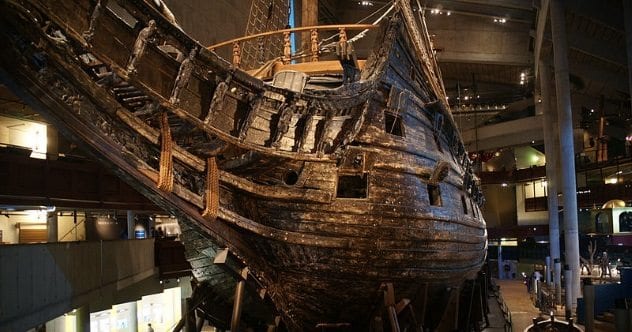
The Vasa was a 17th-century Swedish warship that sank in Stockholm harbor in 1628 on its maiden voyage. That is not ideal ship behavior. Rediscovered and salvaged in 1961, the Vasa is now one of the world’s best-preserved historic ships and a giant case study in ambition, design, politics, and disaster.
Although later than the Viking Age, Vasa is a major archaeological discovery because of its preservation and the enormous collection of objects recovered with it. Archaeologists found thousands of artifacts, including tools, clothing, personal items, equipment, sculptures, and remains that help reconstruct life aboard a Swedish warship.
The Vasa is also a cautionary tale. The ship was heavily armed and lavishly decorated, but it was unstable. Its sinking shows how royal pressure, military ambition, and design problems can produce a very expensive splash. As archaeology, however, it is priceless. The wreck preserved a floating world from the early modern Baltic, almost like a time capsule with cannons.
9. The Gjellestad Ship, Norway
The Gjellestad ship is one of the most exciting modern Viking discoveries in Norway. Detected in 2018 through ground-penetrating radar in Østfold, the buried ship became the focus of the first major Viking ship excavation in Norway since the Oseberg excavation of 1904.
Unlike earlier discoveries made by digging into mounds, Gjellestad highlights the power of digital archaeology. Radar revealed the outline of a ship burial and surrounding features without immediately destroying the site. This matters because modern archaeology is not just about finding things; it is about finding them carefully.
The Gjellestad discovery shows that even in landscapes long studied by historians and archaeologists, major finds may still be hiding below farmland. It also expands the story of Viking elites, burial customs, and regional power centers in Norway. The lesson is simple: never underestimate a quiet field. It may be sitting on a ship.
10. Sammallahdenmäki Bronze Age Burial Site, Finland
Sammallahdenmäki, located near Rauma in Finland, is one of the most important prehistoric burial sites in northern Europe. The UNESCO-listed site contains more than 30 granite burial cairns dating back more than 3,000 years. Unlike the dramatic ship burials of Norway or the bog bodies of Denmark, Sammallahdenmäki speaks in stone, silence, and landscape.
The cairns show how Bronze Age communities in Finland created ceremonial spaces connected to death, memory, status, and belief. Their placement in the landscape suggests that burial was not hidden away from daily life but integrated into a broader sacred geography.
This discovery is important because it widens the Nordic archaeological story beyond Vikings. The Nordic past did not begin with longships, and it certainly did not wait for horned helmets, which, friendly reminder, Vikings did not actually wear in battle. Sammallahdenmäki points to older traditions of ritual architecture and social organization in Fennoscandia, proving that stone monuments can be just as revealing as golden treasures.
Why Nordic Archaeology Feels So Alive
The best archaeological discoveries from the Nordic region share a rare quality: they feel personal. A ship burial is not only a ship; it is a funeral. A bog body is not only a preserved specimen; it is a human life interrupted. A rune stone is not only text; it is a ruler speaking across time. A Bronze Age chariot is not only metalwork; it is a glimpse into how people imagined the sun moving through the world.
Nordic archaeology also benefits from unusual preservation environments. Cold water, peat bogs, clay, sealed mounds, and careful burial conditions have preserved wood, textiles, skin, hair, and organic materials that often vanish elsewhere. That is why the region can offer such vivid details: carved sledges, wool skirts, ship planks, gaming pieces, ropes, feathers, tools, and meals.
At the same time, these discoveries are not frozen in interpretation. New technologies continue to change old stories. DNA analysis, isotope testing, dendrochronology, ground-penetrating radar, underwater archaeology, and microscopic residue studies are helping researchers ask better questions. Who moved? Who held power? What did people eat? How were identities expressed? What did ritual mean? And, in the case of the Vasa, who approved that top-heavy design?
Experiences: Exploring Nordic Archaeology Like a Curious Traveler
One of the best ways to experience Nordic archaeology is to approach it slowly. Do not treat these sites and objects as a checklist of “old things behind glass.” The magic happens when you imagine the ordinary human moments around them. Someone carved the Oseberg ship’s details by hand. Someone dressed the Egtved Girl for burial. Someone stood at Jelling and read runes that announced a new religious and political age. Someone watched Vasa sail proudly into the harbor and then, very awkwardly, watched it sink.
If you visit museums in Oslo, Copenhagen, Stockholm, Roskilde, Silkeborg, or Rauma, give yourself time to look at the small objects, not just the famous centerpiece. Ships grab attention because they are huge, dramatic, and excellent at filling a room. But combs, shoes, tools, textile fragments, cooking equipment, and beads often tell the most relatable stories. A bronze sword may say “power,” but a repaired wooden object says, “Someone cared enough to fix this.” That little detail can be more moving than gold.
Another rewarding experience is comparing museum displays with the landscapes where discoveries were made. Nordic archaeology is deeply connected to place. Fjords shaped travel. Bogs shaped preservation. Burial mounds shaped memory. Stones shaped public identity. When you stand near a mound, shoreline, or cairn, the past feels less like a chapter in a textbook and more like something embedded in the ground beneath your shoes.
For readers exploring from home, digital museum collections, documentaries, academic summaries, and virtual tours can still be surprisingly immersive. Try reading about one discovery at a time rather than bingeing the entire Viking Age like a streaming series. Start with the object. Ask what it is made of, who used it, why it survived, and what scholars still debate. Archaeology becomes much more exciting when you notice that the answer is rarely just “we found a thing.” The real answer is usually, “we found a thing, and now everything is more complicated.”
That is the heart of Nordic archaeology. It does not simply confirm legends. It corrects them, deepens them, and sometimes politely throws them into a bog. These discoveries invite us to see ancient Nordic people not as stereotypes, but as travelers, mourners, leaders, makers, believers, risk-takers, and problem-solvers. Their world was practical and symbolic, local and connected, harsh and beautiful. The surviving evidence is fragmentary, but the human presence is unmistakable.
Conclusion
The top archaeological discoveries from the Nordic region reveal a past far richer than the popular image of Vikings alone. From the Oseberg ship burial and Tollund Man to the Egtved Girl, Trundholm Sun Chariot, Jelling Stones, Skuldelev ships, Birka warrior grave, Vasa, Gjellestad ship, and Sammallahdenmäki cairns, these finds show how Nordic societies understood power, death, travel, belief, identity, and memory.
They also prove that archaeology is not dusty. It is suspenseful, scientific, emotional, and occasionally funny in the way history can be funny when human ambition meets gravity, water, or poor ship stability. The Nordic region continues to produce discoveries that challenge old assumptions and open new windows into ancient life. In other words, the ground is not finished talking.