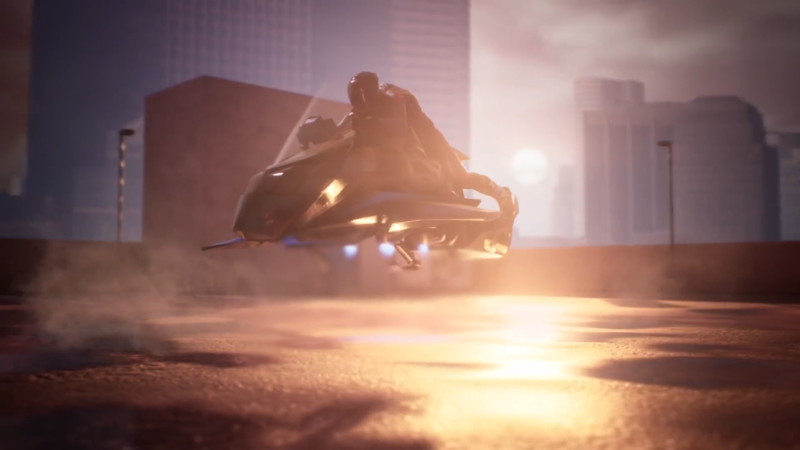
Sapo: Flying motorcycles are no longer just sci-fi furniture for movies with too many laser battles. From jet-powered hoverbikes to ultralight personal eVTOLs, the technology is real, expensive, exciting, and still wrapped in a giant caution label.
The Flying Motorcycle Is Leaving the Poster Wall
For decades, the phrase “flying motorcycle” sounded like something a 10-year-old would draw in the back of a math notebook: a superbike, a rocket engine, maybe flames, possibly a helmet with lightning bolts. Then engineers looked at that sketch and apparently said, “Fine, let’s make the insurance industry nervous.”
Today, flying motorcycles and hoverbike-style personal aircraft are moving from viral videos into limited production, preorders, demonstration flights, and regulatory debates. The machines are not yet replacing traffic jams, school buses, delivery vans, or that one guy on the freeway who refuses to use turn signals. But they are real enough to make pilots, regulators, investors, and very wealthy thrill-seekers pay attention.
The most eye-catching recent example is the Volonaut Airbike, a compact jet-powered flying motorbike developed by Polish inventor Tomasz Patan, also known for his work with the Jetson ONE personal electric aircraft. Volonaut describes the Airbike as a “superbike for the skies,” and the phrase is not exactly shy. The aircraft is designed for one rider, uses jet propulsion rather than exposed spinning propellers, and claims a commercial top speed capped around 63 mph to align with U.S. ultralight rules. Prototype claims have reached as high as 124 mph, which is both impressive and the sort of number that makes a safety engineer slowly remove their glasses.
So yes, a flying motorcycle might be coming soon. But “soon” does not mean “everyone gets one next Christmas.” It means we are entering the strange early phase where the machines exist, the prices are wild, the regulations are catching up, and the public is trying to decide whether this is the next great mobility revolution or simply a jet-powered way to discover gravity’s customer service department.
What Counts as a Flying Motorcycle?
A flying motorcycle is not one single type of vehicle. The term is a loose, media-friendly label for several small personal aircraft that borrow the riding posture, styling, or attitude of a motorcycle. Some are jet-powered hoverbikes. Some are electric vertical takeoff and landing aircraft, also called eVTOLs. Others are more like multicopter drones with seats, frames, roll bars, and enough battery power to turn a backyard into a launch pad.
Hoverbike vs. eVTOL vs. Flying Car
A hoverbike usually suggests a one-person vehicle that the rider straddles, similar to a motorcycle. It takes off vertically, hovers, and flies low or short distances. An eVTOL is a broader category covering aircraft that use electric power to rise vertically and transition into flight. A flying car, meanwhile, usually implies something road-capable and air-capable, though most “flying cars” are closer to compact aircraft than street vehicles.
The flying motorcycle sits between fantasy and aviation. It looks less like a commuter aircraft and more like a prop from a sci-fi chase scene. That design language matters. People do not react to these machines the way they react to a small Cessna. They react with a mix of awe, skepticism, and the facial expression one makes when someone says, “Don’t worry, I watched a tutorial.”
The Big Names in the Flying Motorcycle Race
Volonaut Airbike: The Speeder Bike Energy Is Strong
The Volonaut Airbike has grabbed attention because it looks unusually close to what many people imagined a real flying motorcycle would look like. It is sleek, narrow, single-seat, and designed without exposed propellers. According to public specifications from the company, the Airbike uses redundant jet turbines, a flight-computer-assisted stabilization system, and a lightweight structure built with carbon fiber and 3D-printed components.
Its listed empty vehicle mass is about 66 pounds, which is shockingly light compared with a traditional motorcycle. The rider limit is about 209 pounds, flight time is listed at up to 10 minutes, and the top speed for the commercial version is capped around 63 mph. The preorder price is not for the faint of wallet: about $880,000. That is less “new toy” and more “should I buy a house or become a forest moon scout trooper?”
Volonaut also says the Airbike does not require a pilot certificate in the United States if operated under the ultralight category. That point is important, but it deserves careful wording. “No pilot certificate required” does not mean “no training required,” “no risk involved,” or “go buzz the neighborhood barbecue.” Ultralight aircraft still have strict limits, and operators still need to understand airspace, weather, emergency planning, and common sensethe last one being surprisingly hard to regulate.
Jetson ONE: The Personal eVTOL That Actually Delivered
The Jetson ONE is another major example in personal aviation. It is not exactly a motorcycle, but it scratches a similar itch: one person, open-air cockpit, electric vertical takeoff, and a futuristic “I have escaped traffic and possibly reality” vibe. Jetson lists the ONE with a top speed of about 63 mph, up to 20 minutes of flight time, and an all-up weight around 86 kilograms.
Unlike the Airbike’s jet-style identity, the Jetson ONE uses multiple electric motors and propellers arranged more like a large personal drone. It also emphasizes safety features such as redundant systems, a lightweight frame, assisted controls, and emergency protections. The company has taken orders far into future production years, showing that demand exists even when the market remains tiny, expensive, and highly specialized.
Jetpack Aviation Speeder: The Original “Flying Motorcycle” Pitch
Jetpack Aviation’s Speeder has been one of the most talked-about flying motorcycle concepts for years. The Speeder concept uses turbine power, vertical takeoff, and computerized stabilization. The company has promoted both recreational and military/public-service possibilities, including rapid response, cargo movement, and short-range access to difficult terrain.
The Speeder story matters because it shows both the promise and the difficulty of the category. Building a dramatic prototype is hard. Turning it into a certified, reliable, manufacturable aircraft is much harder. Aviation is full of ideas that fly once for the camera and then spend years wrestling with cost, cooling, control software, maintenance, regulation, and the brutal fact that air is less forgiving than asphalt.
AERWINS XTURISMO: A Cautionary Tale With Rotors
The AERWINS XTURISMO flying bike made headlines when it appeared in public demonstrations and was promoted for the U.S. market with a price tag around $777,000. It looked dramatic, weighed hundreds of pounds, and was presented as a luxury air cruiser inspired by science fiction. Yet the company behind it ran into serious financial trouble, and its Japanese predecessor filed for bankruptcy.
That does not mean the flying motorcycle dream is dead. It means the business model is just as difficult as the engineering. A vehicle can be amazing and still fail if it is too expensive, too limited in where it can fly, too hard to certify, or too early for real customers. In aviation, “cool” is not a business plan. It is just the opening slide.
Why the Technology Is Suddenly Possible
Flying motorcycles are not appearing because someone discovered anti-gravity behind a vending machine. They are arriving because several technologies have matured at the same time.
Lightweight Materials
Carbon fiber, advanced composites, and precision manufacturing make it possible to build strong structures without the weight of traditional metal frames. Weight is the enemy of flight. Every extra pound demands more thrust, more fuel or battery capacity, stronger structure, and more safety margin. A lightweight flying bike has a better chance of fitting within ultralight rules and staying manageable in short flights.
Flight Computers
The rider is not manually balancing every force like a circus performer on a caffeinated unicycle. Modern personal aircraft rely on flight computers, sensors, gyroscopes, accelerometers, and control software to stabilize the vehicle. This is the same basic reason a consumer drone can hover steadily while the pilot is still figuring out which joystick does what.
Electric Propulsion and Small Turbines
Electric motors offer quick response, simpler mechanical layouts, and distributed propulsion. Small turbines, meanwhile, can deliver intense thrust in compact packages. Each approach has trade-offs. Electric systems are quieter and mechanically elegant but limited by battery energy density. Turbines can pack more energy into fuel but bring heat, noise, fuel handling, and maintenance complexity.
Drone Culture
The public has become familiar with multicopters, autonomous stabilization, and vertical takeoff. That mental shift matters. A generation ago, a personal aircraft hovering like a drone would have seemed absurd. Now it seems like the natural next step, although “natural” is doing a lot of emotional support work in that sentence.
The FAA Problem: The Sky Has Rules
In the United States, many one-person flying motorcycle concepts point toward the FAA’s Part 103 ultralight category. This category can allow single-occupant recreational aircraft to operate without a traditional pilot certificate if they meet strict requirements. Powered ultralights are limited by weight, fuel capacity, maximum speed, and other operational restrictions.
The attraction is obvious. If a company can design a vehicle to fit ultralight rules, it may avoid some of the heavier certification burdens that apply to larger aircraft. That can make early sales more realistic. But the restrictions also limit what the machine can do. Ultralights are not air taxis. They are not commercial commuter vehicles. They are not meant to weave through downtown traffic like a deleted scene from a superhero movie.
For larger eVTOL aircraft, the FAA has been building rules around powered-lift aircraft, pilot training, vertiports, and advanced air mobility. NASA is also researching how future low-altitude aircraft could integrate into communities, including questions about noise, public acceptance, weather, infrastructure, and safety. This bigger ecosystem may eventually support air taxis and cargo drones, but a tiny hoverbike still lives in a more experimental, recreational corner of the conversation.
Safety Not Guaranteed: The Real Risks
The title says it plainly because the technology deserves honesty: safety is not guaranteed. That does not mean these machines are reckless by definition. It means flying a small open personal aircraft is inherently more demanding than riding a bicycle, driving a car, or buying a drone from a mall kiosk and apologizing to the neighbor’s roof.
Short Flight Time Changes Everything
Many personal flying machines advertise flight times between 10 and 20 minutes. That is enough for a thrilling ride, a demonstration, a short hop across private land, or a specialized use case. It is not enough for careless route planning. Short endurance means the operator must think about takeoff, landing, reserve energy, wind, unexpected delays, and where to go if something feels wrong.
Low Altitude Is Not Automatically Safer
People often assume low-altitude flight is safer because the ground is closer. Aviation people tend to hear that and quietly wince. Low altitude gives less time to recover from a malfunction. It also increases exposure to trees, wires, buildings, uneven terrain, birds, dust, and curious spectators filming vertically for social media.
Noise and Community Acceptance Matter
A flying motorcycle may look amazing to the rider and sound deeply annoying to everyone underneath it. Public acceptance will depend on noise, safety records, privacy concerns, and where these vehicles are allowed to fly. A machine that works beautifully over private land may face serious resistance in suburbs, parks, beaches, or dense urban areas.
Training Is Non-Negotiable
Even when a pilot certificate is not required, training should be treated as essential. Operators need to understand basic aviation decision-making, weather, airspace, emergency procedures, preflight checks, and personal limits. The most dangerous phrase in personal aviation may not be “engine failure.” It might be “How hard can it be?”
Who Would Actually Use a Flying Motorcycle?
The first buyers will almost certainly be wealthy enthusiasts, private landowners, collectors, extreme mobility fans, and technology investors. At nearly seven figures for some models, the flying motorcycle is not competing with scooters. It is competing with supercars, helicopters, yachts, and other expensive ways to make relatives question your priorities.
Public-service use cases may become more interesting. A compact vertical-lift vehicle could help with search and rescue, border patrol, ranch inspection, disaster response, or reaching areas where roads are blocked. However, those missions demand reliability, training, maintainability, and clear operating rules. Government and emergency users are not buying a vibe; they are buying capability.
Recreation may remain the most realistic early market. Think controlled environments, private courses, desert areas, training centers, and demonstration events. The flying motorcycle may first become less of a commuter vehicle and more of an aviation experiencelike skydiving, racing school, or renting an exotic car, except the waiver is probably thick enough to stop a door draft.
Will Flying Motorcycles Replace Cars?
No, not anytime soon. Cars are boring in the best possible way. They carry groceries, children, luggage, pets, coffee, and questionable dashboard decorations. They work in rain, stop at drive-throughs, and do not require a landing zone. A flying motorcycle is thrilling, but it is not a minivan with altitude.
The better question is whether flying motorcycles can become a new category of personal aviation. On that point, the answer is maybe. The technology is real enough to fly, attractive enough to generate demand, and limited enough to stay niche for years. The machines may improve quickly, but physics, regulations, insurance, noise, cost, and public tolerance will decide how far they go.
The future probably will not look like thousands of people flying to work over city streets. It may look like carefully controlled recreational flights, specialized professional use, and gradual integration with broader advanced air mobility systems. The sky may get busier, but it will not become a lawless vertical freeway unless everyone involved loses their clipboard privileges.
Experience Notes: What It Might Feel Like to Be Near the Flying Motorcycle Era
The first time most people see a flying motorcycle in motion, the reaction is not technical. It is emotional. The brain recognizes the posture of a rider leaning forward like they are on a sport bike, then immediately notices there is no road underneath. That contradiction creates a strange little mental traffic jam. It feels familiar and impossible at the same time.
Watching videos of the Volonaut Airbike or similar machines, one detail stands out: the rider looks exposed. There is no cabin, no windshield, no passenger seat, no cup holder, and absolutely no illusion that you are separated from the air. That openness is part of the appeal. It promises the raw sensation of flight without the cockpit barrier. It also reminds you that aviation has consequences. A flying motorcycle is not a theme-park ride bolted to a track. It is a machine negotiating with gravity in real time.
Imagine standing at a controlled test site while a personal hoverbike lifts off. The sound would likely dominate the moment first: turbine whine, electric rotor buzz, or some futuristic blend of both. Dust might kick up. Grass might flatten. Everyone nearby would instinctively take one step back, even if they were already at a safe distance. That tiny backward step says everything about the category. We are fascinated, but our bodies know this is serious.
The rider experience would probably be more intense than most people expect. On a motorcycle, speed is horizontal. Your body reads the road, the lean angle, the vibration, and the wind. On a flying motorcycle, the world opens in three dimensions. Up, down, drift, hover, yaw, and sideways movement all become part of the ride. The view would be incredible. The responsibility would be just as large.
For early adopters, the best experience may not be commuting over traffic. It may be learning in a structured environment with professional instructors, clear boundaries, and conservative limits. The thrill would come from controlled mastery: lifting off smoothly, hovering steadily, moving across open terrain, and landing exactly where intended. That may sound less dramatic than chasing storm clouds over downtown, but drama is overrated when you are sitting on a flying machine with a short flight clock.
There is also a social experience. A flying motorcycle attracts attention like a celebrity riding a dinosaur. People will film it, question it, cheer for it, criticize it, and ask whether it is real. Every flight becomes public relations for the entire category. One graceful demo can inspire millions. One careless stunt can make regulators, neighbors, and insurers reach for the red pen.
That is why the next chapter of flying motorcycles will be shaped not only by engineering but by behavior. If owners treat them like aircraft, train seriously, respect limits, and fly where appropriate, the category has room to grow. If they treat them like expensive toys with altitude, the future will get smaller very quickly.
Conclusion: The Future Is Flying, But It Still Needs a Helmet
The flying motorcycle is no longer pure fantasy. Machines such as the Volonaut Airbike, Jetson ONE, Jetpack Aviation Speeder, and earlier XTURISMO have shown that compact personal flight is technically possible and commercially tempting. The dream is real enough to preorder, test, fund, and argue about.
But the practical future remains cautious. Flight time is short. Prices are high. Regulations are strict. Training matters. Noise matters. Public trust matters. Above all, safety must lead the story, not trail behind it wearing a cape and hoping for the best.
So, is a flying motorcycle coming soon? Yes, for a small group of trained, well-funded early users in controlled settings. For the rest of us, the flying motorcycle is still more headline than household item. But the direction is clear: personal aviation is becoming smaller, more automated, more dramatic, and far more interesting. Just remember the fine print. The sky may be open, but it is not casual.
SEO Tags
Note: This article is written as clean, body-only HTML for web publishing and intentionally excludes source links, citation markers, and unnecessary reference placeholders.