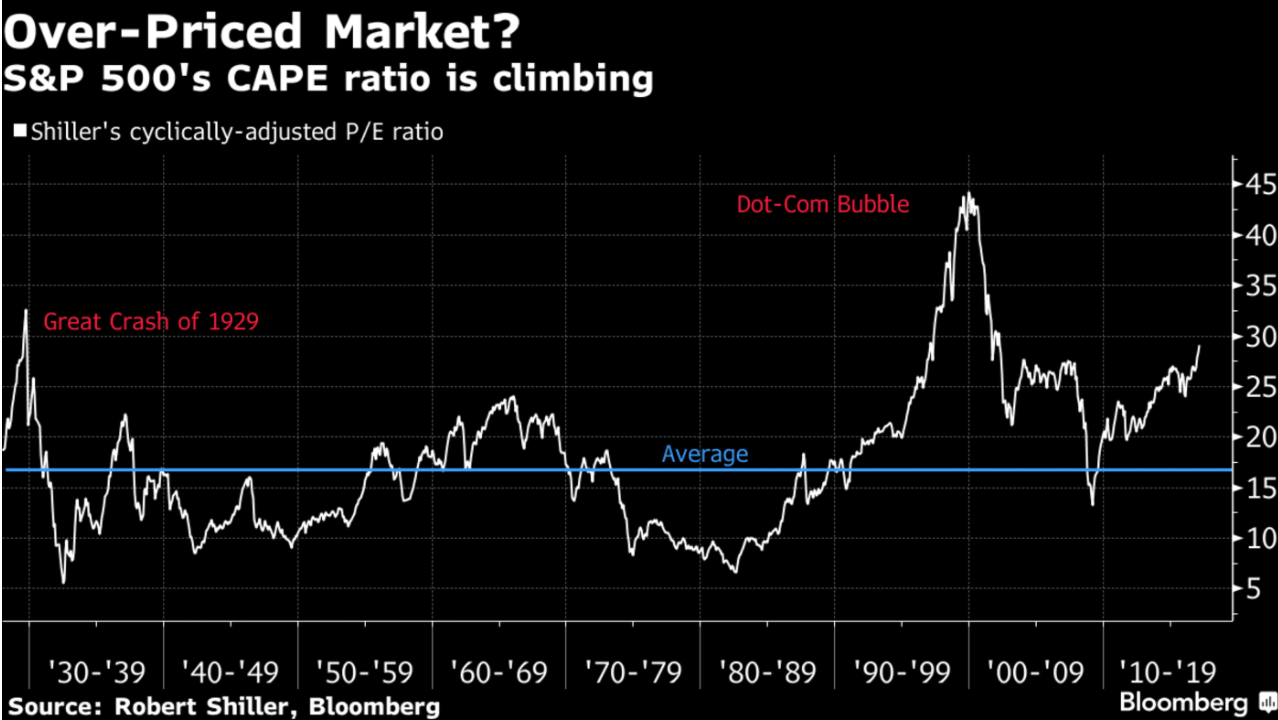
When stock prices look expensive, investing can feel like walking into a grocery store where every avocado costs nine dollars. You know you still need food, but paying any price seems reckless.tirely in cash risks missing further gains, while buying aggressively may expose you to disappointing future returns or a painful correction.
The good news is that successful investing does not require predicting the exact day enthusiasm turns into gravity. Valuation matters, especially over long periods, but it is not a reliable stopwatch for short-term market moves. An expensive market can become more expensive, earnings can grow into elevated prices, or prices can fall suddenly. A sensible response is therefore not “all in” or “all out.” It is a disciplined portfolio plan built around goals, diversification, valuation awareness, and risk control.
Does an Overvalued Market Actually Mean?
A market is commonly described as overvalued when stock prices appear high relative to company fundamentals such as earnings, sales, cash flow, book value, or dividends. Investors often watch measures such as the price-to-earnings ratio, forward P/E, price-to-sales ratio, and cyclically adjusted price-to-earnings ratio. These tools compare what investors are paying with what businesses currently earn or may earn in the future.
However, “overvalued” is not a courtroom verdict. Valuation depends partly on interest rates, inflation, profit margins, industry composition, expected growth, and investor confidence. A fast-growing software company may deserve a higher multiple than a slow-growing utility. Likewise, a market dominated by profitable technology businesses may trade differently from a market led by banks, manufacturers, or energy companies.
High Valuations Are a Warning Light, Not a Sell Button
Starting valuation can influence long-term expected returns because paying more for the same stream of profits generally leaves less room for future gains. Yet high valuation alone does not tell you whether stocks will decline next month, next year, or only after rising much further. Treat valuation as a risk-management input rather than a market-timing command.
gin With Your Time Horizon, Not the Headlines
The right strategy depends less on whether a television commentator says the market is “priced for perfection” and more on when you need the money. Funds required for rent, tuition, taxes, a home purchase, or an emergency should not be riding on short-term stock performance. Money intended for retirement several decades away can usually tolerate more volatility because it has more time to recover from declines.
Divide your goals into time buckets. Near-term money may belong in cash equivalents, Treasury bills, certificates of deposit, or other high-quality short-duration holdings. Intermediate goals may call for a balanced mix of bonds and stocks. Long-term goals can hold a larger equity allocation, provided that allocation matches your ability and willingness to withstand losses.
This step prevents the classic mistake of using the stock market as a checking account with better graphics.
2. Rebalance Before You Reinvent the Portfolio
A long bull market can quietly transform a moderate portfolio into an aggressive one. Suppose your target is 60% stocks and 40% bonds. After a strong equity rally, stocks might grow to 72% of the portfolio. You may feel wealthier, but you are also taking more risk than planned.
Rebalancing means restoring the portfolio toward its target allocation. You can sell part of an overweight holding, direct new contributions toward underweight assets, or use dividends and interest to fill the gaps. The last two approaches may reduce taxable sales in a brokerage account.
Use Rules Instead of Moods
Consider reviewing your allocation on a regular schedule, such as once or twice a year, or when an asset class moves beyond a predetermined band. A rules-based approach discourages emotional trading and naturally trims assets that have become dominant while adding to areas that have lagged.
versify Beyond the Market’s Most Popular Corner
Broad market indexes can become concentrated when a small group of giant companies produces an outsized share of returns. Those businesses may be excellent companies, but an excellent company can still be a poor investment at an excessive price. Concentration also means that one earnings disappointment, regulatory change, or shift in investor taste can affect a surprisingly large part of your portfolio.
True diversification reaches across company sizes, sectors, investment styles, countries, and asset classes. Depending on your plan, that may include U.S. large-cap stocks, small- and mid-cap companies, value stocks, international developed markets, emerging markets, investment-grade bonds, Treasury securities, and cash reserves.
Diversification will not prevent every loss. Its job is more modest and more useful: reduce dependence on one forecast being correct. Think of it as admitting, with admirable maturity, that neither you nor the loudest person on financial television knows which asset will lead next year.
e Dollar-Cost Averaging When a Lump Sum Feels Uncomfortable
If you have a large amount of cash to invest, putting it all into an expensive market may feel unbearable. Dollar-cost averaging offers a behavioral compromise: invest equal or similar amounts at regular intervals, regardless of whether prices rise or fall.
For example, an investor with $60,000 might invest $10,000 per month for six months while keeping the uninvested balance in a suitable short-term vehicle. When prices are high, each installment buys fewer shares; when prices fall, it buys more. The approach does not guarantee a profit or protect against losses, and investing a lump sum immediately may produce better results when markets continue rising. Still, a phased plan can reduce regret and make it easier to follow through.
The crucial word is “plan.” Stretching a six-month schedule into six years because every week produces a new reason to worry is not dollar-cost averaging. It is permanent hesitation wearing business casual.
vor Quality, Financial Strength, and Reasonable Prices
When valuations are elevated, weak businesses can be especially vulnerable. Companies dependent on cheap financing, optimistic projections, or nonstop share issuance may struggle if interest rates rise or enthusiasm cools. Investors selecting individual stocks should examine balance-sheet strength, free cash flow, debt maturity schedules, competitive advantages, profitability, and management’s capital-allocation record.
Price still matters. A wonderful business purchased at an extreme valuation may deliver poor returns even if the company continues growing. Consider comparing a stock with its own historical valuation, industry peers, realistic earnings scenarios, and a conservative estimate of future cash flows. Build in a margin of safety rather than assuming every optimistic forecast will arrive on schedule and wearing a tiny cape.
Investors who do not want to analyze individual companies can use diversified, low-cost funds. Broad funds reduce company-specific risk, while value-oriented or fundamentally weighted funds may provide a measured tilt away from the market’s most expensive stocks. Any tilt should remain consistent with the investor’s long-term plan rather than becoming a disguised bet on next quarter.
6. Remember That Bonds and Cash Have Jobs
Cash is not merely “money that failed to become a stock.” It provides liquidity, covers near-term spending, and gives you the ability to rebalance during a decline without selling assets at distressed prices. Bonds can provide income, capital preservation, and diversification, although their prices can also fall when interest rates or credit conditions change.
Match bond risk to the purpose of the money. High-quality short- and intermediate-term bonds may be more appropriate for stability than long-duration or lower-quality debt, which can fluctuate significantly. Treasury bills and money market instruments may suit short-term reserves, while inflation-protected securities can play a role for investors concerned about purchasing power.
The goal is not to hide forever in cash. Cash has reinvestment risk and may lose purchasing power after inflation. Hold enough for the portfolio’s needs, not enough to avoid every uncomfortable emotion.
ntrol Costs and Taxes
When expected returns are lower, fees consume a larger share of what remains. Review fund expense ratios, advisory charges, trading costs, spreads, and unnecessary account fees. A strategy that promises sophistication but charges heavily for it must clear a taller performance hurdle before helping you.
Taxes also matter in taxable accounts. Rebalancing may create capital gains, so consider using new deposits, charitable gifts, tax-advantaged accounts, or loss harvesting where appropriate. U.S. tax rules distinguish between short-term and long-term gains and allow capital losses to offset capital gains, subject to applicable limits and rules. Tax decisions can be complex, so consult a qualified tax professional for personal guidance.
ience-Based Lessons: What Investing in an Overvalued Market Feels Like
The most difficult part of an expensive market is rarely selecting a fund. It is living with the possibility that every reasonable decision may look foolish for a while. A diversified investor may watch a narrow group of popular stocks soar and wonder why the portfolio owns anything else. A cautious investor who phases money into the market may feel regret as prices rise after each installment. An investor who commits a lump sum may immediately imagine a correction arriving before the trade confirmation email.
Common investor experience shows that discomfort does not prove a strategy is wrong. In fact, a balanced strategy often feels unsatisfying precisely because it refuses to maximize one possible outcome. Diversification means always owning something disappointing. Rebalancing means selling part of what everyone loves and buying assets nobody is discussing at dinner. Dollar-cost averaging means accepting that some purchases will occur at higher prices and others at lower ones. Discipline is not emotionally elegant.
Consider a composite investor named Maya. She begins with a written 65% stock and 35% bond allocation. After several strong years, her stock position rises to 76%, largely because a few technology holdings appreciate dramatically. Friends tell her those companies are “obvious winners,” which is usually a phrase delivered after the winning has already happened.
Maya does not sell everything. She redirects new contributions to bonds and international stocks, trims a small portion of the most concentrated holdings, and restores her emergency reserve. She also creates a six-month schedule for investing excess cash. For the next three months, the expensive assets continue rising. Her decision looks unnecessarily cautious. Then volatility appears, and the diversified parts of the portfolio behave differently. Some decline less, some produce income, and the available cash allows her to continue buying without touching money needed for bills.
The important lesson is not that Maya “beats the market.” A single year cannot prove the superiority of a long-term plan. The lesson is that she remains invested, avoids a forced sale, and keeps her risk close to the level she originally chose. Her portfolio continues functioning even though her forecast is imperfect.
Another recurring experience is the danger of waiting for an obvious buying opportunity. Corrections are obvious only after they occur, and the moment of maximum opportunity often arrives with frightening news. Investors who demanded lower prices may discover that they are even less willing to buy once those prices appear. A written schedule helps because it makes the decision before fear enters the room.
There is also a quieter lesson: savings can matter more than tactical brilliance. An investor who consistently adds money, controls costs, and avoids catastrophic mistakes may build wealth even if purchases occasionally occur at unattractive valuations. By contrast, an investor who repeatedly exits, waits, chases, and changes strategies can lose years to indecision.
The practical experience of investing in an overvalued market is therefore not about feeling certain. It is about building a system that can survive uncertainty. The best portfolio is not the one that wins every quarter. It is the one you can fund, understand, rebalance, and hold through the uncomfortable chapters.
usion
Learning how to invest in an overvalued market begins with rejecting the false choice between reckless buying and permanent retreat. Start with your goals and time horizon. Rebalance a portfolio that has become too aggressive. Diversify beyond the most expensive and popular assets. Use dollar-cost averaging when it helps you execute a sound plan, maintain appropriate cash and bond reserves, and pay close attention to fees and taxes.
Valuation should influence expectations and risk management, but it should not dominate every decision. Markets can remain expensive longer than expected, and abandoning a suitable long-term plan can be just as damaging as ignoring risk. Build rules before emotions take over, then let consistency do the heavy lifting.
Note: This article provides general educational information and is not individualized investment, tax, or legal advice. Investing involves risk, including possible loss of principal. Consider your goals, financial situation, and risk tolerance, and consult qualified professionals when appropriate.