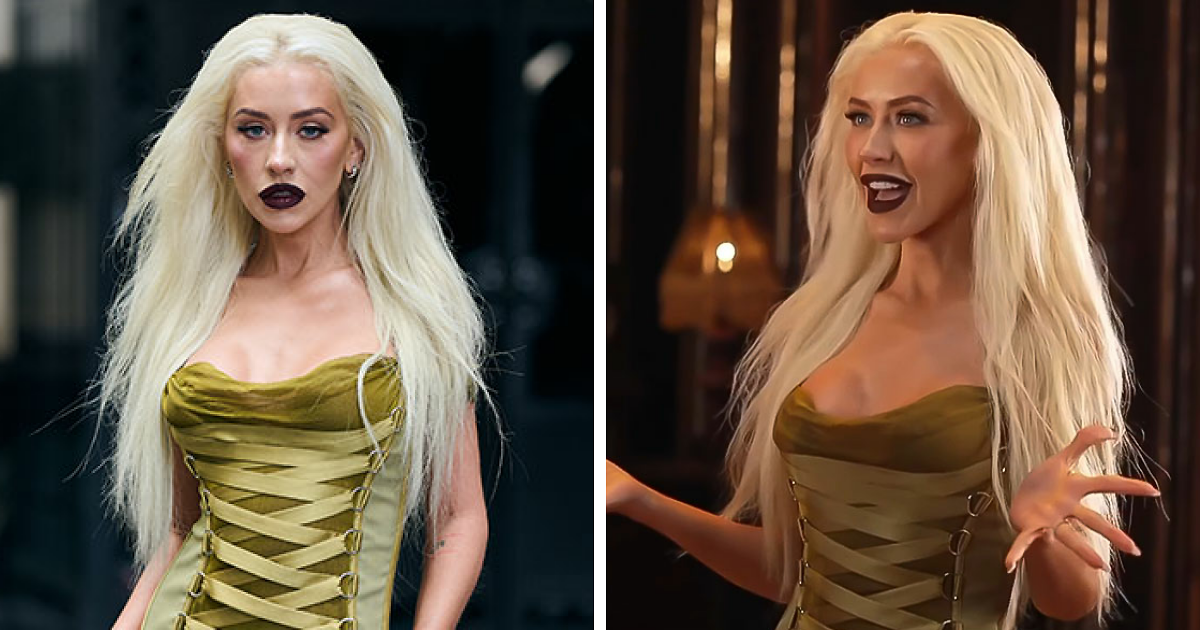
Editorial note: This article discusses public reaction to a celebrity appearance and the larger conversation around body image, beauty standards, and online speculation. It does not claim that Christina Aguilera has any health condition, nor does it diagnose her based on photographs, videos, styling, weight, makeup, or fan comments.
Christina Aguilera has been famous long enough to know that the internet never simply says, “Nice outfit.” The internet puts on bifocals, grabs a magnifying glass, opens three comment sections at once, and announces that it has solved a mystery no one actually assigned. That is exactly what happened after Aguilera’s recent public appearances and promotional moments reignited conversation about her noticeably different look. Some fans praised her glamour, others wondered whether she looked too thin, and a few asked the blunt question now bouncing around social media: “Is that even her?”
The short answer is yes, it is Christina Aguilera. The longer answer is more interesting, and frankly more revealing about us than about her. Aguilera, a Grammy-winning pop powerhouse who has spent more than 25 years in the spotlight, has changed her hair, makeup, fashion, stage persona, and body presentation many times. That is not a scandal; that is basically the job description of a pop icon. Still, when a star’s appearance changes dramatically, the public reaction can quickly shift from curiosity to concern, and from concern to armchair diagnosis.
Why Christina Aguilera’s Appearance Became a Talking Point Again
The latest wave of discussion grew out of highly visible appearances connected to Aguilera’s fashion, beauty, and entertainment work. She has recently leaned into polished, high-glam looks, including promotional content for Nexxus and nostalgic nods to her Burlesque era. Around the same time, her connection to Burlesque: The Musical kept her in the public eye, especially after the stage adaptation opened in London with songs linked to Aguilera, Sia, Diane Warren, Todrick Hall, and Jess Folley.
At these appearances, Aguilera’s styling did a lot of heavy lifting. Think platinum hair, dramatic lips, sculpted makeup, sleek silhouettes, archival fashion moments, and enough confidence to power a small Las Vegas casino. For longtime fans who remember the “Genie in a Bottle,” “Dirrty,” “Beautiful,” and Back to Basics eras, the contrast between past and present images can feel dramatic. But celebrity images are not passport photos. Lighting, camera angles, contouring, hair color, wigs, extensions, filters, red-carpet posing, wardrobe structure, and plain old aging can all change how someone looks from one public moment to the next.
Fans Express Concern, But Concern Is Not the Same as Evidence
Online reactions have ranged from admiring to alarmed. Some fans said Aguilera looked stunning and youthful. Others said she seemed “unrecognizable” or worried about her slim frame. The phrase “health concerns” has appeared in entertainment coverage and social media chatter, often attached to screenshots or short clips. That is where the conversation gets tricky.
It is normal for fans to notice change. Aguilera has been part of pop culture since the late 1990s, so many people feel as if they grew up with her. When someone has been on magazine covers, award-show stages, music videos, reality TV, and concert residencies for decades, the public builds a mental scrapbook. Any new chapter gets compared to the old one. The problem begins when comparison turns into certainty. A person’s health cannot be accurately determined by a viral photo. Even medical professionals do not diagnose strangers from a red-carpet dress and a caption.
Weight changes can happen for countless reasons: lifestyle changes, age, stress, fitness routines, medication, medical conditions, styling choices, or personal preference. Sometimes a person intentionally changes their look. Sometimes the internet simply notices a different angle and behaves as if it has discovered a national emergency. Either way, “she looks different” is an observation. “Something must be wrong” is a leap.
Christina Aguilera Has Already Addressed Body Commentary
Aguilera is not new to public commentary about her body. In interviews, she has reflected on growing up in an industry that praised thinness, criticized weight gain, and often treated women’s bodies like group projects. She has spoken about how, early in her career, her self-esteem became tied to being thin. Later, when her body changed, the scrutiny changed with it. That double standard is not exactly subtle. It is the celebrity equivalent of being told to “be yourself,” followed immediately by a 17-point memo about how your self should look.
In a public message shared as she entered a new year, Aguilera pushed back against the idea that she owes explanations for her appearance. Her message centered on self-definition, growth, and not allowing strangers to dictate one’s identity. She has also said in interviews that other people’s opinions about her body are not her business. That statement may sound simple, but coming from someone who has lived through the peak tabloid era, it lands with extra force.
Remember, Aguilera became famous when celebrity culture was especially brutal. The early 2000s were not exactly a spa retreat for young women in pop. Magazine covers, late-night jokes, paparazzi photos, and gossip blogs routinely turned bodies into punchlines. Aguilera, Britney Spears, Jessica Simpson, and many others were analyzed with a level of casual cruelty that now looks less like entertainment and more like a public stress test nobody consented to.
From “Genie in a Bottle” to Reinvention Queen
Part of the fascination comes from Aguilera’s long history of reinvention. She has never been a one-look artist. Her debut era gave us polished teen-pop sparkle. The Stripped era brought black streaks, leather, piercings, and a loud rejection of the “good girl” box. Back to Basics delivered retro glamour, red lipstick, and old-Hollywood drama. Bionic leaned futuristic. Her Spanish-language work, Las Vegas residency, beauty campaigns, and fashion appearances have continued that shape-shifting tradition.
So when fans say, “Is that even her?” they may not only be reacting to weight or facial features. They may be reacting to the shock of seeing an artist who has always used image as performance. Aguilera’s look has never been frozen in 1999 amber. She has treated style as a costume closet, a diary, a mood board, and sometimes a glitter cannon. Expecting her to look exactly like one previous era is like expecting your phone to still have a headphone jack: nostalgic, but not realistic.
The Ozempic Rumor Problem
Because the current celebrity conversation is obsessed with weight-loss drugs, Aguilera’s slimmer appearance has been pulled into rumors about Ozempic and similar medications. This has happened to many celebrities, often with little or no evidence. The pattern is familiar: a star appears thinner, social media yells “Ozempic,” entertainment sites summarize the yelling, and suddenly speculation dresses itself up as news.
Aguilera has not publicly confirmed using such medication. That matters. Without confirmation, the responsible approach is to avoid presenting rumors as fact. It is also worth noting that GLP-1 medications are real medical treatments used for diabetes and weight management under medical supervision. Turning them into a punchline or accusation oversimplifies a serious health topic and adds yet another way to police people’s bodies.
The healthier conversation is not “Which celebrity is on what?” It is “Why do we feel entitled to know?” Public figures choose to share some parts of their lives. They do not surrender all privacy because they wore a corset dress under bright lights.
Why the “Health Concerns” Headline Gets Clicks
Headlines about celebrity health concerns work because they combine fear, familiarity, and curiosity. Christina Aguilera is a name millions of readers recognize. Add a dramatic phrase like “Is that even her?” and the result is almost algorithmic catnip. It invites readers to compare photos, judge changes, and feel like they are part of a breaking conversation.
But the headline also reveals a tension in celebrity coverage. On one hand, fans may genuinely care. Many people grew up listening to Aguilera’s voice during breakups, school dances, road trips, and dramatic bedroom performances involving hairbrush microphones. On the other hand, concern can become invasive when it demands proof, explanation, or confession.
There is a difference between saying, “I hope she is well,” and saying, “Here is my detailed theory based on cheekbones.” One is human. The other is a comment-section medical degree, which, sadly, remains unaccredited.
What We Actually Know
Here is what can be said with confidence: Christina Aguilera has appeared publicly with a noticeably slim and polished look. She has been active in fashion and beauty campaigns, including a Nexxus partnership connected to hair care. She has remained tied to Burlesque through the stage musical adaptation. She has addressed appearance criticism by emphasizing personal ownership of her story. She has also spoken openly about the pressure she felt in the music industry when her body was judged at different sizes.
Here is what cannot be responsibly claimed: that she is ill, that she used a specific weight-loss drug, that her appearance proves anything about her health, or that fans are entitled to an explanation. Those claims require evidence, not vibes in a TikTok comment section.
The Bigger Issue: Women in Pop Are Still Audited
Aguilera’s situation is part of a larger pattern. Female entertainers are frequently expected to evolve but not age, look glamorous but not artificial, be thin but not “too thin,” be confident but not arrogant, and be honest but not too revealing. This is not a standard. It is a maze with moving walls.
When a male rock star changes his look, people often call it “reinvention.” When a female pop star does, the internet sometimes calls a committee meeting. The scrutiny is especially intense for women who became famous young. Their teenage bodies are treated as the default version, even though no adult should be expected to resemble their teenage self forever. Most of us do not look like our high school photos, and thank goodness. Some of those eyebrow decisions deserve legal protection from public view.
Aguilera has spent decades navigating this impossible standard. She has been criticized at different sizes and praised at different sizes. That contradiction shows the problem is not really her body. The problem is the public’s endless appetite for ranking, decoding, and debating women’s bodies as if they are album tracks.
A More Responsible Way to Talk About Celebrity Changes
There is nothing wrong with discussing fashion, beauty, performance, and public image. Aguilera’s looks are often intentionally bold, and style is part of celebrity culture. But there is a better way to talk about it. Instead of saying, “She looks sick,” say, “Her styling is very different.” Instead of saying, “She must be on something,” say, “She has not publicly addressed the speculation.” Instead of demanding answers, respect the boundary.
Public concern should be paired with public restraint. If a celebrity chooses to discuss health, fans can respond with compassion. If she does not, the silence is not an invitation to invent details. It is just silence.
Christina Aguilera’s Legacy Is Bigger Than a Viral Photo
Aguilera’s career is not built on looking the same forever. It is built on a voice that can turn a ballad into a weather event. It is built on songs that became empowerment anthems, club staples, vocal showcases, and nostalgic comfort food for millennials who still know exactly when to shout the high note. From “Beautiful” to “Fighter,” from “Ain’t No Other Man” to her Spanish-language work, Aguilera’s identity as an artist has always been larger than a snapshot.
That is why the current conversation feels so familiar and so unnecessary at the same time. Of course people noticed. Of course the internet reacted. But Christina Aguilera has already given the most relevant answer: she is the storyteller of her own life. Fans can admire the fashion, debate the styling, and revisit the music without turning her body into a public courtroom.
Experience Section: What This Conversation Teaches Fans, Readers, and Media Watchers
Watching the reaction to Christina Aguilera’s latest public appearance feels like watching a pop-culture rerun with better lighting and worse comment moderation. Many fans have experienced this cycle before. A celebrity appears at an event, looks different from the version people remember, and suddenly everyone becomes a historian, stylist, nutritionist, dermatologist, and detective. It can be entertaining for about five seconds. Then it becomes uncomfortable, because underneath the jokes is a real person.
For readers, the experience is a reminder to slow down before joining the pile-on. A photo captures one second. A video clip captures a few more. Neither captures someone’s full life, health, mood, choices, or medical history. Anyone who has ever taken a bad selfie under fluorescent lighting knows this. One minute you look refreshed; the next you look like you owe money to a haunted doll. Cameras are not truth machines. They are tools shaped by lighting, movement, lenses, editing, and context.
For fans who grew up with Aguilera, the reaction may also carry nostalgia. People remember where they were when “Genie in a Bottle” dominated radio or when “Beautiful” became a personal anthem. Seeing Aguilera now can feel like checking in with a piece of one’s own past. That emotional connection is real. But nostalgia can become unfair when it freezes celebrities at the age they were when we first loved them. Christina Aguilera is not required to look like a 1999 TRL countdown just because our memories still wear low-rise jeans.
For media creators, this topic is a lesson in framing. There is a responsible way to report public reaction without amplifying cruelty. Writers can acknowledge that fans expressed concern while also making clear that speculation is not fact. They can cover fashion details, career updates, and Aguilera’s own comments about body image. They can resist turning every physical change into a medical mystery. That approach is better for readers and fairer to the subject.
For anyone who has ever had their own appearance commented on, the story may feel personal. Most people are not photographed on red carpets, but many know the sting of “You look tired,” “Did you lose weight?” “Did you gain weight?” or the classic family reunion special, “You look different,” delivered with the subtlety of a falling piano. Aguilera’s situation is simply the celebrity-sized version of a common human experience: people often feel entitled to narrate bodies that are not theirs.
The best takeaway is not that fans should stop caring. It is that caring should look like respect. You can hope Christina Aguilera is healthy. You can admire her confidence. You can prefer one era’s styling over another. You can even be surprised by a transformation. But the most grown-up response is to stop before turning surprise into speculation. Let the woman sing, sparkle, change her hair, wear the dramatic lipstick, and live without submitting a quarterly appearance report to the internet.
Conclusion
Christina Aguilera’s latest appearance sparked health concerns because the public is deeply familiar with her image and quick to react when that image changes. But familiarity is not ownership. While fans may be curious about her slimmer look and dramatic styling, the facts do not support diagnosing her or presenting rumors as truth. Aguilera has already made her position clear in past comments: she does not owe the world an explanation for her body, her style, or her evolution.
In the end, “Is that even her?” says more about the internet’s obsession with comparison than it does about Christina Aguilera. Yes, it is her. It is also her life, her image, her body, her career, and her story. The rest of us can press play on “Fighter,” enjoy the glamour, and maybe give the comment-section medical board the day off.