Some hotels whisper. The Chicago Athletic Association Hotel practically clears its throat in a velvet smoking jacket, points across Michigan Avenue toward Millennium Park, and says, “Welcome to Chicagotry not to stare.” Set inside one of the city’s great Venetian Gothic landmarks, this hotel is not merely a place to sleep. It is a layered story of architecture, athletic culture, private-club swagger, adaptive reuse, and the kind of moody interior design that makes even a hallway feel like it has a secret handshake.
The title “Windy City Gothic” fits because the Chicago Athletic Association Hotel by Roman and Williams is both dramatic and deeply Chicagoan. It has carved stone, dark wood, fireplaces, athletic references, and a location so cinematic it feels like the city arranged itself around the building for better lighting. Originally opened in 1893 as an elite private athletic club, the building was later reborn as a public boutique hotel, bringing its once-exclusive rooms, staircases, and social spaces into a new era. The transformation did not erase the past. It polished it, winked at it, and invited everyone inside.
A Venetian Gothic Landmark on Michigan Avenue
The Chicago Athletic Association Building stands at 12 South Michigan Avenue in the Loop, directly across from Millennium Park and near the Art Institute of Chicago. Designed by Henry Ives Cobb and completed in 1893, it arrived during the same ambitious moment that gave Chicago the World’s Columbian Exposition. The city was flexingarchitecturally, culturally, and economicallyand this building joined the performance with a façade inspired by Venetian Gothic architecture, especially the romantic rhythms associated with Venice’s Doge’s Palace.
That influence shows in the crisscrossing arches, ornamental stonework, and vertical drama of the Michigan Avenue streetwall. In a city famous for steel-frame skyscrapers and muscular commercial buildings, the Chicago Athletic Association Hotel offers something more theatrical. It does not look like it was designed by committee. It looks like it was designed by someone who believed buildings should wear excellent coats.
The hotel’s exterior is important because it establishes the mood before guests ever touch a door handle. This is not minimalist luxury, where the design vocabulary is “white wall, quiet chair, expensive leaf.” This is Chicago Gothic hospitality: historical, textured, confident, and slightly mischievous. The façade tells visitors that the experience inside will involve character, not just convenience.
From Private Athletic Club to Public Hotel
For more than a century, the Chicago Athletic Association operated as a private club for the city’s elite. It was a world of sport, business, leisure, and social ceremony. Members came for athletic facilities, dining rooms, card games, conversation, and the pleasure of belonging to a club with serious architectural eyebrows.
Like many private clubs, however, the building eventually faced a changing city and changing habits. The Chicago Athletic Association closed in 2007, and for a time its future was uncertain. A structure that had once represented access and prestige became a preservation challenge. Its ornate interiors, grand staircases, stained glass, fireplaces, and historic rooms needed more than admiration. They needed a viable second life.
That second life arrived through adaptive reuse. Developers and preservation-minded partners worked with Hartshorne Plunkard Architecture and the New York-based design firm Roman and Williams to transform the former club into a hotel. The result opened to the public in 2015, turning a once-exclusive institution into a downtown destination that travelers and locals could finally experience from the inside. In a city that loves reinvention almost as much as it loves arguing about pizza, this was a particularly elegant comeback.
Roman and Williams: Respecting History Without Freezing It
Roman and Williams, led by Robin Standefer and Stephen Alesch, are known for interiors that feel cinematic, collected, and emotionally rich. Their work often avoids the cold perfection of showrooms. Instead, it favors atmosphere: rooms that appear to have memory, personality, and possibly a very good anecdote from 1912.
At the Chicago Athletic Association Hotel, Roman and Williams did not treat the building like a museum trapped behind velvet rope. They also avoided the opposite mistake: dropping aggressively modern interiors into a historic shell just to prove the present had arrived. Their approach was more nuanced. They honored the original architecture while adding new layers that made the building functional, comfortable, and alive as a contemporary hotel.
This is why the interiors work so well. The dark paneling, old athletic-club references, fireplaces, leather details, custom furniture, and vintage-inspired lighting do not feel pasted on. They feel discovered. A guest room might include nods to old gymnasiums, such as metal bed frames, caged lighting, leather accents, or furniture forms that subtly recall sporting equipment. Public rooms feel clubby without being exclusionary. The design says, “Yes, this building has history,” but it does not require guests to speak in whispers or wear a monocle.
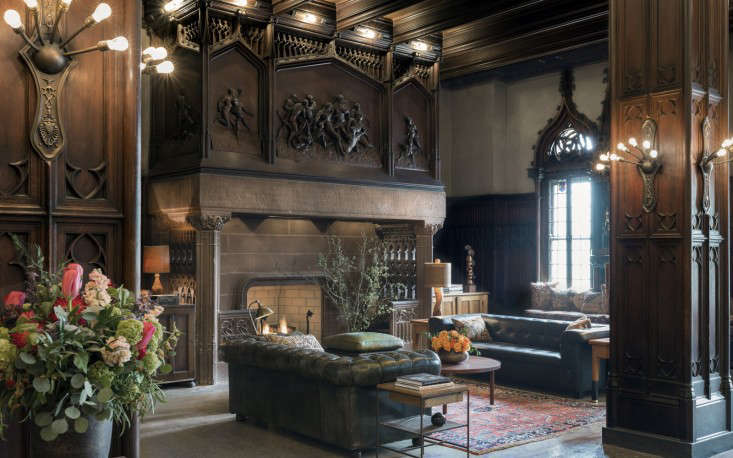
The Drawing Room: The Hotel’s Beating, Burning-Fireplace Heart
The Drawing Room is one of the hotel’s most memorable spaces because it captures the full appeal of the renovation. It has the mood of a grand private club, but now the public can settle in with a drink, a laptop, a conversation, or the noble intention of reading a book before accidentally people-watching for two hours.
With its fireplaces, woodwork, patterned surfaces, and generous seating, the Drawing Room feels like a living room designed by someone with excellent taste and a flair for drama. It is ideal for travelers who want the hotel experience without retreating immediately to their rooms. It is also a favorite kind of Chicago space: warm, social, architectural, and especially satisfying when the weather outside is practicing its winter villain monologue.
The genius of the room is that it makes historic design useful. It is not decorative nostalgia. It is a functioning social space. Guests can meet there before dinner, linger after exploring Millennium Park, or simply absorb the layered details that make the building special. In many hotels, the lobby is a pass-through. Here, it is a destination.
Guest Rooms with Athletic Soul
The guest rooms at the Chicago Athletic Association Hotel continue the athletic-club narrative without turning the place into a theme park. There are no novelty scoreboards over the pillows, thankfully. Instead, Roman and Williams uses materials, shapes, and small gestures that suggest the building’s past. Think crisp rooms, custom furniture, leather details, dark accents, and a sense of play that feels grown-up rather than gimmicky.
The rooms combine contemporary hotel amenities with references to old training rooms, gymnasiums, and club life. Desks, lighting, benches, robes, and hardware all contribute to the atmosphere. It is the rare hotel design that can feel masculine, romantic, historical, and comfortable without becoming heavy. The key is balance. The rooms give you enough drama to remember where you are, but enough simplicity to actually sleep.
That matters. A hotel can have the most beautiful lobby in the Midwest, but if the rooms feel like punishment with pillows, the spell breaks. Here, the design keeps the story going in a quieter register. The public spaces provide grandeur; the guest rooms offer retreat.
Cindy’s Rooftop and the Social Life of the Building
No discussion of the Chicago Athletic Association Hotel is complete without mentioning Cindy’s Rooftop, one of the property’s signature attractions. Set high above Michigan Avenue, Cindy’s offers expansive views over Millennium Park, Lake Michigan, and the city’s cultural core. The experience is part restaurant, part bar, part postcard, and part “please take one more photo, the light just changed.”
The rooftop adds a lighter counterpoint to the hotel’s Gothic richness. Where the lower floors lean into wood, stone, shadow, and club-room intimacy, Cindy’s opens the building to glass, sky, and skyline. The contrast is part of the pleasure. Guests can begin the evening in the moody interiors below, then rise to a bright, greenhouse-like perch above the park. It is a vertical journey from old Chicago to cinematic Chicago.
The hotel’s dining and drinking spaces have evolved over time, but the broader idea remains consistent: the building is not only a place for overnight guests. It is a gathering place. The Drawing Room, Game Room, Cindy’s, Shake Shack, Fairgrounds, and newer culinary concepts help keep the property active throughout the day. That energy is essential. A restored landmark only truly succeeds when people use it.
The Game Room: Historic Hospitality With a Competitive Streak
The Game Room is another smart expression of the building’s athletic past. Instead of reducing history to framed photographs, it lets guests participate in the spirit of leisure and competition. Pool tables, games, drinks, and casual food create a social environment that feels connected to the club’s original purpose.
This is one of the reasons the Chicago Athletic Association Hotel stands out among historic hotels in Chicago. Many landmark properties are beautiful, but some can feel stiff, as though a guest might be scolded for laughing too loudly near a chandelier. This hotel is different. It understands that athletic clubs were not only about prestige; they were also about play. Roman and Williams captured that playful energy while preserving the dignity of the architecture.
In practical SEO terms, this is why travelers searching for a historic hotel near Millennium Park, a boutique hotel in the Chicago Loop, or a design hotel in downtown Chicago often find the Chicago Athletic Association Hotel compelling. It delivers location, atmosphere, food, social life, and architectural significance in one very photogenic package.
Why the Design Still Feels Fresh
The Chicago Athletic Association Hotel opened as a hotel in 2015, but its design continues to feel relevant because it was not built around a trend. It was built around a story. Trends age quickly. Stories, when handled well, deepen.
Roman and Williams created interiors that feel assembled over time. The design uses sturdy materials, historical references, custom pieces, vintage cues, and a controlled sense of imperfection. That approach resists the flatness that can happen in hotels chasing whatever happens to be popular on mood boards. The result is a property that looks good in photographs but feels even better in person, where scale, texture, sound, and light can do their full work.
Another reason the design succeeds is that it belongs to Chicago. It does not feel imported from a generic luxury playbook. The building’s athletic heritage, Michigan Avenue address, Gothic exterior, and relationship to Millennium Park all shape the guest experience. You could not easily pick up this hotel and place it in Miami, Phoenix, or Dallas. It would protest loudly and ask where the lake went.
Historic Preservation That Pays Off
The Chicago Athletic Association Hotel is a strong example of adaptive reuse because it proves preservation can be practical, profitable, and culturally valuable. Saving historic buildings is not only about sentiment. It is also about urban texture. Cities become more interesting when old structures are allowed to evolve instead of being flattened into forgettable sameness.
In this case, the restoration preserved major architectural features while adapting the building for modern hospitality. That required coordination among architects, designers, developers, preservation experts, and operators. It also required restraint. The team had to decide what to repair, what to reveal, what to reinterpret, and what to add. Good adaptive reuse is not simply “old building plus new furniture.” It is a negotiation between memory and use.
The payoff is visible in the way locals use the hotel. Many people who live in Chicago visit the property for drinks, dinner, meetings, views, or a quiet hour in the Drawing Room. That local embrace matters. A hotel that appeals only to tourists can become isolated from its city. The Chicago Athletic Association Hotel feels plugged into Chicago’s daily life, even while giving visitors a concentrated dose of downtown drama.
What Travelers Should Notice
Visitors should take time to look beyond the obvious. Yes, the views from Cindy’s are excellent. Yes, the location across from Millennium Park is almost unfairly convenient. But the quieter details are what make the hotel memorable. Notice the arches on the façade. Study the staircases. Look at the fireplaces, the ironwork, the paneling, the lighting, and the athletic references embedded in furniture and finishes.
Also notice how the building changes mood by floor and function. The lobby areas are social and dramatic. The guest rooms are calmer. The rooftop is open and bright. The Game Room is casual and lively. This variety prevents the hotel from feeling like a single design idea repeated until everyone gets tired. Instead, it feels like a small vertical neighborhood inside a landmark shell.
For architecture lovers, design travelers, and history-minded visitors, the hotel offers an unusually rich stay. For everyone else, it simply feels cool. That is not a minor achievement. The best design does not require a lecture before it can be enjoyed. It works first on the senses, then rewards closer attention.
Experience Notes: A Longer Walk Through Windy City Gothic
Imagine arriving at the Chicago Athletic Association Hotel in the late afternoon, when Michigan Avenue is busy but the light is beginning to soften over Millennium Park. The building does not immediately shout for attention; it commands it in a more old-fashioned way. Its stone façade rises with a kind of theatrical seriousness, as if it knows exactly how many people have photographed it and is politely pretending not to notice.
Step inside, and the pace changes. Downtown Chicago can be all movementtraffic, office workers, tourists, cyclists, theatergoers, museum visitors, and someone always walking too quickly with coffee. Inside the hotel, the energy becomes denser and warmer. The materials absorb the city’s noise. Wood, leather, stone, iron, and low light begin doing their quiet work. You feel less like you have entered a hotel and more like you have crossed into a chapter.
The Drawing Room is the kind of place where time becomes negotiable. You may plan to sit for ten minutes and answer one email. Suddenly, forty minutes have passed, your coffee is gone, and you have developed strong opinions about fireplace placement. Around you, the room performs several roles at once. A couple plans dinner. A solo traveler reads. Friends lean over cocktails. Someone takes a discreet photo of the ceiling, because of course they do. Good design makes everyone a little suspicious that they have become the main character.
Later, you might wander toward the Game Room, where the building’s athletic past loosens its collar. This is history without homework. The room does not need to explain itself with a plaque every six feet. The games, proportions, and social energy do the explaining. You can imagine the old club atmosphere, but the present-day version is more democratic, more relaxed, and much more likely to include someone checking a dinner reservation on a phone.
Then comes the rooftop. Riding up to Cindy’s feels like moving from a secret society to a glassy lookout above the city. The skyline opens, Millennium Park stretches below, and Lake Michigan performs its usual trick of looking calm even when the wind has other plans. The contrast with the darker interiors below is wonderful. Downstairs is Gothic Chicago: carved, shadowed, intimate. Upstairs is postcard Chicago: bright, broad, and ready for its close-up.
Staying overnight adds another layer. Guest rooms in historic hotels can sometimes feel awkward, as if modern comfort had to squeeze itself around old bones. Here, the rooms feel intentional. The athletic references are subtle enough that they do not become costume design. You are reminded of the building’s past through texture, shape, and detail, not through a giant decorative tennis racket looming over the bed like a sporting-goods moon.
Morning brings the best kind of location advantage. You can walk across to Millennium Park, visit the Art Institute, head toward the Chicago Cultural Center, or continue along Michigan Avenue. The hotel acts as both base camp and attraction. That is rare. Many hotels are useful because they are near things. The Chicago Athletic Association Hotel is useful because it is near things and is also one of the things.
The lasting experience is not just luxury. It is atmosphere. You remember how the building made you feel: tucked into history, connected to the city, slightly more stylish than usual, and perhaps tempted to describe everything as “clubby” for the next several days. The Chicago Athletic Association Hotel by Roman and Williams succeeds because it turns preservation into pleasure. It gives old Chicago a new pulse, and it lets guests feel, for a night or even an hour, that they have joined the club at last.
Conclusion
The Chicago Athletic Association Hotel is one of downtown Chicago’s finest examples of historic architecture reimagined for modern travel. Its 1893 Venetian Gothic bones, Henry Ives Cobb pedigree, Roman and Williams interiors, and energetic public spaces create a hotel that feels both grand and welcoming. It is not a sterile luxury box. It is a living landmark with fireplaces, games, rooftop views, athletic wit, and enough Gothic mood to make even a quick lobby visit feel like an event.
For travelers seeking a boutique hotel near Millennium Park, design fans studying Roman and Williams, or anyone who enjoys buildings with personality, the Chicago Athletic Association Hotel delivers a memorable Chicago experience. It preserves the past without embalming it, updates luxury without sanding away character, and proves that the best hotels do more than provide rooms. They give a city another way to tell its story.