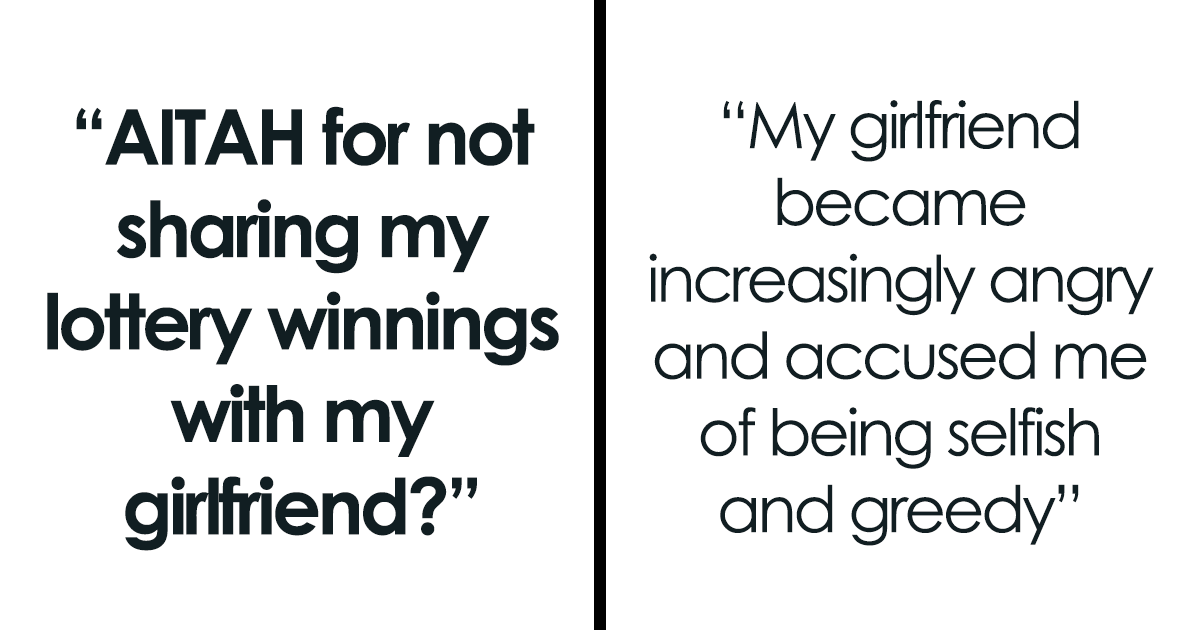
Winning the lottery is supposed to produce champagne, happy dancing, and at least one wildly unnecessary online shopping cart. For one anonymous winner, however, the celebration reportedly lasted only until his girlfriend began calculating how much of the prize should belong to her.
According to an account shared on Reddit and subsequently covered by several media outlets, a Canadian man won approximately C$200,000. His girlfriend of two years allegedly decided that moral support entitled her to at least C$150,000roughly 75% of the entire prize. That is not splitting the pie. That is taking the pie, the plate, and perhaps the refrigerator.
The winner refused, explaining that they had never combined their finances or agreed to share major financial decisions. He planned to invest in his future and help members of his family. As the disagreement escalated, he concluded that his girlfriend’s demands revealed a serious lack of respect for his boundaries and ended the relationship. The original post has since been deleted, so the story remains an anonymous online account rather than an independently verified case.
A C$200,000 Lottery Win Becomes a Relationship Test
The lottery winner said he had been dating his girlfriend for two years. They had not supported each other financially, shared bank accounts, or established a plan for combining their money. When commenters asked what kind of support she had provided, he reportedly described it as moral rather than financial support.
Emotional encouragement matters in a relationship. A caring partner may provide comfort during difficult times, celebrate professional victories, or listen patiently to a 20-minute complaint about a coworker who replies to every email with “per my last message.” None of that automatically creates a bill for C$150,000.
The girlfriend allegedly argued that the length of their relationship and her past support justified her demand. When the winner declined, she accused him of being selfish, greedy, and more committed to the money than to their relationship.
That accusation was the moment many online readers found especially revealing. From their perspective, the person demanding most of someone else’s windfall was accusing the owner of caring too much about money. It was projection with a calculator.
Why the Amount Changed the Entire Conversation
A partner asking whether the winner might pay for dinner, plan a vacation, or buy a thoughtful gift would have created a very different story. Even asking to discuss shared long-term goals would not necessarily be unreasonable.
The problem was the alleged demand for at least three-fourths of the prize. The word “at least” did a remarkable amount of damage. It suggested that C$150,000 was not a hopeful request or opening topic for discussion but the minimum acceptable payment.
Generosity is meaningful when it is voluntary. Once affection is used as leverage“Give me money or you do not value our relationship”the conversation stops being about sharing and starts looking like emotional coercion.
Did the Lottery Money Change Her or Reveal Her?
People often say sudden wealth changes personalities. Sometimes it does. Money can increase confidence, reduce inhibitions, and create opportunities that did not exist before. Yet a windfall can also work like a powerful spotlight. It illuminates expectations, resentments, habits, and values that were already present but easier to ignore when nobody had C$200,000 sitting on the table.
Before the lottery win, this couple apparently had no reason to negotiate ownership of a six-figure asset. Once the money appeared, they discovered that they held dramatically different beliefs about what commitment meant.
The winner apparently viewed the relationship as emotionally committed but financially separate. His girlfriend reportedly believed that her role as a supportive partner gave her a direct claim to his unexpected wealth. Neither perspective had been clearly discussed beforehand, which is common. Many couples can debate dinner toppings for 40 minutes but never discuss debt, savings, inheritances, or what would happen if one person suddenly received a large amount of money.
Research and guidance summarized by the American Psychological Association have long identified financial concerns as a frequent source of conflict between couples. The healthiest response is usually not to avoid money conversations but to have them early, calmly, and specifically.
Entitlement Is Different From a Hopeful Expectation
It is normal for someone in a serious relationship to imagine that a partner’s good fortune might improve their shared life. A long-term couple may reasonably discuss paying off joint debts, purchasing a home, taking a trip, or building an emergency fund.
There is still an important difference between hoping and claiming.
A respectful partner might say, “Have you thought about what this means for us?” An entitled partner says, “This is what you owe me.” One approach opens a conversation. The other arrives with an invoice.
The girlfriend’s alleged reaction also appeared transactional. She reportedly treated past emotional support as an investment that had matured into a six-figure payout. Healthy support does not normally come with hidden interest charges.
Was the Girlfriend Legally Entitled to the Winnings?
The original poster identified himself as Canadian, and legal rules vary by province, relationship status, ticket ownership, agreements, and other facts. Therefore, no firm legal conclusion about this anonymous case can be made from a social media post.
For readers in the United States, the general lesson is that dating someone does not automatically give that person ownership of every asset acquired by their partner. Unmarried couples usually do not receive all the automatic property protections associated with marriage. However, rights can change when couples jointly purchase property, share ownership, make enforceable promises, qualify for a recognized common-law marriage, or sign a cohabitation agreement.
A cohabitation agreement can explain how unmarried partners will handle property, debts, expenses, and finances during the relationship or following a separation. Because state rules differ significantly, people facing a real dispute should consult a qualified attorney in their jurisdiction rather than relying on social media comments, no matter how many upvotes those comments receive.
Marriage can create a different situation. Depending on state law, the timing of the win, the source of the ticket money, and whether assets were mixed together, lottery winnings acquired during a marriage may be treated as marital or community property. Community-property states and equitable-distribution states also approach division differently.
Sudden Wealth Attracts Sudden Opinions
A lottery winner may quickly discover that friends, relatives, former classmates, romantic partners, and people last seen near a middle-school vending machine have detailed plans for the money.
Requests often begin politely. Someone needs help with medical expenses. Another person wants to launch a business. A cousin has found an investment that is allegedly guaranteed, which is usually the financial equivalent of hearing, “Do not worry, this snake is friendly.”
Not every request is manipulative. Helping loved ones can be one of the most rewarding uses of a windfall. The danger arises when the winner makes large decisions while excited, pressured, guilty, or afraid of disappointing people.
FINRA advises people receiving a financial windfall to pause, understand what they actually have, review debts and goals, and consider professional guidance. Official lottery organizations also commonly recommend securing the ticket and consulting financial and legal professionals before making major decisions.
The First Number Is Not Necessarily the Spendable Number
People frequently hear “C$200,000” or “$1 million” and mentally spend the advertised amount before considering taxes, debts, professional fees, or long-term goals.
In the United States, gambling winnings generally must be reported as taxable income. A winner may receive Form W-2G, and federal withholding may apply in certain circumstances. The amount withheld at payment is not necessarily the winner’s final tax liability, which is one reason immediate promises can create trouble.
A substantial prize can be life-changing without being “quit your job, buy a yacht, and name it Fiscal Responsibility” money. After taxes, paying down expensive debt, establishing reserves, and investing for the future, a moderate six-figure win can become much smaller.
What a Healthy Partner Might Have Done Instead
A supportive response would begin with celebration rather than ownership. The girlfriend could have congratulated him, asked about his goals, and waited for him to introduce the question of shared benefits.
If she believed their relationship was moving toward marriage or joint finances, she could have said so directly:
- “Do you still see us building a future together?”
- “Would you like to discuss how this affects our long-term plans?”
- “Are you comfortable telling me how you plan to manage the money?”
Those questions seek clarity without assuming ownership. They also allow the winner to say, “I want to keep this separate,” which may be disappointing but is still a boundary.
A healthy couple can disagree about whether money should be shared. What matters is whether both people can discuss the disagreement without threats, insults, guilt, or financial demands disguised as proof of love.
Practical Steps After Receiving a Lottery Windfall
Pause Before Promising Anything
A winner does not need to answer every request immediately. A simple waiting period can prevent emotional decisions. “I am not making gifts or investments until I complete a financial plan” is a full sentence, even when relatives behave as though it requires a 90-minute appeals hearing.
Protect the Ticket and Personal Information
Secure the winning ticket and follow the instructions of the lottery jurisdiction. Disclosure and anonymity rules differ by location. Winners should also be cautious about unsolicited calls, messages, investment pitches, and requests for account information. Mega Millions warns that legitimate lotteries do not require people to send money to collect a prize they never entered.
Build a Professional Team
Depending on the prize, a winner may benefit from an attorney, tax professional, and properly credentialed financial professional. Their role is not to invent exciting ways to spend money. It is to explain taxes, ownership, privacy, investments, estate planning, and the consequences of gifts.
Create a Written Giving Policy
Decide how much, if anything, will be used to help other people. Establish whether assistance will be a gift, loan, direct payment to a creditor, or contribution to a structured account. Written rules make it easier to treat similar requests consistently and reduce decisions driven by whoever cries the loudest.
Do Not Mix Money Accidentally
Depositing funds into a joint account, adding another person to an asset, or making undocumented promises may create legal and tax complications. Before transferring large sums, obtain advice that reflects the winner’s location and relationship status.
Why Ending the Relationship Was Understandable
The winner did not reportedly end the relationship merely because his girlfriend asked about the prize. He ended it after she allegedly demanded most of the money, dismissed his plans, accused him of selfishness, and continued pressuring him.
That combination matters. A single clumsy remark can be repaired. A pattern of entitlement, anger, and boundary violations raises a deeper question: What happens during the next financial disagreement?
If C$200,000 produced demands before marriage or shared finances, the winner may have reasonably wondered how future disputes involving a mortgage, business, inheritance, children, or retirement savings would unfold.
Breaking up was not necessarily choosing money over love. From his perspective, it was choosing not to remain in a relationship where love had suddenly been assigned a price of at least C$150,000.
Conclusion: The Lottery Prize Was Not the Only Thing He Won
The anonymous winner reportedly received a useful financial windfall and an uncomfortable look at his relationship. The money created possibilities, but it also exposed incompatible beliefs about ownership, generosity, commitment, and personal boundaries.
His former girlfriend may have believed that serious partners should share unexpected wealth. That belief alone is not outrageous. What made the story alarming was the size of the alleged demand and the pressure used to support it.
Money does not always destroy relationships. Sometimes it simply forces people to discuss expectations they should have addressed much earlier. In this case, the conversation ended the romancebut it may also have prevented a far more expensive conflict later.
Related Experiences: What Similar Situations Can Teach Couples
Experience One: The Partner Who Waits to Be Included
Imagine that Maya wins $80,000 from a scratch-off ticket. Her boyfriend congratulates her and asks what she plans to do, but he never requests a payment. Several weeks later, Maya decides to pay for a modest vacation they had already been planning.
The key detail is not the vacation. It is that Maya chooses the gift without pressure. Her boyfriend’s reaction gives her room to be generous instead of making generosity a test she must pass. The experience strengthens trust because neither person confuses affection with ownership.
Experience Two: The Couple Who Already Shares Everything
Now consider spouses who have combined their income, expenses, debts, and savings for 15 years. One spouse wins a substantial lottery prize with a ticket purchased from their shared checking account. They naturally discuss the money as a household asset.
This situation feels different because the couple has an established financial system and may also have legal marital-property rights. Their first conversation could involve paying off the mortgage, funding retirement accounts, helping their children, and preserving a portion for enjoyment.
The lesson is that context matters. Sharing is not automatically foolish, and keeping everything separate is not automatically wise. The central questions are what the couple previously agreed to, how the ticket was acquired, and whether both partners respect the decision-making process.
Experience Three: The Helpful Relative With a Business Idea
A winner tells a small group of relatives about the prize. Within days, an uncle proposes a restaurant, a sibling asks for a down payment, and a cousin needs money for an innovative app that appears to be a calculator with motivational quotes.
The winner initially wants to help everyone but realizes that saying yes to one person creates expectations among the others. After consulting professionals, the winner sets aside a fixed family-assistance fund. Requests must be submitted in writing, and no money will be invested in businesses operated by relatives.
This sounds formal, but formality can protect relationships. Clear rules allow the winner to blame the policy rather than repeatedly defending personal judgments about whose request is most deserving.
Experience Four: The Joint-Ticket Disagreement
Two friends regularly split the cost of lottery tickets but never document the arrangement. One friend buys the winning ticket while the other forgets to send their half of the money that week. Suddenly, both remember the tradition differently.
This experience illustrates why lottery pools and shared purchases should be documented before a drawing. Record who participated, how much each person contributed, which tickets belong to the group, and how winnings will be divided. A two-minute written agreement can prevent months of litigation and a friendship ending in a courtroom.
Experience Five: The 30-Day Silence Rule
A winner chooses not to announce the prize widely and makes no major purchases for 30 days. During that period, the winner lists debts, essential expenses, long-term goals, possible gifts, and the risks of every decision.
The excitement gradually becomes manageable. A luxury car that seemed essential on day one looks unnecessary by day 20. An investment promoted by an acquaintance fails basic due diligence. The winner eventually uses the money to eliminate high-interest debt, build an emergency reserve, and invest gradually.
The most useful experience shared by careful windfall recipients is often surprisingly boring: slowing down works. There is no trophy for spending first. A lottery prize creates options, and preserving those options is usually more valuable than immediately proving to everyone that life has changed.
For couples, the broader lesson is equally simple. Discuss financial values before a crisis or jackpot forces the conversation. Ask how each person views separate property, gifts, debt, family assistance, and shared goals. A relationship that cannot survive an honest conversation about imaginary money is unlikely to improve when the money becomes real.
Note: This article analyzes an anonymous online account that was later reported by multiple publications. The identities and claims were not independently verified. Legal and tax rules vary by jurisdiction, so readers facing an actual windfall or ownership dispute should obtain qualified professional advice.