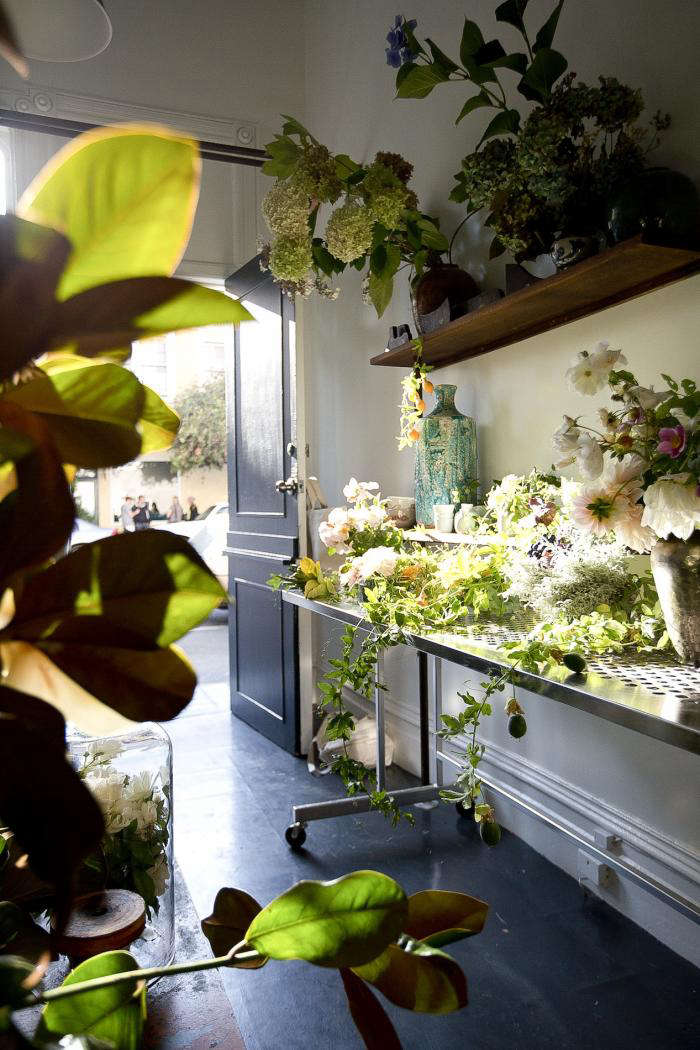
In San Francisco, where fog can accessorize an outfit better than most humans, floral artist Louesa Roebuck created a flower shop that treated unruly branches, fragrant herbs, seedpods, and garden clippings like botanical royalty. Her tiny Hayes Valley space was not built around flawless imported roses. It celebrated whatever California happened to be growing, shedding, ripening, or cheerfully refusing to behave.
A San Francisco Flower Shop With a Wild Streak
When Roebuck opened her narrow shop on Hayes Street in 2012, she offered San Francisco a different definition of luxury. Instead of filling refrigerated cases with identical blooms, she brought in lemon verbena, cardoon blossoms, olive branches, quince, vines, herbs, and flowers gathered from nearby farms and gardens.
The ingredients could be modest, but the results were anything but ordinary. A twisting branch might establish the shape of an arrangement. A cluster of ripe fruit could provide color and weight. A weathered seed headusually the botanical equivalent of someone wearing sweatpants to brunchmight become the star.
Roebuck gathered materials through relationships with friends and organic farmers within roughly a 60-mile radius. The process was partly foraging and partly gleaning: collecting useful plant material that landowners or growers were willing to share, including pruned branches and overlooked seasonal growth.
This distinction matters. Responsible foraging does not mean charging into a public park with pruning shears and the confidence of a pirate. Ethical gathering requires permission, accurate plant identification, respect for local rules, and restraint. Roebuck’s network-based approach connected floral design with the people caring for the land.
Who Is Louesa Roebuck?
Roebuck’s path to floral design wandered through food, fashion, fine art, and environmental thinking. Born in Ohio and trained in printmaking, she moved to California in 1998 and worked at Berkeley’s influential Chez Panisse. The restaurant’s commitment to seasonal ingredients and close relationships with farmers helped shape her view of flowers.
The lesson was beautifully simple: if a restaurant cares about where its peaches and lettuces come from, why should a florist ignore the origins of roses and ranunculus?
From Farm-to-Table Food to Field-to-Vase Flowers
At Chez Panisse, seasonality was not decorative marketing language. It determined what appeared on the plate. Roebuck translated that philosophy into floristry, allowing weather, location, and the natural life cycle of plants to determine what appeared in a vase.
She later worked with textile and clothing designer Erica Tanov before opening August, a San Francisco shop that mixed fashion, art, and community. The business promoted environmentally and socially conscious textiles before “sustainable luxury” became a phrase capable of launching a thousand tote bags.
After August closed during the 2008 financial crisis, Roebuck returned more fully to floral work. Her background remained visible in every composition. Printmaking contributed an understanding of line and negative space; fashion sharpened her eye for color and texture; food culture reinforced her devotion to seasonality.
Her arrangements therefore look less like conventional bouquets and more like temporary sculptures. They are composed, but never bullied into submission.
Inside the Tiny Hayes Valley Shop
The physical shop gave Roebuck’s philosophy a home. She wanted visitors to encounter the scent, scale, and texture of her materials directlysomething photographs and event installations could not fully communicate.
The storefront was a slim space connected to an adjoining organic bedding shop operated by H.D. Buttercup. Its compact dimensions became part of the theater. Large branches and exuberant arrangements felt even more dramatic when displayed inside a room that was practically holding its breath.
Scorched Cedar and a Dutch Door
Roebuck covered the back wall with salvaged western red cedar, then scorched the surface to deepen its character. The treatment kept the reclaimed wood from feeling predictable and gave the flowers a dark, textured backdrop.
A barn-style entrance was cut into a Dutch door and painted in Farrow & Ball’s Railings, a nearly black blue also used on the floor. With the upper half open, the shop could engage the sidewalk while preserving the feeling of a miniature botanical workshop.
Handmade objects completed the space. Ceramics by artists including Yuko Sato and Jared Nelson served as vessels, while waxed-canvas aprons by Matt Dick reflected the practical side of floral work. Books, pottery, branches, and blooms shared the room without making it feel like a conventional retail display.
The result was intimate, moody, and slightly disorientinga little stage on which dahlias, passionflower vines, English roses, and olive branches could perform their brief but memorable show.
Why Foraged Floral Design Looks So Different
Traditional commercial bouquets are often designed around uniformity. Stems are straight, blooms open at similar stages, and colors match as if they have signed a workplace agreement. Roebuck’s arrangements depend on difference.
Line Comes Before Symmetry
A bent quince branch can create movement that a dozen straight stems cannot. Long vines lead the eye across a composition, while gaps allow individual leaves and blossoms to register. Empty space is not an unfinished area; it is part of the structure.
Every Life Stage Has Visual Value
Foraged floral arrangements may include tight buds, open flowers, fading petals, fruit, dried pods, and bare branches. This larger vocabulary makes the work feel connected to time. The arrangement does not pretend nature remains permanently young and camera-ready.
Roebuck developed this idea further in Foraged Flora, created with writer Sarah Lonsdale and photographer Laurie Frankel. Organized around the months of the year, the book explores what becomes available as California’s seasons change. Her later book, Punk Ikebana, combines the influence of Japanese floral composition with a freer, rule-bending West Coast sensibility.
Imperfection Produces Personality
An insect-nibbled leaf, tangled stem, or off-center blossom can provide the detail that makes an arrangement memorable. This does not mean tossing yard debris into a pickle jar and declaring oneself an avant-garde florist. Selection still matters. The art lies in recognizing which imperfections create rhythm, contrast, or emotion.
A Sustainable Alternative to Conventional Floristry
Roebuck’s approach anticipated the expanding Slow Flowers movement, which supports locally grown, seasonal, and responsibly produced flowers. The movement asks consumers to think about flower origins with some of the same curiosity they bring to food.
That question is significant because imported blooms hold a major share of the American cut-flower market. Flowers are perishable, so international supply chains can involve refrigeration, rapid transportation, packaging, and air freight. Imported products may also carry pest risks, which is why the U.S. Department of Agriculture requires inspections and applies detailed rules to cut flowers entering the country.
Local is not automatically perfect, and an imported flower is not automatically an environmental villain wearing a tiny monocle. Growing methods, greenhouse energy, transportation, labor conditions, pesticides, and waste all affect the complete footprint. Nevertheless, seasonal sourcing can shorten supply chains, support regional growers, and encourage customers to appreciate what is naturally available.
Less Floral Foam, More Creative Mechanics
Sustainable florists also question the use of conventional floral foam. The familiar green blocks are commonly made from single-use plastic and eventually become waste. Alternatives include flower frogs, reusable pin holders, branches, chicken wire, and carefully constructed vessel supports.
Roebuck’s loose, structural compositions are well suited to these low-waste methods. A sturdy branch can help support delicate stems while becoming part of the design. The mechanic does not always need to disappear; sometimes it can join the party.
What the Shop Taught San Francisco
San Francisco was a natural setting for this experiment. The Bay Area has long connected food, design, agriculture, and environmental activism. Hayes Valley, with its independent shops and strong pedestrian culture, gave Roebuck’s small storefront an audience willing to pause for an object that was neither a standard bouquet nor a predictable luxury product.
The shop also demonstrated how a physical retail space can communicate a creative philosophy. Customers were not simply purchasing flowers. They were entering a complete sensory argument about locality, abundance, decay, and beauty.
Its small size strengthened that argument. Rather than offering endless inventory, the space presented a tightly edited world. What was available depended on recent discoveries: perhaps giant dahlias from a friend’s garden, aromatic herbs from a farm, or olive branches heavy with fruit. Scarcity became a creative prompt instead of a retail failure.
That model feels increasingly relevant for independent businesses. A tiny shop cannot out-stock a large retailer, but it can provide a point of view. Roebuck’s point of view was unmistakable: the landscape already contains extraordinary material if someone is patient enough to notice it.
How to Bring the Foraged Look Home
Begin With Permission
Use plants from your own garden or ask friends, neighbors, and growers before cutting anything. Never harvest protected species, remove plants from parks without authorization, or assume that a vacant lot is a free botanical buffet.
Choose One Strong Structural Element
Start with a branch, vine, or tall grass that creates a clear line. Place it in the vessel before adding flowers. Let its natural curve determine the direction of the arrangement instead of forcing it into a symmetrical dome.
Mix Familiar and Unexpected Materials
Pair one or two recognizable flowers with herbs, fruiting branches, seedpods, or foliage. Garden roses with fennel, dahlias with olive branches, or nasturtiums with vegetables can feel fresh without becoming chaotic.
Leave Room for Air
Resist the urge to fill every opening. Negative space gives the eye somewhere to rest and allows unusual stems to be seen. If the arrangement resembles a floral traffic jam, remove something.
Accept a Shorter, More Interesting Life
Some gathered materials wilt quickly. Others dry beautifully or change color over several days. Observe the transformation and edit the arrangement as needed. A bouquet can be a process rather than a frozen final product.
Conclusion: A Flower Shop That Changed the View
Louesa Roebuck’s Hayes Valley flower shop was memorable because it did more than sell attractive arrangements. It challenged assumptions about which plants deserve attention, what luxury should look like, and how floristry can respond to a particular place.
By gathering from nearby gardens and farms, working with California’s seasonal materials, and embracing every stage of plant life, Roebuck turned a sliver of retail space into a living installation. Her work suggested that beauty need not arrive in a refrigerated box from thousands of miles away. Sometimes it is growing over a fencewith the owner’s permission, naturally.
The Experience: Learning to See Like a Fearless Forager
The most valuable experience inspired by this San Francisco flower shop begins before a single stem reaches a vase. It begins with a walk.
Imagine moving through a neighborhood slowly enough to notice the difference between the glossy leaves of a magnolia and the silver underside of an olive branch. A hedge that usually registers as “green stuff beside sidewalk” suddenly has shape, rhythm, and color. Fennel raises its yellow umbrellas above an empty lot. A passionflower vine performs botanical science fiction across a garden fence.
The first lesson is observation, not harvesting. Foraging-minded floral design trains the eye to recognize materials while leaving them in place. You notice how branches lean toward light, how grasses bend together, and how seed heads create shadows. This visual practice is free, legal, and unlikely to alarm the neighbors.
Next comes the human part. Instead of clipping first and asking awkward questions later, speak with gardeners, farmers, or friends. Someone pruning an overgrown quince may be delighted to give away a few branches. A grower could have bent stems that are unsuitable for conventional sales but perfect for an expressive arrangement. These conversations turn floral materials into stories.
Back at home, select a vessel with enough weight to hold irregular stems. Handmade pottery, a vintage crock, or a simple glass jar can work. Clean the materials, remove foliage that would sit below the waterline, and inspect everything for insects. Wild-looking is charming; releasing an extended family of aphids onto the dining table is less so.
Place the strongest branch first. Turn it until its line feels intentional. Add a second element that responds to it rather than mirroring it. A low cluster of garden roses might balance a high olive branch, while a curling vine can connect the two areas. Continue slowly, rotating the vessel and leaving visible gaps.
The arrangement may initially feel unfinished because many people have been trained to associate value with volume. Give it time. A single crooked branch can create more drama than twenty identical stems packed shoulder to shoulder.
Over the following days, the experience continues. Flowers open, fruit softens, and leaves change position. Remove anything that has deteriorated and allow the remaining structure to evolve. A composition that began with blossoms may finish as a quiet study of branches and pods.
This process changes more than the vase. It alters the way a person experiences a city. San Francisco becomes a sequence of microclimates, gardens, windy corners, fragrant herbs, and seasonal events. Fog is no longer merely weather; it is part of the system affecting what grows. A neighborhood walk becomes a design lesson conducted by plants that do not charge tuition.
That is the enduring appeal of Roebuck’s fearless approach. It is not really about conquering the landscape or collecting as much as possible. It is about attention, relationships, and the confidence to find beauty outside conventional standards. The finished arrangement is lovely, but the sharpened way of seeing may be the better souvenir.