Gold is the financial world’s oldest drama queen. It sparkles, refuses to pay dividends, sits quietly in vaults, and somehow still manages to become the center of attention whenever inflation, war, banking stress, or currency worries enter the room. A history of gold returns is not just a chart with shiny numbers. It is a story about money, fear, confidence, patience, and the occasional investor who buys at the top because a headline shouted, “Gold is unstoppable!” Spoiler: nothing is unstoppable, not even gold wearing sunglasses.
For centuries, gold was treated less like an investment and more like money itself. In modern portfolios, however, gold is usually viewed as a diversifier, inflation hedge, crisis asset, reserve asset, or store of value. Its returns have moved through long cycles: boring fixed-price decades, explosive bull markets, painful drawdowns, quiet recoveries, and sudden surges when investors remember that paper currencies are, well, paper.
This in-depth guide explores historical gold returns from the gold standard era to the modern market, explains why gold sometimes shines and sometimes sulks, and gives practical context for understanding the role of gold in long-term investing.
Gold Before It Became a Modern Investment
Before the 1970s, discussing “gold returns” in the United States was a little like reviewing the performance of a parked car. For much of U.S. monetary history, the dollar was linked to gold at a fixed official price. Under the Gold Standard Act of 1900, the price was effectively set around $20.67 per troy ounce. That meant gold was not freely floating like a modern asset. It was part of the monetary plumbing.
During the Great Depression, that plumbing sprang a very large leak. In 1933 and 1934, the U.S. government changed the relationship between gold and the dollar. The Gold Reserve Act of 1934 transferred monetary gold to the U.S. Treasury and raised the official gold price to $35 per ounce. In plain English: the dollar was devalued against gold, and gold’s official price jumped. For holders who were legally able to benefit from the change, that was a huge nominal move. For ordinary Americans, private gold ownership was heavily restricted for decades, so the “return” story was more complicated than a simple buy-and-hold chart.
The 1971 Turning Point: Gold Leaves the Cage
The most important date in modern gold return history is August 15, 1971. President Richard Nixon suspended the dollar’s convertibility into gold for foreign governments, effectively ending the Bretton Woods system. Until then, the U.S. dollar had been tied to gold at $35 per ounce, while other major currencies were linked to the dollar. By the late 1960s, rising U.S. deficits, inflation pressure, military spending, and global dollar claims made that system difficult to maintain.
Once gold was no longer fixed to the dollar, its price began trading more freely. That is when modern gold returns truly began. Investors could finally watch gold behave like a market asset: sometimes rational, sometimes emotional, and occasionally as subtle as a marching band in a library.
The 1970s: Gold’s First Great Modern Bull Market
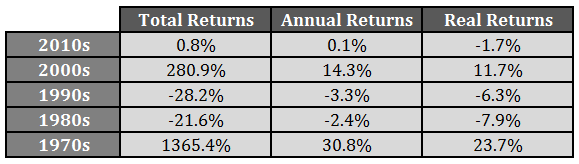
The 1970s were gold’s coming-out party. Inflation rose sharply, oil shocks shook the economy, the dollar weakened, and investors searched for protection against declining purchasing power. Gold answered loudly. From the early 1970s to January 1980, the price climbed from around $35 per ounce to roughly $850 per ounce at its famous peak.
That move created one of the strongest periods in the history of gold returns. It also established the idea that gold could perform well when inflation is high and confidence in paper money is low. But the 1970s also planted a dangerous lesson: investors began to believe gold only went up during trouble. History would soon hand them a very stern homework assignment.
The 1980s and 1990s: The Long Nap Nobody Enjoyed
After gold hit its 1980 peak, the next two decades were difficult. Inflation cooled, Federal Reserve policy became more restrictive, interest rates were high, the U.S. dollar regained credibility, and stocks entered a powerful long-term bull market. Gold, which pays no interest and produces no earnings, looked much less exciting when investors could earn strong returns elsewhere.
This period is essential for understanding gold returns because it proves gold is not magic. Investors who bought near the 1980 high had to wait a very long time to recover in nominal terms, and even longer after adjusting for inflation. Gold protected purchasing power over very long spans, but timing mattered. Buying after a huge emotional spike could lead to years of disappointment. Gold may be shiny, but it still has a sense of humor, and sometimes the joke is on impatient buyers.
The 2000s: Gold Returns to the Main Stage
Gold began a new bull market in the early 2000s. Several forces helped. The U.S. dollar weakened, commodity prices rose, emerging-market demand grew, central banks became more active, and investors looked for alternatives after the dot-com bubble. The launch of U.S.-traded gold ETFs in 2004 also made gold easier to access. Instead of buying coins, finding storage, and worrying about whether Uncle Larry’s “secret safe” was actually just a shoebox, investors could buy exchange-traded products linked to physical bullion.
The 2008 global financial crisis added fuel. As banks failed, credit markets froze, and central banks cut interest rates, gold gained appeal as a crisis hedge. By 2011, gold approached $1,900 per ounce, setting another major nominal high. This period reinforced gold’s reputation as a safe-haven asset, but it also showed another pattern: once panic fades and real interest rates rise, gold can struggle.
2012 to 2018: The Cooling-Off Period
After the 2011 peak, gold entered another weaker phase. The U.S. economy recovered, the dollar strengthened, inflation stayed moderate, and investors moved back toward equities. Gold prices declined and then moved sideways for several years. This was not a failure of gold so much as a reminder of what gold is designed to do. It is not a business. It does not grow earnings, launch products, or surprise Wall Street with quarterly revenue. It simply exists, waiting for the next cycle of doubt.
For long-term investors, this period was useful. It showed that gold can reduce portfolio volatility during certain shocks, but it can also lag badly when confidence is high and risk assets are strong. In other words, gold is less like a racehorse and more like insurance with jewelry-store lighting.
2020 to 2026: Pandemic, Inflation, Central Banks, and New Highs
The pandemic era brought gold back into the headlines. In 2020, massive fiscal stimulus, near-zero interest rates, market panic, and uncertainty pushed gold to new highs above $2,000 per ounce. After that, gold moved unevenly as interest rates rose and inflation became the central economic concern.
Then came another powerful surge. By 2024 and 2025, gold benefited from persistent inflation worries, geopolitical tension, central bank buying, trade uncertainty, and investor demand for diversification. Gold reached repeated record highs, and by early 2026 it had traded far above earlier nominal records. The numbers were dramatic, but the logic was familiar: when investors worry about currencies, debt, conflict, or policy credibility, gold tends to get invited back to the grown-up table.
Long-Term Gold Returns: What the Data Really Suggests
Since gold began trading freely after 1971, its long-term annualized return has been meaningfully positive. Depending on the measurement date, major gold research groups have estimated gold’s annualized return since 1971 at roughly the high-single-digit range. That is impressive for an asset with no cash flow.
However, the return path has been anything but smooth. Gold’s history is full of long stretches of excellent performance followed by long stretches of frustration. Compared with stocks, gold has usually delivered lower long-run growth because businesses can increase earnings, reinvest capital, and pay dividends. Compared with cash, gold has often preserved purchasing power better over long periods. Compared with bonds, gold behaves differently because it has no coupon and no maturity date.
The real lesson is not “gold always wins” or “gold is useless.” Both statements are lazy, and lazy investing ages about as well as milk in a hot car. The better lesson is that gold has historically worked best as a strategic diversifier, not as an all-or-nothing bet.
Why Gold Returns Rise and Fall
Inflation Expectations
Gold often attracts attention when investors fear inflation. If people believe dollars will buy less in the future, they may seek assets with limited supply. Gold’s supply grows slowly, which supports its store-of-value reputation. Still, gold does not track inflation perfectly year by year. Sometimes inflation rises and gold pauses. Sometimes inflation falls and gold rises because other worries are louder.
Real Interest Rates
Real interest rates are one of the biggest drivers of gold returns. When inflation-adjusted yields are low or negative, gold becomes more attractive because the opportunity cost of holding a non-yielding asset falls. When real yields rise, investors may prefer Treasury bills, bonds, or other income-producing assets. Gold does not send interest payments. It sends vibes.
The U.S. Dollar
Gold is priced globally in U.S. dollars, so dollar strength matters. A stronger dollar can pressure gold because it makes the metal more expensive for foreign buyers. A weaker dollar often supports gold returns. This relationship is not perfect, but it is important enough that serious gold investors watch currency markets closely.
Central Bank Demand
Central banks hold gold as part of their reserves. When central banks buy more gold, especially during periods of geopolitical tension or concern about dollar dependence, that demand can support prices. Modern gold returns are increasingly influenced not just by individual investors, but by official-sector buying from countries seeking reserve diversification.
Fear, Crisis, and Confidence
Gold tends to perform well when confidence in financial systems declines. Banking stress, war, sovereign debt concerns, and market crashes can all increase demand. But fear-based rallies can reverse quickly when conditions stabilize. Gold is a hedge, not a crystal ball with a brokerage account.
Gold Compared With Stocks, Bonds, and Cash
Historically, stocks have been the strongest long-term wealth-building asset because companies can innovate, earn profits, and compound growth. Gold cannot do those things. A bar of gold buried in 1980 is still a bar of gold today. It did not open a software division, buy back shares, or improve margins.
Bonds provide income and can stabilize portfolios, especially when interest rates fall. Cash offers liquidity and safety in nominal terms, though inflation can erode its purchasing power. Gold sits in a different category. It is scarce, liquid, globally recognized, and independent of any single company or government promise. That independence is why investors keep returning to it.
In a diversified portfolio, gold’s value often comes from how it behaves relative to other assets. It may rise when stocks fall, or hold value when bonds struggle with inflation. It does not always do this, but its different behavior can be useful. Gold is not the quarterback of a portfolio. It is more like the emergency generator: ignored during normal times, deeply appreciated when the lights flicker.
Nominal Returns vs. Real Returns
When studying gold price history, it is important to separate nominal returns from real returns. Nominal returns show the dollar price increase. Real returns adjust for inflation. A gold price that rises from $850 to $1,900 sounds wonderful until you realize decades may have passed and the dollar’s purchasing power has changed dramatically.
The 1980 peak is the classic example. Gold hit a famous nominal high near $850 per ounce, but because inflation was so high, that level remained difficult to beat in real terms for many years. Investors who ignore inflation may think gold always marches forward. Investors who adjust for inflation see a more nuanced picture: gold can preserve value over long periods, but it can also spend many years catching up to its own past excitement.
Common Myths About Gold Returns
Myth 1: Gold Always Goes Up During Inflation
Gold often benefits from inflation fears, but it does not move in a straight line with consumer prices. Expectations, interest rates, dollar strength, and investor psychology all matter.
Myth 2: Gold Is Risk-Free
Gold has no default risk in the way a bond issuer might default, but it absolutely has price risk. Gold can fall sharply and stay down for years. Shiny does not mean safe every month.
Myth 3: Gold Is Better Than Stocks
Gold and stocks serve different purposes. Stocks are growth assets. Gold is a store-of-value and diversification asset. Comparing them directly is like asking whether a helmet is better than a bicycle. The answer depends on whether you are riding or crashing.
Myth 4: Gold Has No Place in a Modern Portfolio
Gold may not be necessary for every investor, but dismissing it completely ignores its historical role during periods of currency stress, inflation anxiety, and market turmoil. The key is allocation size, not blind devotion.
Lessons From the History of Gold Returns
The first lesson is that gold moves in cycles. It can deliver spectacular gains, then test investor patience for years. The second lesson is that macroeconomic context matters. Gold tends to respond to inflation expectations, real rates, the dollar, central bank demand, and crisis psychology. The third lesson is that starting price matters. Buying after a major surge can reduce future returns, even if the long-term case for gold remains strong.
The fourth lesson is that gold works best when treated as a portfolio tool rather than a personality trait. Investors sometimes become emotionally attached to gold, speaking about it as if it personally saved civilization. Gold has indeed played a major historical role, but it is still an asset with cycles, risks, and opportunity costs.
Experience Notes: What Real Investors Can Learn From Gold’s Long Story
One of the most useful experiences related to gold returns is watching how differently people feel about gold depending on price action. When gold is quiet, many investors call it boring. When it breaks records, the same people suddenly call it essential. This emotional swing is part of gold’s history. The asset itself does not change much. Human attention does.
Imagine an investor in 1999 looking at gold near multi-decade lows. Stocks were booming, technology companies were exciting, and gold looked like an antique from a dusty museum. Buying gold then required patience and a willingness to be unfashionable. A few years later, that patience looked brilliant. Now imagine an investor buying gold near the 1980 peak because inflation headlines were terrifying. That investor had a very different experience: years of waiting, frustration, and second-guessing.
This contrast teaches a powerful lesson: gold returns are deeply connected to investor behavior. People often want gold most after it has already risen and ignore it when it is cheap. That pattern is not unique to gold, but gold makes it especially visible because its story is so emotional. It represents safety, fear, wealth, tradition, and sometimes distrust of financial systems. Those feelings can push investors into bad timing.
A practical experience from studying gold is learning to ask better questions. Instead of asking, “Will gold go up?” a wiser question is, “What role would gold play in a portfolio?” Is it there for inflation protection? Crisis diversification? Currency risk? Long-term store of value? Short-term speculation? Each answer leads to a different decision. Someone buying a small allocation for diversification behaves differently from someone betting the rent money on a price spike. The first person has a plan. The second person has a stomachache scheduled for later.
Another experience is understanding storage and access. Physical gold feels tangible, which many people love. Coins and bars can be held directly, but they require secure storage, insurance considerations, dealer spreads, and careful authentication. Gold ETFs are easier to buy and sell, but they introduce fund expenses, market structure, and custodial arrangements. Gold mining stocks can outperform gold during bull markets, but they also carry company-specific risks such as management decisions, production costs, debt, and political exposure. In other words, “buying gold” is not one single action. It is a menu, and some items come with extra sauce.
Studying gold returns also helps investors respect time horizons. Over one year, gold can be driven by headlines, interest rates, or sudden fear. Over ten years, valuation and macro cycles matter more. Over fifty years, gold’s scarcity and role outside the credit system become clearer. A short-term trader and a long-term wealth protector may both buy gold, but they are playing different games on the same field.
Finally, gold’s history encourages humility. Economists, analysts, central banks, and investors have all been surprised by gold at various times. It has looked outdated right before major rallies and invincible right before long corrections. That does not make gold mysterious; it makes it human-driven. Gold returns are shaped by policy, inflation, confidence, and emotion. The best approach is neither worship nor dismissal. It is disciplined respect.
Conclusion: Gold’s Return History Is a Lesson in Patience
A history of gold returns shows an asset that has survived empires, monetary experiments, inflation scares, financial crises, and several generations of people declaring it either dead or destined for the moon. Gold has delivered strong long-term returns since the end of the Bretton Woods era, but those returns came with volatility, long dry spells, and dramatic bursts of performance.
Gold is not a perfect inflation hedge every year. It is not a guaranteed profit machine. It is not a replacement for productive assets like stocks. But it remains one of the world’s most trusted stores of value, a liquid global asset, and a potential diversifier when confidence in paper promises weakens.
The smartest reading of gold’s history is balanced: gold deserves attention, but not obsession. Used thoughtfully, it can help a portfolio handle uncertainty. Used emotionally, it can turn into an expensive souvenir from the land of bad timing. The metal may be ancient, but the lesson is modern: returns matter, price matters, and patience matters most.