Note: This article is written as original, publish-ready editorial content in standard American English, based on real public information about Berlin architect Julius Kranefuss, ZWEIDREI Architekten, Berlin apartment culture, and the design history of toile.
Some interiors whisper. Others politely clear their throat. And then there is the Berlin apartment of architect Julius Kranefuss, which walks into the room wearing red toile wallpaper, carrying a family tea set, and somehow still looking cooler than your entire Pinterest board. The story behind A Renegade Architect in Berlin, Toile Included is not just about wallpaper, antiques, or one architect’s fondness for objects with personality. It is about a larger design lesson: a home can be intellectual without being cold, historic without being dusty, and rebellious without looking like it lost a fight with a flea market.
Kranefuss, the Berlin-based architect behind ZWEIDREI Architekten, has built a reputation around thoughtful experimentation. His background includes architecture studies at Bauhaus University in Weimar and Roma Tre University, work with internationally known architects, and a practice that has explored the relationship between space, people, technology, and urban identity. In plain English: he is interested in what buildings do to us, not just how nicely they pose for photographs.
That makes his own apartment especially fascinating. Located around the border of Kreuzberg and Neukölln, two Berlin districts known for creative energy, old buildings, improvised beauty, and the occasional staircase that feels like cardio with historical charm, the home is a compact manifesto. It mixes art, inherited objects, handmade work, masculine restraint, soft color, and a burst of red toile in the kitchen. The result is neither minimalist nor maximalist in the predictable sense. It is more like a conversation between a Bauhaus-trained mind and a mischievous grandmother who knows exactly where the good china is hidden.
Who Is Julius Kranefuss?
Julius G. Kranefuss is a German architect based in Berlin and the founder of ZWEIDREI Architekten GmbH. His career path helps explain why his interiors feel layered rather than decorated. He studied architecture at Bauhaus University in Weimar, a school linked to one of the most influential design movements of the twentieth century, and later studied in Rome. His professional experience includes time in offices associated with major architectural figures such as Rem Koolhaas, Massimiliano Fuksas, Christoph Ingenhoven, and Max Dudler.
That mix matters. Koolhaas is known for architecture that questions cities and modern life. Fuksas is associated with dramatic forms and large-scale public projects. Ingenhoven is known for sustainability and high-performance buildings. Dudler often works with rigorous, monumental clarity. Kranefuss’s own practice does not simply copy these influences, but you can sense the lesson: architecture is never just walls. It is behavior, memory, technology, ritual, and sometimes a very opinionated chair.
ZWEIDREI describes its work as searching for solutions beyond the obvious. The firm has worked across renovation, interiors, residential projects, workplace design, and energy-conscious refurbishment. Kranefuss has also been connected with energy consulting for historic buildings, which gives his work another useful tension: the future is welcome, but the past does not have to be thrown into a dumpster just to prove a point.
The Berlin Setting: Kreuzberg, Neukölln, and the Art of Productive Disorder
To understand this apartment, you have to understand Berlin’s design mood. Berlin is not a city that asks every room to behave. Many of its most memorable homes are in older buildings with high ceilings, wood floors, awkward corners, imperfect plaster, and histories that refuse to be painted over with landlord-white optimism. The city rewards people who can work with friction.
Kreuzberg and Neukölln, in particular, have long been associated with artists, designers, students, small studios, immigrant communities, nightlife, and creative reinvention. The interiors that emerge from these neighborhoods often feel less like showroom displays and more like evidence of life being actively lived. A table might be handmade. A lamp might be vintage. A painting might be from a friend. A wall might be rough brick because the wall simply insisted on being rough brick.
Kranefuss’s apartment belongs to this tradition, but it is not casual in the lazy sense. It is curated, just not sterile. It respects patina without worshiping clutter. It lets an antler, an artwork, a tea set, a mirror, and toile wallpaper sit in the same visual sentence without calling the grammar police.
Toile in Berlin: Why the Wallpaper Works
Toile, especially toile de Jouy, is often associated with French pastoral scenes, delicate storytelling, and refined interiors where even the curtains seem to have attended finishing school. Historically, toile de Jouy refers to printed cotton cloth linked to Jouy-en-Josas, near Paris, where Christophe-Philippe Oberkampf helped popularize the style in the eighteenth century. Today, the term is used broadly for scenic, often single-color narrative patterns.
So why does red toile work in a Berlin architect’s kitchen? Because contrast is the whole point. In the wrong setting, toile can look like a room trying too hard to impress a duchess. In Kranefuss’s apartment, it becomes witty. The red pattern plays against rougher textures, art, old objects, and the informal mood of the kitchen. It does not pretend to be modern. It does something better: it makes modernity relax.
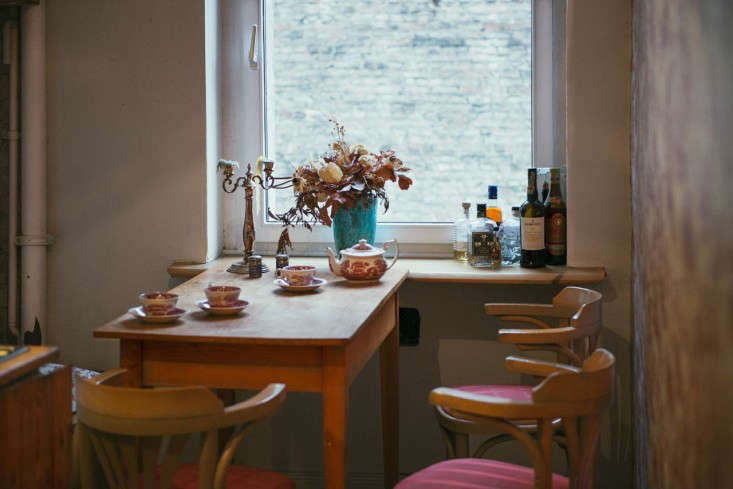
The toile also connects to a family tea set, giving the room emotional logic. That detail is important. Pattern used only for trend can feel thin. Pattern tied to memory becomes architecture of another kind. It organizes feeling. It tells visitors that the kitchen is not merely a place for coffee and toast; it is a place where inherited taste, humor, and personal history get a seat at the table.
Grandmotherly Objects, Contemporary Art, and the Anti-Showroom Home
One of the strongest design lessons from Kranefuss’s apartment is that good interiors do not need to choose between sentiment and seriousness. His rooms include contemporary artworks, vintage pieces, family objects, and slightly theatrical details. Works by artists such as Julius von Bismarck and Santiago Taccetti have been associated with the space, while older objects, including a wildlife painting and antlers from his grandfather, bring a different kind of presence.
This mixture could have gone wrong very quickly. Put enough unrelated objects together and a room starts looking like an estate sale hosted by a philosophy professor. But here the combinations feel intentional because they are held together by proportion, restraint, and personal meaning. The apartment does not treat art as decoration sprinkled on top. It treats art as part of the atmosphere.
That is a useful idea for anyone designing a home. You do not need to own museum-level works to make a room feel thoughtful. You need objects that have tension, scale, and a reason to be there. A cheap print chosen with conviction can be more powerful than an expensive object selected because a sales associate used the word “timeless” three times.
Media Architecture: The Big Idea Behind the Small Rooms
Earlier in his career, Kranefuss was interested in the idea of media architecture, a term that expands architecture beyond static buildings. The idea asks how space shapes social interaction, how technology affects the way people experience environments, and how architecture can help create urban identity. It is a big concept, but his apartment makes it surprisingly easy to understand.
Every room influences behavior. A kitchen with red toile and a tea set invites conversation differently than a white box with one lonely espresso machine. A bedroom with art, mirrors, and collected objects changes the way you slow down. A sitting room with a dusty pink wall and vintage lighting creates a softer rhythm than a room built only around a television. Architecture, in this sense, is not just construction. It is choreography.
Kranefuss has also spoken about the importance of maintaining distance from digital work. His apartment has been described as a place where he can work with his hands and step away from the constant pull of the computer. That choice feels more relevant now than ever. In a world where even refrigerators want Wi-Fi, a home that protects quiet is quietly radical.
Lessons From ZWEIDREI: Beyond the Obvious Solution
ZWEIDREI’s projects show the same interest in unconventional problem-solving. One notable example is the Betahaus workspace in Berlin, created in collaboration with Kim Wang. The project involved transforming part of a 1970s industrial building into a flexible workplace for entrepreneurs, artists, designers, and start-up teams. The original space reportedly lacked neat parallel walls and perfect right angles, which is the kind of discovery that makes architects either panic or reach for coffee with heroic determination.
The solution was not to hide every irregularity. Instead, the design introduced clear spatial elements: private offices, Skype rooms, a communal office area, a long spruce table, plywood storage, and a meeting area with bleacher seating. The result reflected the social purpose of the project. It was not merely about making a workplace look professional. It was about creating zones for collaboration, privacy, performance, and daily improvisation.
That same logic can be seen in the apartment. The rooms are not polished into anonymity. They are shaped around use, memory, art, and personality. The red toile kitchen is not a decorative accident. It is an architectural move at the scale of wallpaper.
Why This Interior Still Feels Fresh
The apartment continues to feel relevant because it resists several tired design traps. It is not obsessed with minimalism, though it uses restraint. It is not vintage cosplay, though it honors old things. It is not a maximalist explosion, though it enjoys pattern and personality. It does not chase the “warm modern” formula so aggressively that every object looks beige, rounded, and emotionally supervised.
Instead, it shows how a home becomes memorable when it allows contradiction. Red toile can sit beside contemporary art. A family tea set can belong in a serious architect’s kitchen. A rough wall can make delicate china look better. A masculine room can include pink. A designer can admire digital life and still refuse to let the internet move into the apartment like a noisy roommate with no boundaries.
How to Borrow the Look Without Copying It
1. Start With One Strong Pattern
If toile feels too traditional, use it in a concentrated way. A kitchen wall, powder room, reading nook, or curtain panel can carry the pattern without turning the home into a historical reenactment. Red toile is especially bold because it feels graphic, warm, and slightly theatrical.
2. Add Personal Objects With Real Meaning
The reason Kranefuss’s family tea set works is that it is not random. Choose objects connected to your life: a bowl from your parents, a lamp from a flea market trip, a drawing from a friend, or a chair you rescued before good sense could stop you.
3. Mix Rough and Refined Textures
Toile looks better when it is not surrounded only by elegance. Pair it with painted brick, simple wood, clear glass, white ceramics, metal, or handmade furniture. The goal is contrast, not costume drama.
4. Let Art Lead the Room
Use art as structure, not afterthought. A room with one confident artwork often feels more complete than a room with ten matching accessories that all appear to have been purchased during a panic scroll.
5. Leave Some Imperfection Alone
Berlin interiors often succeed because they do not sand away every sign of life. If your home has an odd corner, old floor, exposed texture, or strange little niche, consider whether it can become character instead of a problem.
Design Analysis: The Beauty of Controlled Rebellion
The phrase “renegade architect” suggests someone breaking rules, but Kranefuss’s apartment is not chaotic rebellion. It is controlled rebellion. That is much harder to achieve. Anyone can make a room weird. The trick is making it weird and good.
The apartment’s design strength comes from balance. The toile is decorative, but the architecture keeps it grounded. The art is contemporary, but the inherited objects soften it. The palette includes pinks and reds, but the overall mood remains composed. The result is a home that feels lived-in by a person with ideas, not staged by a brand with a quarterly content calendar.
For SEO readers searching for Berlin apartment design, eclectic interiors, toile wallpaper ideas, or architect homes, this project offers a rare case study. It proves that personality is not the enemy of sophistication. In fact, personality may be the only thing that keeps sophistication from becoming boring.
Experience Section: Living With the Spirit of a Renegade Berlin Interior
Spending time with an interior like this, even through photographs and design reporting, changes the way you evaluate your own rooms. At first, the red toile gets all the attention. It is the loud guest at the dinner party, telling stories before the soup arrives. But after a while, the quieter details become more interesting: the way white ceramics calm a patterned wall, the way a vintage object makes contemporary art feel less aloof, the way a handmade surface can interrupt the smoothness of modern life.
The most useful experience related to A Renegade Architect in Berlin, Toile Included is the permission it gives. Many people decorate as if they are trying not to make a mistake. They buy the safe sofa, the safe rug, the safe lamp, and then wonder why the room feels like a waiting area for tasteful ghosts. Kranefuss’s apartment suggests a different process. Start with what matters. Then build the room around it.
Imagine applying that lesson at home. Instead of asking, “What style should this room be?” ask, “What story should this room remember?” That question changes everything. A kitchen might begin with a family dish set. A hallway might begin with a strange old mirror. A bedroom might begin with a painting that makes no sense to anyone else but makes perfect sense to you. Once the emotional anchor is chosen, design becomes less about matching and more about composing.
Another experience worth borrowing is the idea of boundaries. Kranefuss’s choice to keep his apartment at a distance from constant digital work feels almost luxurious. Not luxury in the marble-countertop sense, but luxury in the nervous-system sense. A home should not only display taste; it should protect attention. A room with books, art, objects, and hand-finished details asks you to slow down. It gives your eyes something to do besides check a screen. That may be the most rebellious design decision of all.
There is also a lesson in confidence. Toile has baggage. Pink has baggage. Antlers have baggage. Family china definitely has baggage, sometimes literally packed in newspaper in someone’s attic. But confident design does not erase associations; it redirects them. In a Berlin apartment shaped by art, architecture, and rough urban charm, red toile becomes witty rather than fussy. A tea set becomes graphic rather than precious. A vintage painting becomes atmospheric rather than old-fashioned.
For homeowners, renters, designers, and design lovers, the experience is both practical and philosophical. Practically, it says: choose one brave pattern, mix eras, respect texture, and let personal objects do real work. Philosophically, it says: your home does not need to impress everyone. It needs to make a convincing argument for the way you live.
That is why this Berlin interior remains compelling. It is not a template. It is a challenge. It asks whether we are brave enough to let our rooms become specific, funny, imperfect, cultured, sentimental, and alive. In a design world crowded with identical “curated” spaces, that kind of individuality feels like opening a window. Preferably one in an old Berlin apartment, with a little red toile waving from the kitchen like a flag.
Conclusion
A Renegade Architect in Berlin, Toile Included is more than a clever title. It captures a complete design philosophy: architecture should engage life directly. Julius Kranefuss’s Berlin apartment shows how pattern, art, memory, and disciplined spatial thinking can produce a home that feels intelligent without becoming stiff. The red toile wallpaper matters because it refuses the false choice between seriousness and charm. The family objects matter because they root the room in lived experience. The art matters because it keeps the apartment visually awake.
For anyone interested in Berlin architecture, eclectic apartment design, or the modern use of toile wallpaper, the lesson is clear. Great interiors are not assembled by trend alone. They are built through attention, courage, and a willingness to let objects carry meaning. The best rooms do not simply look designed. They feel argued into existence, lovingly and with just enough mischief to keep the china from getting smug.