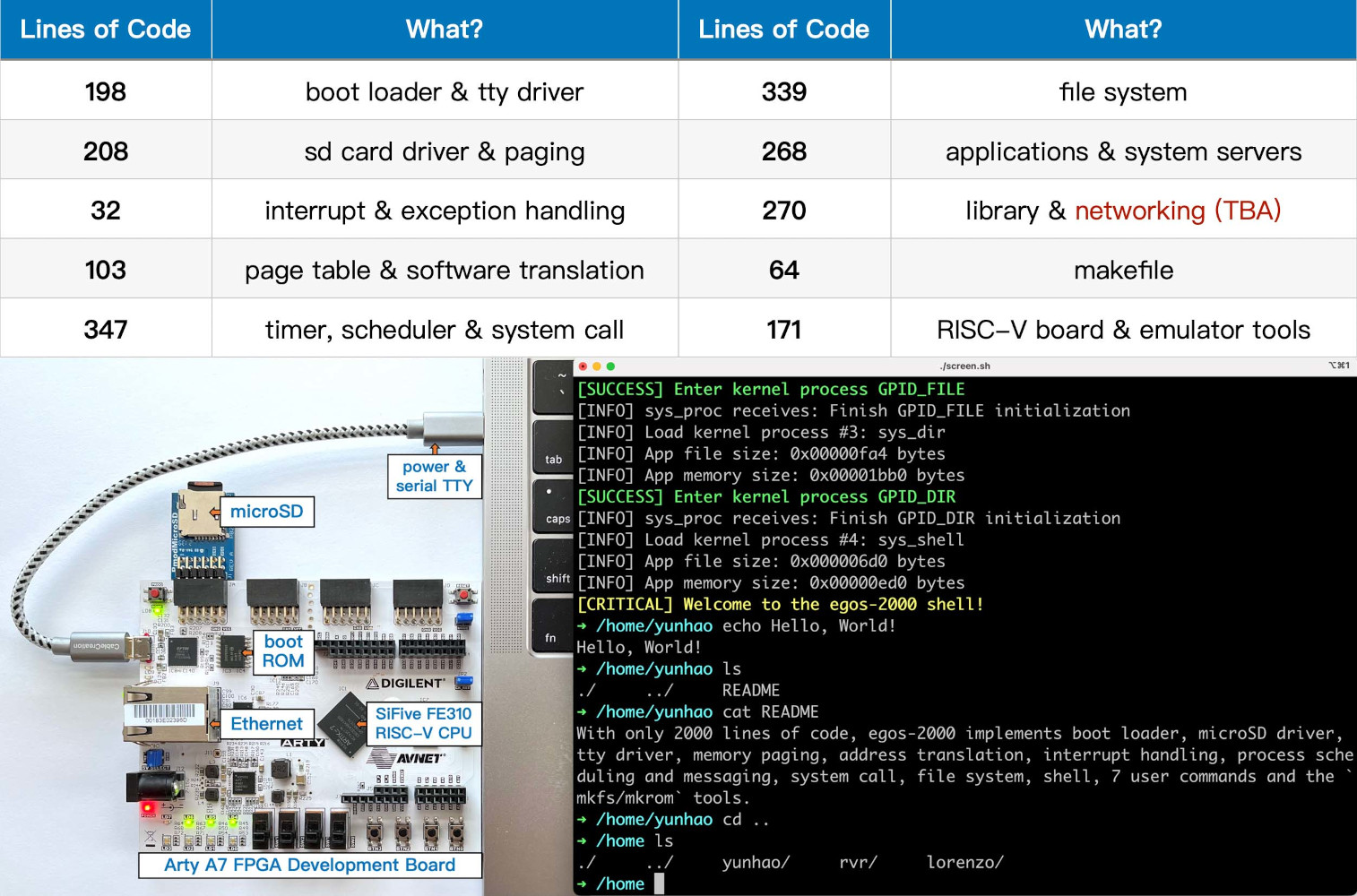
If you have ever stared at a modern operating system and thought, “Surely this thing was assembled by a secret underground army of caffeinated octopuses,” you are not alone. Production operating systems are enormous. That is exactly why the idea of a complete RISC-V operating system in roughly 2,000 lines feels so deliciously rebellious. It strips away the giant forests of abstraction and leaves you with the bones of the machine: boot code, interrupts, scheduling, system calls, virtual memory, and just enough file-system magic to prove the whole thing is real.
The beauty of a tiny RISC-V OS is not that it can replace Linux, macOS, or Windows. It cannot, and it should not try. Its real power is educational. In a compact codebase, you can actually read everything. You can follow the path from power-on to first process without losing your will to live somewhere around page 4,000 of the manual. That is rare. And in systems programming, rare is precious.
Why a 2,000-Line Operating System Matters
When developers talk about learning operating systems, they often mean reading textbook diagrams, tracing kernel calls, and pretending that the arrows in a block diagram are emotionally supportive. A tiny RISC-V OS changes that. Instead of learning only the theory, you see the mechanisms in code. You see how a timer interrupt becomes a context switch. You see how a system call crosses the boundary between user space and kernel space. You see what “virtual memory” actually means when the page table is no longer a mysterious rectangle in a slide deck.
That is why small teaching kernels are so effective. They make the operating system finite enough to understand. A project like this does not merely explain an OS. It gives you one that you can read, build, run under QEMU, and sometimes even boot on real RISC-V hardware. Suddenly, the kernel stops being mythology and starts being software you can reason about.
In plain English, 2,000 lines is small enough for one curious human to hold in their head. That alone makes the project a minor miracle.
What “Entire” Really Means
The word entire does a lot of work in this title, so let’s be fair about it. A tiny RISC-V operating system is “entire” in the teaching sense, not the enterprise-data-center sense. It includes the core pieces that make an operating system feel like an operating system:
Boot and Startup
The machine starts somewhere low-level, sets up enough state to survive, and transfers control into kernel code. That may involve firmware, a boot path, memory layout decisions, and a linker script that tells the program where everything belongs. This is the part where the computer wakes up and asks, in effect, “What am I, and where is my code?”
Interrupts and Trap Handling
Once the OS is alive, it has to respond when the CPU gets interrupted or when user code deliberately enters the kernel. On RISC-V, that means dealing with control and status registers, trap vectors, saved program counters, privilege transitions, and the surprisingly important act of not crashing immediately. Tiny kernels make this process visible. You can trace the handler registration, the timer setup, and the moment the machine jumps into kernel code after an event occurs.
Scheduling
A kernel is not very interesting if one program hogs the CPU forever like a toddler with the TV remote. Even a small OS usually demonstrates cooperative threading first, then preemptive scheduling. That means the kernel can decide when to switch tasks, often using timer interrupts. This is the point where your OS graduates from “single-track demo” to “tiny manager of chaos.”
System Calls and Protection
Applications cannot be allowed to poke random hardware registers and rewrite the universe before lunch. So the OS provides system calls: controlled gateways from user programs into kernel services. This is where privilege modes matter. Tiny RISC-V systems often teach protection incrementally, starting simple and then showing how the kernel enforces boundaries. That lesson is gold, because security is just architecture wearing serious shoes.
Virtual Memory
At some point, the tiny kernel stops letting programs believe they all live in one giant shared apartment. It introduces page tables and address translation so each process can have its own virtual address space. On RISC-V, that usually means confronting the paging model directly, including entries, permissions, and the register that points to the root page table. It sounds intimidating until you realize the tiny OS has nowhere to hide its tricks. You can inspect the whole thing.
File System Basics
Storage turns the kernel from a live demo into something that remembers things after power is gone. Even a minimalist file system teaches profound ideas: blocks, directories, metadata, and the difference between raw bytes on a device and something humans can actually use. Once a toy kernel has a file system, it starts feeling oddly grown up, like a child who suddenly knows how to file taxes.
Why RISC-V Is So Good for This Kind of Project
RISC-V is ideal for teaching because it is open, clean, and far less cluttered than many legacy architectures. The instruction set is easier to reason about, the privilege model is well documented, and the ecosystem makes it practical to run code under emulation or on accessible hardware. In other words, you spend more time learning systems concepts and less time wrestling ancient architectural baggage that looks like it was designed during a thunderstorm in 1987.
That simplicity matters. A teaching OS lives or dies on readability. RISC-V helps because its structure encourages straight-line explanations: here is the instruction, here is the control register, here is the privilege level, here is the trap entry, here is the return. The cause-and-effect chain is visible. For students and curious engineers, that is the difference between insight and headache.
Another advantage is the emulator story. You can run a tiny RISC-V kernel in QEMU, which lowers the barrier to entry dramatically. You do not need a lab full of boards to get started. You can compile, boot, crash, fix, repeat, and gradually understand why the OS did what it did. That loop is where real learning happens.
The Architecture of a Tiny RISC-V OS
Most minimalist RISC-V operating systems are organized in layers, even if they refuse to wear fancy enterprise architecture badges. At the bottom, there is hardware-specific code: interrupt setup, serial output, timer handling, memory mapping, and board quirks. Above that sits the hardware-independent kernel logic: threads, processes, scheduling, protection, file-system routines, and higher-level services. This split is practical, not decorative. It keeps the code portable enough to run in emulation and on at least some real boards.
That layered design is one reason the 2,000-line challenge works. If you separate what is board-specific from what is conceptually universal, you can teach the important OS ideas without drowning in device-driver detail. A UART driver may still appear. A timer still matters. But the code is focused on why the OS needs those pieces, not on burying the reader in implementation rubble.
How the Kernel Teaches Big Ideas with Small Code
A well-designed tiny kernel usually teaches in stages. First, you print something to a console. Then you create threads. Then you add a timer so the CPU can interrupt a running program. Then you schedule among tasks. Then you introduce system calls and privilege separation. Then virtual memory arrives and makes everyone slightly nervous. Then a file system shows up and the whole machine suddenly feels legitimate.
This progression is not accidental. It matches how operating-system ideas build on one another. You do not need page tables to appreciate a scheduler. You do not need networking to understand system calls. A compact RISC-V OS turns the kernel into a staircase rather than a cliff.
That staircase also explains why projects like this show up in university operating-systems courses. They are small enough to assign, modify, and extend. Students can read the whole codebase, then implement one feature at a time without needing an archaeological expedition permit.
What a 2,000-Line OS Can Teach Better Than a Giant Kernel
Large kernels are realistic, but tiny kernels are honest. In a huge production OS, the important ideas are there, but they are wrapped in years of compatibility layers, architecture-specific paths, security hardening, performance tricks, and “please never touch this file again” comments. A 2,000-line teaching OS removes the camouflage.
For example, trap handling on RISC-V becomes much easier to understand when you can see exactly what the CPU saves automatically and what the kernel must save on its own. Context switching becomes easier when there are only a few data structures to inspect. Virtual memory becomes easier when the page table setup fits on one screen instead of ten tabs and a therapy session.
That does not make the tiny kernel trivial. It makes it visible. And visibility is the whole game in education.
Where the Tiny OS Stops Being Tiny and Starts Being Ambitious
The most charming thing about a compact RISC-V OS is that it often starts with the bare essentials and then quietly grows into surprisingly serious topics. One minute you are printing to a serial console. The next minute you are dealing with memory-mapped I/O, storage, networking, multicore behavior, and synchronization. That escalation feels almost rude, but in a good way.
Still, there are limits. A 2,000-line OS will not compete with production kernels in driver support, process isolation maturity, performance tuning, power management, observability, or security depth. It may busy-wait in places where a full OS would sleep. It may cut corners that would be unacceptable in a laptop or server. That is fine. The goal is not commercial perfection. The goal is conceptual clarity.
Think of it as the difference between building a wooden go-kart and buying a Formula 1 car. The go-kart is slower, rougher, and much less glamorous. It is also the one that teaches you how steering works.
Why Developers, Students, and Tinkerers Love It
There is a special thrill in building something that talks directly to the machine. High-level software can feel abstract, layered, and politely distant. A tiny RISC-V OS is the opposite. It is immediate. You write code, boot it, and the machine either obeys or humbles you. Usually both.
For students, this kind of project turns operating systems from a theoretical subject into a hands-on discipline. For embedded developers, it clarifies what the hardware is actually doing. For hobbyists, it scratches the ancient itch to understand the computer all the way down. And for experienced engineers, it is a refreshing reminder that underneath every giant software stack is still a kernel making choices about time, memory, and control.
That is the emotional appeal of “an entire RISC-V operating system in 2000 lines.” It makes the impossible look inspectable.
What the Experience Is Really Like
Spending time with a tiny RISC-V operating system feels different from reading about one. At first, it is strangely empowering. The repository is small enough that you think, “I can absolutely understand this by Friday.” Then Friday arrives, and you discover that one register write controls your entire weekend. That is normal. Tiny kernels are compact, but they are not shallow.
The first real experience most people have is delight mixed with confusion. You boot the system in QEMU, get text on the screen, and feel like a wizard. A few minutes later, you change one line in the trap path, and the machine stops speaking to you entirely. No error message. No stack trace. Just silence. This is when operating systems stop being academic and become personal.
Then comes the rhythm. Edit, compile, boot, stare, repeat. You begin to understand that every feature in a kernel is a negotiation with the hardware. Want preemption? Then the timer has to fire, the interrupt has to arrive, the handler has to save state correctly, and the scheduler has to pick the next runnable task without turning the CPU into decorative furniture. Want user programs? Great. Now privilege modes, protection boundaries, and system-call conventions suddenly matter a lot more than they did five minutes ago.
One of the most memorable parts of the experience is how quickly abstractions collapse into reality. “Virtual memory” sounds grand until you are manually checking page mappings and permissions. “Context switch” sounds elegant until you realize it is really a disciplined act of saving and restoring machine state without losing your place in the story. Tiny RISC-V kernels make these ideas tangible. You do not merely learn the vocabulary. You earn it.
There is also a surprisingly joyful side to the process. When a user program finally traps into the kernel correctly and returns alive, it feels like the computer has nodded at you in approval. When the scheduler rotates between tasks the way you intended, it is absurdly satisfying. And when the file system starts behaving, you briefly forgive every bug that came before it.
Perhaps the best part is that the experience changes how you look at all software afterward. Web apps, databases, mobile apps, game engines, compilers, and cloud systems all begin to look a little different once you have built even a tiny OS. You stop seeing the computer as a magic box and start seeing contracts: between hardware and firmware, kernel and process, code and memory, time and control. That perspective is hard to unlearn, and honestly, why would you want to?
A 2,000-line RISC-V operating system will not make you a kernel master overnight. But it will give you something better: a concrete, hard-earned mental model of how the machine actually works. And that is the kind of knowledge that keeps paying rent long after the demo boots.
Conclusion
An entire RISC-V operating system in 2,000 lines is not a stunt. It is a lens. It shows how surprisingly small a kernel can be when the goal is understanding instead of productization. It reveals the architecture behind booting, traps, scheduling, privilege, paging, and storage without burying the reader under industrial-scale complexity. That is why projects like this matter so much. They make operating systems readable again.
If you want to understand what a kernel does, this kind of codebase is one of the best places to start. It is compact, concrete, and wonderfully honest. And in a field that often hides its most important ideas behind mountains of code, honesty is a feature.
Note: This article is intentionally written without inline source links so it is cleaner for web publishing and easier to reuse in a CMS editor.