Animal Spirits Episode 24: The False Breakdown is one of those finance podcast episodes that feels like it was recorded in 2018 and somehow left a note on the refrigerator for every investor living through market drama today. Hosted by Michael Batnick and Ben Carlson, the episode jumps from technical market signals to financial literacy, hedge fund fame, FANG stocks, diamonds, college costs, and the oldest villain in investing: human overconfidence wearing a tiny crown.
The title itself, “The False Breakdown,” comes from a classic market moment. A chart appears to break down, traders gasp, Twitter lights its hair on fire, and then the price quickly reverses higher. In plain English: the market pretends to fall through the floor, then bounces back like it just remembered it had dinner plans. False breakdowns are frustrating because they punish certainty. They are the market’s way of saying, “Nice opinion. Shame if something happened to it.”
But this episode is not really about one chart or one trade. It is about how investors interpret incomplete information. It asks why people overreact to small samples, why star money managers can suddenly look mortal, why ordinary Americans struggle with basic financial decisions, and why “I don’t know” may be the most underrated sentence in personal finance.
What Is a False Breakdown in Investing?
A false breakdown happens when an asset price falls below a widely watched support level, moving average, or chart pattern, only to reverse quickly and move higher. Technical traders may see the initial drop as a bearish signal. The problem is that markets enjoy embarrassing anyone who treats a signal like a prophecy.
In the episode, the hosts use a false breakdown as a jumping-off point to discuss how fast narratives can flip. One minute, a stock looks broken. The next, it is up sharply from its lows. This is why the phrase “from false moves come fast moves” resonates with traders. When too many investors crowd into the same bearish interpretation, a reversal can force them to scramble, creating fuel for the move in the opposite direction.
The broader lesson is simple: technical signals can be useful, but they are not magic spells. A moving average does not know your retirement goals. A support line does not care about your spreadsheet. A chart can provide context, but it cannot remove uncertainty.
Financial Literacy: The Problem That Refuses to Retire
One of the major topics in Animal Spirits Episode 24 is financial literacy in America. The episode discusses surveys showing that many adults struggle with questions about interest, risk, inflation, debt, and long-term planning. This is not just trivia-night embarrassment. It affects retirement savings, emergency funds, student loans, mortgages, credit cards, insurance choices, and investment behavior.
The uncomfortable truth is that personal finance is both simple and hard. The principles are simple: spend less than you earn, save consistently, avoid toxic debt, diversify, insure against catastrophe, and let compounding do its quiet little miracle in the corner. The hard part is behavior. People do not fail financially only because they lack information. They fail because life is expensive, incentives are confusing, emotions are loud, and a new truck with heated seats can make a budget weep softly into a spreadsheet.
Why Education Alone Is Not Enough
The episode makes an important point: simply teaching financial facts does not automatically create better financial behavior. Knowing what compound interest is and actually saving money every month are different skills. One is knowledge; the other is a system.
That is why good financial education should not stop at definitions. It should give people a map. For example, instead of only explaining emergency funds, a stronger approach says: open a separate savings account, automate a transfer every payday, start with $500, then build toward one month of expenses, then three. Instead of saying “invest for the long term,” say: enroll in the workplace retirement plan, increase contributions by 1% each year, choose a diversified fund, and stop checking it like it is a fantasy football lineup.
Financial literacy works best when it becomes financial architecture. The easier the good behavior, the more likely people are to repeat it.
Retirement Expectations: Big Numbers, Bigger Confusion
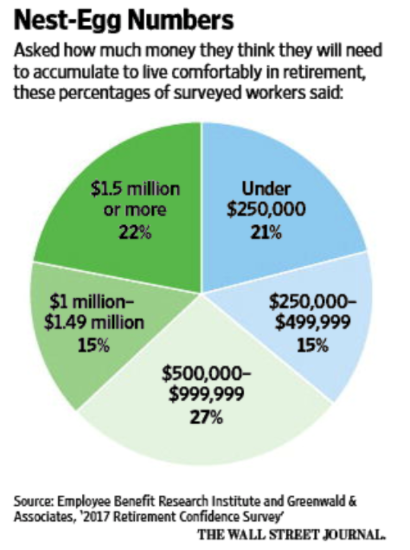
The hosts also discuss how much money people think they need to retire comfortably. Retirement planning is a perfect example of how humans struggle with large numbers. To many households, $500,000 sounds enormous. And it is enormous compared with an empty account. But as a retirement portfolio, it may generate a much smaller annual income than people expect.
Using a rough 4% withdrawal rule, a $500,000 portfolio might support about $20,000 per year before taxes and before adjusting for personal circumstances. That does not mean the 4% rule is perfect, and it does not mean everyone needs the same number. Social Security, pensions, home equity, health costs, lifestyle, location, and longevity all matter. But it does show why retirement math can be humbling.
The emotional problem is that retirement planning asks people to think clearly about a future version of themselves they have never met. Today’s self wants convenience. Future self wants income, healthcare, and perhaps a beach chair that does not require assembly. The gap between the two is where planning lives.
Bill Ackman, David Einhorn, and the Fallibility of Star Managers
Episode 24 spends time on the struggles of prominent hedge fund managers, including Bill Ackman and David Einhorn. Both had reputations as brilliant investors. Both experienced periods when performance disappointed clients. This is where the episode becomes especially valuable for anyone who thinks manager selection is easy.
A great long-term record can hide painful stretches. A bad three-year stretch can be either temporary underperformance or evidence that a strategy has stopped working. The cruel joke is that nobody knows which one it is in real time. Investors only get certainty after the decision would have been useful. Very considerate of the universe.
The episode highlights a dilemma faced by institutions and individuals alike: when do you stick with a struggling manager, and when do you move on? Fire too early, and you may miss the rebound. Wait too long, and you may ride a dying strategy into the swamp. This is why investment process matters more than personality. Fame is not a risk-control system.
The Narrative Shift Around Genius
When performance is strong, investors often describe a manager as disciplined, visionary, and brave. When performance collapses, the same person may suddenly be described as stubborn, outdated, or lucky. The facts may not have changed as much as the story around them.
This is one of the best lessons from the episode: markets do not just reprice assets; they reprice reputations. A winning trade can make someone sound like a philosopher-king. A losing trade can make the same person sound like a raccoon that found a Bloomberg terminal.
Overconfidence: A Little Knowledge Can Be Dangerous
The episode connects hedge fund struggles with behavioral finance, especially overconfidence. Beginners often know they are beginners. The danger zone begins after someone learns a little. That is when a person can mistake vocabulary for mastery. They learn “P/E ratio,” “support level,” or “discounted cash flow,” and suddenly they are ready to explain why Amazon is doomed, the Fed is trapped, and their cousin’s crypto coin is “basically infrastructure.”
This is the practical version of the Dunning-Kruger effect. People with limited knowledge may overestimate their competence because they do not yet know how much they do not know. In investing, this can be expensive. A little valuation knowledge can lead to bad short positions. A little chart reading can lead to overtrading. A little macro knowledge can turn every headline into a portfolio emergency.
The Power of Saying “I Don’t Know”
One of the strongest ideas in the episode is that “I don’t know” is not weakness. It is a risk-management tool. It keeps investors from building oversized positions around fragile opinions. It reminds them that markets are adaptive, competitive, and full of people with different goals and time horizons.
“I don’t know” does not mean “do nothing forever.” It means “size the bet properly.” It means diversify. It means rebalance. It means avoid turning every belief into a leveraged trade. It means leaving room for surprise, because surprise is one of the market’s favorite hobbies.
The Changing Nature of the Stock Market
Another theme in The False Breakdown is how markets evolve. Sector weights change. Business models change. Index composition changes. What worked in one decade can struggle in another. The S&P 500 of the past was dominated by different industries than the S&P 500 of today. That makes historical comparisons useful but imperfect.
This matters because investors love clean analogies. They want to say, “This is just like 1999,” or “This is exactly like 2008,” or “This is the 1970s all over again.” Usually, it is not exactly like anything. History rhymes, but sometimes it rhymes like a toddler banging a spoon on a saucepan.
The episode’s discussion of market change is especially relevant to value investors and active managers. If technology grows into a larger share of the index, avoiding technology is not a neutral decision. Relative to the benchmark, it may behave like a short position. That does not mean investors must own every popular stock. It does mean they should understand the hidden bets inside their portfolios.
FANG Stocks and the Problem of Valuing Great Companies
The episode also touches on FANG stocks: Facebook, Amazon, Netflix, and Google. Around that period, these companies had delivered extraordinary growth and had become central to the performance of the U.S. stock market. They were also difficult to value using traditional tools.
This creates a classic investing puzzle. A stock can look expensive for years and still keep rising because the business keeps compounding revenue, market share, and investor belief. On the other hand, great companies can still become bad investments if expectations get too extreme. The problem is not knowing the idea. The problem is timing it without getting financially steamrolled.
Shorting expensive growth stocks can be especially dangerous. Being “right eventually” is not enough if the stock rises 200% before reality politely checks in. In markets, path matters. Your brokerage account does not accept “but my thesis was intellectually elegant” as collateral.
Drew Brees, Diamonds, and Exotic Diversification
One of the more colorful parts of the episode involves Drew Brees and a lawsuit related to diamond purchases. The broader lesson is not about one athlete or one asset. It is about the temptation wealthy people face to make investing unnecessarily exotic.
Once someone has a lot of money, boring can feel insulting. Index funds? Bonds? Cash reserves? Please. Where is the vineyard, the private restaurant, the racehorse, the film fund, the diamond collection, the friend’s app that will “change wellness forever”? The problem is that every extra investment category adds complexity. Complexity can be useful, but it can also become a fog machine for fees, illiquidity, and poor decision-making.
Alternative assets are not automatically bad. Real estate, private businesses, collectibles, and private funds can play a role for some investors. But they require expertise, proper sizing, and realistic expectations. A good rule of thumb: if an investment needs a dramatic dinner-party explanation, it should probably be small enough that failure will not ruin dessert.
College Costs and the ROI Debate
The episode also moves into the question of whether college is worth the cost. This debate has only become louder. Student debt is real, tuition inflation is real, and not every degree has the same economic payoff. At the same time, broad data has historically shown that college graduates tend to have higher earnings and lower unemployment than those without degrees.
The smart answer is not “college is always worth it” or “college is a scam.” The smart answer is: it depends. Cost matters. Major matters. School choice matters. Debt matters. Career path matters. The student’s temperament matters. A low-cost state school, community college transfer path, or scholarship-supported degree can be a terrific investment. A vague degree financed with six-figure debt and no plan can become a financial backpack full of bricks.
There is also a non-financial side. College can help young adults build networks, independence, friendships, and life skills. Those benefits are hard to enter into a spreadsheet, mostly because spreadsheets are terrible at measuring things like “met my future spouse” or “learned how to live with a roommate who believed dishes were decorative.”
Key Lessons From Animal Spirits Episode 24
1. False signals are part of the game
Markets produce false breakdowns, false breakouts, fake narratives, and emotional head fakes. The investor’s job is not to eliminate uncertainty. It is to survive it.
2. Behavior beats trivia
Financial literacy matters, but systems matter more. Automation, defaults, checklists, and coaching can turn knowledge into action.
3. Star managers are human
Even brilliant investors have bad stretches. A strong process matters more than a famous name.
4. Humility compounds
The phrase “I don’t know” protects investors from oversized mistakes. Humility is not the opposite of confidence; it is the foundation of durable confidence.
5. Markets change
Sector leadership, business models, investor preferences, and economic conditions evolve. Strategies must be disciplined, but investors should not confuse discipline with denial.
Experiences Related to Animal Spirits Episode 24: The False Breakdown
The most relatable experience connected to Animal Spirits Episode 24: The False Breakdown is the feeling of watching a market signal fail in real time. Almost every investor has lived through some version of it. You see a stock fall below a key level. You read five smart-sounding posts explaining why this is the beginning of the end. You check the chart again, nod solemnly like a hedge fund manager in a Patagonia vest, and decide the signal is obvious. Then the stock reverses and rockets higher, leaving your confidence standing alone at the bus stop.
This experience teaches a lesson that no textbook can fully deliver: markets are not classroom problems with clean answers. They are messy, emotional, adaptive systems. A false breakdown feels personal because it exposes the gap between analysis and outcome. You can do the work, read the chart, understand the valuation, and still be wrong. That does not mean analysis is useless. It means analysis needs humility attached, preferably with industrial-strength glue.
Another common experience is learning just enough about investing to become dangerous. Many investors begin with curiosity. They read about index funds, valuation ratios, moving averages, dividend yields, or macro cycles. That learning is valuable. But there is often a middle stage where confidence rises faster than competence. This is when people start making bold calls. They declare a stock “obviously overvalued.” They explain why the market “has to crash.” They rotate their portfolio based on one podcast, two charts, and a cup of coffee strong enough to qualify as a controlled substance.
Episode 24 is useful because it normalizes uncertainty. Batnick and Carlson discuss serious topics without pretending every issue has a neat answer. That tone matters. In finance media, confidence often sells better than honesty. People want forecasts, targets, and dramatic declarations. But real investing success usually comes from boring habits: saving more, diversifying, keeping costs reasonable, avoiding panic, managing taxes, and not doing something heroic every Thursday.
The discussion of hedge fund managers also connects with real investor experience. Many people have bought a fund, stock, or strategy after a strong run, only to watch it underperform. At first, they tell themselves to be patient. Then they wonder if the strategy is broken. Then they read a negative article and feel foolish. The hardest question is always the same: am I being disciplined, or am I being stubborn? There is no universal answer, which is exactly why process matters. Before investing, you need criteria for why you own something, what would make you add, what would make you reduce, and what would prove your thesis wrong.
The diamonds discussion offers a different kind of experience: the temptation to make money more complicated after success. People often assume that wealthy investors need sophisticated investments. Sometimes they do. Often they need better boundaries. A simple portfolio can look embarrassingly plain, but plain is underrated. Plain is liquid. Plain is understandable. Plain does not require a specialist appraisal, a lawsuit, or a dinner conversation that begins with, “So technically, the diamonds are part of our diversification strategy.”
Finally, the college discussion reflects a life-planning experience many families face. The decision is not only financial. It is emotional, social, and personal. Parents want opportunity for their children. Students want independence. Everyone wants a good outcome without accidentally purchasing a luxury-priced identity crisis. The best approach is thoughtful, not ideological: compare costs, likely earnings, debt levels, alternatives, and the student’s actual goals.
That is the lasting value of The False Breakdown. It is not just an episode about a market head fake. It is a reminder that life and investing are full of false signals. Some look like danger and become opportunity. Some look like genius and become luck. Some look like education and become overconfidence. The goal is not to predict every turn perfectly. The goal is to build enough knowledge, humility, and structure that one bad signal does not wreck the whole plan.
Conclusion
Animal Spirits Episode 24: The False Breakdown remains a sharp and entertaining finance discussion because it connects market behavior with human behavior. The episode covers false technical signals, weak financial literacy, retirement confusion, hedge fund struggles, overconfidence, FANG stock valuation, alternative investments, and the college ROI debate. Underneath all those topics is one big idea: investors should be careful with certainty.
A false breakdown is more than a chart pattern. It is a metaphor for how easily people mistake noise for signal. In personal finance, markets, education, and career decisions, the best defense is not pretending to know everything. It is building systems that can survive being wrong.
Note: This article is an original, web-ready analysis based on verified public episode information, financial research themes, market history, and behavioral finance concepts. It is for educational content purposes only and should not be treated as personal investment advice.