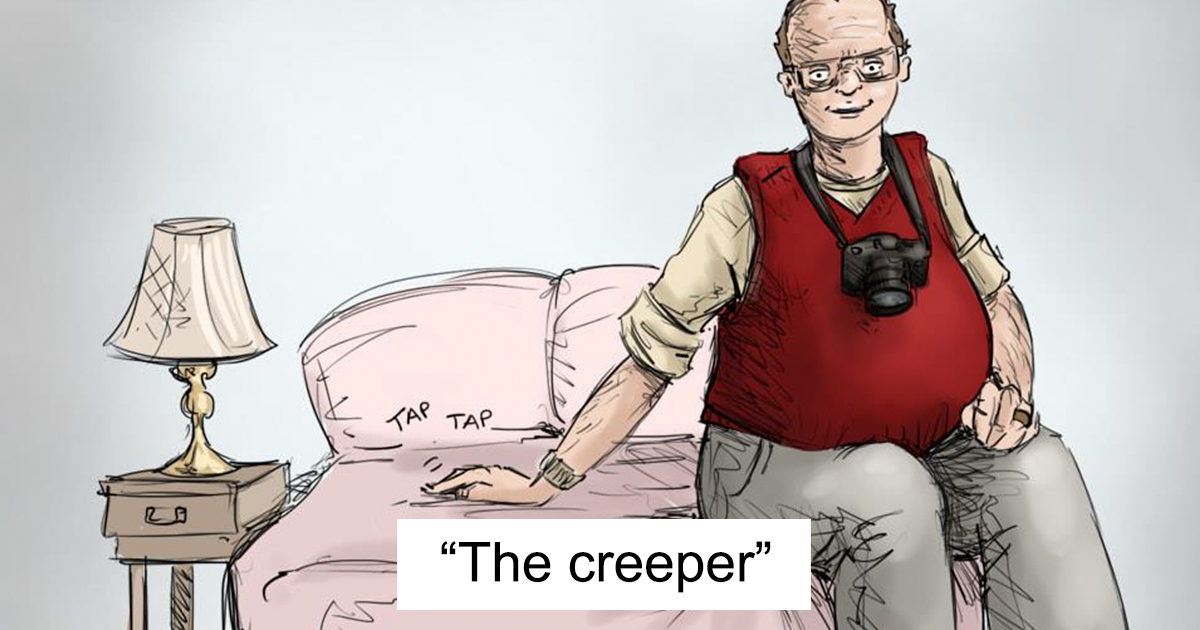
Every so often, the internet stumbles across a piece of art that makes people laugh, wince, and immediately tag a friend with the digital equivalent of, “This is painfully you.” That is exactly why these caricatures of stereotypical male and female photographers hit such a nerve. The illustrations are funny on first glance, but the reason people keep sharing them is a little deeper: they exaggerate habits, poses, personalities, and visual clichés that many photographers really do recognize from workshops, weddings, street shoots, camera clubs, Instagram feeds, and those mysteriously intense people in camera stores who treat lens hoods like a personality trait.
What makes the concept so effective is not just the drawing style or the punchline. It is the fact that photography has always been about more than cameras. It is also about image, identity, status, performance, taste, and, yes, gender expectations. So when an artist turns “male photographer” and “female photographer” into visual archetypes, audiences do not just see a joke. They see a map of assumptions that have been floating around photography culture for years.
Why This Illustration Series Feels So Instantly Familiar
The caricatures work because they play with a truth most creative industries understand: every niche develops its own cast of recurring characters. In photography, those characters are especially visible because photographers do not just make images. They often become part of the visual story themselves. The oversized backpack. The all-black uniform. The vintage film camera used like a moral philosophy. The perfectly color-coordinated portrait photographer with a feed so curated it looks like sunlight signed a management deal.
That is why people are calling the artwork “spot on.” Caricature succeeds when it takes patterns that already exist and pushes them just far enough to become absurd. It gives audiences the thrill of recognition. You laugh because you have met that person, worked with that person, or, on a humbling day, realized you might actually be that person.
Photography culture is especially vulnerable to this kind of self-parody because it lives at the intersection of art and gear. A painter can obsess quietly in a studio. A photographer might obsess in public while comparing dynamic range, debating natural light like it is theology, or explaining why a certain focal length “tells the truth.” That blend of artistry and performance gives stereotype-based humor a lot to work with.
The Male Photographer Stereotype: Gear, Grit, and a Little Bit of Theater
The stereotypical male photographer in jokes and illustrations is often built around technical swagger. He is the guy with too many straps, too many opinions, and an almost spiritual relationship with expensive equipment. He does not merely own a camera. He has a “system.” He can tell you, unprompted, why your favorite lens is overrated. He photographs abandoned warehouses, dramatic shadows, moody portraits, motorcycles, street corners in the rain, and occasionally a friend standing very still in a parking garage looking “cinematic.”
There is some truth hiding under the comedy. Men in photography are often culturally encouraged to lean into the technical side first. Master the gear. Control the lighting. Know the specs. Talk about sharpness. Build authority through hardware. In that framework, the photographer becomes a kind of engineer-poet, someone whose expertise is signaled by how much equipment he can explain and how confidently he can use words like “compression” in casual conversation.
Of course, this stereotype is ridiculous when stretched to the extreme. Plenty of male photographers are gentle portraitists, brilliant collaborators, incredible listeners, and deeply uninterested in gear peacocking. But the stereotype persists because photography culture has long rewarded a performance of technical mastery, and men have often been granted automatic credibility in that performance.
The Female Photographer Stereotype: Taste, Warmth, and the Soft-Light Box
The stereotypical female photographer in internet humor often gets framed differently. She is imagined as polished, client-friendly, aesthetically refined, and focused on portraits, branding shoots, children, families, interiors, weddings, or dreamy lifestyle content. Her color palette is immaculate. Her posing guidance is calm. Her editing is cohesive. Her social media presence is clean enough to make a minimalist cry with joy.
Again, the joke lands because it reflects a real cultural script. Women in photography are frequently pushed toward genres associated with emotion, beauty, intimacy, and service. They are often assumed to be naturally better at people skills and naturally less interested in the heavy technical side, which is both unfair and outdated. A woman can walk onto a set with years of experience, flawless lighting instincts, and more technical skill than everyone else in the room, and someone will still ask where the “actual photographer” is. That is not comedy. That is the part of the stereotype that stops being funny.
This is also why these illustrations can feel both hilarious and slightly irritating at the same time. The female photographer stereotype tends to flatten women into style before substance, taste before technical ability, softness before authority. It is a cartoon version of a bias that the real industry has not fully outgrown.
Why “Spot On” Is Not the Same Thing as “Completely True”
The internet loves calling a joke accurate, but accuracy in satire is slippery. These caricatures are not portraits of real people. They are magnified symbols. They work because our brains are wired to sort visual information quickly. The second we see a certain outfit, pose, facial expression, lighting setup, or camera accessory, we start assigning identity. We decide what kind of photographer someone must be before they even take a shot.
That mental shortcut is part of what makes visual culture powerful and dangerous. A stereotype can be funny because it is familiar, but familiarity is not proof of fairness. It just means a pattern has been repeated enough to feel legible. In photography, repetition matters. The more often people see men represented as technical experts and women represented as tasteful nurturers, the more natural that split begins to seem, even when reality is much messier and much more interesting.
The Bigger Industry Context Behind the Joke
This is where the conversation gets more serious. Women have been part of photography since the medium’s earliest days, yet they have often been undercredited, underseen, or boxed into narrower narratives than their male peers. The history of photography is full of women who shaped portraiture, documentary work, war coverage, fashion imagery, experimental practice, and visual storytelling, but institutional recognition has not always kept pace with their contributions.
That imbalance still echoes in modern photography culture. Industry reporting and advocacy groups have spent years pointing to gaps in visibility, pay, prestige, and authorship. Representation is not just about who gets to hold the camera. It is about who gets hired, who gets marketed as an authority, who becomes a brand ambassador, whose work gets circulated, and whose eye becomes the default way of seeing the world.
Once you understand that context, the caricatures become more than a goofy viral art post. They become a mirror held up to an industry still negotiating old habits. People laugh because the stereotypes are recognizable. They pause because those same stereotypes still shape real expectations.
How Social Media Turned Photographer Types Into Full-Blown Characters
Social media supercharged all of this. Before Instagram and TikTok, photographers had reputations. Now they have brands. A photographer is no longer judged only by the work. The outfit, the captions, the behind-the-scenes clips, the editing tutorials, the studio tour, the presets, the travel reel, and the camera-bag reveal all become part of the public identity.
That makes photographer stereotypes easier to spot and easier to parody. The “cinematic bro” became a character because the internet kept rewarding that aesthetic. The “golden-hour portrait queen” became a character because polished branding and a recognizable vibe perform well online. The “film purist,” the “flash nerd,” the “street monk,” the “wedding whisperer,” and the “minimalist brand storyteller” all became exaggerated internet species because photography is now part craft, part performance, and part content strategy.
In other words, the artist did not create these types out of thin air. The internet has been building them for years like a very stylish zoo.
What the Illustrations Get Right
To be fair, the caricatures absolutely nail a few things. First, photographers do develop visible subcultures. Different genres attract different habits, postures, and visual priorities. Second, audiences really can identify those patterns almost instantly. Third, the divide between how men and women are expected to show up in creative work is still strong enough that people can recognize the joke in a split second.
They also capture another truth: photography is full of personas. Some photographers build identity around ruggedness. Others build it around taste, calm, luxury, speed, authenticity, rebellion, or emotional intimacy. The camera may be the tool, but the persona often becomes part of the sales pitch. That is especially true in commercial, wedding, influencer, and editorial spaces, where trust and branding can be almost as important as the portfolio.
What the Illustrations Get Wrong
Where the joke becomes flimsy is in the assumption that gender predicts artistic depth, technical skill, or creative range. It does not. Some women are gear fanatics. Some men are extraordinary directors of emotion. Some photographers are maximalists, some are minimalists, and many move fluidly across genres. The strongest work usually comes from people who outgrow the script entirely.
The best photographers are rarely the pure stereotype. They are the people who blend craft with empathy, confidence with curiosity, and style with substance. They know how to light a subject, but they also know how to listen. They know how to plan a shoot, but they also know how to notice something unexpected. They are not trapped in the role the culture assigned them.
That is why the most useful response to these illustrations is not outrage and not blind agreement. It is recognition followed by reflection. Yes, the joke is funny. Yes, some of it is accurate. But it is also worth asking why those patterns exist and who benefits when they keep repeating.
Why Better Representation Changes the Whole Conversation
Photography changes when more kinds of people shape the visual record. More women behind the camera, more nonbinary photographers, more photographers of color, more disabled photographers, more working-class photographers, and more people from different regions and communities all expand what feels normal, visible, and valuable. That matters because photography does not just document culture. It teaches culture what to notice.
When the same narrow assumptions dominate who gets seen as authoritative, the result is stale imagery and stale thinking. When representation broadens, the visual language broadens too. Subjects are no longer reduced to tired poses. Working women are not photographed like decorative props. Mothers do not exist only to cradle. Men do not exist only to appear stoic and technically competent. Real people become more legible than clichés.
That may be the most important takeaway hiding inside this viral joke: stereotypes are easy, but better seeing is harder. Photography is at its best when it moves past shorthand and gets curious.
Real-World Experiences That Make the Stereotypes Feel Familiar
If you spend enough time around photography communities, the reason these caricatures feel familiar becomes obvious. Walk into a camera store on a Saturday and you can almost watch the stereotypes introduce themselves. One person is testing a lens like they are evaluating a race car. Another is talking about skin tones, posing flow, and how to make nervous clients relax in the first five minutes. One customer wants charts and specs. Another wants to know whether the files feel beautiful. Neither approach is wrong, but the culture has spent years teaching people to read one as “serious” and the other as “soft,” even when both require expertise.
You see it at workshops, too. The men are often socially rewarded for taking up space, asking loud technical questions, and presenting themselves as naturally authoritative. The women are often expected to be organized, collaborative, pleasant, and visually polished. If a man is obsessive, he is passionate. If a woman is obsessive, she can be called picky. If a man directs confidently, he is a leader. If a woman directs confidently, someone may decide she is intimidating. That double standard has shown up in creative industries forever, and photography is hardly immune.
Weddings offer another familiar scene. A male photographer can arrive dressed like he is about to summit a mountain and still be read as professional. A female photographer may feel pressure to appear professional, stylish, approachable, calm, and invisible all at once, while also carrying the technical responsibility of not missing a once-in-a-lifetime moment. The workload is the same; the social expectations are not.
Online spaces make the contrast even louder. Social media has trained photographers to package themselves into instantly recognizable brands. That means people often lean into the version of themselves that performs best. The result is a parade of recognizable types: the moody street guy with black-and-white opinions about everything, the pastel portrait artist whose feed looks like a cloud learned color theory, the film shooter who talks about grain like it is a sacred text, the studio expert who owns enough lights to simulate three separate suns. These personas are fun, but they also become boxes.
The strangest part is that many photographers eventually end up resisting the stereotype that first brought them attention. The gear-obsessed guy becomes a subtle portrait artist. The “soft-light” lifestyle photographer turns out to be a ruthless lighting technician. The wedding specialist becomes a documentary storyteller. Real experience tends to blur the categories that internet humor likes to sharpen. That is why the caricatures feel true at first and incomplete a moment later. They catch the costume, but not the full person wearing it.
Final Take
So yes, the artist’s take on stereotypical male and female photographers is funny, sharp, and uncomfortably recognizable. People are saying it is spot on because it captures the costumes, habits, and visual shorthand of photography culture with a little wicked precision. But the real reason the artwork sticks is that it reveals something bigger: the camera world still carries old assumptions about who is technical, who is tasteful, who is authoritative, who is emotional, and who gets to be seen as the default image-maker.
The best response is to laugh, then look closer. Caricatures can expose clichés, but photographers do their best work when they move beyond them. In a medium built on seeing, that may be the most spot-on lesson of all.