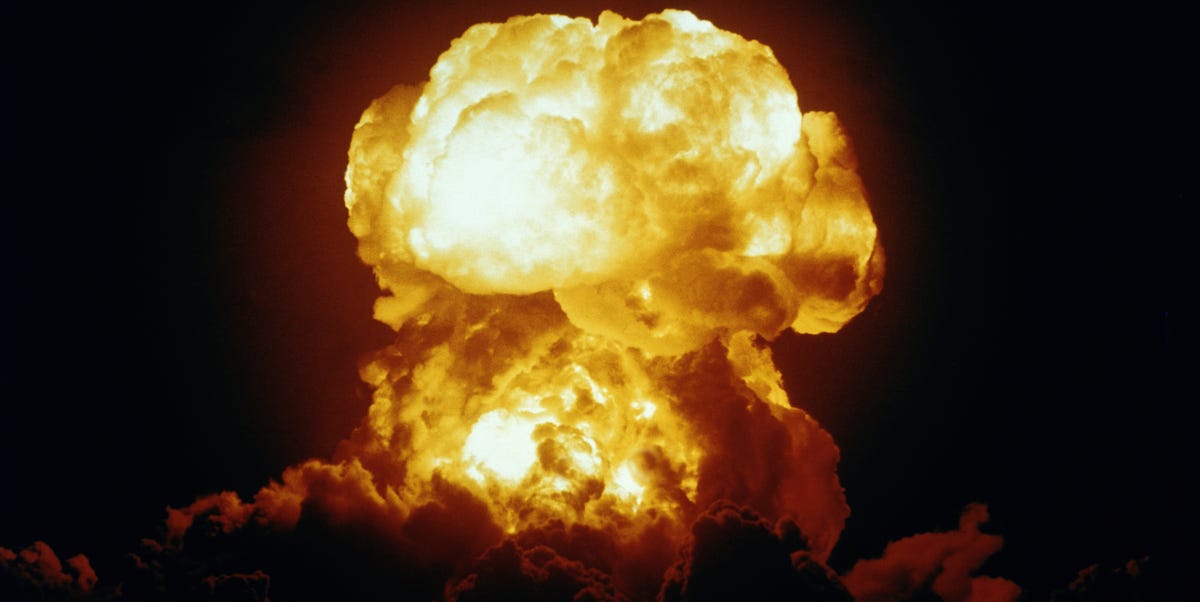
“Atomic bomb” and “nuclear bomb” are often used as though they were two labels for the same terrifying machine. In casual conversation, that usually works. In science, history, and military terminology, however, the relationship is more like “sedan” and “car”: one is a specific type within a broader category.
An atomic bomb is a nuclear weapon powered primarily by nuclear fission, the splitting of heavy atomic nuclei such as uranium or plutonium. A nuclear bomb is the wider term for any explosive weapon that releases energy through nuclear reactions. That umbrella includes atomic, or fission, bombs as well as thermonuclear weapons, commonly called hydrogen bombs, which use both fission and fusion.
The difference matters because the terms describe distinct physical processes, historical generations of weapons, and potential explosive yields. It also helps separate accurate science from movie dialogue, political shorthand, and the occasional headline that treats every mushroom cloud as interchangeable.
Sources:
The Quick Answer
Atomic bombs are a subset of nuclear bombs. They release energy mainly through fission. Nuclear bomb is the broader category, covering both fission weapons and thermonuclear weapons that combine fission with fusion.
| Feature | Atomic Bomb | Nuclear Bomb |
|---|---|---|
| Meaning | A fission-based nuclear weapon | Any weapon powered by nuclear reactions |
| Main reaction | Nuclear fission | Fission, or fission plus fusion |
| Common examples | Little Boy and Fat Man | Atomic bombs and hydrogen bombs |
| Other names | A-bomb or fission bomb | Nuclear weapon or nuclear explosive |
| Potential scale | Usually discussed in kilotons | Can range from kilotons to megatons |
Sources:
What Is an Atomic Bomb?
An atomic bomb is a nuclear explosive that derives most of its energy from nuclear fission. During fission, the nucleus of a heavy atom splits into smaller nuclei. The event releases energy and additional neutrons, which can trigger more fissions. When that process becomes an extremely rapid, uncontrolled chain reaction, an enormous amount of energy is released in a fraction of a second.
The materials most closely associated with fission weapons are certain isotopes of uranium and plutonium. The crucial point is not simply that the weapon contains radioactive material. It is that the weapon creates a runaway nuclear chain reaction. A piece of uranium sitting quietly is not automatically a bomb, much as a tank of gasoline is not automatically a fireworks display. The arrangement, conditions, and reaction behavior are what matter.
The word atomic became popular during the 1940s, when public understanding focused on the revolutionary idea that energy could be released from atoms. Modern scientific writing generally favors nuclear because the reaction occurs in the atomic nucleus, not throughout the atom as a whole.
Sources:
What Is a Nuclear Bomb?
A nuclear bomb is any explosive weapon whose destructive energy comes from nuclear reactions. The category includes two major families:
- Fission weapons: commonly called atomic bombs or A-bombs.
- Thermonuclear weapons: commonly called hydrogen bombs or H-bombs, which use a fission stage to initiate fusion reactions.
Therefore, saying “atomic bomb versus nuclear bomb” can be slightly misleading. The two are not equal categories standing side by side. An atomic bomb belongs inside the nuclear-bomb category. A more exact comparison would be fission bomb versus thermonuclear bomb.
That distinction explains why historians often call the Hiroshima and Nagasaki weapons atomic bombs, while governments and modern news reports use the broader phrase nuclear weapons when discussing arsenals, testing, deterrence, treaties, or warheads of several designs.
Sources:
Fission vs. Fusion: The Science Behind the Names
Nuclear Fission Splits Heavy Nuclei
Fission begins when a heavy nucleus absorbs a neutron and becomes unstable. It splits, releasing energy, radiation, and more neutrons. Those neutrons may strike additional nuclei, creating a chain reaction.
In a nuclear power reactor, engineers control the reaction so the released heat can generate electricity. In a fission weapon, the reaction proceeds explosively. The scientific vocabulary overlaps, but the engineering purpose and speed of energy release are profoundly different. A reactor is designed to sustain and regulate fission; a bomb is designed to release energy almost instantaneously.
Nuclear Fusion Joins Light Nuclei
Fusion combines light atomic nuclei to form heavier nuclei, releasing energy. The sun and stars shine because fusion occurs under immense temperature and pressure. Producing a large fusion reaction on Earth is difficult because the fuel must be placed under extraordinary physical conditions.
A thermonuclear weapon uses a fission explosion to create the extreme environment needed to drive fusion. This is why a hydrogen bomb is still a nuclear bomb and still involves fission. Fusion does not politely replace fission; in a thermonuclear weapon, the two processes work together in a much more powerful system.
Sources:
How Atomic and Thermonuclear Bombs Differ
1. Their Primary Energy Sources
An atomic bomb relies mainly on fission. A thermonuclear bomb uses a fission stage and one or more fusion-related stages. In everyday language, both may be called nuclear bombs, but only the first is strictly an atomic, or fission, bomb.
2. Their Potential Explosive Yields
Explosive yield is commonly expressed as the amount of TNT that would release a comparable quantity of energy. A kiloton equals the energy of approximately 1,000 tons of TNT. A megaton equals approximately 1 million tons of TNT, or 1,000 kilotons.
The Hiroshima explosion is estimated at about 15 kilotons, while Nagasaki is estimated at about 21 kilotons. Thermonuclear devices can reach megaton-scale yields, although not every modern nuclear weapon is designed to maximize raw explosive power. Military planners may also prioritize size, weight, delivery method, accuracy, or adjustable yield rather than simply trying to win history’s worst “bigger boom” contest.
Sources:
3. Their Historical Development
Fission weapons appeared first. The Trinity test on July 16, 1945, demonstrated a plutonium implosion device. Weeks later, the United States used the uranium-based Little Boy bomb over Hiroshima on August 6 and the plutonium-based Fat Man bomb over Nagasaki on August 9.
The thermonuclear era followed. The United States conducted the experimental Ivy Mike test in 1952. That milestone demonstrated that a fission explosion could initiate a much larger thermonuclear reaction, pushing the Cold War nuclear arms race into an even more destructive phase.
Sources:
4. Their Complexity
At a high level, fission weapons involve creating conditions for a rapid chain reaction in fissile material. Thermonuclear weapons add further stages and far more demanding physical conditions. Their greater scientific and engineering complexity is one reason the terms should not be casually exchanged when precision matters.
5. Their Names in Modern Use
“Atomic bomb” frequently appears in World War II history, museum exhibits, school textbooks, and references to Hiroshima and Nagasaki. “Nuclear weapon” is more common in contemporary discussions because it includes a wider range of weapon types, warheads, delivery systems, policies, and arms-control issues.
Little Boy and Fat Man: Both Atomic, Both Nuclear
The two weapons used against Japan in August 1945 were both atomic bombs because both relied on fission. They were also nuclear bombs because “nuclear” is the larger category.
Little Boy, used over Hiroshima, was a uranium-based fission weapon. Fat Man, used over Nagasaki, was a plutonium-based implosion weapon. Their internal approaches differed, but both produced explosive energy through fission rather than a large-scale fusion stage.
Their yieldsapproximately 15 and 21 kilotonswere small compared with later megaton-class thermonuclear tests, yet their human consequences were catastrophic. Blast pressure destroyed structures, thermal energy caused fires and severe burns, intense light damaged vision, and ionizing radiation produced immediate and long-term health effects.
This is an essential reality check. Technical comparisons can make nuclear weapons sound like entries on a specification sheet. They are not merely impressive physics demonstrations. Their defining characteristic is the ability to inflict mass destruction on people, infrastructure, and the environment in an extraordinarily short time.
Sources:
Do All Nuclear Bombs Produce the Same Effects?
No. The severity and distribution of nuclear-weapon effects depend on explosive yield, burst altitude, terrain, weather, building density, weapon characteristics, and distance from the detonation. Still, the major hazards generally include:
- Blast: a powerful pressure wave that can collapse buildings, break windows, and propel debris.
- Thermal radiation: intense heat and light capable of causing burns and igniting fires.
- Initial ionizing radiation: radiation released near the moment of detonation.
- Radioactive fallout: contaminated particles that may travel downwind, especially after a surface or near-surface explosion.
- Long-term disruption: damage to health systems, communications, transportation, power, water, government services, and the economy.
A higher-yield thermonuclear weapon can affect a much larger area than an early fission bomb, but yield alone does not tell the entire story. A smaller detonation in a densely populated urban area could still produce overwhelming casualties. Context is not a footnote; it is part of the physics and the human outcome.
Sources:
Common Misconceptions About Atomic and Nuclear Bombs
“Atomic” Means Small, While “Nuclear” Means Large
Not exactly. Atomic describes the fission category, while nuclear describes the broader family. Many people associate “nuclear” with larger modern weapons, but the word itself does not specify explosive yield.
Hydrogen Bombs Use Only Fusion
They do not. A thermonuclear weapon requires a fission stage to create the conditions that initiate fusion. Depending on the weapon, additional fission may also contribute substantially to the total explosive yield and radioactive fallout.
A Dirty Bomb Is a Nuclear Bomb
A dirty bomb uses conventional explosives to spread radioactive material. It does not produce a nuclear detonation or a self-sustaining fission chain reaction. The contamination can be dangerous and disruptive, but the explosive mechanism is fundamentally different.
Sources:
Nuclear Reactors Can Explode Like Atomic Bombs
Commercial reactors and nuclear weapons are built for very different purposes and operate under different conditions. A reactor accident can release radioactive material and cause severe harm, but a power reactor does not detonate as a nuclear weapon. Hollywood loves shortcuts; nuclear engineering does not.
Sources:
Every Mushroom Cloud Indicates a Nuclear Explosion
Mushroom-shaped clouds can also form after large conventional explosions or volcanic events. The shape results from hot gases rising rapidly and interacting with cooler surrounding air. A mushroom cloud may look ominous, but by itself it does not prove that a nuclear weapon was used.
Why the Difference Matters Beyond Vocabulary
Precise language improves public understanding. When a report mentions a fission device, thermonuclear warhead, nuclear test, or radiological dispersal device, those terms are not decorative synonyms. They describe different technologies, hazards, and policy problems.
The distinction also matters in discussions of arms control and nuclear proliferation. A country’s ability to produce a basic fission device does not automatically mean it can construct a reliable, compact thermonuclear warhead. Testing history, fissile-material production, delivery systems, weaponization, and verification all shape how experts assess nuclear capabilities.
Accurate terminology also prevents a common mental trap: treating nuclear weapons as a single, frozen technology from 1945. The Hiroshima and Nagasaki bombs began the nuclear age, but later weapons developed along different paths and reached vastly greater potential yields. Understanding that evolution makes the historyand the stakesclearer.
Sources:
Atomic Bombs, Hydrogen Bombs, and Delivery Systems
The type of nuclear reaction should not be confused with the method used to deliver the weapon. A nuclear explosive may be carried by an aircraft, placed in a missile warhead, or designed for another military delivery platform. Terms such as ballistic missile, cruise missile, and gravity bomb describe delivery methods, not whether the explosive mechanism uses fission or fusion.
Similarly, the word warhead refers to the explosive component carried by a missile or other delivery system. A thermonuclear warhead is still a nuclear weapon, even though people may not casually call it a “bomb.” In ordinary speech, “nuclear bomb” is often used as a catch-all expression for nuclear weapons delivered in several different ways.
This distinction is useful when reading about modern arsenals. A report may discuss the number of warheads, missiles, bombers, or submarines. Those numbers measure different things. Counting delivery vehicles is not the same as counting nuclear explosives, and neither figure automatically reveals the internal design or yield of every weapon.
A Practical Learning Experience: Making Sense of the Difference
For many readers, the first encounter with the subject happens in a history class. The teacher mentions Hiroshima, Nagasaki, Little Boy, and Fat Man, and the phrase “atomic bomb” becomes mentally welded to a black-and-white photograph of a mushroom cloud. Years later, the same reader hears “nuclear bomb” in a movie or news report and assumes it is simply an updated, more dramatic version of the same term.
A useful learning experience begins by drawing two circles. The large circle is labeled nuclear weapons. Inside it are smaller circles labeled fission weapons and thermonuclear weapons. The first contains atomic bombs. The second contains hydrogen bombs. That simple picture often clears up more confusion than a page of intimidating equations.
The next step is to explore the history without turning it into trivia. Museum displays, survivor testimony, archival photographs, and carefully produced documentaries can show how the technology affected real cities and real families. The scientific distinction becomes easier to remember when it is connected to consequences: the early bombs used fission, later thermonuclear weapons added fusion, and both belong to a category capable of extraordinary human devastation.
Another helpful experience is comparing units. Kilotons and megatons can sound like interchangeable science words until they are translated. One megaton equals 1,000 kilotons. That does not mean every hydrogen bomb is exactly 1,000 times stronger than every atomic bomb, but it reveals why megaton-class weapons represented such a frightening escalation. Suddenly, the vocabulary stops being abstract and starts showing scale.
News literacy provides another lesson. When a headline says a nation tested a “nuclear device,” the phrase may be intentionally broad because analysts do not yet know the exact design. Claims that a test involved a hydrogen bomb require evidence, and estimates may change as seismic, atmospheric, and intelligence data are assessed. A careful reader learns to distinguish confirmed facts from government claims and expert inference.
Classroom models can also demonstrate the difference without recreating dangerous processes. A row of falling dominoes can represent a self-sustaining fission chain reaction: one event triggers several more until the available sequence is exhausted. Fusion is better explained through the extreme pressure and temperature found inside stars. The analogy is imperfect, but it gives beginners a mental framework without burying them under advanced nuclear physics.
The most responsible way to study atomic bombs versus nuclear bombs is therefore to combine three perspectives. Physics explains the reactions. History explains how the technologies developed. Humanitarian evidence explains why the subject cannot be reduced to engineering alone. The vocabulary matters, but the people affected by these weapons matter more.
Once those perspectives are joined, the central answer becomes easy to retain. Atomic bombs are fission-based nuclear weapons. Nuclear bombs are the larger category. Hydrogen bombs are thermonuclear weapons that use fission to enable fusion. It is a tidy taxonomy attached to an untidy and sobering chapter of human history.
Sources:
Conclusion
The difference between atomic bombs and nuclear bombs is mainly a difference of scope. An atomic bomb is a nuclear bomb powered primarily by fission. A nuclear bomb may be an atomic bomb or a thermonuclear weapon that combines fission and fusion.
That means the most accurate one-sentence explanation is also the simplest: all atomic bombs are nuclear bombs, but not all nuclear bombs are atomic bombs. The terms overlap, yet they are not identical. Knowing where they overlap makes discussions of World War II, hydrogen bombs, explosive yield, radiation, and nuclear policy much easier to understandand much harder for sloppy headlines to scramble.
Sources: