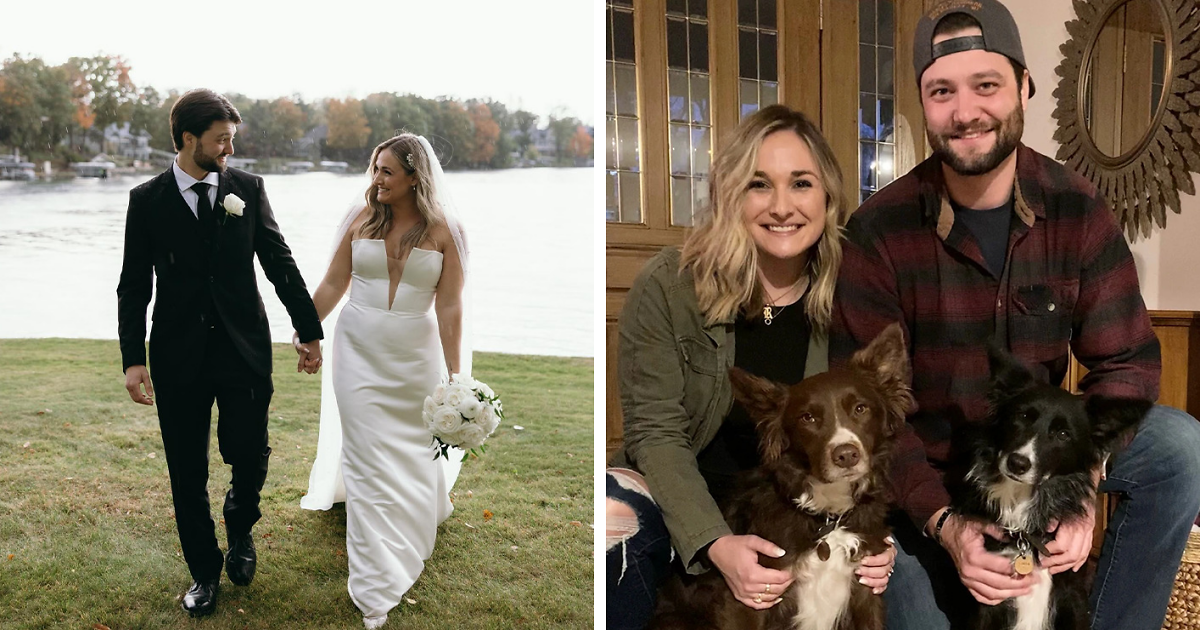
Some headlines sound like they were engineered to stop thumbs mid-scroll. A smiling honeymoon memory. A couple just days away from their first anniversary. A parked car with hazard lights blinking into the dark. And then, the kind of official update that turns an internet mystery into something much more devastating.
That is exactly why the deaths of Rachel and Brandon Dumovich captured so much attention. At first, the story looked like a grim puzzle: a newlywed couple from Wisconsin found dead inside a vehicle in Harvard, Illinois, with few details released beyond the fact that both had suffered gunshot wounds and a firearm was found inside the car. Later, autopsy findings and a police update stripped away much of the uncertainty. What remained was not a spooky internet riddle, but a deeply sad and painfully real case that authorities said was a homicide-suicide.
Still, this story keeps circulating because it contains the ingredients the online world never seems able to resist: romance, tragedy, a final social media post, and the uneasy feeling that a normal-looking day can hide an entirely different reality. But if we set aside the dramatic packaging for a moment, the more important story is what investigators confirmed, what remains unknown, and why the public should be careful not to turn human loss into a guessing game.
What Investigators Confirmed About the Newlywed Couple Found Dead in Their Car
According to Illinois authorities, the case began late on the night of October 6, 2025, when a Harvard police officer noticed a vehicle stopped on Route 14 in the 700 block of North Division Street with its hazard lights activated. What may have looked, at first glance, like a stranded motorist turned out to be something far worse. Inside the car, officers found Rachel Dumovich, 29, in the driver’s seat and Brandon Dumovich, 30, in the passenger seat.
Early reporting described the situation as an active death investigation. Police said both victims had gunshot wounds, and a firearm was recovered from inside the vehicle. At that stage, officials were cautious, and understandably so. In high-profile deaths, especially those involving a married couple, every early detail gets magnified. Investigators initially focused on confirming identities, securing evidence, and determining whether there was any risk to the public.
Authorities later said there was no ongoing threat to the community. That clarification mattered. In the first hours after a case like this breaks, uncertainty can spread faster than facts. Rumors start doing cardio before official statements have even tied their shoes. Police, meanwhile, have to move at the less glamorous pace of evidence review, autopsy results, and coordinated investigative work.
The Autopsy Findings Changed the Story From Mystery to Official Determination
As the investigation progressed, the McHenry County Coroner’s Office determined that both Rachel and Brandon died from gunshot wounds to the head. That finding narrowed the possibilities quickly. Then came the update that reframed the entire case: Harvard police said the incident was being deemed a homicide-suicide. In their public statement, investigators said Brandon Dumovich fatally shot Rachel Dumovich before taking his own life.
That conclusion was chilling not because it was dramatic, but because it was definitive enough to end much of the public speculation. The question was no longer whether something terrible had happened. It had. The official record moved the story away from mystery and toward a much darker reality involving intimate violence and fatal finality.
Even so, police also noted that the investigation remained active while authorities finalized their review of reports and evidence. That is an important detail. An official manner-of-death ruling does not automatically answer every question the public wants answered. It does not reveal motive. It does not provide a full timeline of the couple’s final hours. And it certainly does not explain the private emotional terrain that may have existed behind a relationship that, from the outside, looked joyful and stable.
That gap between confirmed facts and unanswered questions is exactly where a lot of sensational coverage rushes in. The responsible approach is the opposite: stick to what is verified, resist filling in the blanks with imagination, and remember that not every tragedy arrives with a tidy explanation.
The Haunting Final Post That Intensified Public Fascination
One reason this story spread so widely is that Rachel’s last public Facebook post, shared just hours before the couple were found, seemed heartbreakingly ordinary in hindsight. The post read, “Forever chasing sunsets. Wishing we were back in Greece.” It appeared to reference the couple’s honeymoon, and that detail gave the story the kind of emotional contrast that often makes online audiences freeze for a second and say, well, that is haunting.
But the power of that final post is not that it contained some hidden warning. It is that it did not. It sounded warm, nostalgic, and affectionate. That is what makes it linger. People are often unsettled not by obvious darkness, but by how normal everything can look right before a tragedy becomes public.
In viral storytelling, these final digital traces often get treated like clues in a thriller. In real life, they are usually just snapshots. A memory. A photo. A passing mood. A caption written without any expectation that strangers would later dissect it like scripture. The internet likes to act as if every final post must mean something larger. Sometimes it does. Often it doesn’t. Sometimes it is simply the last visible piece of a life that was much more complicated than a caption could ever show.
Who Rachel and Brandon Dumovich Were Before the Headlines
A love story that stretched back to middle school
Part of what made coverage of this case especially striking was the couple’s long shared history. Public details from their wedding page described Rachel and Brandon as middle school sweethearts who first met around age 12. They remained friends for years before their relationship became romantic in 2022. Brandon later proposed in the summer of 2023, and the couple married on October 12, 2024.
That timeline gave the story a narrative arc that news coverage could not resist: childhood connection, adult romance, wedding, honeymoon, then catastrophe just days before the first anniversary. It reads like a script that should not end the way this one did. And maybe that is another reason the public reacted so intensely. Tragedies that clash with the expected storyline always hit harder.
The public image of a happy newlywed life
Reports also painted a picture of two people who seemed rooted in ordinary ambitions and everyday life. Rachel had attended the University of Wisconsin–Milwaukee and worked in human resources. Brandon was described as a U.S. Navy veteran. Their social posts and wedding materials suggested the sort of life many young couples build in plain view: trips, photos, milestones, jokes, plans, and the next chapter always sitting just ahead.
That does not mean the public image told the full truth. Public image almost never does. Social media is a highlight reel, not a sworn deposition. Wedding pages are even more curated; they are basically optimism in formalwear. But those details matter because they remind readers that the people inside this story were not just names pulled into a headline. They had friends, families, routines, and a history that predated the tragedy by many years.
Why This Story Spread So Fast Online
The phrase “haunting final post” practically comes with its own algorithmic jetpack. Stories framed that way travel fast because they combine emotional intimacy with unresolved tension. Readers feel as if they are being handed access to something private and ominous at the same time.
There is also a broader cultural reason these stories stick. We live in a time when many people leave behind a running public diary of sorts. Vacations, anniversaries, inside jokes, food photos, pet pictures, beach sunsets, random Tuesday thoughts. When tragedy strikes, those digital traces become part memorial, part evidence board, part public theater. Strangers scroll backward looking for clues that may not exist. Friends and relatives return to posts that once felt casual and now feel unbearable.
That dynamic can make coverage feel more intimate, but it can also make it less responsible. The temptation is to transform real people into characters in a story that must somehow “make sense.” Yet not every painful event comes with a satisfying explanation, and not every ordinary post hides a secret message. Sometimes the most honest answer is still the hardest one: the public knows only part of what happened.
What We Still Do Not Know About the Case
Despite the official homicide-suicide ruling, some major questions have not been publicly answered. Authorities have not publicly released a motive. They have not outlined a complete timeline of the couple’s final day. And they have not provided evidence that would allow outsiders to understand what, if any, conflict or crisis unfolded before the deaths.
That uncertainty matters because it should place limits on the story people tell themselves. It is one thing to report the official findings. It is another to leap from those findings into unsupported theories about private relationships, hidden warning signs, or what either person must have been thinking. Those leaps may feel emotionally satisfying to readers, but they are not journalism, and they are certainly not empathy.
The most responsible reading of the case is also the simplest one: investigators established what happened at the scene, but the deeper why may never be fully public.
The Bigger Lesson Behind the Newlywed Couple Tragedy
This case is a reminder that shocking stories often become internet folklore before they become fully understood. The public sees the final post, the honeymoon reference, the anniversary date, and the police tape, then starts writing a narrative with a beginning, middle, and end. Real life is messier. Real grief is messier too.
It is also a reminder that tragedy involving intimate partners should never be romanticized just because the couple once looked happy online. Love stories do not become less dangerous because they began young. Honeymoon pictures do not make violence more mysterious. And a final affectionate caption does not erase the reality of what authorities say occurred.
For readers, the better response is not thrill, but humility. We should be wary of treating “haunting final posts” as entertainment. Behind every viral headline is a family receiving phone calls they never wanted, a community struggling to process what happened, and a set of lives that deserve more dignity than rumor can offer.
If you or someone you know in the United States is in crisis, call or text 988 for the Suicide & Crisis Lifeline. If you believe someone is in immediate danger, call 911 right away.
Experiences Related to Stories Like This That Make Them So Hard to Forget
One of the strangest parts of modern tragedy is how often it arrives with a digital before-and-after. Before, there is a smiling photo, a caption about travel, a wedding memory, or a goofy little update that barely registers in the feed. After, that same post gets revisited thousands of times and starts carrying a weight it was never meant to hold. Anyone who has followed a case like this online knows the feeling: you scroll past something tender and ordinary, then later learn it became the final public marker before disaster. That contrast is what makes these stories feel so cold long after the facts are known.
Families often experience this in an even more painful way. They are not just grieving a loss; they are watching pieces of a loved one’s online life become public artifacts. A honeymoon photo becomes a news peg. A caption becomes a headline. A wedding page becomes supporting material in dozens of stories. There is something uniquely difficult about seeing happy memories transformed into evidence of irony. For loved ones, those posts are not “haunting content.” They are reminders of a real person who existed outside the frame of the story.
Communities feel it too. In small towns and suburban areas, cases like this can leave a long aftertaste. People remember where the vehicle was found. They remember when the police lights went up. They remember the first vague alert, the shelter-in-place concern, the swirl of rumor, and the slow drip of updates. Even after the official ruling comes out, the emotional atmosphere does not vanish. It lingers in conversations at work, in neighborhood Facebook groups, and in the uneasy recognition that something catastrophic happened in an otherwise familiar place.
There is also the experience of hindsight, which can be both understandable and misleading. After a shocking death, people start re-reading everything: photos, comments, captions, body language, timelines. They search for signs because signs feel easier to live with than randomness. If there were clues, maybe the tragedy was explainable. Maybe preventable. Maybe less terrifying. But hindsight has a way of turning ordinary details into apparent warnings. That does not mean people are foolish for looking back. It means grief and fear often push us to seek patterns whether or not the evidence can support them.
Journalists, readers, and even casual social media users now share a responsibility in how these stories are handled. The experience of living through a viral tragedy online has taught many people that attention can become a kind of distortion field. The more clickable the story, the more likely nuance gets flattened. The challenge is to remember that there is a difference between reporting and dramatizing, between honoring a loss and packaging it. Cases like this stay with people because they expose a deeply uncomfortable truth: someone’s life can look bright, ordinary, and full of plans right up until the moment the public learns it was not. That realization is what makes these stories so difficult to shake, and it is exactly why they should be covered with more care than spectacle.
Conclusion
The newlywed couple found dead in their car did not leave behind a mystery novel. They left behind a tragedy. Officially, investigators say Rachel Dumovich was killed by Brandon Dumovich, who then took his own life. The haunting final post, the wedding-page love story, and the looming anniversary all made the case feel especially cinematic online, but the reality is far more sobering than the headline language suggests.
The most meaningful takeaway is not that the internet found one more chilling story to obsess over. It is that real lives can sit behind the most viral headlines, and those lives deserve accuracy, restraint, and compassion. When the facts are this heavy, the least we can do is carry them carefully.