Note: The descriptions “vulgar” and “misogyny” reflect criticism and public reaction to the performance. They are not presented as established facts about Bianca Censori’s intentions, beliefs, or personal agency.
Bianca Censori has spent years being watched, photographed, judged, memed, and discussed as though she were a walking headline with a very expensive shoe collection. So when she stepped into performance art with BIO POP (THE ORIGIN), the internet did what the internet does best: it turned a surreal art project into a full-contact debate about feminism, fame, control, architecture, fashion, and whether a chair can have a moral crisis.
Censori’s debut performance in Seoul was designed to be unsettling. It blended domestic rituals, sculptural furniture, masked doubles, and body-centered design into a short but highly stylized visual statement. Supporters saw an artist using discomfort to challenge expectations around women’s bodies and domestic labor. Critics saw something much darker: an aestheticized version of female submission that risked repeating the very power structures it appeared to question.
The result was not a polite gallery debut with a cheese plate and a few vague comments about “texture.” It was a pop-culture collision between performance art and celebrity spectacle. And because Censori’s public identity is already closely tied to debates about visibility, autonomy, and her marriage to Ye, the audience did not enter the room with a blank slate.
What Was Bianca Censori’s BIO POP Performance?
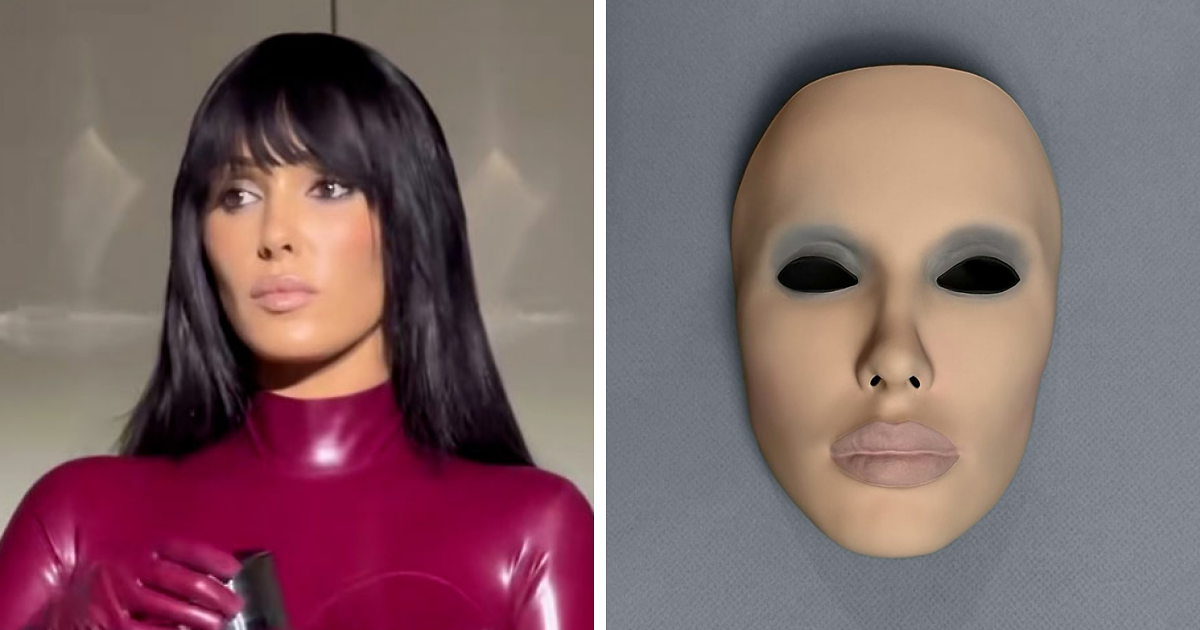
BIO POP (THE ORIGIN) debuted in Seoul in December 2025 as the first chapter of what Censori described as a larger multi-year art cycle. The performance used a domestic setting as its central stage. Censori appeared in a glossy red outfit while carrying out a slow, choreographed kitchen ritual: baking and presenting a cake.
That sounds harmless enough until the setting shifted. The cake was brought into a dining-room-like environment populated by dark-haired doubles of Censori, posed within furniture forms that blurred the line between human body, sculpture, and household object. The seated or contorted figures were not simply near the furniture. They were treated as part of it.
The project’s official framing positioned the home as a place where identity, power, care, obligation, and social roles are learned. In that reading, the cake is not merely dessert. It becomes an offering. The kitchen is not merely a kitchen. It becomes a system. And the furniture is not merely furniture. It becomes a reminder that bodies are often shaped, supported, corrected, displayed, and contained by the environments around them.
That is a serious artistic concept. It is also a concept that walks into a minefield wearing platform boots.
Why Critics Called the Performance “Vulgar” and “Misogynistic”
The harshest reactions to BIO POP focused less on whether the performance was visually striking and more on what it appeared to do with women’s bodies. Critics argued that the use of female performers as furniture-like objects made the artwork feel less like a critique of objectification and more like objectification with gallery lighting.
This is the central tension surrounding the Bianca Censori art performance: Can an artist expose a harmful system by recreating it? Or does recreating it without enough distance, resistance, or explanation simply make the system look fashionable?
Some viewers felt the performance treated the women in the installation as anonymous props. They were masked, visually similar, quiet, and physically integrated into the furniture. Meanwhile, Censori remained the recognizable central figure: the artist, the performer, the public-facing symbol, and the person whose image has already been intensely commodified by celebrity culture.
To critics, that hierarchy mattered. The work appeared to place one woman in the role of author and several other women in the role of material. That does not automatically make the work misogynistic, but it explains why some audiences were uncomfortable. A project about domestic control can be difficult to separate from control when the performers have little visible individuality or agency within the scene.
The word “vulgar” also surfaced because the imagery was intentionally provocative. Censori’s public persona has long been associated with extreme fashion, bodily display, and spectacle. For people already skeptical of her image, BIO POP looked less like a meaningful artistic evolution and more like another escalation in an attention economy where shock is the product and controversy is the shipping fee.
The Bigger Context: Celebrity, Autonomy, and Ye
No discussion of Bianca Censori’s art debut can ignore the context surrounding her public life. Censori is an architect and designer with professional training, but much of the public knows her primarily through her marriage to Ye and through high-profile fashion appearances that have generated fierce online discussion.
That context makes interpretation complicated. When a relatively unknown artist stages bodies as furniture, audiences may focus mainly on the formal qualities of the piece: material, posture, space, repetition, visual symbolism, and art-historical references. When a globally watched celebrity does it, audiences also bring questions about publicity, influence, power, consent, brand-building, and who benefits from the spectacle.
Some critics connected BIO POP to public concern about the balance of power in Censori’s relationship with Ye. Others argued that this interpretation risks stripping Censori of her own authorship by assuming that every controversial choice she makes must belong to someone else.
Both concerns deserve caution. It is unfair to declare that an adult woman has no agency without evidence. It is equally fair for viewers to question how a celebrity image is shaped when it is built around repeated themes of exposure, silence, bodily control, and submission. The responsible position is not to invent private facts. It is to acknowledge that public context changes how public art is read.
In other words, an artwork does not arrive alone. It brings its baggage, its press coverage, its famous spouse, its mood board, and approximately nine thousand comment-section arguments.
Is BIO POP Feminist Critique or Just Shock Art?
This is where the debate becomes more interesting than the outrage itself. Performance art has a long history of using discomfort, repetition, vulnerability, and bodily restriction to confront social expectations. Feminist artists have often used domestic objects, labor, clothing, beauty rituals, and physical endurance to question how women are expected to behave.
Seen through that tradition, Censori’s performance can be interpreted as a critique of domestic roles. The kitchen ritual may represent repetitive care work. The cake may symbolize service. The furniture may represent the way bodies are shaped by social expectations. The duplicate figures may suggest how women are pressured into becoming interchangeable versions of a recognizable ideal.
That interpretation has real weight. Homes can be places of love, comfort, routine, and creativity. They can also be places where gender roles are normalized before anyone is old enough to question them. A performance that turns comfort into confinement is not automatically shallow. In fact, it can be an effective way to expose how familiar spaces sometimes carry invisible rules.
But critics argue that BIO POP did not go far enough. It presented confinement without showing resistance. It displayed women as controlled forms without making their subjectivity visible. It used the language of feminist performance art while leaving some viewers unsure whether it was challenging power or merely borrowing power’s most photogenic costume.
That criticism is not a demand that every artwork include a neat moral lesson and a giant flashing sign reading “OBJECTIFICATION: BAD.” Art can be ambiguous. Art can be messy. Art can even be frustrating. Still, when a performance uses women’s bodies as decorative structures, the burden of meaning becomes heavier. Ambiguity may be part of the work, but it cannot erase the consequences of imagery.
Architecture, Furniture, and the Body as a Design Object
Censori’s architectural background is important to understanding why the furniture in BIO POP became such a major part of the conversation. Architecture is never only about buildings. It is also about movement, comfort, restriction, posture, privacy, visibility, and who gets to occupy space freely.
Furniture may seem innocent, but it quietly tells bodies what to do all day. Sit here. Stand there. Rest this way. Work at this height. Keep your elbows off the table. Try not to fall asleep during the meeting. A chair is a small dictator with upholstery.
In BIO POP, furniture becomes much more than a useful object. It becomes a device for shaping bodies. The forms reportedly resembled medical supports, orthopedic structures, or padded apparatuses. That visual language suggests care and control at the same time. A support can help someone stand. It can also limit how they move.
This is one of the strongest ideas in the performance. The project asks viewers to consider whether design can ever be neutral. A domestic object can comfort us, but it can also enforce routines. A room can protect us, but it can also define who is expected to serve, who is expected to sit quietly, and who is expected to be looked at.
Whether Censori’s execution successfully communicated that idea is still debatable. But the question itself is worthwhile: How often do we mistake familiar design for freedom simply because it is comfortable?
Why the Online Reaction Became So Intense
Celebrity performance art almost never gets the luxury of slow interpretation. A gallery visitor might spend ten minutes staring at a sculpture, read an artist statement, leave confused, return later, and gradually form an opinion. The internet gives the same sculpture a six-second video clip, a dramatic caption, and a comment section full of people declaring either “genius” or “jail.”
That speed shaped the reaction to Bianca Censori’s debut art performance. Many people encountered still images of body-shaped furniture or brief clips without the full context of the artist’s intended themes. That does not invalidate criticism, but it does explain why interpretations became sharply divided.
Social platforms reward certainty. It is easier to say “this is misogyny” or “this is revolutionary” than to admit that a work might be visually compelling, politically confused, uncomfortable, and genuinely interesting at the same time. But complex art often deserves a more complicated response.
The strongest criticism of BIO POP is not that it made people uncomfortable. Good art often does. The stronger criticism is that it may have created an image of female containment without giving the women inside that image enough visible power, voice, or escape.
The strongest defense is not that critics “just do not get art.” That phrase has protected many lazy projects from deserved criticism. The better defense is that Censori is using spectacle to force audiences to confront the ways bodies are consumed, displayed, and controlled in both domestic life and celebrity culture.
Experiences and Lessons From the Debate Around BIO POP
The reaction to Bianca Censori’s BIO POP offers useful lessons for artists, audiences, curators, students, and anyone who has ever posted something online and watched strangers interpret it like a detective show with worse lighting. The first lesson is that intention does not travel alone. An artist may intend critique, irony, discomfort, or social commentary, but viewers bring their own experiences with sexism, domestic expectations, exploitation, and celebrity culture.
For audiences, the experience of encountering provocative art can be surprisingly personal. One person may look at the human-furniture imagery and see a critique of beauty standards. Another may see women being reduced to decorative objects. Someone else may see a darkly funny commentary on how modern life turns everyone into a piece of functional décor by the end of the workday. None of these reactions has to cancel the others.
For emerging artists, this debate shows why context matters as much as concept. A powerful visual can become misunderstood when it is detached from the work’s larger purpose. Artist statements, interviews, performer credits, behind-the-scenes information, and curatorial framing can help audiences understand whether a difficult image is meant to challenge power or simply borrow its visual appeal.
For curators and galleries, the experience is a reminder that provocative work needs thoughtful presentation. If a performance deals with restraint, identity, gender, or bodily control, the exhibition should not assume that audiences will automatically understand the politics behind it. Clear framing does not weaken art. It gives viewers more tools to engage with it critically instead of reducing it to a viral screenshot.
For public figures, the biggest lesson may be that celebrity makes artistic ambiguity harder. Censori is not entering the art world as an unknown artist whose work can be evaluated in isolation. She is entering it with an existing public narrative around fashion, fame, marriage, controversy, and public visibility. That does not make serious art impossible. It simply means the work has to work harder.
Ultimately, the experience of BIO POP is a reminder that art does not need unanimous approval to matter. It can be flawed, fascinating, uncomfortable, and controversial all at once. The question is not whether viewers should feel uneasy. The question is whether that unease leads somewhere meaningful.
Final Thoughts
Bianca Censori’s BIO POP performance landed in a cultural space already crowded with questions about women’s bodies, celebrity control, domestic roles, fashion as performance, and the thin line between critique and exploitation. That is why the backlash was so intense.
Some viewers saw an artist confronting the systems that turn women into symbols, objects, and surfaces. Others saw a glossy reproduction of those systems, dressed up as avant-garde commentary. The truth may sit somewhere in the uncomfortable gap between those reactions.
What is clear is that Censori’s debut did not fade quietly into the art-world wallpaper. It sparked discussion, criticism, confusion, and curiosity. For an artist beginning a larger performance cycle, that may be exactly the point. The next challenge will be proving that the project has more to say than its most shocking image.