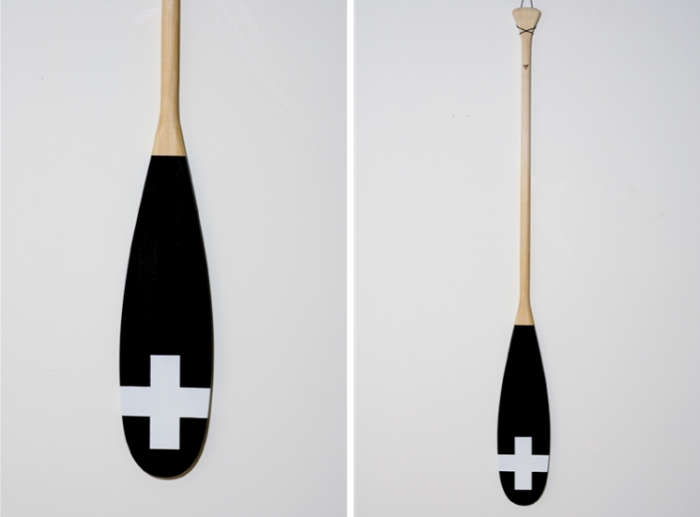
A canoe paddle is normally expected to do one simple job: move a boat through water without snapping, slipping, or launching its owner backward into the lake. The Black Cross Canoe Paddle, however, was designed to do something more. It combined the familiar silhouette of a traditional wooden paddle with a bold black cross, turning an outdoor tool into a striking piece of functional art.
Originally associated with the Toronto design studio Contact Voyaging Co., the paddle attracted attention because it looked equally comfortable beside a cedar canoe or hanging above a modern fireplace. Its clean geometry, natural wood grain, and high-contrast painted symbol captured the growing interest in handcrafted paddles as decorative objects.
Although the original model is difficult to find today, the idea remains surprisingly relevant. Painted canoe paddles now appear in lake houses, rustic cabins, coastal homes, restaurants, boutique hotels, and even city apartments owned by people whose closest encounter with wilderness is an aggressively overwatered houseplant.
This guide examines the history, design, materials, usability, decorating potential, maintenance, and do-it-yourself possibilities behind the Black Cross Canoe Paddle.
What Is the Black Cross Canoe Paddle?
The original Black Cross Canoe Paddle was a handcrafted wooden paddle decorated with a simple black cross on its blade. Archived product information for related Contact Voyaging paddles describes a 56-inch beavertail paddle made from basswood in Ontario, Canada, then painted and finished by hand in the company’s Toronto studio. The paddles were accompanied by signed certificates identifying the title, paddle style, and edition.
Its appeal came from restraint. There were no complicated wilderness scenes, inspirational quotations, or cartoon moose wearing sunglasses. The natural wood remained visible, while the black cross supplied a strong visual center.
The design could be interpreted in several ways. Some viewers saw a Scandinavian-style geometric motif. Others connected it with traditional symbols, modern graphic design, or religious imagery. Because the paddle itself was so simple, its meaning depended largely on the room and the person displaying it.
A Paddle Designed as an Art Object
Contact Voyaging helped popularize the idea that a canoe paddle could be collected and displayed like a limited-edition print. Rather than hiding the paddle in a garage under three folding chairs and a suspiciously sticky fishing net, owners were encouraged to mount it prominently on a wall.
The long, narrow shape creates a strong architectural line. It can visually widen a small room when hung horizontally, add height when mounted vertically, or introduce movement when positioned diagonally. The black cross adds enough contrast to command attention without overwhelming other furnishings.
Why the Design Still Looks Modern
Many rustic accessories rely heavily on distressed paint, artificial aging, and decorative bears. The Black Cross Canoe Paddle takes the opposite approach. Its power comes from proportion, negative space, and contrast.
Natural Wood and Graphic Black
Warm wood tones soften the severity of black paint. Meanwhile, the black cross prevents the paddle from looking like an ordinary sporting item accidentally left in the living room.
This combination works with several popular interior styles:
- Modern rustic: Natural materials paired with simple shapes and neutral colors.
- Scandinavian-inspired design: Pale wood, restrained decoration, and graphic accents.
- Lake house décor: Authentic outdoor objects displayed without excessive nautical clutter.
- Industrial interiors: Black metal, exposed brick, leather, and unfinished wood.
- Minimalist spaces: One distinctive object replacing a collection of smaller decorations.
The Cross as a Compositional Element
From a design perspective, the cross divides the blade into balanced sections. Its horizontal line interrupts the long vertical movement of the paddle, while its vertical line reinforces the paddle’s central axis.
The result feels stable and intentional. Even when viewed from across a room, the symbol remains recognizable. That strong readability is one reason the design reproduces well in photographs, editorial layouts, and online inspiration boards.
Understanding the Beavertail Paddle Shape
The Black Cross model was commonly described as a beavertail paddle. A beavertail blade has a long, gradually rounded profile resemblingno surprise herethe tail of a beaver.
Traditional beavertail paddles are valued for smooth, controlled strokes. Their long blades work especially well when the paddler can submerge most of the blade in deeper water. The shape provides dependable power while remaining comfortable during relaxed touring.
Modern beavertail paddles are offered in a range of lengths and woods. One established American paddle maker describes the classic shape as providing a balance of power and control, with longer grips allowing paddlers to change hand positions and reduce fatigue.
Is a 56-Inch Paddle the Right Size?
A 56-inch paddle falls within a common range for recreational canoeing, but total paddle length is not the only measurement that matters. Torso length, canoe seat height, paddling position, blade dimensions, and water conditions all influence fit.
REI notes that many canoe paddlers use paddles between 52 and 60 inches. A more reliable on-water method is to sit in the canoe and measure from the paddler’s nose to the waterline. That distance should approximately match the section from the paddle grip to the throat, where the shaft enters the blade.
Therefore, a 56-inch Black Cross Canoe Paddle may suit many adults, but it should not be assumed to fit everyone simply because 56 sounds pleasantly official.
Why Basswood Was an Interesting Choice
Basswood is pale, lightweight, and easy to shape. Its subtle grain provides a quiet background for painted graphics, which makes it particularly attractive for decorative paddles.
Woodworking references describe basswood as soft, light, easy to carve, and receptive to glue and finish. Its fine, even texture also helps painted lines appear clean. However, basswood is not exceptionally hard, so it can dent more easily than tougher paddle woods such as ash.
That trade-off makes sense for an art-oriented paddle. Basswood keeps the object manageable on the wall and makes hand shaping easier. A serious wilderness paddler, however, may prefer a harder wood, a laminated construction, or a reinforced blade for repeated contact with rocks and shallow riverbeds.
Decorative Paddle Versus Working Paddle
A paddle can look functional without being ideal for demanding use. Before taking any painted decorative paddle onto the water, inspect it carefully.
Check for:
- Straight grain running through the shaft
- A symmetrical blade with no severe warping
- A smooth, comfortable grip
- No cracks around the throat or blade edges
- A finish rated for regular moisture exposure
- Paint that does not become slippery when wet
If the paddle was sold primarily as wall art, treat it as wall art unless the maker confirms otherwise. A decorative paddle failing above a sofa is inconvenient. A paddle failing halfway across a cold lake is a considerably less charming design experience.
How to Make a Black Cross Canoe Paddle
Because the original product is discontinued or difficult to obtain, many enthusiasts create their own interpretation. The simplest method begins with a ready-made unfinished paddle. More experienced woodworkers can shape one from a solid board or laminated blank.
Materials and Tools
- An unfinished wooden canoe paddle
- Sandpaper in medium and fine grits
- Painter’s tape
- A ruler, square, and pencil
- Black exterior-grade paint
- A suitable primer, if required by the paint system
- Clear exterior finish or marine varnish
- A clean brush or foam applicator
- Respiratory, eye, and hand protection
Step 1: Prepare the Paddle
Inspect the wood for dents, glue residue, fuzzy grain, or manufacturing marks. Sand in the direction of the grain until the blade and shaft feel consistently smooth. Slightly soften sharp edges, but do not aggressively round the blade until it begins resembling an expensive wooden spoon.
Remove all sanding dust with a vacuum, tack cloth, or lint-free rag. A clean surface improves paint adhesion and helps prevent tiny particles from becoming permanent landscape features beneath the finish.
Step 2: Plan the Cross
Determine whether the cross will be centered on the blade or positioned closer to the throat. A centered design feels formal and balanced. A slightly higher placement can make the blade appear longer.
Use a ruler and square to mark light reference lines. Measure both arms carefully. The simplicity of the design makes inaccuracies obvious; a crooked cross cannot hide behind artistic complexity.
Step 3: Mask the Design
Apply painter’s tape along the outside edges of the cross. Press the tape firmly, especially near the blade edges and any open grain.
To reduce paint bleeding, apply a thin clear sealing coat along the tape lines before adding black paint. Once dry, the clear coat helps close small gaps beneath the tape.
Step 4: Apply the Black Paint
Apply several thin coats rather than one heroic, dripping coat. Thin applications level more evenly and are less likely to develop ridges.
Follow the manufacturer’s drying instructions. Temperature and humidity can significantly affect drying and curing time. Rushing this stage often leads to fingerprints, torn paint edges, or the sudden realization that “dry to the touch” does not mean “ready to stack under a toolbox.”
Step 5: Remove the Tape
Peel the tape away slowly while the final paint coat is still slightly flexible. Pull it back over itself rather than lifting it straight upward. If necessary, score the edge lightly with a sharp craft knife to prevent cured paint from tearing.
Step 6: Seal the Paddle
Choose a finishing system based on the paddle’s intended use. A display-only piece may need relatively light protection. A paddle that will be used outdoors requires a finish formulated for moisture and ultraviolet exposure.
Exterior finishes are generally water-resistant rather than completely waterproof, and every outdoor wood finish eventually needs maintenance. Penetrating oils are comparatively easy to renew, while film-forming topcoats may offer stronger protection but require more preparation during refinishing.
Seal the entire paddle, including the grip, shaft, blade edges, and tip. Unsealed end grain absorbs moisture rapidly and can become the starting point for swelling, discoloration, or cracking.
How to Display a Black Cross Canoe Paddle
Above a Fireplace
A single horizontal paddle can replace a conventional mantel artwork. Leave enough empty wall around it so the shape remains visible. Avoid mounting real wood too close to excessive heat or an open flame.
In an Entryway
Mounted diagonally, the paddle creates movement and gives visitors an immediate clue that the household enjoys outdoor designor at least wants to look as though it could survive a weekend without Wi-Fi.
Over a Bed or Sofa
Use secure brackets anchored into studs or appropriate wall fasteners. Decorative paddles are lighter than canoes but heavier than framed posters. Gravity remains unimpressed by interior design trends.
As Part of a Paddle Collection
Pair the black cross design with paddles featuring stripes, solid color blocks, exposed wood, or simple geometric patterns. Repeat one color across the collection to keep the arrangement cohesive.
In a Modern Office
The paddle can introduce warmth into a workspace dominated by screens, metal, and glass. Its long form is particularly effective on narrow walls, above low cabinets, or inside a conference room with an outdoor brand identity.
Care and Maintenance
Dust a display paddle with a dry microfiber cloth. Avoid soaking it with household cleaner, particularly if the surface has an oil finish or hand-painted details.
For paddles used on the water:
- Rinse away mud, sand, salt, and plant material after each trip.
- Dry the paddle before placing it in an enclosed storage area.
- Store it horizontally with adequate support or vertically without resting the blade tip on damp concrete.
- Inspect the blade edges and throat for cracks.
- Touch up damaged finish before moisture penetrates deeply.
- Reapply oil or varnish according to the finish manufacturer’s guidance.
Wood naturally exchanges moisture with the surrounding air. Repeated wetting, drying, temperature changes, and humidity shifts can affect its dimensions and long-term performance. Proper sealing and storage reduce those stresses but cannot eliminate them entirely.
Can You Actually Paddle With It?
Potentially, yesprovided the paddle was constructed and finished for water use. A traditional 56-inch beavertail shape can be practical for calm lakes, slow rivers, and relaxed touring when it fits the paddler and canoe.
However, an original collectible should probably not be treated like an inexpensive spare paddle. Scraping a limited-edition design along a gravel shoreline may produce what the art world calls “patina” and what the owner calls “a terrible decision.”
Anyone taking a canoe onto the water should carry appropriate safety equipment. U.S. federal guidance requires recreational vessels to carry a wearable personal flotation device for each person aboard, while state rules may add further requirements. The Coast Guard recommends wearing an approved life jacket rather than merely storing it under a seat.
For moving water, paddlers should also use equipment suited to the route, inspect the boat and paddle, avoid paddling alone when conditions are demanding, and develop self-rescue skills.
Experience With a Black Cross Canoe Paddle
The experience of owning a Black Cross Canoe Paddle usually begins differently from owning ordinary sporting equipment. A standard paddle may arrive with a barcode, a plastic sleeve, and instructions printed in seven languages. A handcrafted painted paddle feels more like receiving a piece of artwork. The first instinct is often not to put it in water but to hold it at different angles and watch how the grain changes in the light.
In a typical home, the most difficult decision is placement. Hung horizontally above a console, the paddle looks calm and architectural. Mounted diagonally, it feels more energetic, as though someone has just returned from a morning on the lake and temporarily placed it on the wall for the next 12 years.
The black cross makes a greater visual impact than expected. From nearby, the viewer notices small variations in the wood, brushwork, and finish. From across the room, those details disappear, leaving a strong graphic symbol. That dual personality is one of the design’s best qualities. It rewards close inspection without becoming visually confusing at a distance.
Handling the paddle also reveals why wood remains appealing in an age of fiberglass and carbon fiber. A wooden shaft gradually warms in the hands. The surface has a slight organic variation that molded materials rarely reproduce. Even a perfectly sanded paddle feels handmade because the grain never repeats itself.
Taking a similar beavertail paddle onto calm water creates another kind of experience. The long blade enters quietly when the stroke is controlled. Rather than delivering the abrupt bite of a short, wide blade, it develops pressure smoothly. On a still lake, that makes relaxed cruising pleasant and encourages a slower rhythm.
The painted cross also becomes more animated outdoors. Reflections break across the glossy black surface, and droplets collect along the paint boundary. Against green water, gray rock, or autumn foliage, the simple design looks less like indoor décor and more like a deliberate piece of expedition equipment.
There are practical concerns, of course. A soft basswood blade requires more care around rocky landings. The owner quickly learns not to use the paddle as a bridge, tent stake, pry bar, or tool for pushing an overloaded canoe off a gravel bank. Canoe paddles are versatile, but they do have emotional boundaries.
After use, the maintenance routine becomes part of the experience. The paddle is rinsed, wiped dry, and inspected along the blade tip. Small scratches can be sanded and resealed before they grow. An oil-finished paddle develops a softer, more natural appearance as it ages, while a varnished paddle tends to retain a brighter surface until the coating begins to wear.
Making a homemade version provides an even stronger connection. Measuring and masking the cross may take longer than expected because every tiny error seems visible. Removing the tape after the final coat is the most satisfying moment. Clean black lines suddenly transform an ordinary wooden blank into an object with identity.
The greatest lesson is that a Black Cross Canoe Paddle does not need to choose between beauty and usefulness. It can be an outdoor tool, a craft project, a collectible, or a piece of wall art. The best examples retain enough of the paddle’s original function to feel authentic, even if they spend most of their lives several feet above a sofa.
Final Thoughts
The Black Cross Canoe Paddle represents a simple but enduring design idea: begin with a familiar functional object, preserve its natural materials, and add one confident graphic element.
Its beavertail shape connects it with traditional canoeing, while the black cross moves it into the world of contemporary decoration. Basswood contributes lightness and a clean surface for painting, though a harder or laminated wood may be preferable for intensive paddling.
Whether purchased as a collectible, recreated as a woodworking project, displayed in a lake house, or carefully used on quiet water, the paddle offers more personality than mass-produced nautical décor. It does not need fake rope, artificial rust, or a sign reading “Life Is Better at the Lake.” The paddle already makes the point.
Note: The original Black Cross Canoe Paddle appears to be discontinued. Product dimensions and materials in this article reflect archived descriptions of the original and related Contact Voyaging designs. A decorative reproduction should not be used for paddling unless its construction, finish, and condition are suitable for water use.