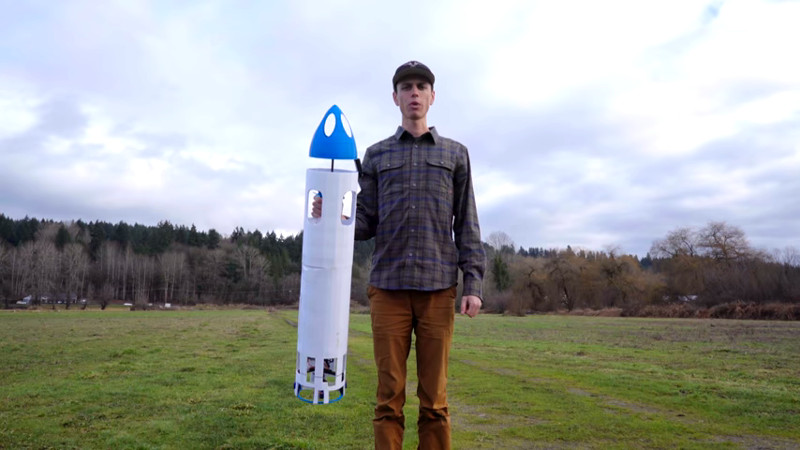
Note: This article is written for educational and editorial use. Electric R/C rockets, ducted-fan test vehicles, and VTOL experiments should be flown only in legal, controlled, open areas with appropriate safety precautions, local permissions, and respect for airspace rules. Tiny flying tubes are fun; surprise lawn darts are not.
When a Rocket Is Not Quite a Rocketbut Still Acts Like One
The phrase brushless R/C rocket sounds like something a mad scientist would scribble on a napkin after three cups of coffee and one too many SpaceX landing videos. Technically, though, many of these projects are not “rockets” in the traditional sense. A real rocket carries propellant and oxidizer, accelerates mass out of a nozzle, and does not need atmospheric air to produce thrust. A brushless R/C rocket, by contrast, usually relies on electric motors, propellers, or electric ducted fans to push air. It is more like a rocket-shaped drone or tail-sitter aircraft wearing a pointy costume.
That distinction matters, but it does not make the project less interesting. In fact, it makes it more interesting. A conventional model rocket has a dramatic but short job: launch, coast, deploy recovery, and hope it does not choose a tree as its forever home. A brushless R/C rocket has to do something much more complicated. It must take off vertically, remain controllable at low airspeed, transition into a horizontal or near-horizontal flight regime, then rotate back toward vertical flight for descent and landing. That is not just “make it fly.” That is asking a skinny cylinder to be a helicopter, an airplane, and a rocket impressionist in the same performance.
The project popularized by RCTestFlight and discussed in maker circles explored exactly this kind of mixed-mode flying. The goal was not simply altitude; it was to test different flight regimes: vertical lift, forward motion, coasting behavior, reorientation, and landing control. In plain English, the vehicle had to answer one big question: can a brushless electric craft shaped like a rocket move between very different aerodynamic states without turning into confetti?
What “Different Flight Regimes” Means in This Project
In aerospace, a flight regime is a condition or mode of flight where the physics, control strategy, and aerodynamic behavior are meaningfully different. A paper airplane gliding across a classroom lives in one simple regime. A VTOL aircraft lifting off vertically and then flying forward like a plane must survive several. That is why a brushless R/C rocket is such a good testbed: it exaggerates the awkward middle zones.
Regime 1: Vertical Takeoff and Hover
The first regime is vertical takeoff. Here, the motors must produce enough thrust to overcome weight, plus a margin for control. At this stage, aerodynamic surfaces such as fins contribute little because the vehicle is not moving fast enough through the air. Control comes mostly from differential thrust, thrust vectoring, or rapid motor response. Brushless motors are useful because they are compact, powerful, and responsive when paired with the right electronic speed controllers.
This regime is also where the vehicle exposes its biggest weakness: a rocket-like body is tall, narrow, and eager to tip over. Hovering a tube is like balancing a broom on your finger, except the broom has batteries, spinning fans, and an attitude problem. The flight controller must correct pitch, roll, and yaw quickly before a small lean becomes a dramatic exit.
Regime 2: Transition to Forward Flight
The transition phase is the spicy part. During transition, the craft pitches from vertical toward horizontal flight. Suddenly, the body begins acting less like a hovering drone and more like a moving airframe. Lift, drag, side force, and center-of-pressure effects start to matter. If the vehicle has fins or stabilizing surfaces, they gradually wake up as airspeed increases. If it relies mainly on thrust, the motors must keep working hard while the flight controller manages the rotating frame of reference.
Tail-sitter UAVs face a similar challenge. They take off like multicopters but cruise like fixed-wing aircraft. The difficult part is not either endpoint; it is the awkward handshake between them. Too slow, and the aircraft falls through its own transition. Too aggressive, and it overshoots attitude targets. Too little thrust, and gravity files a complaint.
Regime 3: Horizontal Coast or Cruise
Once the brushless R/C rocket reaches a more horizontal attitude, the vehicle enters a forward-flight or coasting regime. This is where the word “rocket” becomes even more playful. A chemical rocket coasts after burnout because it has momentum. An electric R/C rocket may coast briefly, reduce throttle, or continue powered forward flight depending on the design. Either way, the airframe now experiences a different relationship between drag and stability.
A cylindrical body is not famous for efficient cruise. It has more drag than a sleek winged aircraft and less lift than even a modest airplane wing. That means horizontal flight can demand high power for limited efficiency. Still, efficiency is not always the point. A test vehicle is built to learn. If it looks a little silly while teaching useful lessons, that is merely aerospace tradition wearing foam board.
Regime 4: Return to Vertical Attitude
The return transition is often harder than the outbound one. The craft must slow, pitch upward, and regain vertical control authority before landing. During this phase, aerodynamic forces may fight the commanded motion. If the vehicle has too much forward speed, it may resist pitching up. If it slows too quickly, control surfaces lose effectiveness. If the motors are partially blocked by the airframe, available thrust drops just when the pilot wants a calm, confident recovery.
This is where small design details become big drama. Fan placement, duct shape, inlet area, battery sag, control tuning, and center of gravity all matter. In tests of brushless rocket-like craft, builders often discover that the body can reduce available thrust by disturbing airflow into the fans. That is a classic electric ducted fan lesson: air does not care how cool the shape looks; it only cares whether it can enter and exit cleanly.
Regime 5: Vertical Descent and Landing
Finally comes vertical landing. The dream is a graceful tail-first touchdown, SpaceX style, scaled down for the park. The reality may include wobble, bounce, overcorrection, or what engineers politely call “rapid unscheduled gardening.” Landing requires fine throttle control, stable attitude, and enough thrust margin to arrest descent. If the vehicle is underpowered or airflow is blocked, the last few feet become exciting in the least relaxing way.
Why Brushless Motors Make This Possible
Modern brushless motor systems are the reason projects like this can exist outside a professional aerospace lab. A brushless motor offers high power density, fast throttle response, and relatively good efficiency. Combined with lithium-polymer batteries and compact flight controllers, it gives hobbyists access to thrust levels that would have looked magical in older R/C eras.
But motor choice is more than grabbing the biggest shiny cylinder online. Builders must think in complete power systems. A motor’s Kv rating describes approximate no-load RPM per volt, not its total usefulness. A high-Kv motor can spin fast, but without the right fan, propeller, battery, and ESC, it may produce heat instead of helpful thrust. Power is tied to voltage and current, while flight time depends on battery capacity, average current draw, and how much reserve the pilot wants to keep. In electric flight, the battery is not just fuel; it is also part of the weight problem.
For a brushless R/C rocket, thrust-to-weight ratio is critical. Hover requires thrust greater than weight. Controlled vertical acceleration requires more. Recovery from a bad attitude requires still more. That extra margin is what saves the aircraft when the wind nudges it, the battery voltage sags, or the airframe steals efficiency from the fan. A vehicle that barely hovers on a workbench may not survive real outdoor air, because real outdoor air has opinions.
The Aerodynamics: Center of Gravity, Center of Pressure, and Tube Trouble
Classic model rocket stability depends heavily on the relationship between the center of gravity and the center of pressure. In a stable model rocket, the center of gravity should sit ahead of the center of pressure, allowing aerodynamic forces to restore the nose toward the direction of travel. Fins help move the center of pressure rearward. Nose weight can move the center of gravity forward. This is why a well-built model rocket flies straight while a bare motor casing becomes a tiny chaos machine.
A brushless R/C rocket complicates that simple picture. It may fly vertically with little airflow over the fins, then transition sideways where the body suddenly produces drag and side force. During hover, stability comes mostly from active control. During forward motion, passive aerodynamic stability may help or hurt depending on the shape, speed, and attitude. In transition, the craft may be partly stabilized by thrust and partly affected by airflow. That is a messy neighborhood, and the flight controller has to live there.
The long cylindrical body also creates drag. A smooth tube can look aerodynamic from a distance, but without wings or carefully designed ducts, it is not automatically efficient. If fans are placed inside or behind the body, inlet losses can reduce static thrust. If the fan exhaust is blocked or poorly directed, thrust drops again. The result is a painful engineering truth: the same body that makes the craft look rocket-like can reduce the thrust needed to keep it rocket-like in motion.
Flight Controllers: The Quiet Heroes of the Experiment
No human pilot can manually correct every tiny attitude disturbance at the speed required for a hovering tube. That is why flight controllers matter. Gyroscopes and accelerometers detect rotation and attitude changes, while control algorithms adjust motor outputs many times per second. In a multicopter, this is routine. In a rocket-shaped VTOL craft, it becomes more experimental because the vehicle’s dynamics change dramatically across regimes.
In vertical hover, the controller thinks like a drone controller. In forward flight, it may need airplane-like logic. During transition, it needs a blended strategy or carefully tuned attitude commands. This is where open-source autopilot ideas from the VTOL and tail-sitter world become relevant. Many modern VTOL platforms use special transition logic to decide when the aircraft is acting more like a copter and when it is acting more like a plane. The brushless R/C rocket is a hobby-scale version of that same puzzle.
The best tests are usually incremental. A sensible builder does not leap from bench spin-up to heroic vertical landing on day one. The path usually goes through restrained thrust tests, hover hops, low-altitude stabilization checks, short transitions, and careful review of flight logs or video. That may sound less glamorous than “launch it and see what happens,” but glamorous wreckage is still wreckage.
Safety and Legality: The Part Nobody Should Skip
Because this project sits between model aircraft, drones, and rocket-like vehicles, safety thinking must be conservative. The exact rules depend on location, vehicle weight, propulsion type, altitude, and intended operation. In the United States, actual amateur rockets are addressed under FAA Part 101, while radio-controlled aircraft and drones may involve recreational UAS rules, community-based organization guidance, or local flying-field policies. The safest assumption is simple: do not fly near people, roads, airports, buildings, power lines, or anything you would feel bad explaining to an insurance adjuster.
Model rocketry organizations emphasize open fields, safe launch practices, stable vehicles, and proper recovery systems. Model aviation groups stress visual line of sight, safe distances from spectators, and responsible operation. NASA educational materials also underline basic precautions: check the vehicle, avoid hazardous areas, and treat even small models with respect. A brushless R/C rocket may not burn propellant, but spinning motors and falling batteries can still hurt people. Foam is friendly; kinetic energy is not.
There is also a communication issue. A rocket-shaped R/C craft may alarm bystanders even if it is electrically powered and harmlessly experimental. Clear labeling, controlled test sites, spotters, and calm procedures matter. The goal is to test flight regimes, not test how quickly a park ranger can appear from behind a tree.
What the Project Teaches About Modern Hobby Aerospace
The brushless R/C rocket is valuable because it exposes the tension between raw thrust and elegant design. With enough brushless power, many odd shapes can be made to leave the ground. That alone is not the victory. The real engineering challenge is making the craft controllable, repeatable, efficient, and safe across multiple states of flight.
It also demonstrates how hobby tools now overlap with serious aerospace concepts. VTOL transition, thrust vectoring, active stabilization, duct efficiency, center-of-pressure management, and battery power budgeting are not just textbook topics. They appear in small backyard-scale experiments, YouTube projects, university UAV research, and commercial electric aircraft development. The scale changes, but the physics keeps showing up like a strict teacher with excellent attendance.
For readers, the key takeaway is that “different flight regimes” is not fancy wording. It is the whole story. A craft that behaves well in hover may become unstable in forward flight. A body that looks sleek may starve a fan. A motor that has enough static thrust may struggle once airflow changes. A controller tuned for one mode may oscillate in another. Testing regimes separately helps builders understand the vehicle instead of merely celebrating the one flight where everything accidentally worked.
Practical Experiences and Lessons from Brushless R/C Rocket Testing
Anyone who has spent time around electric R/C experiments learns the same humbling lesson: the bench test is optimistic, the field test is honest, and the slow-motion replay is brutally honest. With a brushless R/C rocket, the first experience is usually surprise at how much thrust modern electric systems can produce. Even a small motor and fan can sound serious when spooled up. The second experience is realizing that thrust pointed in the wrong direction is not flight; it is an argument with gravity.
A useful testing habit is to separate excitement from measurement. Before thinking about vertical landing, measure static thrust, current draw, battery voltage under load, motor temperature, and control response. If the craft needs nearly full throttle just to hover, there is little reserve left for recovery. That margin matters when the vehicle tilts, when wind hits the side of the body, or when the battery voltage sags after the first climb. Many ambitious R/C projects fail not because the idea is bad, but because the power budget is written like a wish list.
Another experience is that airflow is often the invisible villain. A ducted fan that performs well in open air may lose thrust when placed inside a narrow body or behind awkward intake openings. Builders may blame the motor, ESC, or battery, when the real problem is that the fan is trying to breathe through a keyhole. Smooth inlets, clean exits, and enough open area are not cosmetic details. They are the difference between “stable hover” and “why is it sinking while screaming?”
Control tuning is equally educational. A rocket-shaped vehicle can oscillate because the controller is overcorrecting, or drift because it is undercorrecting. It may hover acceptably near the ground but become nervous higher up. It may transition forward smoothly once, then wobble on the return because airspeed and attitude are different. Video review helps tremendously. Watching a flight frame by frame can reveal whether the tail swings first, whether the nose lags, whether one motor is working harder, or whether the craft is being pushed by wind rather than poor tuning.
Landing teaches humility. A vertical takeoff feels dramatic, but vertical landing demands patience. Small throttle changes near the ground can create bounce, ground effect, or sudden attitude changes. A wider landing base, sacrificial legs, and low-altitude practice can save the airframe from becoming modern art. The best pilots treat early tests as data collection, not performance. A one-foot hover that ends safely is more valuable than a high climb that ends with parts distributed like confetti at a parade.
The most rewarding experience is the moment the vehicle moves through regimes intentionally. It lifts, pitches, travels forward, slows, rotates back, and settles. Even if the motion is not perfect, it proves the concept. The fun is not just that a brushless R/C rocket flies. The fun is watching a homemade machine negotiate several different versions of flight in one short mission. That is the sweet spot where hobby building, aerospace learning, and good old-fashioned tinkering meet.
Conclusion: A Small Vehicle with Big Engineering Lessons
Brushless R/C Rocket Tests Different Flight Regimes is more than a catchy maker headline. It captures a fascinating corner of modern electric flight where drones, model rockets, VTOL aircraft, and experimental engineering overlap. The project shows how brushless motors and flight controllers can make strange airframes fly, but it also shows why thrust alone is not enough. Stability, airflow, transition logic, power margin, and safety planning all matter.
Calling it a rocket may be technically debatable, but the nickname works because the project borrows the visual drama of rocketry while using the control tools of electric aviation. That hybrid identity is exactly why it is so educational. It reminds us that flight is not one problem. It is a collection of problems that change with speed, attitude, airflow, and power. Build carefully, test slowly, respect the rules, and keep the broomstick-with-motors jokes handy. In experimental R/C aviation, a sense of humor is not optional equipment.