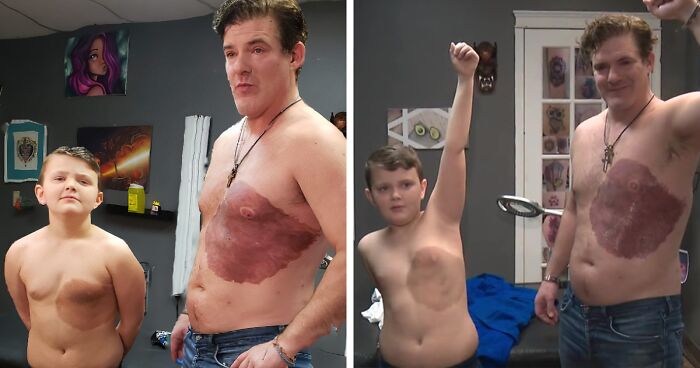
Some dads build treehouses. Some dads coach Little League. And some dads look at a problem, walk into a tattoo studio, and say, “You know what? Let’s solve this with pain, patience, and a very committed chest piece.” That, in a nutshell, is why this story took off online.
The viral headline about a father sitting for 30 hours to copy his 8-year-old son’s birthmark sounds like internet bait written by an overcaffeinated poet. But behind the dramatic wording is a genuinely moving act of support. The dad, Derek Prue Sr. of Alberta, decided to get a tattoo replicating the large birthmark on his son Derek Jr.’s torso after noticing the boy had become increasingly self-conscious about it, especially when swimming. What followed was not a spur-of-the-moment ink adventure. It was a long, painful, carefully executed process that reportedly took about 30 hours over six to eight weeks.
And that is exactly why the story landed so hard. It was not really about tattoos. It was about solidarity. It was about a parent saying, in the loudest visual language possible, “You are not the only one.” In an age when so many viral stories disappear faster than a New Year’s resolution by January 4, this one stuck around because it tapped into something timeless: a child’s fear of feeling different, and a parent’s willingness to carry part of that burden.
Why This Matching Tattoo Story Resonated So Strongly
At first glance, the story seems almost unbelievably cinematic. A boy feels shy about a visible mark on his body. His father quietly decides to recreate it on himself. He endures session after session under the tattoo needle. Then he reveals the finished work while the child is at a pool, the very place where that insecurity had been most obvious. If a screenwriter pitched that in a meeting, somebody would probably say, “Great, but maybe tone it down a little.”
But real life occasionally outdoes fiction, and this is one of those times.
What makes the story especially powerful is that the father did not try to erase the birthmark, hide it, or speak over his son’s feelings with generic motivational slogans. He did something more effective. He joined him. That subtle difference matters. Children often do not need a lecture on confidence nearly as much as they need proof that the adults around them are not ashamed of what makes them unique.
There is also something deeply human about the tattoo itself. A name tattoo is meaningful. A birthday tattoo is sweet. A tattoo that intentionally mirrors a child’s visible difference is a whole different category. It is not decorative. It is relational. It says the point is not how the body looks; the point is who gets loved inside it.
Birthmarks Are Common, But Feelings About Them Can Be Complicated
One reason this story struck such a nerve is that birthmarks are common, but confidence around them is not automatic. Dermatology and pediatric resources consistently explain that birthmarks come in many shapes, colors, and sizes. Some are flat, some are raised, some fade, and some stay for life. They are generally divided into vascular birthmarks, which involve blood vessels, and pigmented birthmarks, which involve skin pigment. In many cases, they are harmless. In some cases, doctors keep an eye on them because certain types may need evaluation or treatment.
That clinical reality is important, but it is only half the conversation. The other half is emotional. A mark can be medically harmless and socially complicated at the same time. That is especially true for children, who are still learning how to see themselves through their own eyes instead of everybody else’s.
An adult may see a birthmark and think, “That is simply part of a person’s appearance.” A child may see the same mark and think, “This is the thing people notice first.” That gap matters. It helps explain why a birthmark that seems easy to accept on paper can still become a source of anxiety in locker rooms, pools, classrooms, and photos.
Visible differences do not automatically create shame. Kids are not born analyzing their torso like disappointed fashion editors. Shame usually creeps in through reactions, comparisons, and the slow realization that looking different can attract attention. Once that happens, confidence can become fragile in a hurry.
Why the Pool Scene Matters More Than It Seems
The detail about Derek Jr. not wanting to remove his shirt while swimming is one of the most revealing parts of the story. Pools are not just pools when you are a kid. They are social stages. They are places where bodies are suddenly more visible, more comparable, and more open to comments, even when nobody means harm.
That is why the father’s reveal at the pool was more than a sweet surprise. It was smart symbolism. He chose the place where his son felt most exposed and transformed it into the place where he felt less alone. That is good parenting with dramatic timing. Frankly, Hollywood should take notes.
Children remember moments like that. Not because they are viral, but because they rearrange the meaning of a memory. A pool had become a place of discomfort. Then it became the setting for reassurance. That emotional rewrite may be one of the most valuable things this dad gave his son.
The Pain Was Part of the Message
Another reason the story grabbed attention is simple: 30 hours is a lot. Thirty hours is not “I popped into a tattoo shop after lunch” energy. Thirty hours is “this man basically turned empathy into a part-time job” territory.
Reports about the tattoo described it as painful not only because of the size, but because of where it sat on the torso. The tattoo had to be scaled to the father’s body so it would proportionally match the son’s birthmark. In other words, this was not symbolic in the abstract. It was intentionally specific. The father wanted it to look right. That level of care matters because it communicates seriousness. He was not making a vague tribute. He was reproducing something meaningful with precision.
And pain, in this case, becomes part of the emotional logic of the story. Parents regularly tell children, “I’d do anything for you.” This dad essentially turned that phrase into body art. He did not merely say acceptance matters. He sat through enough discomfort to prove it.
What This Story Says About Parenting and Self-Esteem
Parenting experts and self-esteem researchers have long pointed out that children build confidence not just from what parents say, but from what parents model. Kids are astonishingly good at detecting what adults really believe. If a parent treats visible differences like something awkward, children notice. If a parent treats them like a normal part of being human, children notice that too.
Recent family and body-confidence coverage has also emphasized that body image concerns can begin surprisingly early. That may sound alarming, but it is also clarifying. It reminds parents that self-esteem is not a switch that flips on in the teenage years. It is built gradually, conversation by conversation, reaction by reaction, joke by joke, compliment by compliment.
That is what makes Derek Prue Sr.’s decision so compelling. He did not wait until his son was older and more firmly shaped by insecurity. He intervened while the story his son was telling himself was still being written. And he did it with action, not just advice.
In a strange way, the tattoo works because it bypasses the usual parental script. Instead of saying, “Don’t worry about what people think,” he showed, “I care enough to stand with you in a way people can see.” For a child, that kind of visible loyalty can be more persuasive than a hundred pep talks.
This Was About More Than a Viral Dad Moment
Stories like this often get flattened into internet shorthand. Best dad ever. Faith in humanity restored. Somebody hand this man a trophy. Those reactions are understandable, but they miss the deeper point. This was not just a feel-good parenting stunt. It was a real-world example of what emotional protection can look like when it is tailored to a child’s actual fear.
There is also a broader cultural reason people responded so strongly. We live in a time of relentless image management. Filters, edits, angles, glow-ups, and unspoken beauty rules are everywhere. Against that backdrop, a parent saying, “I will copy the thing you feel insecure about so you can see it differently,” feels almost rebellious. It rejects the whole idea that love should only gather around polished, idealized bodies.
That is what gives the story staying power. It is not sentimental fluff. It quietly challenges the assumption that anything visually different must be corrected, concealed, or apologized for.
What Parents Can Learn From This Without Booking a Tattoo Appointment
Most parents are not going to walk into a tattoo studio tomorrow and request a matching chest piece for moral support. Fair enough. Needles are not everybody’s preferred love language. But the lesson of this story does not depend on copying the exact gesture.
The real takeaway is that children benefit when parents respond to visible differences with calm, practical acceptance. That might mean not overreacting to a birthmark. It might mean avoiding language that frames appearance as a problem to solve. It might mean helping a child answer questions from peers without embarrassment. It might mean praising courage, humor, creativity, and kindness more often than looks.
It also means taking the child’s feelings seriously. Telling a kid, “It’s no big deal,” may be meant as reassurance, but it can backfire if the child already feels vulnerable. A better message is, “I can see this bothers you sometimes, and I’m with you.” That is the emotional equivalent of the tattoo: not denial, but companionship.
Related Experiences: Other Parents Who Used Tattoos and Visible Solidarity to Support Their Kids
Derek Prue Sr.’s story is powerful, but it is not completely alone. Over the years, several other parents have made similar choices, using tattoos to mirror scars, marks, or medical differences that made their children feel singled out. Together, these stories show a pattern: when a child feels isolated by what they carry on their body, some parents try to carry a version of it too.
One widely shared example involved a Kansas father who got a tattoo to match his young son’s surgery scar after the child underwent treatment related to brain cancer. The idea was simple but profound: if the boy had to live with a visible reminder of a hard medical experience, his father would choose to wear one as well. The gesture was not about making the scar disappear. It was about reframing it as something that did not need to be hidden.
Another case featured a Missouri father who got a tattoo replicating his son’s burn scars after a serious accident left the child with permanent marks on his leg and foot. The father’s reasoning echoed Derek Prue Sr.’s. He wanted his son to feel less alone, less watched, and less defined by what had happened to him. Once again, the tattoo functioned as a bridge, not decoration. It turned sympathy into visible participation.
More recently, a New Jersey dad made headlines after getting a tattoo of his baby son’s heart surgery scars across his own chest. That story carried a slightly different emotional tone because the child was still very young, but the motivation was familiar. The father described wanting his son to grow up and see that his body was not strange, shameful, or separate from the people who loved him most. He essentially said, “I want to wear what he wears.” That line explains a lot about why these stories resonate. They are not really about ink. They are about shared burden.
Even beyond tattoos, parents have long found ways to mirror their children’s visible differences. Some shave their heads when a child loses hair during cancer treatment. Some adapt clothing, language, routines, or family rituals so a difference feels normalized rather than spotlighted. The methods vary, but the emotional strategy is the same: reduce isolation, increase belonging.
That is why Derek Prue Sr.’s tattoo landed with so many readers. It belongs to a larger family of stories in which parents answer insecurity with presence, not pity. And that may be the most lasting part of all this. The matching birthmark tattoo is memorable, yes. But what people are really responding to is the deeper promise behind it: whatever marks life puts on you, you do not have to wear them alone.
Conclusion
“Dad Sits For 30 Hours Straight To Get Identical Tattoo To His 8-Year-Old’s Birthmark” is the kind of headline that stops people mid-scroll, but the reason it endures is more meaningful than shock value. It captures a rare kind of parenting gesture: visually bold, emotionally intelligent, and rooted in the simple desire to make a child feel safe in his own skin.
Birthmarks are common. Childhood self-consciousness is common too. What is uncommon is seeing a parent respond with this level of creativity and commitment. Derek Prue Sr. did not just get a tattoo. He offered his son a new reflection to look at. One that said difference is not a flaw, love can be visible, and confidence sometimes starts when somebody decides to stand beside you in the most literal way possible.
That is why this story still works. It is not merely about a father, a birthmark, or 30 punishing hours in a tattoo chair. It is about the extraordinary power of being matched where you once felt alone.