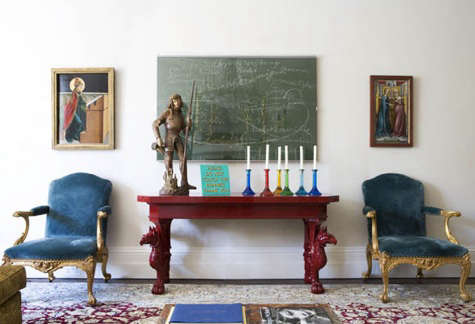
Step into Marianna Kennedy’s London world and you quickly understand that “designer visit” is too modest a phrase. This is not a quick peek at a polished showroom where everything behaves itself. It is more like walking into a jewel box that has read poetry, studied old craft manuals, learned to gild, and then decided to throw a very elegant party in Spitalfields. Kennedy’s work sits at the deliciously unusual crossroads of art, interiors, history, color, and handcraft. Her lamps glow like boiled sweets for grown-ups. Her mirrors feel part medieval, part futuristic, and part secret passage. Her tables and decorative objects are made with a seriousness of craft that still manages to wink at you from across the room.
Based in London’s historic Spitalfields, Marianna Kennedy has built a reputation as an artist and designer who reimagines traditional forms through modern color, rare materials, and meticulous techniques. Her studio is known for resin lamps, gilded and carved mirrors, lacquered tables, bookcloth blinds, horsehair shades, candlesticks, and sculptural pieces that feel both old and new. That tension is exactly the magic. Nothing looks mass-produced. Nothing looks like it arrived by accident in a cardboard box marked “generic luxury.” Kennedy’s pieces have fingerprints, personality, and a sense of theatrical intelligence.
Who Is Marianna Kennedy?
Marianna Kennedy is a London-based artist and designer whose work is closely associated with Spitalfields, an area of East London known for its layered history, Huguenot houses, markets, workshops, and creative energy. Originally from Canada, Kennedy has long lived and worked in London, where she has developed a practice that moves gracefully between furniture, lighting, mirrors, decorative objects, and exhibition-scale art pieces.
What makes Kennedy’s work especially compelling is her refusal to choose between beauty and intellect. Her designs are not simply “pretty things,” although they are often extremely pretty. They are studies in material memory. Resin is not just resin; it becomes a glowing column of color. A mirror is not just a reflective surface; it becomes a sculptural object with echoes of Renaissance frames, Venetian glass, bronze patina, and old-world gilding. A blind is not just a practical window covering; in Kennedy’s hands, bookcloth becomes a soft filter for light, turning an ordinary window into a quiet color experiment.
A London Studio Rooted in Spitalfields
Spitalfields is not merely a backdrop for Kennedy’s work. It is part of the vocabulary. The neighborhood’s 18th-century architecture, craft history, and sense of lived-in eccentricity appear to feed her imagination. Her home, workshop, and showroom have been described as a place where domestic life and artistic production overlap. That overlap matters because Kennedy’s designs do not feel like objects conceived in isolation. They feel tested by rooms, stairs, windows, fireplaces, shadows, and daily rituals.
This is one reason her interiors have such atmosphere. A Marianna Kennedy lamp does not simply sit on a table. It converses with paint, books, old floorboards, glass panes, and the particular gray-gold light of London. Her mirrors do not flatten a wall; they activate it. The result is an interior language that feels layered without being cluttered, historic without being dusty, and colorful without behaving like a circus tent that has misplaced its ringmaster.
The Signature Look: Ancient Craft, Modern Color
Kennedy’s work is often described through contrasts: ancient and modern, refined and playful, rigorous and whimsical, decorative and sculptural. These contrasts are not contradictions. They are the engine of her style.
Resin Lamps That Glow Like Modern Heirlooms
Among her most recognizable pieces are hand-polished resin lamps. Available in vivid tones such as pink, red, yellow, amber, green, blue, turquoise, purple, black, and clear, these lamps have become modern design favorites because they offer color without apology. They are cheerful, but not childish. Elegant, but not stiff. Their forms are often simple enough to live comfortably in traditional rooms, yet their saturated color gives them a contemporary charge.
The Spring Lamp, Trumpet Lamp, Beanpole Lamp, Tulip Lamp, Candle Lamp, and Flying Saucer Lamp each bring a slightly different mood. The Spring Lamp is perhaps the most approachable: tall, slim, polished, and lively. It is the kind of piece that can wake up a bedside table faster than a double espresso. In a restrained room, one resin lamp becomes punctuation. In a colorful room, it becomes part of the orchestra.
Bookcloth Blinds and Shades
Kennedy’s use of bookcloth for lampshades and blinds is one of those design ideas that feels obvious only after someone brilliant has already done it. Bookcloth, traditionally used in binding books, has texture, color depth, and a soft ability to diffuse light. On a window, it creates a glow that is warmer and more nuanced than standard roller shades. On a lamp, it brings a tactile quality that makes the object feel crafted rather than assembled.
The idea is especially charming because it links domestic design to the world of books, libraries, and handwork. Instead of treating fabric as decoration alone, Kennedy treats it as a material with cultural memory. A bookcloth blind suggests reading rooms, archives, artists’ studios, and afternoons when the light behaves itself beautifully for once.
Mirrors with Sculptural Presence
Kennedy’s mirrors are among her most ambitious works. They often use carved frames, gilding, bronze, colored glass, and historical references. Pieces such as the Fetters of Gold series, Rosebud Mirror, Carmine Mirror, Rose Mirror, Convex and Concave Mirrors, and other sculptural works show her interest in reflection as both function and metaphor.
A Kennedy mirror does more than help you confirm that your hair has made a questionable decision. It changes the architecture of a room. The frame becomes sculpture. The glass becomes color. The reflection becomes part of the composition. In many interiors, mirrors are treated as supporting actors. Kennedy’s mirrors arrive fully prepared for the lead role.
Why Designers Love Her Work
Interior designers are drawn to Marianna Kennedy’s pieces because they solve a difficult problem: how to add individuality without creating chaos. Her work has enough character to make a room memorable, but enough craft and proportion to sit comfortably among antiques, contemporary art, patterned fabrics, modern furniture, and architectural details.
In high-end interiors, the challenge is often not finding expensive objects. That part is easy. The harder task is finding objects with soul. Kennedy’s work offers that rare quality. A resin lamp can loosen up a formal room. A gilded mirror can add ceremony to a plain wall. A bookcloth shade can make a practical element feel intentional. Her pieces carry the mark of human decision-making: color chosen carefully, surfaces finished by hand, historical forms reconsidered rather than copied.
The Art of Limited Production
One of the most important things to understand about Marianna Kennedy’s practice is that it resists the logic of endless availability. Many pieces are produced in small numbers or as special commissions. This matters because limited production changes the emotional value of an object. It is not just something you buy; it is something you encounter.
In a world where interiors can be duplicated with a few clicks, Kennedy’s approach feels refreshingly human. Her work reminds us that rooms become more interesting when they include objects with stories, irregularities, and deep material intelligence. The luxury is not only in the finish. It is in the time.
Recent Exhibitions and Growing Recognition
Kennedy’s work has moved beyond domestic interiors into the realm of collectible design and art exhibitions. Her exhibitions have highlighted her interest in old techniques, especially gilding, patination, bronze, carved frames, and the poetic transformation of materials. The exhibition Invincible Truth at Fondazione Giorgio Cini in Venice presented her work in a historic cultural setting. Hortus Alchemicus at Fondazione Luigi Rovati in Milan explored patination, bronze mirrors, and the connection between ancient materials and contemporary design. More recently, Supersonic Mediaeval, curated by Tilda Swinton at Christie’s Paris, brought fresh attention to Kennedy’s practice and its unusual blend of historical resonance and modern energy.
The phrase “supersonic mediaeval” is especially useful because it captures what many people feel when they see Kennedy’s work. Her objects seem to travel through time without asking permission. They nod to castles, libraries, Venetian palazzi, Georgian houses, alchemy, folk ornament, and modern color theory, yet they never collapse into pastiche. They are not reproductions. They are reinventions.
How to Bring the Marianna Kennedy Mood Into Your Own Home
Not everyone can commission a hand-carved gilded mirror or place a bronze lamp beneath a horsehair shade, but the Kennedy spirit is surprisingly adaptable. The lesson is not to copy her work. The lesson is to think more deeply about color, craft, and material contrast.
Use Color as an Accent With Confidence
Kennedy’s resin lamps show that one bold color can transform a room. Try adding a single saturated object: a lamp, vase, cushion, painted chair, or lacquered tray. The trick is to make it deliberate. A flash of turquoise or amber works best when it feels chosen, not abandoned by a rainbow in a hurry.
Mix Old and New Without Apologizing
Kennedy’s rooms often feel timeless because they refuse to obey one strict period. A modern resin lamp can sit near an antique table. A gilded mirror can hang above a simple mantel. A historic room can handle contemporary color. In fact, it often benefits from it.
Choose Materials With Texture
Smooth surfaces alone can make a room feel flat. Add materials with depth: bookcloth, horsehair, linen, bronze, patinated metal, carved wood, lacquer, handmade paper, or colored glass. Texture is the quiet ingredient that makes an interior feel rich even before anyone knows why.
Let Functional Objects Be Beautiful
A window blind, lampshade, candlestick, or mirror does not have to be boring simply because it has a job. Kennedy’s work is a reminder that practical pieces can carry artistry. If an object must exist in your room, it might as well bring something to the conversation.
Designer Visit Experience: Seeing London Through Marianna Kennedy’s Lens
A visit inspired by Marianna Kennedy’s London is not just about looking at beautiful objects. It is about learning to notice the relationship between craft, place, and atmosphere. Imagine beginning in Spitalfields on a cool morning, when the old brick buildings still hold the night air and the market is waking up with coffee steam, flower buckets, and the shuffle of people pretending they are not already thinking about lunch. This is the kind of neighborhood where history does not sit behind glass. It leans out of windows, hides in staircases, and appears in worn thresholds.
Walking through Spitalfields with Kennedy’s work in mind, you start to understand why her designs feel so layered. The area itself is a collage: Huguenot houses, Georgian proportions, modern shops, artists’ studios, restored facades, and unexpected color. A carved mirror suddenly seems less like an isolated object and more like a response to a city where every surface has lived several lives. A resin lamp begins to feel like a bright modern note placed against centuries of soot, stone, and timber.
The most rewarding experience is to look slowly. Notice how London light behaves. It is rarely obvious. It slips through windows, bounces off pale walls, softens strong colors, and makes reflective surfaces feel alive. This helps explain the power of Kennedy’s bookcloth blinds and colored glass. They are not merely decorative. They manage light. They turn it into mood. In an ordinary room, a blind blocks the outside world. In Kennedy’s vocabulary, a blind edits the day.
For design lovers, the practical lesson is simple: visit rooms as if they are conversations, not showrooms. Ask what each object is doing. Is it adding warmth? Creating contrast? Holding memory? Providing humor? Kennedy’s best pieces seem to answer several of these questions at once. A lamp brings illumination, but also color and silhouette. A mirror reflects, but also frames, distorts, and dramatizes. A lacquered table offers a surface, but also a small stage for flowers, books, or the daily theater of misplaced keys.
Another experience worth borrowing from Kennedy’s world is the joy of restraint within richness. Her interiors are colorful, but not careless. They are filled with special objects, yet they still allow space around them. This is a useful reminder for anyone decorating a home: personality does not require overcrowding. Sometimes one extraordinary lamp can do more than five nervous accessories huddled together on a console table, looking as if they are waiting for instructions.
Finally, a Marianna Kennedy-inspired London visit encourages patience. Her work celebrates slow processes: carving, gilding, polishing, patinating, finishing, adjusting, and refining. In a culture obsessed with instant makeovers, that patience feels almost radical. Rooms do not need to be completed overnight. They can mature. They can collect evidence of taste, travel, mistakes, discoveries, and small acts of bravery. Add one vivid lamp. Frame one odd little drawing. Paint one chair a color that makes your sensible relatives nervous. Let your home become a place where past and present meet, shake hands, and perhaps share a very stylish cup of tea.
Conclusion
Marianna Kennedy’s London practice proves that collectible design does not have to be cold, predictable, or trapped inside a museum whisper. Her work is alive with color, craft, and historical imagination. From resin lamps and bookcloth blinds to gilded mirrors and bronze sculptural pieces, Kennedy creates objects that feel both deeply rooted and wonderfully unexpected. Her Spitalfields world reminds us that interiors are at their best when they combine beauty with intelligence, function with poetry, and tradition with a little electricity.
For anyone searching for inspiration, the lesson is not simply to admire Kennedy’s designs from afar. It is to adopt her way of seeing. Look harder at materials. Give color a real job. Choose handmade things when possible. Let old forms become new again. Above all, make rooms that feel personal enough to be remembered. A Marianna Kennedy piece does not merely decorate a space; it gives the room a pulse.