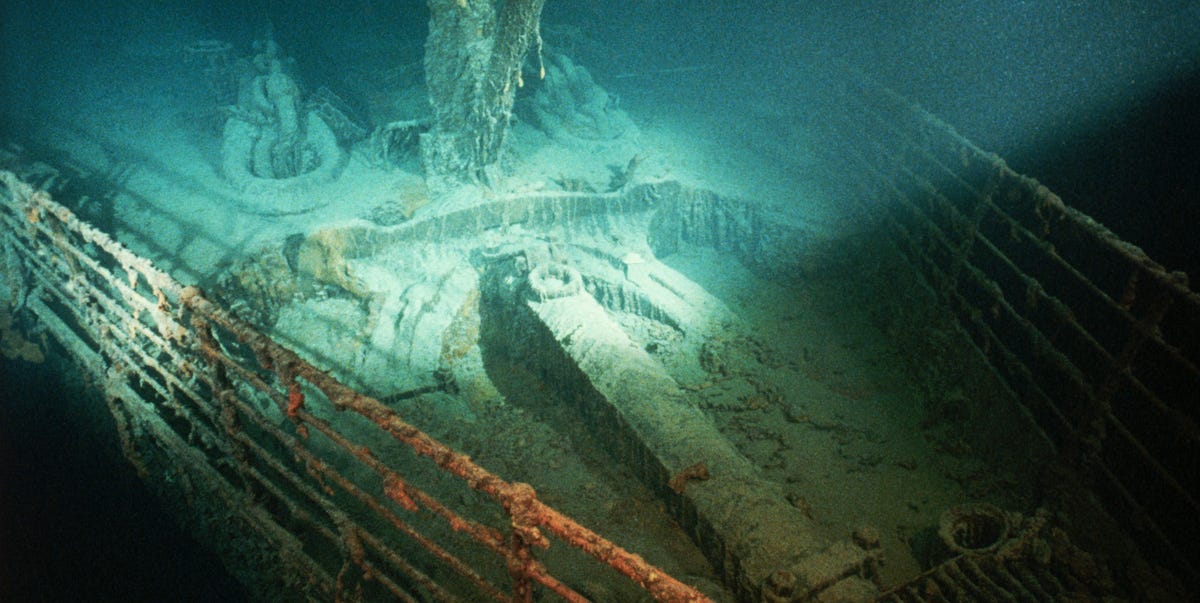
When people hear the word “Titanic,” they usually picture a moonlit iceberg, a grand staircase, and a violin section having the worst gig of all time. But the Titanic had a younger sister with a story almost as dramatic, far less famous, and somehow even more mysterious. Her name was HMHS Britannic, and today she rests on her starboard side in the blue depths of the Aegean Sea, near the Greek island of Kea.
Recently, the Britannic has returned to headlines because divers explored the wreck and recovered artifacts for the first time in more than a century. That is not a casual “grab your snorkel and let’s look around” situation. The wreck lies about 390 feet below the surface, a depth where sunlight fades, pressure becomes a bully, and every minute has to be planned with the precision of a moon landing. The result is one of the most fascinating underwater archaeology stories of modern times.
The Titanic’s Sister Ship That Never Became a Luxury Legend
Britannic was the third Olympic-class liner built for the White Star Line, following RMS Olympic and RMS Titanic. She was constructed by Harland and Wolff in Belfast, the same shipyard responsible for her famous siblings. In another timeline, Britannic might have carried wealthy travelers across the Atlantic in floating-palace style, complete with elegant dining rooms, grand public spaces, and enough polished wood to make a carpenter weep with joy.
But history had other plans. Britannic was launched in 1914, just as World War I was changing Europe. Instead of entering glamorous transatlantic service, she was requisitioned by the British Admiralty and converted into a hospital ship. Her hull was painted white, marked with large red crosses and green bands, and she was renamed HMHS Britannic: His Majesty’s Hospital Ship.
Her mission became humanitarian rather than luxurious. She transported sick and wounded soldiers from the Mediterranean back toward Britain. The ship that had been designed to represent comfort, speed, and status became a floating medical lifeline.
Why Britannic Was Supposed to Be Safer Than Titanic
After the Titanic disaster in 1912, ship designers did not simply shrug and say, “Well, that was unfortunate.” Britannic was modified with improved safety features. She had a double hull in key areas, more lifeboats, and watertight compartments that were intended to give her better survival odds if disaster struck.
In theory, Britannic was the safer sister. She was larger than Titanic, better protected, and equipped with lessons learned from one of the most infamous maritime disasters in history. Unfortunately, the sea has a rude habit of ignoring human confidence. On November 21, 1916, while traveling through the Kea Channel in the Aegean Sea, Britannic struck a naval mine.
The explosion tore into her starboard side. Water rushed in. Open portholes and internal flooding worsened the situation. Captain Charles Bartlett tried to beach the ship on Kea, but Britannic sank in about 55 minutes. Titanic had taken roughly two hours and forty minutes to disappear beneath the North Atlantic; Britannic went down much faster.
A Tragedy, But Not Another Titanic
Despite the speed of the sinking, the loss of life was far smaller than Titanic’s. More than 1,000 people were rescued, while 30 died. The most heartbreaking detail is that many of those deaths occurred when lifeboats were pulled into the ship’s still-turning propellers. In the chaos of evacuation, two lifeboats were launched too soon and drifted into deadly danger.
That haunting image explains why Britannic remains more than a shipwreck. She is a war grave, a medical history site, a feat of engineering, and a cautionary tale about how even improved technology can be overwhelmed by timing, circumstance, and human error.
Where Is the Britannic Wreck Today?
Britannic lies near Kea, about 45 miles southeast of Athens. Unlike Titanic, which rests more than two miles deep in the North Atlantic, Britannic sits at a depth reachable by elite technical divers. That does not mean the dive is easy. At around 390 feet, Britannic is far beyond recreational scuba limits.
The ship rests mostly intact on her starboard side. Her immense hull, cranes, deck structures, and interior spaces still reveal the shape of a giant early twentieth-century liner. For divers, the sight is almost surreal: a Titanic-class ship lying in clear Aegean water, close enough to explore but deep enough to demand absolute respect.
This combination is what makes Britannic legendary in the diving world. Titanic is too deep for ordinary diving and requires submersibles. Britannic, however, sits in that dangerous middle zone where skilled divers can visit, but only with advanced training, complex gas planning, rebreathers, support teams, and nerves made of reinforced steel.
Jacques Cousteau and the Rediscovery of Britannic
The wreck remained lost for decades after the sinking. In 1975, legendary ocean explorer Jacques Cousteau located Britannic using sonar. His team later explored the site, helping bring the forgotten sister ship back into public memory.
Cousteau’s discovery changed Britannic from a footnote in Titanic history into a major underwater archaeology site. The wreck became a magnet for historians, filmmakers, technical divers, and maritime researchers. Each expedition added pieces to the puzzle: how the ship sank so quickly, what condition the wreck was in, and how the structure was changing over time.
Unlike many shipwrecks that collapse into debris fields, Britannic remains dramatically recognizable. That makes exploration both scientifically valuable and emotionally powerful. Divers are not just looking at scattered metal. They are hovering beside one of the largest passenger liners ever built, frozen in the posture of disaster.
The Recent Dive That Brought Britannic Back Into the News
In 2025, an 11-member deep-sea diving team carried out a weeklong recovery operation at the Britannic wreck site under Greek supervision. The mission retrieved artifacts including the ship’s bell, a navigation light, binoculars, ceramic tiles from the Turkish baths, trays, and cabin-related objects. These items are being conserved and are expected to be displayed in Greece’s developing underwater antiquities museum.
That recovery matters because it was the first successful artifact retrieval from Britannic since she sank. For more than a century, the ship had remained largely untouched. Removing objects from a wreck like this is not treasure hunting in the pirate-movie sense. Nobody is kicking open a chest and yelling, “Gold!” while a parrot gives legal advice. The goal is preservation, documentation, and public education.
Artifacts from Britannic help tell a richer story. A bell is not just a bell; it is a voice from a vanished ship. A navigation light speaks to the vessel’s movement through wartime waters. Tiles from the Turkish baths remind us that Britannic began as a luxury liner, not a hospital ship. Each object connects the practical, human, and elegant sides of the ship’s identity.
Why Diving Britannic Is So Difficult
At nearly 400 feet deep, Britannic presents serious technical challenges. Divers often use closed-circuit rebreathers, which recycle breathing gas and produce fewer bubbles than traditional open-circuit scuba. This can reduce disturbance inside the wreck and allow more efficient use of gas during long, deep dives.
But the risks are significant. Depth increases pressure dramatically. Breathing gas must be carefully mixed to avoid oxygen toxicity, nitrogen narcosis, and other life-threatening problems. Divers also need long decompression stops during ascent. A short visit to the wreck can require hours of staged return to the surface.
Currents, low visibility, equipment complexity, cold stress, and mental fatigue all add to the difficulty. At that depth, a small mistake can grow up very quickly, put on a hat, and introduce itself as a crisis. That is why Britannic is often described as one of the great challenges of technical wreck diving.
What Divers Actually See Underwater
Accounts from divers describe a scene that is both grand and ghostly. The ship is enormous, and the clear water around Kea can make the wreck appear suddenly from the blue like a steel mountain. Railings, davits, cranes, and sections of deck equipment still give the impression of a working vessel paused in time.
Inside and around the wreck, divers may encounter objects that reveal different chapters of the ship’s life: medical fittings, luxury-era design elements, structural machinery, and debris shaped by the explosion and sinking. The scale can be disorienting. A diver is tiny next to Britannic, like a housecat inspecting an aircraft carrier.
The experience is not only visual. It is historical. Divers know they are visiting a place where nurses, doctors, crew members, soldiers, and sailors once moved with urgency. The ship is beautiful, but it is not merely scenery. It is a memorial.
Britannic vs. Titanic: Why the Sister Ship Matters
Britannic is often introduced as “Titanic’s sister ship,” which is accurate but slightly unfair. She deserves her own spotlight. Titanic represents peacetime luxury, overconfidence, and tragedy. Britannic represents wartime service, medical duty, survival, and the complicated legacy of a ship designed for one life but forced into another.
The two wrecks also tell different preservation stories. Titanic lies in deep, cold Atlantic darkness and is deteriorating under natural processes. Britannic rests in warmer, shallower water, more accessible to divers, but still exposed to corrosion, biological growth, and structural stress. Both are fragile. Both need careful management.
The recent artifact recovery underscores a larger question in maritime archaeology: how do we balance preservation in place with the need to rescue objects before they decay? Leave everything untouched, and some artifacts may vanish. Recover too aggressively, and a wreck can lose context. The best work happens in the careful middle, where documentation, conservation, ethics, and respect guide every decision.
The Human Side of the Britannic Story
Shipwrecks can become numbers: tonnage, depth, date, casualty count. Britannic pushes back against that. She carried nurses who had volunteered for difficult wartime service. She carried crew members who knew the sea but could not control the mine beneath it. She carried medical staff prepared to care for others, only to become survivors themselves.
The survival rate was remarkable, but the deaths were no less tragic. The lifeboat accident involving the propellers remains one of the most chilling parts of the sinking. It shows how disaster is rarely one event. It is a chain: explosion, flooding, movement, decisions, timing, panic, rescue. Break one link and history might change. Leave one porthole closed, stop one engine sooner, delay one lifeboat launch, and perhaps more lives are saved.
That complexity is why Britannic still fascinates historians. Her story is not a simple repeat of Titanic. It is a different disaster with its own engineering lessons, wartime context, and moral weight.
Why the 2025 Artifact Recovery Is Important
The recovered objects give museums a way to tell Britannic’s story beyond photos and diagrams. Visitors may not understand a 53,000-ton liner at first glance, but they can understand a bell, a lamp, a tile, or a pair of binoculars. Small things make enormous history feel human-sized.
The conservation process is also crucial. Objects that spend more than a century underwater cannot simply be polished and placed in a display case. Salt, corrosion, marine growth, and material weakness must be handled carefully. Conservation can take months or years. The goal is not to make artifacts look brand-new, but to stabilize them so future generations can study and appreciate them.
For Greece, Britannic is part of a broader underwater cultural landscape. The Aegean Sea is rich with ancient and modern wrecks, from classical trade ships to wartime losses. Bringing Britannic artifacts into a museum setting helps connect World War I history with maritime archaeology and public education.
Experiences Related to Exploring Britannic
To understand why divers are drawn to Britannic, imagine preparing for a dive where the destination is not a reef, a cave, or a small wreck, but a massive ocean liner from the Titanic family. The planning begins long before anyone touches the water. Gases must be calculated. Equipment must be checked again and again. Backup systems are prepared because at 390 feet, “Oops” is not a strategy.
On the boat, the mood is usually focused rather than casual. Divers review roles, timing, descent procedures, emergency signals, and decompression plans. There is excitement, of course, but it is wrapped tightly in discipline. Nobody wants to be the person who forgets a critical clip, valve check, or timing mark before visiting one of the most demanding wrecks in the world.
The descent can feel like entering another century. The surface noise fades. The blue deepens. Light thins. Then, slowly, a shape appears below: first a shadow, then a wall, then the unmistakable form of a giant ship. Britannic does not look like a small wreck scattered across sand. She looks like architecture. A diver approaching her hull can feel the same awe someone might feel standing at the base of a cathedral.
But awe must share space with caution. Bottom time is limited. Every movement matters. Divers may document specific sections, photograph artifacts, inspect structural features, or follow a planned route along the exterior. Penetration into the wreck, when permitted and professionally planned, requires even stricter control. Silt, tight passages, fragile interiors, and depth make the environment unforgiving.
The emotional experience can be surprisingly strong. A diver may pass a railing once touched by crew, a davit linked to the lifeboats, or a section that hints at the ship’s hospital service. It is easy to think of Britannic as Titanic’s sibling, but underwater she becomes herself: not a supporting character, not a sequel, but a complete story lying in silence.
The ascent is often longer than the visit. Divers leave the wreck behind and begin staged decompression, stopping at set depths while the body safely releases absorbed gases. This can take hours. During that time, the mind replays images from below: the huge hull, the pale light, the strange stillness, the knowledge that history was not read in a book that day but seen face to face.
For non-divers, the lesson is still powerful. Exploration is not only about reaching rare places. It is about returning with greater understanding. Britannic teaches that shipwrecks are not just disasters; they are archives. They hold design choices, personal stories, wartime pressures, and unanswered questions. The divers who explore her are not simply adventurers. At their best, they are careful witnesses.
Conclusion
The story of divers exploring the Titanic’s incredible sunken sister ship is more than an underwater adventure. HMHS Britannic was a luxury liner transformed into a hospital ship, a safer sister vessel lost to war, and now one of the most remarkable intact shipwrecks on Earth. Her rediscovery by Jacques Cousteau, continued exploration by technical divers, and recent artifact recovery have brought her back into public view at exactly the right time.
Britannic reminds us that history often hides in the shadow of more famous events. Titanic may always command the spotlight, but Britannic has a voice of her own. It is quieter, deeper, and surrounded by Aegean blue. Thanks to careful divers, archaeologists, and conservators, that voice is being heard again.