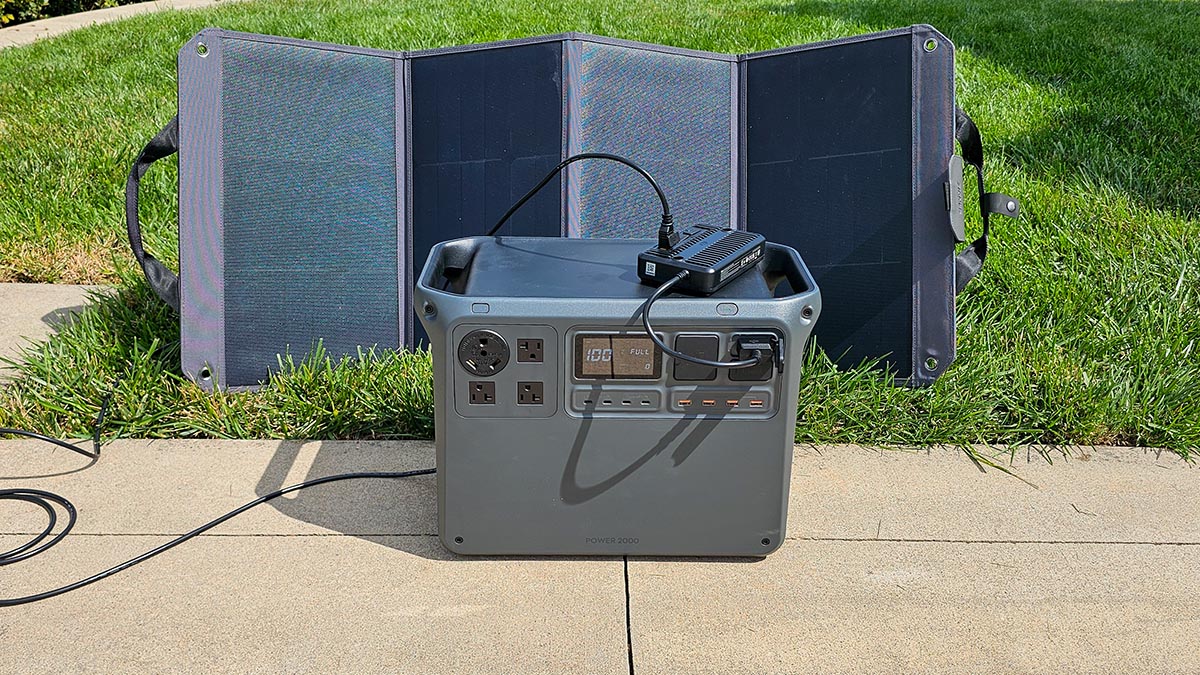
The portable power station market used to be a polite little neighborhood of campers, emergency-prep folks, and people who really did not want their Wi-Fi router to die during a storm. Then DJI showed up. Yes, that DJIthe company best known for drones that make your vacation footage look like a Netflix documentaryhas been pushing into portable energy. The DJI Power 2000 is its biggest statement yet: a 2,048Wh LiFePO4 power station with high AC output, rapid charging, quiet operation, smart app monitoring, and special sauce for DJI drone owners.
In simple terms, the DJI Power 2000 is built for people who need serious battery backup without dragging around a gas generator that sounds like a lawn mower arguing with a blender. It is designed for home outages, RV trips, camping, mobile production, jobsite power, drone charging, and “I just want my refrigerator to survive the storm” situations. With up to 3,000W continuous output on the U.S. model, it can handle far more than phones and laptops. We are talking refrigerators, microwaves, coffee makers, power tools, routers, fans, camera gear, and small kitchen appliances.
But specs are only half the story. A power station can look amazing on paper and still annoy you in real life if it is noisy, heavy, slow to charge, badly laid out, or stuck with an app that feels like it was designed during a lunch break. So, let’s break down what the DJI Power 2000 does well, where it stumbles, and who should actually buy it.
DJI Power 2000 at a Glance
The DJI Power 2000 is a large-capacity portable power station built around a 2,048Wh lithium iron phosphate battery. LiFePO4, often shortened to LFP, is now the battery chemistry of choice for many premium solar generators and backup power stations because it offers a longer life cycle, better thermal stability, and stronger long-term durability than older lithium-ion battery packs.
Its headline features include high output, fast AC charging, quiet cooling, UPS-style backup, app control, expansion battery support, solar input, and DJI-specific SDC ports. Those SDC ports are especially interesting because they allow fast charging for compatible DJI drone batteries with optional cables. For pilots, videographers, survey crews, and creators who already live in the DJI ecosystem, that is not a small perk. That is the difference between waiting around for batteries and getting back into the air while the light is still pretty.
Core Specs
- Battery capacity: 2,048Wh LiFePO4 battery
- Continuous AC output: up to 3,000W on the U.S. model
- Battery expansion: expandable with DJI Power Expansion Battery 2000 modules
- Maximum expanded capacity: up to 22,528Wh with compatible expansion batteries
- USB ports: four USB-A ports and four USB-C ports, including high-wattage USB-C options
- AC outlets: multiple AC outputs, with the U.S. version including an RV-friendly outlet layout
- UPS function: fast automatic switchover for essential devices
- Noise level: around whisper-quiet operation in standard charging modes, roughly 29–30 dB in reported testing
- Weight: roughly 48–50 pounds depending on market and configuration
Charging-time claims vary a little depending on region, input mode, and retailer listing. In the U.S., DJI and major retailers generally present the Power 2000 as a fast-charging unit capable of reaching 80 percent in under an hour under high AC input. Some international materials and independent reviews reference 0–80 percent in about 45 minutes, while other U.S.-focused testing reports about 55 minutes to 80 percent and around 75–90 minutes to full. The safe takeaway: it charges very quickly for a 2kWh power station.
Design and Build Quality: Compact, Tough, and Very DJI
The DJI Power 2000 looks like something a drone engineer would design after staring at a toolbox, a server battery, and a premium camera case. It has a clean, industrial shape, a dark gray finish, sturdy integrated handles, and a front-facing control layout. It does not scream “camping gadget.” It looks more like professional equipment that politely agreed to go camping.
For a 2,048Wh power station, the footprint is reasonably compact. That matters because large power stations often become awkward plastic cubes that live in the garage forever because nobody wants to move them. The DJI Power 2000 is still heavyaround 50 pounds is not “toss it in a backpack” territorybut it is manageable for two-handed lifting and easier to store than many bulky competitors.
The build feels rugged enough for RV bays, home storage rooms, production carts, and light jobsite use. It is not something you should leave out in a rainstorm like a forgotten patio chair, but the overall construction gives confidence. DJI also emphasizes internal safety features such as battery management, protective coatings, temperature monitoring, and flame-retardant housing. Translation: the company seems to understand that a big battery should not be treated like a mystery box full of spicy electrons.
Performance: Enough Power for Real Appliances
The biggest reason to consider the DJI Power 2000 is output. A 3,000W continuous AC rating means this unit is not limited to phones, tablets, and the emergency lamp you bought three years ago and never charged. It can run common household appliances and many higher-draw tools, as long as the total load stays within its output limits.
That opens the door to practical use cases: keeping a refrigerator cold during an outage, powering a fan during a heat wave, running a router and laptop for remote work, supporting camera lights on location, operating small cooking appliances at a campsite, or powering a shop vac away from wall outlets. It is also strong enough for many tools that smaller portable power stations would treat like a personal insult.
Of course, runtime depends on load. A 2,048Wh battery does not mean every device runs for days. A 100W router-and-laptop setup could run for many hours. A 1,500W heater or high-power cooking appliance will drain it much faster. This is normal battery math, not DJI wizardry. The Power 2000 gives you a large energy bucket, but if you attach a fire hose, the bucket empties quickly.
Quiet Operation: The Feature You Appreciate at 2 A.M.
Quiet operation is one of the DJI Power 2000’s strongest selling points. Portable power stations can get surprisingly loud when charging fast or feeding heavy loads. Fans spin up, cases vibrate, and suddenly your peaceful RV sounds like a tiny data center. DJI seems to have paid close attention to acoustics here.
Reported noise levels around 29–30 dB put the Power 2000 in whisper territory under calmer operating conditions. That makes it much more bedroom-, office-, tent-, and RV-friendly than a gas generator. It also makes sense for creators recording audio, drone operators working around clients, and homeowners who want backup power without adding a soundtrack called “Angry Plastic Fan, Extended Remix.”
Will it remain completely silent under every load? No. Any high-capacity power station needs cooling, and fans may become more noticeable during heavy output or rapid charging. But compared with many competing units, the DJI Power 2000’s low-noise profile is a genuine advantage. If you plan to run essential devices overnight, quiet cooling is not just a luxury. It is the difference between sleeping and lying awake wondering if your power station is preparing for takeoff.
Fast Charging: Big Battery, Small Waiting Time
A 2kWh battery is only convenient if it does not take half a day to refill. This is where the DJI Power 2000 earns its “fast-charging” label. With high AC input, it can recharge from low battery to 80 percent in roughly under an hour depending on region, charge mode, and power source. Full charging is also impressively quick for this capacity class.
This matters in real life. During outage season, you might have a short window between rolling blackouts. On a road trip, you might stop at a powered site or wall outlet and want to refill before heading out again. On a filming job, you may need to top off between locations. Fast charging turns the Power 2000 from a “charge it overnight and hope” device into something much more flexible.
DJI also offers slower, quieter charging modes. That is smart because not every situation requires maximum speed. If you are charging overnight in an RV or near a sleeping area, slower charging can reduce fan noise and stress. If you are preparing before a storm, fast charging is the hero mode. Options are good. Batteries like options. People who forgot to charge before the storm really like options.
Ports and Connectivity: Plenty to Plug In
The DJI Power 2000 includes a generous port selection. You get multiple AC outlets, four USB-A ports, four USB-C ports, and DJI’s SDC ports. The USB-C layout is especially useful because modern laptops, tablets, camera gear, and even some portable monitors can pull serious wattage over USB-C Power Delivery.
The two higher-wattage USB-C ports are a big win for creators and mobile workers. Instead of wasting AC outlets on laptop bricks, you can plug directly into USB-C and keep the AC side free for larger gear. Meanwhile, the USB-A ports remain useful for older cables, lights, small fans, radios, battery chargers, and the random device in your drawer that somehow still uses a cable from 2014.
The SDC ports are what separate DJI from many competitors. With the correct accessories, they support DJI drone battery charging, solar accessories, car charging, and expansion modules. This is both a strength and a small weakness. It is powerful if you are in DJI’s ecosystem, but some users may prefer more universal built-in inputs and outputs without relying on proprietary accessories.
UPS Backup: A Strong Option for Routers and Workstations
The DJI Power 2000 can function as a UPS-style backup for sensitive electronics. When connected to wall power with devices plugged into it, the unit can switch to battery power very quickly if the grid drops. That makes it useful for routers, modems, desktop computers, network storage, camera security systems, and other essentials that do not enjoy sudden power naps.
For remote workers, this is one of the most practical features. A storm can knock out power for a few seconds and still ruin a video call, corrupt a file transfer, or reboot your entire home network. With the Power 2000 in place, short outages become less dramatic. Your router keeps blinking, your laptop keeps charging, and you can continue pretending you are calm while checking the outage map for the seventeenth time.
It is important to remember that a portable power station is not the same as a professionally installed whole-home backup system. The Power 2000 is best used for selected circuits or directly plugged-in essentials. It is not a drop-in replacement for a transfer switch, standby generator, or permanently installed home battery. But for keeping important devices alive, it is very capable.
Solar and Expansion: Built for Longer Trips and Bigger Backup Plans
The DJI Power 2000 supports solar charging through compatible accessories, which makes it useful for camping, RV travel, off-grid work, and longer emergency scenarios. Solar charging speed depends heavily on panel wattage, sun angle, temperature, weather, and whether your panels are clean or wearing a decorative layer of campsite dust.
With a small 100W panel, charging a 2,048Wh battery from empty will take a long time. With a larger solar array, the Power 2000 becomes much more practical as an off-grid hub. The ability to accept substantial solar input is important because a large battery deserves a large refill pipeline. Otherwise, it is like trying to fill a swimming pool with a drinking straw.
Expansion is another major advantage. DJI allows the Power 2000 to connect with Power Expansion Battery 2000 modules, scaling total capacity dramatically. The maximum expanded setup can reach more than 22kWh, which moves the system from “portable station” toward “modular backup ecosystem.” Most casual users will never need that much storage, but RV owners, production teams, emergency-prep households, and mobile professionals may appreciate the headroom.
DJI Drone Charging: The Secret Weapon
For drone pilots, the DJI Power 2000 is more than a big battery. It is a field charging station that understands DJI gear. With optional SDC cables, it can fast charge compatible DJI drone batteries much more conveniently than using standard AC adapters alone.
This is a major benefit for aerial photographers, surveyors, real estate videographers, search-and-rescue teams, agricultural operators, and content creators. Drone batteries are expensive, and carrying enough of them for a full day can feel like packing gold bars. A fast field charger lets pilots rotate batteries more efficiently and spend more time flying instead of watching LEDs blink.
If you do not own DJI drones, this feature may not matter much. But if your workflow already includes Mavic, Air, Matrice, Inspire, or other compatible DJI batteries, the Power 2000 becomes more compelling than a generic power station with similar capacity. It is a niche advantage, but for the right buyer, it is a big one.
App Experience: Useful, But Not the Star of the Show
The DJI Home app allows users to monitor battery status, input and output power, manage settings, check connected accessories, and update firmware. The interface is generally useful, and app control is now expected in this price class. Nobody wants to walk across the room just to check if the fridge is using 120W or 700W, especially when the couch is already doing such a good job holding you in place.
That said, the app experience is not the strongest part of the product. Some reviewers have praised its clean monitoring features, while others have found it less polished than apps from brands like EcoFlow, Anker, Jackery, or Bluetti. The app is functional, but it does not yet feel like the deep energy-management dashboard that serious backup users may want.
For most owners, this will not be a deal-breaker. You can still see the basics, control outputs, and manage firmware. But if you love detailed automation, advanced scheduling, and highly refined energy analytics, DJI has room to improve.
What We Like
Strong Output for Demanding Loads
The 3,000W continuous output gives the Power 2000 enough muscle for practical appliances, tools, and mobile work setups. It is not just a phone charger with delusions of grandeur.
Excellent Charging Speed
Reaching 80 percent in under an hour under high AC input is excellent for a 2kWh-class power station. This makes it easier to prepare for storms, road trips, or workdays.
Very Quiet Operation
The low noise profile is one of its best everyday advantages. For RVs, bedrooms, offices, campsites, and audio-sensitive work, quiet matters.
Great for DJI Drone Owners
The SDC ecosystem and drone battery fast-charging support give DJI users a real reason to choose this over similarly sized rivals.
Expandable Capacity
The ability to scale with expansion batteries makes the Power 2000 more future-proof than a fixed-capacity unit.
What Could Be Better
It Is Still Heavy
At around 50 pounds, the Power 2000 is portable in the “carry it with intention” sense, not the “skip through a meadow” sense. Built-in wheels would have made it easier to move.
Some Accessories Feel Necessary
To unlock the best solar, drone charging, car charging, and expansion features, you may need extra DJI accessories. That adds cost and complexity.
The App Could Be More Advanced
The DJI Home app is useful, but serious power users may want deeper controls, better analytics, and a more mature ecosystem.
Regional Specs Can Be Confusing
Output ratings, charging times, and outlet layouts may vary by market. Buyers should check the exact U.S. product page or retailer listing before purchasing.
Who Should Buy the DJI Power 2000?
The DJI Power 2000 is a strong fit for homeowners who want emergency backup for essential devices, RV owners who need quiet overnight power, drone pilots who want fast field charging, creators who work on location, and campers who need a reliable battery that can handle more than string lights and a phone.
It also makes sense for people who want a quieter alternative to a gas generator for short-term backup. You will not get unlimited runtime, and you still need to manage loads intelligently, but the convenience is hard to ignore. No fumes, no fuel storage, no oil changes, no pull cord, no angry neighbors. Just plug in, monitor, and keep your essentials running.
It may not be ideal for buyers who need a lightweight weekend battery, a budget-friendly entry-level power station, or a complete whole-home backup system with integrated panel support. For those users, smaller units or more specialized home battery systems may be better.
Real-World Experience: Living With a Quiet 2kWh Power Station
Using a power station like the DJI Power 2000 changes how you think about electricity. Normally, power is invisible until it disappears. The lights go out, the router dies, the fridge gets suspiciously quiet, and suddenly everyone becomes an amateur infrastructure expert. With a 2kWh portable power station nearby, that panic drops a few levels. You start thinking in priorities instead of problems.
The first thing you notice is the comfort of silence. A gas generator can save your food during an outage, but it also announces itself to the entire street. The DJI Power 2000 feels different. You can run a fan, charge phones, keep a router online, and power lights without turning your home into a construction site. In an RV, that quietness matters even more. When you are trying to sleep at a campground, a low fan hum is acceptable. A roaring generator is how you become the villain in someone else’s vacation story.
The second experience is how useful fast charging becomes. A large battery that charges slowly can feel like a chore. You have to plan around it, babysit it, and hope you remembered to plug it in before bad weather arrived. With the Power 2000, quick AC charging makes topping off feel practical. You can plug it in while packing the car, preparing camera gear, or getting dinner ready, and it can recover a large amount of capacity in a surprisingly short time.
The third experience is load awareness. A power station teaches you which devices are reasonable and which ones are energy goblins wearing appliance costumes. A router and laptop sip power. LED lights barely make a dent. A refrigerator cycles on and off, so it is often manageable. But heating appliances, hair dryers, and electric kettles can pull huge wattage. The Power 2000 can handle many of them, but runtime drops quickly. After a while, you become the kind of person who casually says, “That’s probably pulling 1,500 watts,” at family gatherings. Congratulations, you are now fun at very specific parties.
For creators, the experience is even more practical. Camera batteries, drone packs, laptops, monitors, lights, and audio gear all need reliable power. The Power 2000 gives a mobile production setup a central energy source. Instead of scattering chargers across outlets or relying on a vehicle inverter, you can build a cleaner charging station. For DJI drone users, the specialized charging path is the big bonus. It helps keep batteries rotating during long shoot days when every minute of daylight matters.
For home backup, the best experience is not dramatic. Ideally, the DJI Power 2000 sits quietly in the corner, fully charged, waiting to be boring. Then a storm hits, the power drops, and it becomes the most popular object in the house. The internet stays on. Phones charge. A fan keeps moving air. The fridge gets a few hours of support. Nobody cheers for a power station when everything is normal, but during an outage, it becomes the household MVP.
The main adjustment is mobility. At around 50 pounds, you do not casually move it from room to room all day. You choose a spot, or you use a cart. That is the trade-off for capacity. Smaller power stations are easier to carry, but they will not run as much for as long. The DJI Power 2000 sits in the sweet spot for people who want real backup power while still keeping the system technically portable.
Final Verdict: Is the DJI Power 2000 Worth It?
The DJI Power 2000 is one of the most interesting 2kWh-class portable power stations because it combines high output, fast charging, quiet operation, and deep DJI ecosystem support. It is powerful enough for meaningful home backup, polished enough for creators, quiet enough for RVs and bedrooms, and flexible enough for solar and expansion setups.
It is not perfect. It is heavy, some of its best features require optional accessories, and the app could be more advanced. Buyers should also pay attention to regional specifications and retailer details because charging claims and outlet layouts can vary. But the core product is strong. It feels like DJI took its battery and charging knowledge from drones and scaled it into a serious portable power station.
If you need a quiet, fast-charging power station for outages, RV travel, camping, production work, or DJI drone charging, the DJI Power 2000 deserves a close look. It is not the cheapest box of watts on the shelf, but it is refined, capable, and unusually quiet. In a category where many products compete by shouting bigger numbers, DJI’s best trick may be that this one barely shouts at all.
Note: This review-style article is based on publicly available product specifications, retailer listings, and independent hands-on testing reports from reputable technology, home, outdoor, RV, and tool-review publications. Always verify the exact U.S. model specifications, outlet configuration, accessories, and current pricing before buying.