At Fermilab, tiny particles are behaving like the universe still has a few secrets stuffed in its lab coat pocket. That is not just a dramatic opening line; it is basically the daily job description at one of America’s most important particle physics laboratories. Located in Batavia, Illinois, Fermi National Accelerator Laboratory, better known as Fermilab, has spent decades pushing beams of particles through accelerators, building world-class detectors, and asking questions so fundamental they make ordinary mysteries look like missing car keys.
The phrase “Fermilab particle physics experiment” can point to several major scientific efforts, but the one that recently captured public attention is the Muon g-2 experiment. This study measured the magnetic behavior of the muon, a heavier cousin of the electron, with extraordinary precision. Why should anyone care about the wobble of a particle that exists for only a blink? Because that wobble may reveal whether the Standard Model of particle physics, the best rulebook scientists have for subatomic matter, is complete or quietly missing a chapter.
Fermilab’s work also connects to other frontier experiments, including Mu2e, NOvA, and the Deep Underground Neutrino Experiment, or DUNE. Together, these projects are not just polishing old theories. They are testing whether nature contains hidden particles, unknown forces, or deeper patterns that could reshape modern physics. In other words, this is science at the “please do not touch the universe until we finish measuring it” level.
What Is Fermilab and Why Does It Matter?
Fermilab is the United States’ flagship laboratory for high-energy particle physics. It is funded by the U.S. Department of Energy and has been central to discoveries involving quarks, neutrinos, accelerators, and precision measurement. While the Large Hadron Collider in Europe often grabs headlines with particle collisions at enormous energies, Fermilab is famous for another kind of power: precision.
Precision physics is like using a microscope on the laws of nature. Instead of smashing particles together simply to see what flies out, scientists measure known particles so carefully that even a tiny mismatch between experiment and theory can signal something new. Imagine weighing a feather and discovering it is secretly carrying a piano. That is the spirit of precision particle physics: small differences can have enormous consequences.
At Fermilab, accelerators create beams of particles such as muons and neutrinos. These particles are sent into carefully designed detectors, where their behavior is recorded and compared with mathematical predictions. The goal is not merely to collect numbers. The goal is to test whether the universe follows the Standard Model exactlyor whether new physics is waiting just outside the spotlight.
The Standard Model: Physics’ Best Rulebook With a Few Awkward Blank Pages
The Standard Model explains the known elementary particles and three of the four fundamental forces: electromagnetism, the weak force, and the strong force. It has predicted many experimental results with stunning accuracy. Scientists do not praise it lightly; this model has survived decades of tests that would have embarrassed a weaker theory.
Still, the Standard Model is incomplete. It does not explain gravity at the quantum level. It does not identify dark matter. It does not fully explain why the universe is made mostly of matter instead of antimatter. It also does not answer why neutrinos have mass or why particle masses follow the patterns they do. The Standard Model is brilliant, but it is not the final boss of physics.
That is where Fermilab comes in. Experiments like Muon g-2 and Mu2e look for tiny cracks in the model. Neutrino experiments such as NOvA and DUNE investigate ghostly particles that may help explain why matter survived after the Big Bang. These experiments are different in design, but they share one big ambition: find evidence that nature is richer than the equations currently say.
Muon g-2: The Particle Wobble That Made Physicists Lean Forward
The Muon g-2 experiment measures the magnetic anomaly of the muon. That sounds like something a robot would say during a weather report, so let’s translate it. A muon acts like a tiny spinning magnet. When placed in a magnetic field, it wobbles, or precesses, at a rate that scientists can measure. The Standard Model predicts that wobble with extreme precision because the muon interacts with a buzzing quantum environment of virtual particles.
The name “g-2” refers to a quantity connected to the muon’s magnetic moment. In a simplified picture, the value “g” should be close to 2. Quantum effects make it slightly different, and that difference is exactly where the scientific excitement lives. If the measured wobble does not match the Standard Model prediction, the gap could point to undiscovered particles or forces influencing the muon.
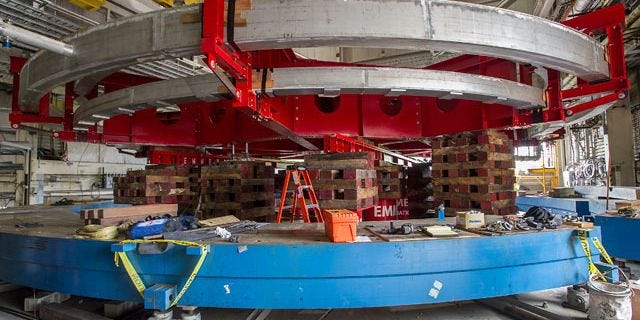
Fermilab’s Muon g-2 experiment used a 50-foot-wide magnetic storage ring originally built for an earlier experiment at Brookhaven National Laboratory. The ring was famously transported from New York to Illinois in 2013, a move so unusual it sounds like the beginning of a science-themed road trip comedy. Once installed at Fermilab, the experiment was upgraded to use more intense muon beams and improved detectors.
How the Experiment Works
In the experiment, muons are injected into a powerful magnetic ring. As they travel around the ring, their spins precess. Because muons quickly decay into other particles, detectors track the decay products to infer the muons’ behavior. The challenge is extreme: scientists must understand the magnetic field, particle motion, detector response, timing systems, and statistical uncertainties with astonishing care.
The result is not a simple “yes” or “no.” It is a measurement with uncertainty, compared against a theoretical prediction that also has uncertainty. When the experimental value and theoretical value differ significantly, physicists pay attention. When they agree, physicists also pay attention, because agreement can rule out many speculative theories. Either way, nature is giving useful testimony.
Did Fermilab Discover New Physics?
The careful answer is: not yet. Earlier Muon g-2 results created excitement because they seemed to strengthen a long-standing difference between experiment and the older Standard Model prediction. For a while, the muon looked like it might be waving a tiny flag that said, “Something new is over here.”
However, the story became more complicated as theoretical calculations improved. The biggest theoretical challenge involves hadronic contributions, especially effects related to the strong force. These are extremely difficult to calculate. Recent advances in lattice quantum chromodynamics and updated theory work have brought the Standard Model prediction closer to the experimental value than older comparisons suggested.
That does not make the Fermilab result boring. Quite the opposite. The final Muon g-2 measurement reached a precision of 127 parts per billion, surpassing the experiment’s original design goal. Even if the result no longer screams “new physics” as loudly as earlier headlines implied, it now gives theorists and experimentalists a sharper benchmark. In science, closing a false door is still progressespecially when that door had a neon sign reading “possible revolution.”
Why the Study Could Still Change Physics
The phrase “study could change physics” should not be treated like clickbait with a lab coat. Fermilab’s particle physics experiments could change physics in several realistic ways.
First, precision measurements can expose hidden flaws in existing theories. If future theoretical work settles on a Standard Model prediction that again diverges from the Fermilab measurement, the muon could become one of the strongest clues for physics beyond the Standard Model. That might guide searches for new particles, new interactions, or new principles connecting known particles.
Second, even agreement changes physics by narrowing possibilities. Many proposed theories beyond the Standard Model predict small changes in the muon’s magnetic behavior. A highly precise measurement can eliminate models that do not fit. This is less flashy than discovering a new particle, but it is scientifically powerful. Physics advances not only by finding what exists, but also by proving what probably does not.
Third, Fermilab’s work improves the tools of particle physics. The detectors, magnetic-field mapping methods, accelerator technologies, and data-analysis techniques developed for these experiments can influence future research. A single experiment may end, but the expertise it creates keeps moving.
Mu2e: Looking for a Forbidden Transformation
Another Fermilab experiment with major discovery potential is Mu2e. This project searches for a process in which a muon converts directly into an electron without producing neutrinos. In the Standard Model, charged lepton flavor violation of this type is so incredibly rare that observing it at Mu2e would be a strong sign of new physics.
Mu2e is designed to stop muons in an aluminum target and look for a very specific electron signal. If such a signal appears above background, it would mean that the rules governing leptons are not complete. That would be a huge deal. It would be like catching a cat turning into a toasternot because the image is scientifically accurate, but because the transformation would violate everything you thought you understood about the household.
The experiment is technically demanding because the expected signal, if it exists, is rare. Scientists must suppress background events, calibrate detectors, and control particle beams with extraordinary precision. The reward could be enormous: evidence for new interactions at energy scales that may be difficult to probe directly with colliders.
Neutrino Experiments: Fermilab’s Other Route to Big Answers
Fermilab is also a world leader in neutrino science. Neutrinos are tiny, electrically neutral particles that rarely interact with matter. Trillions pass through your body every second, which is both scientifically amazing and personally rude. They do not ask permission; they just pass through like cosmic commuters.
NOvA, one of Fermilab’s long-baseline neutrino experiments, sends neutrinos from Illinois to a detector in Minnesota. Scientists study how neutrinos change flavors as they travel, a phenomenon known as neutrino oscillation. These oscillations prove that neutrinos have mass, something the original Standard Model did not fully explain.
The next giant step is DUNE, the Deep Underground Neutrino Experiment. DUNE will send an intense beam of neutrinos about 800 miles from Fermilab to massive detectors deep underground at the Sanford Underground Research Facility in South Dakota. Its goals include studying neutrino oscillations, investigating matter-antimatter asymmetry, watching for neutrinos from supernovae, and searching for proton decay.
Why Neutrinos May Explain Why We Exist
One of the biggest mysteries in physics is why the universe contains more matter than antimatter. According to simple expectations, the Big Bang should have produced matter and antimatter in nearly equal amounts. When matter meets antimatter, both can annihilate. If everything had balanced perfectly, the universe might have become a very clean but very empty place.
Since we are here, sipping coffee, reading articles, and occasionally losing phone chargers, something tipped the balance. Neutrinos may be part of the answer. If neutrinos and antineutrinos behave differently, that difference could help explain why matter won. DUNE is built to explore this question with unprecedented reach.
The Role of Theory: Why Experimental Results Need Mathematical Muscle
Particle physics is a partnership between experiment and theory. Experiments measure what particles do. Theories predict what particles should do. Progress happens when the two either match beautifully or disagree in a way that cannot be ignored.
For Muon g-2, the experimental measurement is now incredibly precise, but the theoretical prediction remains challenging. The muon interacts with quantum fields, and some of the most difficult contributions involve hadrons, particles affected by the strong nuclear force. Calculating these effects requires advanced methods, including data-driven approaches and lattice QCD, where physicists simulate quantum fields on a space-time grid using powerful computers.
This is why headlines about Fermilab must be read carefully. A dramatic experimental result does not automatically mean new physics. Scientists must also be confident that the Standard Model prediction is equally solid. If theory changes, the size of the experimental tension changes. That is not a weakness of science; it is science doing the responsible thing and checking its homework twice, then asking another scientist to check it again.
Specific Example: What Precision Really Means
When Fermilab reports a result with precision at the level of parts per billion, it means tiny effects matter. Picture measuring the distance between New York and Los Angeles and caring about an error smaller than the width of a human hair. That is not the exact scale of Muon g-2, but it gives the right emotional flavor: the experiment is operating in a world where small mistakes cannot be ignored.
To reach that precision, scientists must understand the magnetic field inside the storage ring, the motion of muons, the timing of decay signals, detector calibrations, and environmental stability. It is a reminder that modern physics is not one genius scribbling on a chalkboard while dramatic music plays. It is large teams, careful engineering, statistical analysis, and years of patient work.
Why the Public Should Care About Fermilab Particle Physics
It is fair to ask why society should care about tiny particles when there are practical problems everywhere. The answer is that fundamental science expands human knowledge and often produces unexpected technological benefits. Particle physics has contributed to advances in accelerators, detectors, superconducting magnets, medical imaging, computing, data science, and materials research.
But there is also a deeper reason. Fermilab experiments ask what the universe is made of and why it behaves as it does. These questions belong to everyone. You do not need a Ph.D. to feel wonder at the idea that a particle’s wobble may reveal hidden layers of reality. You only need curiosity and perhaps a little patience with Greek letters.
Particle physics also teaches intellectual humility. The Standard Model is one of humanity’s greatest scientific achievements, yet scientists know it is incomplete. That combinationconfidence in what works and openness to what remains unknownis one of the healthiest habits science offers.
Experience Section: Following the Fermilab Story as a Curious Reader
Experiencing the Fermilab particle physics story from the outside feels a little like standing at the edge of a giant machine that is quietly asking the universe extremely personal questions. At first, the topic can seem intimidating. Muons, neutrinos, magnetic anomalies, lepton flavor violationthese are not exactly words people use while ordering lunch. But once the core idea clicks, Fermilab’s work becomes surprisingly human.
The first experience many readers have with Muon g-2 is confusion followed by fascination. A tiny particle wobbles in a magnetic field. Scientists measure that wobble. If the wobble is slightly different from what theory predicts, the difference might point to unknown physics. That is the whole drama, and it is beautiful because it shows how much information nature hides in small details. The experiment does not need fireworks. It needs patience, precision, and a willingness to care about decimals.
Learning about Fermilab also changes how you think about scientific discovery. Popular culture often presents breakthroughs as sudden lightning bolts. In real life, the process looks more like a long relay race. Brookhaven made earlier measurements. Fermilab transported and upgraded the storage ring. Hundreds of scientists worked on beamlines, magnets, detectors, simulations, and analysis. The final result was not one person shouting “Eureka!” It was a collaboration slowly reducing uncertainty until the measurement became one of the most precise in particle physics history.
There is also something oddly charming about the physical scale of these experiments. The particles are unimaginably small, but the tools are enormous. A giant magnetic ring is used to study a particle that vanishes almost instantly. Massive underground detectors are built to catch neutrinos that usually ignore entire planets. It is like building a cathedral for a whisper. That contrast makes Fermilab’s work memorable: tiny clues, giant instruments, cosmic questions.
For students, science writers, and curious readers, the most useful lesson is that uncertainty is not failure. When the Muon g-2 result appeared to differ strongly from older predictions, excitement was justified. When newer theory work reduced the tension, that did not ruin the story. It made the story more honest. Science is not about protecting a favorite headline. It is about letting evidence, calculation, and criticism sharpen the truth.
Fermilab’s neutrino program offers a different kind of experience: awe. Neutrinos are everywhere, yet they are almost impossible to catch. The idea that Fermilab can send a beam through hundreds of miles of Earth toward distant detectors sounds like science fiction, except it is real engineering. DUNE, in particular, feels like a message to the future. It may take years to collect the data needed for major answers, but the questions are worth the wait: Why does matter exist? Do protons decay? What can neutrinos from a supernova tell us about dying stars?
The best way to understand Fermilab’s importance is to see it not as a single experiment, but as a long conversation with nature. Sometimes nature answers clearly. Sometimes it mumbles. Sometimes it gives an answer that forces scientists to rebuild part of the question. That is why Fermilab particle physics matters. It is not only searching for new particles. It is refining the way humanity listens to the universe.
Conclusion: A Study That Could Change Physics by Making the Unknown Smaller
The Fermilab particle physics experiment story is not a simple tale of one measurement overthrowing everything. It is more interesting than that. Muon g-2 has produced one of the most precise measurements ever made of the muon’s magnetic behavior. Mu2e is preparing to search for a forbidden transformation that would strongly suggest new physics. NOvA and DUNE are probing neutrinos, matter-antimatter imbalance, and some of the deepest questions in cosmology.
Together, these experiments show how modern physics advances: not always with instant revolutions, but with sharper measurements, better theories, and braver questions. Fermilab’s work could change physics by revealing a new phenomenon. It could also change physics by ruling out attractive but incorrect ideas. Either outcome matters.
The universe is not obligated to be simple, and Fermilab scientists know it. They are measuring the smallest signals with some of the most sophisticated instruments ever built. Whether the next breakthrough comes from a muon wobble, a rare conversion, or a beam of neutrinos traveling through Earth, Fermilab remains one of the key places where the future of physics is being testedone stubborn particle at a time.
Note: This article is written for educational web publishing and is based on current public information from major U.S. science institutions, Fermilab-related experiment updates, and peer-reviewed particle physics reporting.