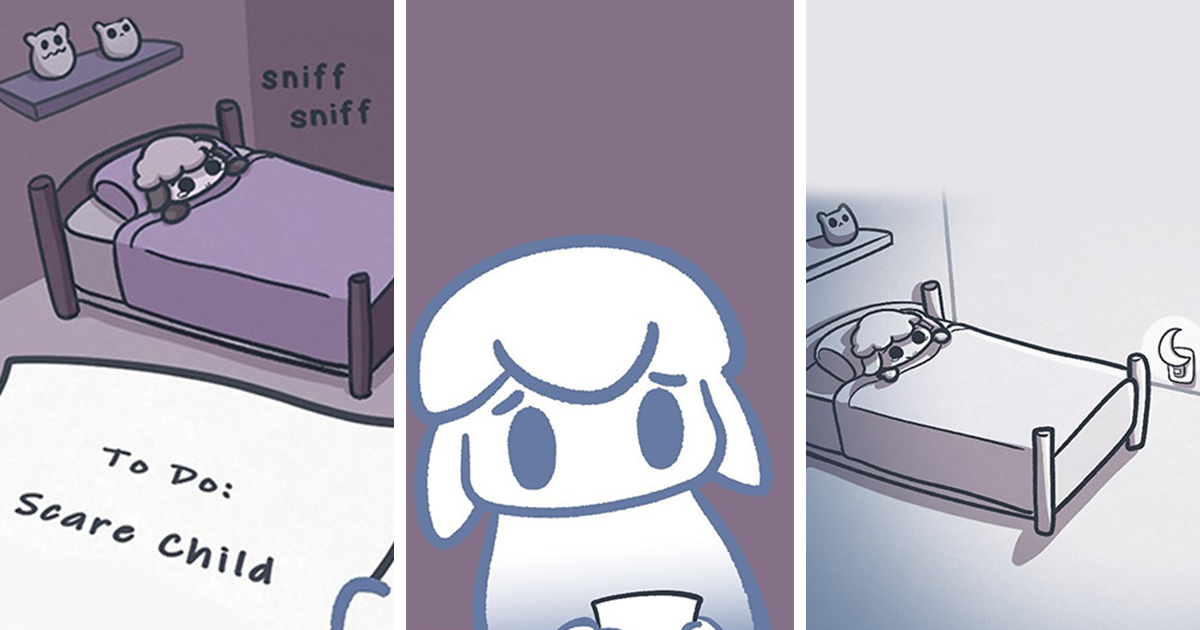
The artist behind these 18 wholesome comics understands something many people spend years trying to put into words: healing rarely looks dramatic. Most of the time, it looks like getting out of bed when your brain is acting like a grumpy landlord. It looks like answering one text message. It looks like letting yourself cry without turning it into a courtroom drama about whether your feelings are “valid enough.” And that is exactly why these comics hit so hard.
In a crowded internet where everybody seems to be either thriving, branding, optimizing, or pretending to drink green juice with inner peace, these gentle mental health comics feel like a warm mug held between cold hands. They do not shout. They do not lecture. They do not promise that one inspirational quote and a yoga mat will solve everything by Tuesday. Instead, they offer something much more useful: recognition.
Across these 18 wholesome comics, the message is simple but powerful. Growth is uneven. Healing is awkward. Some days you make incredible progress; other days you celebrate because you did not completely spiral after one mildly weird email. Both count. These comics revolve around mental health, but they never reduce a person to a diagnosis, a rough patch, or a tragic backstory. They keep returning to the everyday moments where recovery, self-compassion, and emotional resilience quietly live.
Why These Mental Health Comics Feel So Comforting
What makes these comics work is not just the adorable art style or the soft humor, though both definitely help. It is the emotional accuracy. The artist captures the strange little contradictions of mental health with impressive tenderness: wanting to be alone and desperately wanting someone to notice; laughing at your own overthinking while still being trapped inside it; making progress and still feeling fragile. That balance is hard to pull off. These comics do it with an almost suspicious amount of grace.
Wholesome comics about anxiety, depression, burnout, and self-worth often succeed because they shrink overwhelming feelings down to a human size. A comic panel can take an emotion that feels huge and formless and give it shape. Suddenly, the thing haunting your Tuesday afternoon has a face, a joke, a tiny bit of context, and, best of all, an ending. It does not erase pain, but it makes pain easier to approach. That matters.
And unlike some online “mental health content,” these comics do not treat healing like a productivity hack. There is no smug, polished energy here. No “wake up at 5 a.m. and become your best self” nonsense. The artist seems far more interested in emotional honesty than performance. That honesty is what turns a simple comic into something readers save, share, and revisit on hard days.
Growth Without the Glitter Cannon
One of the smartest things these comics do is redefine growth. Popular culture loves a makeover montage. One sad song, one meaningful walk, one life-changing smoothie, and voilà a transformed person emerges, emotionally exfoliated and camera-ready. Real growth is much less cinematic. It is repetitive, slow, and often deeply unphotogenic.
These comics understand that. They show growth as a series of small internal shifts: setting a boundary without apologizing three hundred times, noticing your inner critic and not automatically believing it, asking for help before you are completely overwhelmed, or deciding that rest is not laziness wearing pajamas. That kind of storytelling is refreshing because it treats emotional progress like what it actually is: practice.
The artist also resists the temptation to confuse healing with perfection. That is a big deal. In many of these strips, the characters are still anxious, still tired, still figuring things out. But they are also kinder to themselves. More aware. More willing to pause before turning one bad moment into a full identity crisis. That is healing in real life. Messy, imperfect, and deeply worth celebrating.
Small Wins Matter More Than the Internet Admits
One recurring strength in wholesome mental health comics is the way they validate small wins. Not glamorous wins. Not “I launched a company and moved to a cabin and found my purpose” wins. Small wins. Brushed teeth. Ate lunch. Took a walk. Told a friend the truth. Closed the laptop. Cried and then still made dinner. These things may sound ordinary to someone on the outside, but for a struggling mind, they can feel like scaling a mountain in socks.
This artist seems to know that emotional recovery is built from these tiny moments. The comics never mock that reality. Instead, they dignify it. They remind readers that progress is not only measured by huge breakthroughs. Sometimes it is measured by gentleness. Sometimes by surviving the week without abandoning yourself. Sometimes by learning that your worth does not disappear just because your energy did.
Humor as a Soft Landing, Not a Distraction
The humor in these comics deserves its own standing ovation, or at least a respectful little golf clap. It is not there to trivialize mental health. It is there to make difficult feelings easier to hold. That is a huge difference. The artist uses wit the way good friends do: to lighten the room without denying what is in it.
That is why the jokes land. They do not punch down at pain. They create breathing room around it. A comic can say, “Yes, your brain is being dramatic again,” while also saying, “And no, that does not make you ridiculous.” It can tease the chaos of overthinking, avoidance, or emotional exhaustion without turning the person experiencing those things into the punchline.
This balance is especially valuable in conversations about anxiety and depression because humor can lower defenses. Readers who might scroll past a heavy essay may stop for a four-panel comic with a relatable expression and one painfully accurate sentence. Then the comic sneaks past the armor and says something true. Very rude of it, honestly. Also very effective.
Why Funny and Tender Works So Well Together
People often assume that something serious must be solemn to be meaningful. These comics politely disagree. Their sweetness does not weaken the message; it strengthens it. Tenderness makes the hard truths easier to receive. Humor makes them easier to remember. When a comic wraps insight in kindness, it becomes less like a lecture and more like a companion.
That is part of why wholesome comics about mental health perform so well online. They are highly shareable, yes, but they are also highly usable. People send them to friends because the comics express what they cannot always say themselves. “This made me think of you” becomes a low-pressure way to communicate care. “This is exactly how my brain feels” becomes a way to explain yourself without needing a perfect vocabulary for every emotion.
The Best Comics About Mental Health Make Readers Feel Seen
Being seen is one of the quiet miracles of good art. Not being watched. Not being analyzed. Seen. That is the emotional heartbeat of these 18 comics. They revolve around mental health, but their real achievement is that they make inner experiences visible without making them feel exposed.
Many readers respond to this kind of art because it turns private struggles into shared language. A comic about burnout, people-pleasing, self-doubt, or emotional numbness can create a tiny moment of relief: “Oh good, it is not just me being weird in a corner.” That feeling should not be underestimated. Shame thrives in silence. Recognition interrupts it.
The artist seems especially skilled at depicting common emotional patterns that are hard to explain: the guilt of resting, the panic of disappointing people, the way one thought can snowball into ten imaginary disasters before breakfast. These experiences are not rare, but they often feel isolating. In comic form, they become understandable. Even approachable. Sometimes even a little funny in hindsight, which is a very luxurious emotional upgrade.
Healing Is Not a Straight Line, and These Comics Know It
Another reason these comics resonate is that they do not pretend recovery is linear. There is no fake “before and after” fantasy here. Instead, the emotional arc feels more like a scribble. You improve, you backslide, you learn something, you forget it, you remember it again three months later in the shower. That is not failure. That is being human.
By showing setbacks without despair, the artist offers one of the healthiest messages in modern mental health storytelling: a bad day is not proof that you are broken. It is just a bad day. Maybe a bad week. Maybe a deeply cursed Wednesday. But still not a verdict on your future.
What These 18 Wholesome Comics Say About Modern Emotional Life
Taken together, these comics offer a sharp little portrait of modern emotional life. People are overstimulated, under-rested, self-critical, and often lonely even when surrounded by notifications. We are expected to function at full speed while carrying invisible stress, old wounds, complicated family dynamics, work pressure, identity questions, and the occasional meltdown over a message that ended with a period instead of an exclamation point. The emotional math is not simple.
That is why wholesome comics that revolve around mental health feel so relevant right now. They cut through the noise. They remind readers that healing does not require becoming a new person. It starts with meeting the current version of yourself more honestly. More gently. Less like a hostile manager, more like someone worth caring for.
These comics also emphasize connection. Again and again, the softest and strongest moments tend to involve support: a friend who checks in, a partner who listens, a family member who learns, or a character finally giving themselves the kindness they hand out so easily to everyone else. Emotional growth rarely happens in a vacuum. Even when healing is personal, it is often sustained by connection.
Why This Artist’s Work Leaves a Mark
Plenty of comics are funny. Plenty are cute. Plenty are “relatable” in the sense that they know everyone hates Monday mornings. But work like this lingers because it does something deeper. It helps people feel less alone without demanding that they collapse into sentimentality. It offers comfort without pretending comfort is cure. It makes room for pain, hope, exhaustion, self-awareness, and affection all at once.
That emotional layering is what gives these wholesome comics staying power. The artist is not just drawing feelings; they are translating them. They are taking experiences that are often invisible and turning them into something understandable, memorable, and surprisingly beautiful. That is not just cute content. That is craft.
And perhaps the best thing about these comics is that they do not insist on a grand moral at the end of every struggle. Sometimes the lesson is simply that you deserve patience. Sometimes it is that rest is part of growth. Sometimes it is that you are allowed to be a work in progress without treating yourself like a failed project.
Experiences That Mirror the Heart of These Comics
What makes the topic of growth and healing so universal is that almost everyone has lived through some version of it, even if they would never phrase it that way. One person may call it burnout. Another may call it a rough season. Someone else may simply say, “I’ve been off lately,” which is often the emotional equivalent of saying a hurricane is “a bit windy.” These comics resonate because they capture experiences that are incredibly common but rarely described with enough softness.
For example, many people know the feeling of waking up already tired, not because they did something dramatic the night before, but because their mind has been running a secret overnight marathon. Even simple tasks can feel heavier on those days. Making breakfast feels like a negotiation. Replying to messages feels like a performance review. And yet, when someone sees a comic that captures that exact emotional weight with one expression and one line of dialogue, it can feel strangely relieving. Suddenly, exhaustion has context. It has shape. It feels survivable.
Another familiar experience is the guilt that can come with needing rest. A lot of people have been taught to measure their value by productivity, which means slowing down feels suspicious. Rest starts to feel earned only after complete depletion, which is a terrible system and a very rude invention. These wholesome comics gently challenge that mindset. They suggest that pausing is not quitting, that taking care of yourself is not selfish, and that healing often requires less punishment and more permission.
There is also the experience of learning how to talk to yourself differently. For many people, the harshest voice in the room is the one in their own head. It is the voice that says you are behind, too sensitive, too messy, too much, not enough, and somehow also responsible for every awkward moment since middle school. Growth often begins when that voice is finally questioned. Not silenced forever, because brains love recurring drama, but challenged. These comics reflect that turning point beautifully. They show what happens when self-criticism stops being treated like wisdom and starts being recognized as noise.
Relationships are another huge part of the healing experience. Sometimes growth is deeply personal, but often it unfolds in ordinary exchanges with other people. A friend notices you have gone quiet. A sibling says the right thing at the right time. A partner offers support without trying to “fix” you. Even small interactions can become emotional anchors. Many of these comics revolve around exactly that kind of care support that is steady, not flashy; kind, not performative.
Perhaps the most relatable experience of all is discovering that healing is not one big breakthrough but a collection of returns. You return to better habits. You return to honesty. You return to yourself after periods of numbness, stress, fear, or self-doubt. Some days you feel strong. Other days you feel like a puddle with opinions. Both are part of the process. That is why comics like these matter. They do not just entertain; they accompany. They remind readers that growth is not about becoming someone unrecognizable. It is about becoming more at home with who you already are, one gentle realization at a time.
Final Thoughts
Growth And Healing: 18 Wholesome Comics That Revolve Around Mental Health, By This Artist is the kind of title that sounds sweet at first glance and then turns out to be surprisingly accurate. These comics are wholesome, yes, but not in a shallow, sugar-coated way. They are wholesome because they make room for complexity without cruelty. They acknowledge pain without worshipping it. They make mental health feel discussable, survivable, and human.
That is no small achievement. In a world full of noise, these comics offer clarity. In a culture obsessed with polished transformation, they celebrate gradual healing. And in moments when readers may feel isolated by what is happening in their own minds, they deliver one of the most powerful messages art can give: you are not the only one, and you do not have to hate yourself while you heal.
Note: This article is for informational and inspirational purposes only and is not a substitute for professional mental health care or diagnosis.