Interest has a sneaky talent: it looks harmless when expressed as a tiny daily percentage, then strolls into your monthly statement wearing a much larger hat. Whether you are reviewing a credit card bill, estimating student loan costs, comparing savings accounts, or checking a lender’s math, understanding how to calculate a daily interest rate puts you back in control.
The basic calculation is usually straightforward: convert an annual interest rate into a daily rate, multiply it by the applicable balance, and account for the number of days involved. The details become more interesting when balances change, interest compounds, or a lender uses a 360-day year instead of 365 days.
This guide explains the main daily interest formulas, provides step-by-step examples, and shows how calculations differ for loans, credit cards, savings accounts, and other financial products.
What Is a Daily Interest Rate?
A daily interest rate is the percentage of a balance that is charged or earned during one day. It may also be called a daily periodic rate, or DPR.
Credit card companies commonly convert an annual percentage rate into a daily periodic rate and apply that rate to a daily balance or average daily balance. Interest may then be added to the account, allowing subsequent interest to be calculated on a slightly larger balance.
Daily interest can work in either direction:
- On a loan or credit card, it increases the amount you owe.
- On a savings account or interest-bearing deposit, it increases the amount you own.
The math may be similar, but the account agreement determines the exact rate, balance method, compounding schedule, and day-count convention.
The Basic Daily Interest Rate Formula
When an annual rate is based on a 365-day year, the standard formula is:
Daily interest rate = Annual interest rate ÷ 365
The annual percentage must be converted into decimal form before using it in a dollar calculation.
For example, an annual rate of 18% becomes:
18% ÷ 365 = 0.049315% per day
Decimal daily rate = 0.00049315
That collection of zeros is important. Using 0.049315 instead of 0.00049315 would turn a manageable interest charge into a mathematical disaster movie.
How to Convert a Percentage Into a Decimal
Divide the percentage by 100:
18 ÷ 100 = 0.18
Then divide the decimal annual rate by the number of days in the lender’s year:
0.18 ÷ 365 = 0.00049315
How to Calculate Daily Simple Interest
Simple interest is calculated only on the principal balance. Previously accrued interest does not automatically become part of the principal for the next day’s calculation unless it is capitalized under the account terms.
The formula is:
Daily interest = Principal × Annual interest rate ÷ Days in year
To calculate interest over several days:
Total interest = Principal × Annual rate ÷ Days in year × Number of days
Example: Daily Interest on a Personal Loan
Suppose you have:
- Principal balance: $10,000
- Annual interest rate: 7.5%
- Day-count basis: 365 days
Convert 7.5% to a decimal:
7.5% = 0.075
Calculate one day of interest:
$10,000 × 0.075 ÷ 365 = $2.0548
The loan accrues approximately $2.05 per day.
For 45 days:
$2.0548 × 45 = $92.47
Assuming the balance remains unchanged, approximately $92.47 in interest would accrue during that period.
Federal student loan servicers use a similar daily simple-interest calculation, although some official servicing formulas use 365.25 days. Borrowers should therefore use the divisor shown by their servicer rather than assuming every loan uses exactly 365.
How to Calculate Interest for a Specific Number of Days
When you know the principal, annual rate, and exact number of elapsed days, you can combine the calculation into one formula:
Interest = P × r × d ÷ y
Where:
- P = principal balance
- r = annual interest rate as a decimal
- d = number of days
- y = number of days used for the annual basis
Example: Interest Accrued Over 90 Days
Assume a $15,000 balance at 6.25% annual interest for 90 days:
$15,000 × 0.0625 × 90 ÷ 365 = $231.16
The estimated interest is $231.16.
This calculation is useful when estimating a loan payoff, checking accrued interest between payments, or comparing the cost of making a payment today versus next month.
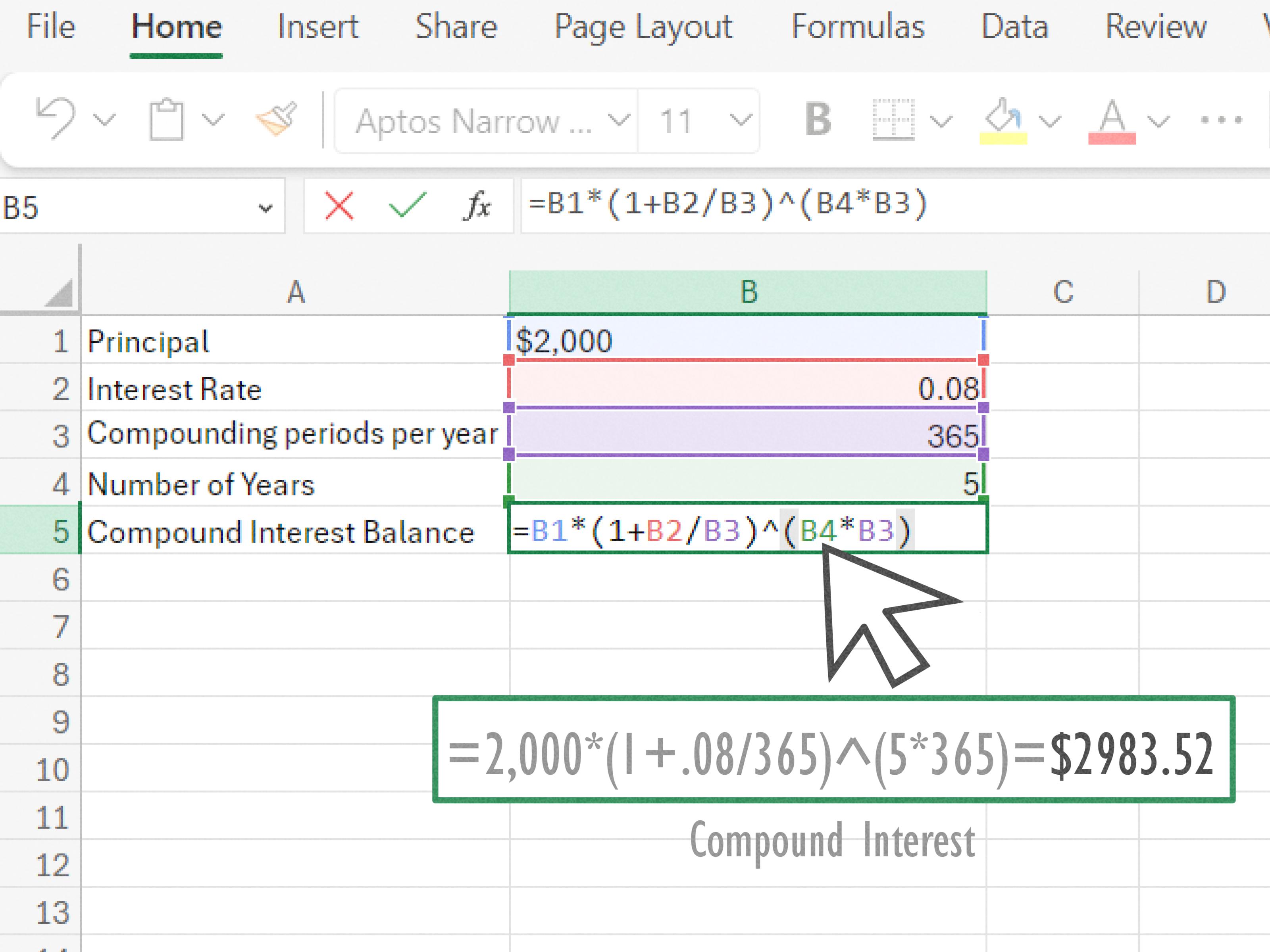
How to Calculate Daily Compound Interest
Compound interest is calculated on the original principal plus previously accumulated interest. In friendly territory, such as a savings account, compounding helps your money grow. In less friendly territory, such as revolving debt, it lets your debt grow a tiny pair of legs.
The general compound interest formula is:
A = P(1 + r/n)nt
Where:
- A = ending balance
- P = starting principal
- r = nominal annual interest rate
- n = number of compounding periods per year
- t = time in years
For daily compounding, n is generally 365. When calculating a specific number of days, the formula can be written as:
A = P(1 + r/365)d
Here, d is the number of days.
Example: $5,000 Compounded Daily for 30 Days
Assume:
- Starting balance: $5,000
- Nominal annual rate: 5%
- Compounding: Daily
- Time: 30 days
A = $5,000(1 + 0.05/365)30
A ≈ $5,020.59
The interest earned during the 30-day period is approximately:
$5,020.59 − $5,000 = $20.59
Compound interest means that each day’s interest can become part of the balance used for the next day. Investor.gov, the FDIC, and Fidelity describe compounding as earning or charging interest on both principal and accumulated interest.
APR Versus APY in Daily Interest Calculations
APR and APY may both appear as annual percentages, but they are not interchangeable.
Annual Percentage Rate
APR generally describes the annualized cost of borrowing. For credit cards, the daily periodic rate is commonly calculated by dividing the applicable APR by 365, although some agreements may use another day-count basis.
Annual Percentage Yield
APY describes the annual yield on a deposit after accounting for compounding. This makes APY especially useful when comparing savings accounts and certificates of deposit with different compounding schedules.
Federal Truth in Savings rules treat APY as a measure that reflects both the interest rate and compounding frequency.
Converting APY Into an Effective Daily Rate
When you are given APY rather than a nominal annual rate, use:
Effective daily rate = (1 + APY)1/365 − 1
For a 5% APY:
(1 + 0.05)1/365 − 1 = 0.00013368
As a percentage, the effective daily rate is approximately 0.013368%.
This is slightly different from simply dividing 5% by 365 because APY already includes the effect of compounding.
How Credit Card Companies Calculate Daily Interest
Many credit card issuers use the average daily balance method. They calculate the balance for each day, add those balances together, and divide the result by the number of days in the billing cycle.
Average daily balance = Sum of daily balances ÷ Days in billing cycle
The estimated finance charge can then be calculated as:
Interest charge = Average daily balance × Daily periodic rate × Billing-cycle days
Example: Credit Card Balance Changes Mid-Cycle
Assume the following:
- APR: 24.99%
- Billing cycle: 30 days
- Balance for the first 10 days: $1,200
- Balance after a payment for the next 20 days: $800
First, calculate the total of the daily balances:
($1,200 × 10) + ($800 × 20) = $28,000
Calculate the average daily balance:
$28,000 ÷ 30 = $933.33
Calculate the daily periodic rate:
0.2499 ÷ 365 = 0.00068466
Estimate the billing-cycle interest:
$933.33 × 0.00068466 × 30 = $19.17
The estimated interest charge is $19.17.
This example also demonstrates why an earlier payment can reduce interest. Lowering the balance sooner creates more low-balance days in the average. CFPB guidance and major card issuers describe daily periodic rates and average daily balance calculations in similar terms, though individual agreements can vary.
Should You Divide the Annual Rate by 360, 365, or 366?
Not every financial product uses the same number of days.
- 365 days: Common for consumer credit cards, personal loans, and deposit accounts.
- 360 days: Sometimes used in commercial lending and certain financial contracts.
- 366 days: May be used during a leap year under some account rules.
- 365.25 days: Used by some federal student loan servicers to account for leap years over time.
Consumer deposit rules generally require a daily rate of at least 1/365 of the annual interest rate, with provisions addressing leap years. Other contracts may specifically authorize a 360-day convention.
Example: The Difference Between 360 and 365
For a $20,000 balance at 9%:
365-day basis: $20,000 × 0.09 ÷ 365 = $4.93 per day
360-day basis: $20,000 × 0.09 ÷ 360 = $5.00 per day
The difference is only about seven cents per day, but over large balances or long periods it becomes more noticeable.
How Payments Affect Daily Interest
On a simple-interest loan, payments are often applied first to fees and accrued interest, with the remainder reducing principal. Once the principal falls, future daily interest is calculated on that lower amount.
Suppose a loan balance drops from $10,000 to $8,000 while the rate remains 7.5%:
Before payment: $10,000 × 0.075 ÷ 365 = $2.05 per day
After payment: $8,000 × 0.075 ÷ 365 = $1.64 per day
The principal reduction saves approximately 41 cents per day. That may not sound worthy of fireworks, but it equals roughly $150 over a full year if the balance remains $2,000 lower.
Common Daily Interest Calculation Mistakes
Using the Percentage Instead of the Decimal
For a 12% rate, use 0.12 in the formula, not 12.
Dividing APY by 365
APY already accounts for compounding. Use the effective daily-rate formula when you need to reverse an APY into a daily rate.
Assuming Every Year Uses 365 Days
Check the loan agreement, cardholder agreement, deposit disclosure, or servicing statement.
Ignoring Balance Changes
If purchases, payments, withdrawals, or deposits occur during the period, one starting balance may not produce an accurate result.
Rounding Too Early
Keep several decimal places in the daily rate and round the final dollar amount. Rounding the rate too soon can create avoidable errors, particularly for large balances.
Confusing Accrual With Posting
Interest may accrue every day but be credited or charged only once per month. Daily accrual describes how it is calculated, not necessarily when it appears on the statement.
A Quick Daily Interest Checklist
- Find the correct annual rate for the balance being calculated.
- Confirm whether the figure is APR, APY, or a nominal interest rate.
- Convert the percentage to decimal form.
- Check whether the account uses 360, 365, 365.25, or 366 days.
- Determine whether interest is simple or compounded.
- Use the correct principal or average daily balance.
- Count the exact number of calendar days.
- Keep extra decimal places until the final step.
- Compare your estimate with the actual account statement.
Practical Experience: What Daily Interest Calculations Teach You
The most useful lesson from working with daily interest is that timing matters almost as much as the rate. Two borrowers can owe the same amount at the same APR and still pay different interest because one makes a payment earlier in the billing cycle. The account with more low-balance days generally produces the smaller charge.
Consider a credit card user who plans to pay $600 toward a balance. Paying on the fifth day of the cycle instead of the twenty-fifth day gives the payment 20 additional days to reduce the balance used in daily calculations. At a high credit card APR, that timing difference can create a measurable saving even though the payment amount never changes.
Another practical lesson is that statement estimates rarely match hand calculations to the penny. That does not automatically mean the lender has made a mistake. Transactions may post on different dates than expected, payments may be credited at a particular cutoff time, and separate balances may have separate APRs. A purchase balance, cash advance, promotional transfer, and penalty-rate balance can all live on the same statement like financially incompatible roommates.
Rounding also causes confusion. A statement may display a daily rate rounded to four or five decimal places while the issuer’s system uses a more precise internal rate. Multiplying the displayed rounded number can produce an answer that differs by a few cents. For reliable estimates, calculate the daily rate directly from the full APR whenever possible and avoid rounding until the end.
Savings calculations create a different challenge. People often take an advertised APY, divide it by 365, and expect the result to match the bank’s daily credit. Because APY already incorporates compounding, that shortcut is not exact. The effective daily-rate formula produces a better estimate. Even then, the bank may use a daily balance method, a collected balance, minimum balance requirements, or tiered rates.
Experience also shows why reading account disclosures is more valuable than memorizing one universal formula. The math is usually simple; identifying the correct inputs is the real job. A flawless calculation using the wrong rate or wrong balance is still flawlessly wrong.
Spreadsheets can help when a balance changes repeatedly. Create one row for each date, enter the opening balance, add purchases or deposits, subtract payments or withdrawals, and multiply the resulting balance by the daily rate. For daily compounding, add the day’s interest before beginning the next row. This approach makes it easier to identify the exact day on which a discrepancy begins.
Finally, daily interest calculations reveal the practical value of small actions. An extra principal payment, an earlier credit card payment, or a few additional days in a high-yield savings account may seem minor in isolation. Repeated over months or years, those small daily differences accumulate. Interest is rarely dramatic on Tuesday afternoon. It becomes dramatic after being allowed to repeat itself hundreds or thousands of times.
Conclusion
To calculate a daily interest rate, start by identifying the correct annual rate and day-count basis. Divide a nominal annual rate or APR by 365, 360, or the divisor stated in the agreement. Then multiply the daily decimal rate by the applicable balance and number of days.
For simple interest, use the principal balance without adding prior interest. For compound interest, allow accumulated interest to become part of the next period’s balance. For credit cards, calculate the average daily balance when balances change throughout the billing cycle. For savings accounts, remember that APY already reflects compounding and should not automatically be treated like a nominal annual rate.
The formulas are not difficult once the terms are clear. The real secret is checking the fine print, keeping your decimals under supervision, and never assuming that every financial institution counts the year in exactly the same way.