Note: This article is written as a fresh, publish-ready feature inspired by real doodle-comic culture, independent artist stories, visual storytelling practices, and modern web publishing guidance.
Some stories need dragons, cinematic explosions, three generations of family secrets, and a villain with cheekbones sharp enough to slice bread. Other stories need a spider named Steve, a fly named Dave, a pen, a sheet of paper, and the emotional intensity of two tiny bugs having a very normal, very ridiculous day.
That is the quiet magic behind simple doodles. They do not ask for perfect anatomy, professional lighting, expensive software, or a studio that smells faintly of coffee and panic. They ask only one question: can a tiny drawing make someone pause, smile, and think, “Yes, that bug absolutely has bills to pay”?
The title “I Create Simple Doodles To Tell Short, Funny Stories (35 Pics)” captures a style of internet art that has become oddly powerful: minimalist drawings that tell miniature stories in seconds. These doodles often look casual, but the best ones are carefully built around timing, character, contrast, and a punchline that lands before the reader has time to put on their serious face.
Why Simple Doodles Work So Well
Simple doodles are effective because they remove almost everything except the idea. A clean line, a blank background, and a small character can do more than a crowded illustration when the joke is strong. In funny doodle comics, the lack of visual detail becomes part of the charm. A bug with two dots for eyes can look more emotionally exhausted than a fully rendered hero after a twelve-volume fantasy war.
Readers understand doodles quickly. There is no need to decode a complicated scene. The eye moves straight to the character, the caption, and the twist. That speed matters online, where people scroll like they are being chased by a raccoon with a deadline. A doodle that tells a complete story in one or two panels has a serious advantage: it respects the reader’s attention while rewarding it immediately.
This is also why short funny comics travel so well on social media. A doodle can be understood on a phone screen, shared in a group chat, pinned to a mood board, or saved for later when someone needs a tiny emotional snack. It is art with low friction and high personality.
From Meeting Margins To Tiny Comic Worlds
Many doodle projects begin in ordinary places: a notebook during a meeting, a napkin at lunch, the margin of a planner, or the back of an envelope that was supposed to hold Very Important Adult Information. The charm is that the origin story feels accessible. The artist is not always sitting under a dramatic skylight waiting for inspiration. Sometimes inspiration arrives because a meeting has gone on too long and a spider suddenly needs a job interview.
In the doodle-story format, ordinary creatures become surprisingly relatable characters. Bugs, blobs, ghosts, cats, plants, worms, or random household objects are given names, moods, and problems. They are not funny because they are weird. They are funny because they are weirdly normal. A fly worrying about social awkwardness, a spider misunderstanding workplace etiquette, or a beetle taking life too literally can feel more human than an actual human character.
This contrast creates the comedy. The character is small, simple, and absurd, but the emotion is familiar. The reader sees a bug and recognizes anxiety, friendship, confusion, embarrassment, optimism, or the special kind of panic that appears when someone says, “Can we jump on a quick call?”
The Secret Ingredient: Tiny Characters With Big Feelings
Great doodle humor often depends on giving small characters oversized emotional lives. A spider does not simply sit in a web; he has opinions. A fly does not merely fly; he has poor judgment, confidence issues, and possibly a snack-based worldview. A worm is not just a worm; he is a philosopher with no arms and far too much time to think.
The best simple doodles are rarely random scribbles. They are micro-stories. Each one usually contains a setup, a turn, and a payoff. The setup introduces a familiar situation. The turn makes it strange. The payoff makes the reader laugh because the strangeness feels logical inside the doodle’s little universe.
Example of a doodle-story structure
Imagine two insects standing beside a crumb. One says, “We should save it for winter.” The other is already eating it and replies, “I am emotionally in winter.” That is the whole story. It has character, conflict, timing, and a punchline. It also has the nutritional value of one crumb, but emotionally, it is a banquet.
Simple doodles thrive on this kind of compact storytelling. The artist does not need to explain the entire world. A few lines and a sentence can suggest everything. Readers fill in the gaps, which makes the joke feel collaborative. The drawing starts the story; the reader’s imagination finishes it.
Why Imperfect Art Can Be More Relatable
One reason doodle comics feel so friendly is that they do not pretend to be polished beyond recognition. A wobbly line can make a character feel alive. A slightly uneven circle can look like nervous energy. A hand-drawn speech bubble can carry more warmth than a perfect digital box.
This does not mean skill is irrelevant. Good doodles still rely on composition, pacing, readability, and visual rhythm. But the skill is often hidden under simplicity. The artist must know what to leave out. That is harder than it sounds. Anyone can add more details until a drawing looks busy. It takes control to use only the details that serve the joke.
Minimalism also lowers the emotional barrier for the audience. People who might feel intimidated by fine art often feel invited by doodles. A simple comic says, “Come in. No art degree required. The spider is confused too.”
What Makes These 35 Pics So Fun To Browse
A gallery of 35 funny doodles works because it creates a rhythm. One image gives you a joke. Thirty-five images create a tiny world. By the tenth doodle, readers begin to understand the rules. By the twentieth, they have favorite characters. By the thirty-fifth, they may be emotionally invested in the survival of a bug whose entire body is basically a circle with legs.
The recurring nature of the characters is important. When the same spider, fly, beetle, or doodle creature returns again and again, the comedy becomes richer. A running joke can build. A character’s personality can become clearer. The reader starts anticipating how that character will react, and anticipation is comedy’s favorite trampoline.
Short visual stories also benefit from surprise. A doodle might start with a normal question and end with a very bug-specific misunderstanding. It might use a pun, a literal interpretation, or a tiny emotional meltdown. The format is small, but the range is wide: wholesome jokes, darkly silly jokes, wordplay, social awkwardness, and everyday observations wrapped in bug legs.
How Doodles Turn Everyday Life Into Comedy
The funniest doodles often come from ordinary frustration. Meetings, chores, awkward greetings, bad decisions, self-doubt, snacks, sleep, work, friendship, and existential dread all become funnier when acted out by tiny creatures. A doodle does not need a huge plot. It needs a recognizable feeling wearing a ridiculous costume.
For example, a doodle about procrastination could show a spider saying, “I will start building the web tomorrow,” while sitting under a sign that says “Fly Buffet Today Only.” It is silly, but it works because everyone knows what it feels like to delay the exact thing that would solve the problem.
Another doodle might show a beetle carrying a crumb twice its size while saying, “No, I am not overcommitted. I am ambitious.” That is not just a bug joke. That is Monday morning with six tabs open and one brain cell trying to manage the team.
Why Doodling Is More Than “Just Scribbling”
Doodling has often been dismissed as something people do when they are bored or distracted, but that view misses the point. Sketching can support thinking, memory, and idea development. It gives the brain a different way to organize information. For artists and writers, doodling can act like a shortcut between thought and expression.
That matters for storytelling. A polished comic may require planning, layout, pencils, inks, colors, lettering, revisions, and a heroic amount of caffeine. A doodle can catch an idea while it is still warm. It is fast enough to preserve the spark. Sometimes that spark is all the story needs.
For creators, the simplicity of doodling is liberating. You do not need permission to begin. You do not need to wait until your style is “ready.” You can draw a nervous potato today, give it a name, and see whether the internet relates to its emotional journey. Spoiler: the internet probably does.
Tips For Creating Short, Funny Doodle Stories
Start With A Feeling, Not A Masterpiece
Ask yourself what small emotion you want to capture: awkwardness, pride, confusion, jealousy, relief, fear, joy, or the strange satisfaction of canceling plans. Once the feeling is clear, the character can be extremely simple. A circle with eyebrows can do a lot of work if the emotion is specific.
Give Your Characters Normal Names
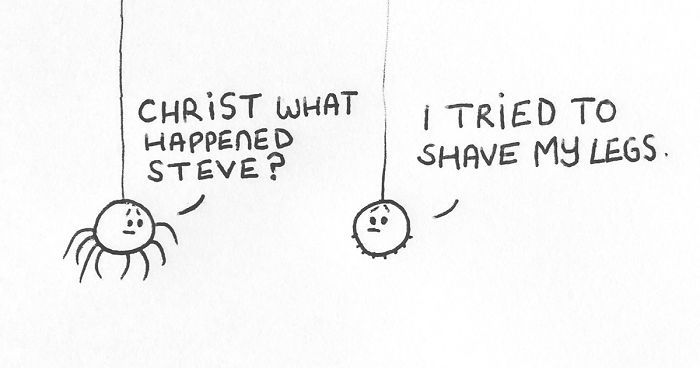
Normal names make absurd characters funnier. A spider named Steve feels instantly more relatable than “Arachnor the Web Lord,” unless Arachnor is applying for a mortgage, in which case please continue.
Use One Clear Joke Per Doodle
A short doodle should not carry five punchlines, a subplot, and a surprise musical number. Choose one idea and make it sharp. The cleaner the setup, the stronger the payoff.
Let The Image And Text Share The Work
In strong visual storytelling, the caption should not merely describe the drawing. It should add meaning. If the picture shows a bug holding a crumb, the words should reveal why the crumb matters. Is it dinner? A trophy? A failed investment strategy? That difference is where comedy lives.
Keep The Lines Readable
Doodles can be messy, but the story should not be confusing. Readers should know where to look first, who is speaking, and what changed between the setup and the punchline. Clarity is not the enemy of charm. It is the tiny ladder that helps the joke climb into the reader’s brain.
Publishing Doodle Comics Online
One reason simple doodles have become popular online is that they are easy to publish. An artist can sketch on paper, photograph the drawing, clean it lightly, and post it. Others may draw directly on a tablet or phone. The path from idea to audience is shorter than ever.
For web publishing, presentation matters. A gallery should use descriptive headings, short captions, relevant alt text, and image names that make sense. Instead of uploading “IMG_0047.jpg,” a creator might use “funny-spider-doodle-steve-web-problem.jpg.” That small detail helps both accessibility and search visibility. It also helps editors stay sane, which is a public service.
Readers also appreciate scannable structure. A long article about doodles should not become a giant wall of text wearing a fake mustache. Use headings, short paragraphs, and natural keyword placement. Phrases like “simple doodles,” “funny short stories,” “doodle comics,” “visual storytelling,” and “funny drawings” should appear where they make sense, not be shoved into every sentence like an overeager intern.
Why This Style Feels So Human
In a digital world full of polished images, ultra-smooth animation, and algorithm-friendly perfection, simple doodles feel refreshingly human. You can see the hand behind the line. You can feel the quick decision, the little mistake, the joke that arrived before the artist had time to overthink it.
That human quality is part of the appeal. A doodle says, “This came from a person.” Not a content factory. Not a corporate mood board. Not a committee that spent six meetings deciding whether the spider’s sadness aligned with brand values. Just a person, a pen, and a funny thought.
And because the format is so simple, it invites participation. After seeing a gallery of funny doodles, many readers think, “I could try that.” That is one of the best things art can do. It does not only entertain; it opens a door.
Experiences Related To Creating Simple Doodles To Tell Short, Funny Stories
Anyone who has tried making simple doodle stories quickly learns that the drawing is usually the easy part. The hard part is noticing the joke before it runs away. Funny ideas are slippery little creatures. They appear while making coffee, sitting in traffic, pretending to listen during a meeting, or staring at a snack and wondering whether it counts as dinner. If you do not capture them quickly, they vanish into the same mental drawer where forgotten passwords and New Year’s resolutions live.
A useful habit is to keep a tiny idea list. Not a fancy productivity system. Just a note on your phone or a small notebook where you write things like “ant with gym membership,” “moth attracted to bad decisions,” or “worm afraid of tunnels.” These phrases may look ridiculous to anyone else, but later they can become finished doodles. The trick is not to judge the idea too early. A bad idea can become a good joke after one unexpected twist. A good idea can become a bad doodle if it is forced to wear too many details.
Another experience many doodle artists share is learning to trust repetition. At first, drawing the same characters again and again may feel boring. But repetition is how a small comic universe becomes familiar. The more often you draw a character, the more naturally their personality appears. The spider might become cautious. The fly might become chaotic. The beetle might become dramatic. The worm might become the group therapist, despite having no visible qualifications.
It also helps to accept that not every doodle will be hilarious. Some will be mildly funny. Some will be cute. Some will sit there like a confused bean and offer nothing. That is normal. A gallery of 35 pictures probably comes from many more than 35 attempts. Behind every clean little comic is a pile of ideas that did not quite work. The audience sees the tiny stage show, not the rehearsal where the beetle forgot its line.
Posting doodles online can feel surprisingly personal. Because the drawings are simple, people often respond directly to the idea. They tag friends. They quote the punchline. They say, “This is me,” which is both flattering and slightly concerning if the character is a fly making terrible life choices. Comments can reveal which jokes connect most strongly. Sometimes the doodle you almost did not post becomes the one everyone loves. Sometimes the one you were sure would become a masterpiece receives the emotional response of a wet sock. This is part of the process.
The best experience, though, is discovering that simple drawings can create real connection. A few lines on a page can make strangers laugh in different countries, during different kinds of days, for different reasons. That is a small miracle. It proves that storytelling does not always need scale. Sometimes it just needs timing, honesty, and a bug named Steve having the worst Tuesday of his life.
Conclusion
I Create Simple Doodles To Tell Short, Funny Stories (35 Pics) is more than a catchy gallery title. It describes a creative philosophy: start small, stay clear, make it human, and let the joke breathe. Simple doodles remind us that storytelling is not reserved for perfect artists or giant studios. A short funny story can live inside a speech bubble, a wobbly line, or a tiny insect with a surprisingly relatable problem.
The beauty of doodle comics is that they make creativity feel possible. You do not need a professional setup to begin. You need a small idea, a simple character, and the courage to let imperfect lines carry a funny truth. Whether the result is a spider sitcom, a fly tragedy, or a beetle with management issues, the goal is the same: make someone smile before they scroll away.