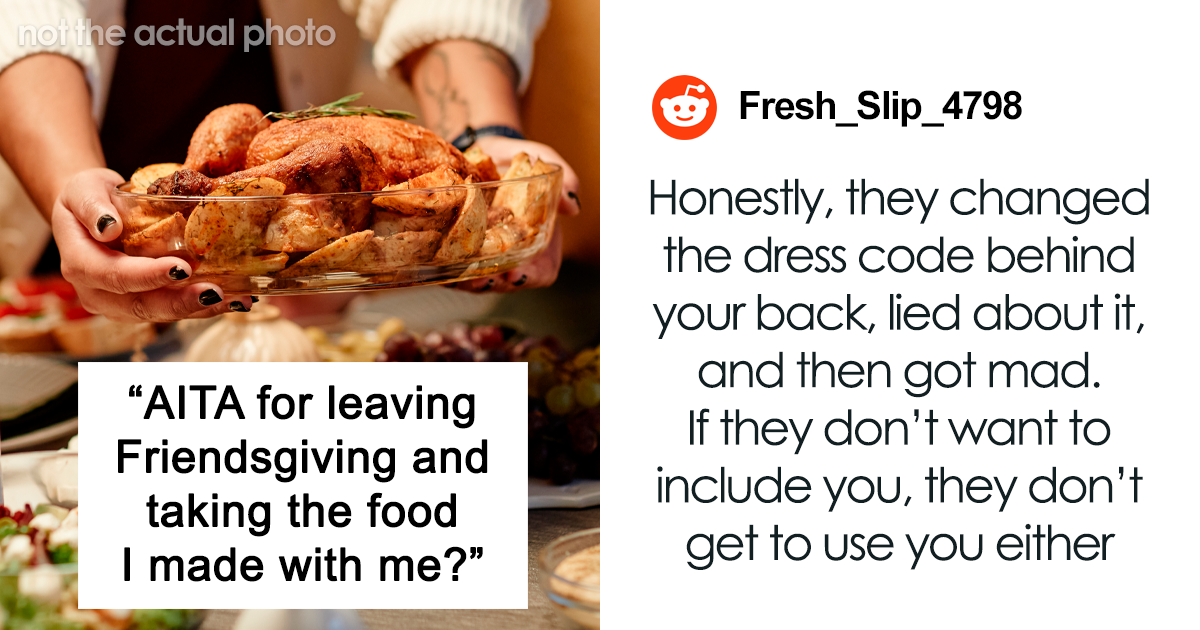
Some holiday stories come with pie, warm lighting, and a lesson about gratitude. Others come with a turkey, a secret dress-code switch, and the emotional equivalent of someone kicking over the folding table. This one falls into the second category.
A viral Friendsgiving story caught fire online after a woman explained that she arrived in joggers and an old T-shirt because the group had agreed to keep things comfy. Simple enough, right? Very sweatpants. Very elastic-waistband diplomacy. But when she got there, everyone else was dressed up. That is when she learned the group had quietly changed the plan behind her back because one friend felt insecure around her and assumed she would “do too much” with her outfit anyway. Instead of sitting down and pretending everything was fine, she grabbed the food she had brought, including the turkey, and left.
Internet readers did what internet readers do best: they formed tribes within minutes. One side said she was absolutely justified. The other side said taking the turkey turned hurt feelings into theatrical holiday warfare. The reason this story traveled so fast, though, is not because of the turkey. The turkey is merely the delicious prop. What really hooked people was the emotional mess underneath it: jealousy, exclusion, passive-aggressive planning, and that awful moment when you realize a friend group has been discussing you like you are a problem to be managed instead of a person to be respected.
That is why this Friendsgiving drama feels bigger than a single dinner gone wrong. It taps into anxieties a lot of adults know well but do not always admit out loud. Am I too much? Are people being honest with me? Are they laughing with me or quietly adjusting the rules around me? Nothing kills holiday cheer faster than discovering you were not invited into the real conversation.
The Friendsgiving Twist That Made Everyone Take Sides
According to the original post, the woman and her friends had agreed to dress casually for the gathering. She followed the plan. Other people apparently followed a different plan, one she was not told about. Later, she learned that the switch came after a pregnant friend confided that seeing her dress nicely made her feel insecure while struggling with body confidence late in pregnancy. Instead of handling those feelings directly and kindly, the group went full cloak-and-dagger over a holiday meal. In the follow-up, the pregnant friend reportedly admitted the move was childish, and the poster learned that another close friend had pushed the idea of changing the vibe without telling her.
That detail matters. The issue was never really joggers versus dress pants. It was the decision to create a private social test and let one person walk into it blind. When people say, “It’s just clothes,” they usually mean, “Please ignore the fact that this was actually about power, belonging, and embarrassment.”
Friendsgiving, by design, is supposed to be the casual cousin of Thanksgiving. It is the holiday where your friend’s apartment becomes sacred ground, somebody burns one pan a little, somebody else insists their stuffing recipe is “basically famous,” and everyone pretends the folding chairs are part of the aesthetic. It only works when the vibe is mutual. Once the group starts engineering who gets to feel comfortable and who gets to feel awkward, the whole thing stops being a celebration and starts looking like social hazing with cranberry sauce.
Why This Story Hit a Nerve Online
It was not about fashion. It was about social exclusion.
That is the part people recognized immediately. Most adults have lived through some version of this. Maybe not with a turkey, but with a text thread, birthday dinner, vacation plan, office party, or wedding-adjacent event where the rules somehow changed for everyone except one person. Exclusion hurts because it creates two wounds at once: the event itself feels humiliating, and the secrecy behind it makes you question the relationship.
Research and mental health experts have long pointed out that strong friendships are good for well-being, while strained or unhealthy ones can become deeply mentally draining. When a group starts operating on inside deals, selective transparency, and quiet alliance-building, trust erodes fast. That is why the story felt less like “women arguing over outfits” and more like “someone discovered she was no longer standing on solid ground with her own people.”
Insecurity may explain behavior, but it does not excuse sabotage.
The pregnant friend’s insecurity makes emotional sense. Pregnancy can bring major body-image shifts, discomfort, and a real sense of not feeling like yourself in your own clothes. Plenty of reputable health sources note that body image and self-esteem can be fragile under social pressure, and appearance-based comparison can make that worse. That part deserves compassion.
But compassion is not the same thing as a free pass. Feeling insecure does not entitle anyone to stage-manage another person’s appearance, downgrade them socially, or recruit a friend group into a secret workaround. There is a huge difference between saying, “I’ve been feeling rough lately and I don’t want tonight to feel dressy,” and saying, “Let’s all alter the plan so one person walks in looking out of place.” One is vulnerability. The other is a coordinated ambush in soft lighting.
The conspiracy made the food symbolic.
Taking the turkey was not just about food. It was the only immediate power the woman had left. She could not undo the embarrassment. She could not rewind the group chat she was excluded from. She could not force honesty into the room. What she could do was refuse to keep contributing labor, generosity, and a literal main dish to a gathering where she had just been made the punchline.
That is why so many readers sympathized with the dramatic exit. Was it graceful? Not especially. Was it understandable? Extremely.
What the Friends Actually Did Wrong
The biggest mistake was not the dress code itself. Hosts and guests can set whatever level of formality they want. The real failure was choosing secrecy over communication. Good social etiquette, especially around potlucks and holiday gatherings, depends on clarity. People need to know what to bring, what to expect, and how to show up. When a group communicates one thing publicly and another thing privately, it turns hospitality into a trap.
The second mistake was treating one woman’s style as a problem to solve. A lot of friendship tension is really comparison wearing a fake mustache. Someone dresses well, someone else feels underdressed, and instead of naming the insecurity honestly, the group starts talking about the stylish person as if she is intentionally “doing too much.” That phrase is often less about actual behavior and more about how somebody’s confidence lands in a room full of people who are not feeling their best.
The third mistake was gossip as conflict management. Healthy friendships can survive awkward conversations. They usually cannot survive a steady diet of side chats, assumptions, and “we just figured she would…” logic. When people stop speaking directly and start curating one another behind closed doors, every future interaction gets contaminated. Suddenly nobody knows what is real. Even the mashed potatoes feel fake.
Was Taking the Turkey Petty, Fair, or Both?
Honestly? Both. And that is why the story works so well.
Traditional etiquette says that when you bring food to a gathering, especially a potluck-style holiday meal, you are contributing it to the shared table. Under ordinary circumstances, yanking your dish and leaving would read as rude. But ordinary circumstances do not include discovering you were deliberately set up to feel out of place by the very people eating your food.
In that context, the turkey became a boundary. Not the most elegant boundary, perhaps, but a memorable one. It said: if I am welcome only as a cook, not as a respected friend, then the labor leaves with me. There is a lesson in that, even if it arrived wrapped in foil and righteous indignation.
People often expect the hurt person to remain polite for the comfort of everyone else. Smile. Sit down. Be the bigger person. Pass the gravy. But there is another side to that expectation. Sometimes “be the bigger person” is just code for “please make this less inconvenient for the people who embarrassed you.” That is not maturity. That is social cleanup duty handed to the wrong employee.
The Real Lesson: Insecurity Is a Conversation, Not a Group Project
If the friend who felt insecure had simply spoken up, this whole thing might have ended with understanding instead of a dramatic turkey relocation. She could have said she was struggling with how she felt in her body. She could have asked for a genuinely casual night. She could have admitted she was feeling weird and vulnerable. Those are human conversations. Messy, yes. But human.
Likewise, the woman at the center of the story could probably have had a direct conversation before things escalated to a cinematic exit. That does not make her the villain. It just means the cleanest endings are not always available in the moment you discover people have been weird behind your back. Hurt tends to arrive before perfect phrasing.
The healthiest version of this story would have involved honesty on both sides. One friend says, “I’m feeling bad about myself lately.” The other says, “I had no idea. I’m not trying to compete with you.” The group says, “Let’s make tonight actually comfortable for everyone.” No secret planning. No accidental fashion prank. No turkey custody dispute.
Why Stories Like This Spread So Fast
Part of it is simple holiday chemistry. Thanksgiving and Friendsgiving already come loaded with expectations: gratitude, closeness, nostalgia, and enough emotional history to power a small city. Add group dynamics, appearance anxiety, and one person who realizes too late that she has wandered into a social setup, and you have internet gold.
But the deeper reason is that these stories validate quiet experiences people carry around for years. The birthday where everyone “forgot” to mention the dress code changed. The dinner where two friends spent the night referencing jokes made in another chat. The group trip where one person mysteriously got left off planning calls. People read this Friendsgiving story and think, “Oh, so I was not overreacting. That weird feeling had a shape.”
And once a feeling has a shape, it gets harder to dismiss.
Experiences Related to This Story That Many People Recognize
One reason the turkey story resonated is that it feels like a louder, funnier version of situations many adults have already lived through. Someone gets invited to a “casual” birthday dinner and arrives in jeans, only to discover everyone else is dressed for rooftop photos and expensive cocktails. Nobody says anything cruel outright, but the person who followed the original plan spends the night feeling like they missed a memo written in invisible ink. The meal is still served. The pictures are still taken. Yet the real memory is the strange loneliness of standing in the middle of your own friend group and feeling miscast.
Another common version happens around money instead of clothes. A group agrees to keep a holiday exchange simple, then quietly upgrades the budget without telling one person. Suddenly the person who brought a thoughtful but modest gift looks cheap, even though they honored the agreement. The sting is not really financial. It is relational. They were not given the same information, which means they were not given the same chance to belong comfortably.
There are also body-image versions of this story that never go viral but live rent-free in people’s memories. A friend who has recently gained weight starts dreading events where photos will be taken. Another friend, who has always loved fashion and naturally puts outfits together well, becomes an accidental trigger. If nobody speaks honestly, resentment starts doing push-ups in the corner. Soon, harmless things get assigned motives they do not deserve. A fitted dress becomes “showing off.” Makeup becomes “trying too hard.” Confidence becomes “making people uncomfortable.” What could have been a tender conversation turns into a character accusation.
Then there is the classic group-chat split. The official chat remains cheerful and full of pumpkin emojis, while a side chat handles the “real” decisions. Many people have experienced that moment when they realize the discussion they thought was happening openly was actually happening elsewhere. It creates a special kind of embarrassment because it forces you to review recent memories like a detective. Was that joke about me? Was that delay intentional? Was everyone already informed except me?
Sometimes the hurt person leaves quietly. Sometimes they stay, smile, and cry later in the car. And sometimes, in the most emotionally satisfying version, they pick up their casserole, pie, or turkey and head for the door like a patron saint of delayed self-respect. That reaction may not be polished, but it is honest. It says, “I see what happened here, and I’m not going to pretend I don’t.”
What makes these experiences linger is not just the awkwardness of the event. It is the realization that friendship can go wrong in small, deniable ways. Nobody has to scream. Nobody has to throw a drink. Sometimes the injury is simply a changed plan, a withheld detail, a private assumption, and the sinking knowledge that your friends managed your feelings instead of respecting them. That is why the Friendsgiving story landed with so many readers. Beneath the joggers and turkey, it captured an experience people know all too well: the moment a social slight becomes impossible to explain away.
Final Takeaway
The woman who left Friendsgiving with her turkey did not just walk out over clothes. She walked out over betrayal disguised as etiquette. Her friends did not merely fail to coordinate a dress code; they turned one person’s insecurity into another person’s humiliation. That is the real offense.
If there is a lesson here, it is wonderfully unglamorous: say the awkward thing early. Tell the truth before the table is set. If you feel insecure, admit it. If you are hurt, name it. If the group is planning something, include everyone who will be affected by it. Social comfort should never be created by secretly making one person less comfortable than the rest.
Also, and this feels important, never conspire against the person bringing the turkey. That is not just bad etiquette. That is bad strategy.