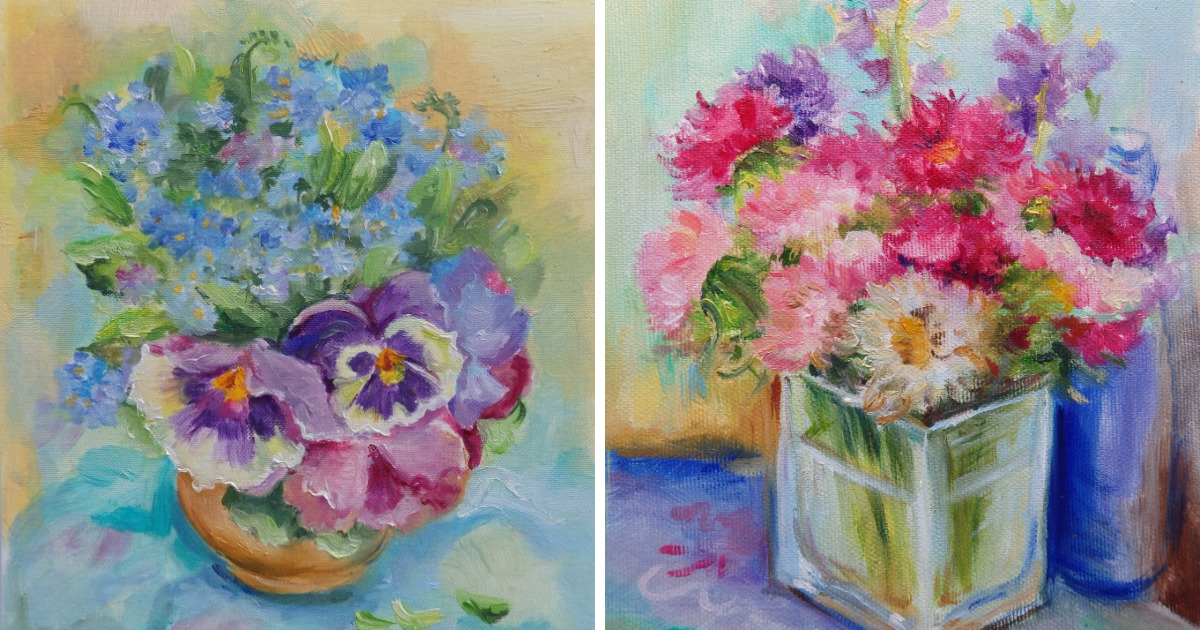
Flowers are among nature’s most generous models. They arrive already dressed for the occasion, hold dramatic poses without charging an hourly rate, and provide enough color combinations to make a paint store feel underqualified. Yet painting flowers from nature is not simply a matter of placing a rose in a vase and copying its petals. It is an exercise in observation, interpretation, timing, design, and occasionally negotiating with a peony that has decided to collapse before lunch.
When I paint flowers from nature, I am trying to capture more than botanical facts. I want the weight of a blossom, the rhythm of its leaves, the light slipping across a curved petal, and the quiet sense that this beautiful object will not remain unchanged for long. That tension between permanence and passing time is one reason flower painting has fascinated artists for centuries.
Why I Paint Flowers From Nature
A photograph can preserve a flower’s appearance, but working from life reveals its behavior. A tulip leans toward the window. A poppy trembles whenever someone walks across the room. A rose opens slowly, changing its entire geometry between the first sketch and the final layer of paint. Nature refuses to freeze, and that is precisely what makes it interesting.
Direct observation also exposes details that photographs often flatten. Petals are not merely “pink.” They may shift from warm coral near the center to cool lavender at the edge. White flowers contain reflections of blue sky, green leaves, warm walls, and surrounding objects. Even a dark leaf may hold several temperatures and values.
The U.S. Botanic Garden describes field journals as records combining sketches with observations about a plant’s size, color, habitat, location, and surrounding conditions. That same attentive approach is invaluable to painters because it turns casual looking into purposeful seeing.
Painting from nature is therefore part art lesson, part botany lesson, and part reminder that the word “green” is almost comically inadequate.
Flower Painting Has Deep Historical Roots
Artists have used flowers in devotional scenes, portraits, mythological images, landscapes, botanical studies, and still-life paintings for centuries. The Metropolitan Museum of Art notes that botanical imagery has appeared throughout Western painting in subjects ranging from religious narratives to secular mythology and independent still lifes.
From Scientific Study to Spectacular Bouquets
Early botanical artists often worked at the intersection of art and science. Accurate drawings helped scholars identify plants before modern photography existed. The artist needed to record recognizable structures without squeezing all the personality out of the specimen.
Joris Hoefnagel, for example, became known for highly accurate studies made after nature. Evidence in his surviving work suggests that he sometimes combined separate flower studies into elaborate bouquets. In other words, artists were assembling floral compositions from individual references long before digital layers and the phrase “we can fix it in post.”
The National Gallery of Art traces the development of Northern European flower painting through botanical treatises, manuscripts, watercolors, and lavish seventeenth-century still lifes. These works explored not only natural beauty but also the relationship between art, science, poetry, life, and mortality.
The Flower Still Life Becomes a Major Art Form
Dutch and Flemish painters transformed bouquets into miniature worlds. Artists such as Ambrosius Bosschaert, Jan Brueghel the Elder, Jan Davidsz de Heem, Rachel Ruysch, Maria van Oosterwyck, and Jan van Huysum painted flowers with extraordinary precision.
Many historical arrangements included blooms that would not naturally flower at the same time. Rather than painting the whole bouquet in one sitting, an artist could study individual flowers during their respective seasons and combine them into an ideal arrangement. Some highly detailed floral paintings therefore represented monthsor even yearsof observation rather than one conveniently cooperative vase.
These paintings were not merely decorative. Insects, damaged leaves, fallen petals, ripe fruit, watches, and fading blossoms could suggest abundance, fragility, or the brief duration of earthly pleasure. A flower painting might look cheerful from across the room while quietly whispering, “Enjoy your afternoon; time remains undefeated.”
Learning to See a Flower Before Painting It
The first step is not drawing. It is looking long enough for assumptions to get out of the way. Beginners often paint a mental symbol of a flower: a round center surrounded by evenly spaced petals. Real flowers are less interested in symmetry. They twist, overlap, curl, bruise, sag, and grow in directions that appear to have been approved by a committee with no chairperson.
Study the Basic Structure
Before choosing colors, identify the flower’s largest shapes. Is the blossom shaped like a cup, trumpet, disk, bell, cone, sphere, or loose cluster? Where does it connect to the stem? How do the leaves emerge? Which direction is the flower facing?
Rather than outlining every petal, I begin with the overall silhouette and central axis. I compare the width of the flower to its height, locate the darkest interior area, and observe how the blossom sits in space. This structural beginning prevents the painting from becoming a collection of decorative petals floating without support.
Look for Negative Shapes
The spaces between leaves, stems, and petals are often easier to judge than the objects themselves. A narrow triangle between two stems or an irregular patch of background between petals can help establish accurate proportions.
Negative space also improves composition. When every gap is the same size, a bouquet may feel stiff. Varied intervals create rhythm and make the arrangement appear natural rather than assembled by a floral robot with a ruler.
Observe With More Than Your Eyes
Close observation can include texture, scale, flexibility, and even scent. Denver Art Museum educational materials encourage viewers to examine real flowers closely, compare textures, and use magnification to notice details that are easy to overlook.
A magnifying glass can reveal veins, pollen, fine hairs, jagged edges, and tiny color transitions. I do not need to paint every microscopic discovery, but seeing those features helps me decide which details communicate the flower’s identity.
Setting Up Flowers for Painting
Choose Subjects With Character
A flawless flower is not always the most interesting one. I look for bent stems, half-open buds, irregular petals, insect marks, and leaves that turn in different directions. These features create individuality.
Simple flowers are excellent for early studies. Daisies, tulips, sunflowers, cosmos, and poppies have clear structures. Roses, chrysanthemums, hydrangeas, and peonies offer more complexity once the painter is comfortable simplifying crowded forms.
Use a Simple Background
A neutral wall, sheet of paper, cloth, or shadowed corner usually works better than a visually busy room. The background should support the silhouette and color of the flowers without attempting a hostile takeover.
Dark backgrounds can make pale blossoms luminous, while light backgrounds create airy, contemporary compositions. A colored background can establish harmony, but its temperature should be tested against the flowers before painting begins.
Control the Light
One clear light source makes form easier to understand. Side lighting is especially useful because it produces visible transitions from light to shadow. North-facing daylight is traditionally valued for its relative consistency, but a steady artificial lamp is often more practical.
I avoid combining several competing light sources. Warm indoor lamps mixed with cool window light can create interesting color effects, but they can also make the painter wonder whether the daisy is white, yellow, blue, or experiencing an identity crisis.
Plan for Change
Cut flowers move and fade. To manage this, I sketch the main structure immediately and establish the largest light and dark shapes early. I may also take reference photographs from the exact painting position, not as replacements for observation but as emergency records.
Historical artists faced the same challenge. Accounts associated with floral painters emphasize the need to work while blossoms remained fresh. The short life of the subject encourages decisive choices instead of endless polishing.
My Process for Painting Flowers From Life
Step 1: Make Small Composition Studies
I begin with several thumbnail sketches. These quick drawings test the placement of the bouquet, the balance of empty space, the direction of stems, and the location of the focal area. A two-minute thumbnail can prevent two days of trying to rescue a weak composition.
I avoid positioning every flower at the same height. Overlapping shapes, varied angles, and a mixture of open blossoms and buds produce a more convincing rhythm.
Step 2: Block In Large Shapes
Whether I use watercolor, gouache, acrylics, or oils, I first mass in the major shapes. I squint at the arrangement so minor details disappear. The bouquet becomes a pattern of light, middle, and dark values.
If the value structure is weak, adding petal veins will not save it. Detail is seasoning, not dinner.
Step 3: Mix Color Families
Instead of mixing one color for each object, I prepare related color families: several greens, warm and cool versions of the flower color, shadow mixtures, and a few neutrals. This keeps the painting unified while providing enough variation to describe light.
For white blossoms, I reserve the lightest paint for only the brightest areas. Most petals are painted with subtle grays, creams, blues, violets, and reflected greens. Using pure white everywhere makes flowers look flat and strangely refrigerated.
Step 4: Model the Flower as a Form
I treat the entire blossom as a three-dimensional object before separating individual petals. A rose may resemble a rounded cup, while a sunflower behaves more like a broad disk. Establishing the large form gives the smaller marks somewhere meaningful to live.
Step 5: Select Details Carefully
The focal flower receives sharper edges, stronger contrast, and more information. Secondary flowers are simplified. Some petals may be suggested with a single stroke or allowed to merge into the background.
This selective focus reflects how people naturally see. We do not inspect every petal simultaneously with equal intensity, despite what certain hyper-detailed paintings may have led our eyeballs to believe.
Step 6: Step Back Frequently
Close work can make small passages feel more important than they are. I step back, view the painting in a mirror, or photograph it in grayscale to evaluate value relationships. At a distance, awkward shapes and unnecessary details become much easier to identify.
Botanical Accuracy Versus Artistic Interpretation
Botanical illustration and expressive flower painting share a subject but may pursue different goals. Scientific botanical art prioritizes recognizable structure, accurate proportions, and identifying characteristics. Fine-art painting may distort color, enlarge forms, simplify anatomy, or rearrange space to communicate an emotional response.
The New York Botanical Garden describes botanical art training as a combination of scientifically accurate observation and fine-art technique. Mary Vaux Walcott similarly became known for watercolors that joined careful botanical description with visual beauty; hundreds of her North American wildflower illustrations were eventually published by the Smithsonian.
Accuracy and expression are not enemies. Close study gives artists the knowledge required to simplify intelligently. Once I understand how petals attach, how a leaf turns, and how a stem supports a blossom, I can exaggerate those features without losing the flower’s essential character.
Georgia O’Keeffe demonstrated how observation could lead toward abstraction. By enlarging flowers and emphasizing their internal rhythms, she encouraged viewers to notice forms they might otherwise overlook. Her paintings do not function as conventional botanical diagrams, yet they remain deeply connected to nature.
Common Flower-Painting Mistakes
Painting Every Petal Separately
This approach often produces stiff, cutout shapes. Group petals into larger light and shadow masses first. Separate only the petals that clarify structure or strengthen the focal point.
Using One Green Everywhere
Leaves vary according to species, age, light, atmosphere, and reflection. Mix warm yellow-greens, cool blue-greens, muted olive tones, and dark neutrals. Adding red, violet, or earth colors can prevent greens from looking electrically artificial.
Making All Edges Equally Sharp
Hard edges attract attention. When every edge is crisp, the painting becomes noisy. Use soft, lost, and broken edges in secondary areas so the focal flower can command attention without filing formal paperwork.
Ignoring the Stem and Leaves
The blossom may be the star, but supporting forms create movement and stability. A beautifully painted flower attached to an unconvincing stem resembles a glamorous actor standing on a cardboard set.
Continuing After the Painting Is Finished
Many flower paintings are harmed not by neglect but by enthusiasm. Once the composition reads clearly and the focal area feels alive, additional detail may weaken the freshness. Learning when to stop is a technical skill disguised as self-control.
What Flowers Teach the Painter
Flowers train patience without allowing procrastination. They demand close attention but continue changing while being observed. They teach that color is relational, edges are expressive, imperfections create identity, and beauty does not require permanence.
They also demonstrate that still life is never completely still. Leaves turn toward light, petals unfold, water levels fall, and stems bend under the weight of blossoms. The subject is quietly active throughout the session.
This helps explain why floral painting has remained relevant across so many periods and styles. It can be decorative, symbolic, scientific, meditative, abstract, personal, or all of these at once. The Smithsonian’s collections, for example, bring together floral studies ranging from precise wildflower illustrations to expressive modern interpretations, demonstrating how one subject can support remarkably different artistic intentions.
Conclusion: Painting What Will Not Stay
I paint flowers from nature because they make ordinary looking feel extraordinary. A single blossom can contain complex geometry, reflected color, delicate texture, movement, and evidence of time. The longer I observe it, the less simple it becomes.
A successful flower painting does not need to reproduce every detail. It needs to communicate the experience of paying attention. That may mean accurately describing the curve of a petal, exaggerating a surprising color, simplifying a bouquet into rhythmic shapes, or preserving the crooked stem that gives the entire arrangement its personality.
Flowers fade, but the act of painting slows the encounter. It gives the artist time to notice what would otherwise disappear between breakfast and tomorrow morning. The resulting picture is not merely a record of a plant. It is evidence that, for a little while, someone truly looked.
Studio Experiences: What Painting Flowers From Nature Feels Like
The experience usually begins with optimism. I arrange several flowers, adjust the lamp, prepare my palette, and imagine that the composition will proceed with museum-level dignity. Then one tulip turns forty-five degrees, a leaf falls into the water, and the tallest stem leans directly over the flower I intended to make the focal point. Nature has reviewed my design and submitted revisions.
That unpredictability has become one of the best parts of working from life. It prevents the process from becoming mechanical. Each session involves a conversation between the arrangement and the painting. Sometimes the original plan survives. More often, I discover that the flower’s natural movement is better than the pose I tried to impose on it.
One useful experience is returning to the same bouquet over several hours. In the morning, petals may be tight and upright. By afternoon, the blossoms open wider and cast different shadows. The color may appear warmer under changing light, while the stems begin to curve. These shifts make it impossible to treat observation as a single frozen moment.
I have also learned that the most difficult flower is not necessarily the most complicated one. A many-petaled chrysanthemum can be simplified into a few large masses, but a plain white calla lily may expose every weakness in drawing, value, and edge control. Simple subjects have nowhere to hide, which is admirable in a flower and mildly inconvenient for the painter.
Another recurring lesson involves color. I may begin convinced that a rose is bright red, only to discover muted crimson in the shadows, orange along one illuminated edge, violet where petals overlap, and reflected green near a leaf. Mixing those variations changes the way I see the actual flower. After a long session, even grocery-store bouquets begin to look like complicated color laboratories.
Not every painting succeeds. Sometimes the flowers wilt before the composition is resolved. Sometimes careful detail removes the energy of the first sketch. Occasionally the painted bouquet looks less like a celebration of nature and more like evidence from a suspicious gardening incident.
Those imperfect sessions are still valuable. They reveal whether I rushed the drawing, ignored the value pattern, overworked the focal area, or used detail to avoid a larger compositional problem. Because flowers change quickly, they encourage repetition. I can make another study tomorrow without feeling obligated to produce a masterpiece every time.
The most satisfying moment arrives when the painting begins to feel alive without copying everything. A soft edge suggests a petal turning away. One dark accent reveals the center of a bloom. A loose green stroke becomes a leaf because its angle, value, and temperature are right. At that point, technique becomes less visible and the sensation of the flower takes over.
Painting flowers from nature has ultimately changed my attention outside the studio. I notice weeds growing through sidewalks, shadows under roadside blossoms, damaged leaves, seedpods, and plants turning toward windows. The practice does not merely create paintings. It makes the visible world more specific, more surprising, and considerably harder to walk past without stopping.