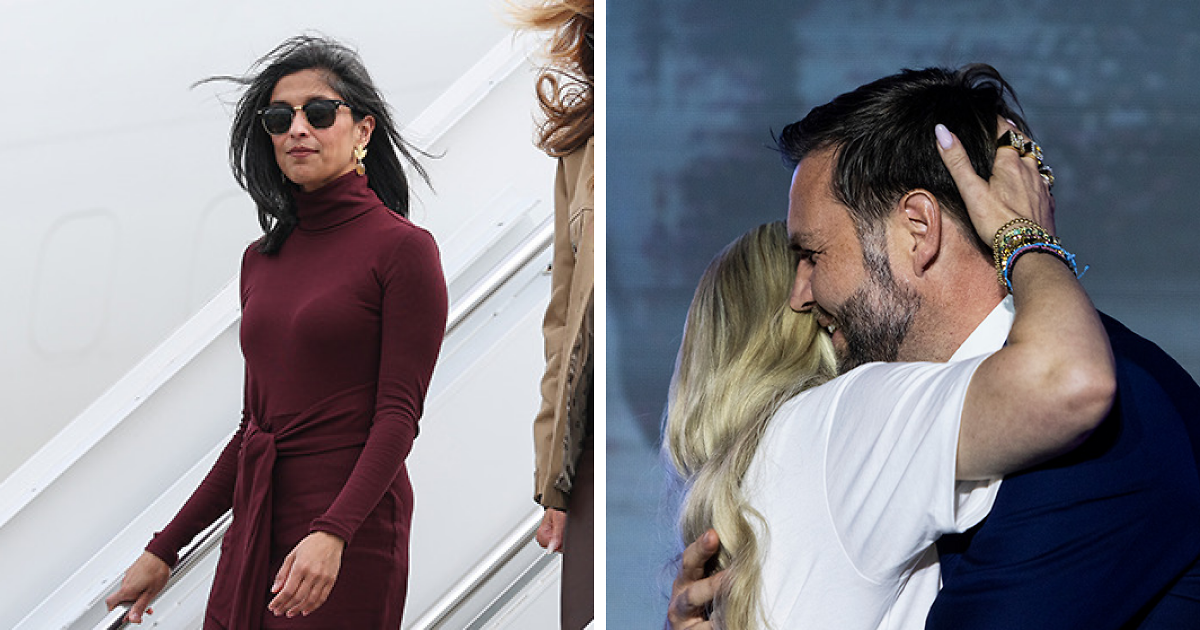
One missing ring. One viral photo. A few overheated social posts. And suddenly the internet was acting like it had been deputized as a national marriage counselor. That, in a nutshell, is how the latest round of speculation around Usha Vance and Vice President JD Vance spiraled into one of those very modern mini-scandals where a routine public appearance gets transformed into a full-blown relationship detective series.
But when Usha Vance finally addressed the chatter, her answer was not dramatic, defensive, or especially interested in performing for the rumor economy. It was refreshingly ordinary. Which, honestly, may be why it landed so hard. In a digital culture that feeds on chaos, ordinary can feel downright rebellious.
This story matters for more than tabloid-style curiosity. It says something about how political spouses are watched, how women’s bodies and accessories get turned into public evidence, and how quickly online speculation can outrun reality. It also shows why Usha Vance has become such a compelling public figure: she does not seem eager to audition for the role of internet myth, even when the internet very much wants her to.
The Photo That Lit the Match
The immediate trigger was simple enough. Usha Vance appeared publicly without her wedding ring, and online commentators treated that bare finger like it was the Zapruder film. Screenshots spread. Captions got breathless. Amateur analysts emerged from the digital woodwork with the confidence of veteran divorce attorneys and the evidence standards of people who once got duped by an onion article.
From there, the rumor cycle followed a familiar path. A small visual detail became a narrative. The narrative became a meme. The meme became a “conversation.” And the conversation quickly outran anything that could be verified. Suddenly, a ringless photo was being folded into larger theories about the Vances’ marriage, public appearances, and body language.
That kind of escalation is not new, but it does feel especially intense now. Political spouses are no longer just observed at official events. They are freeze-framed, zoomed in on, decoded, and judged in real time by thousands of people who mistake confidence for evidence. In that ecosystem, not wearing jewelry for one appearance is not treated like a normal human choice. It becomes “content.”
And that is where this story turned from mild gossip into what can only be called an online marriage meltdown: not because the marriage itself appeared to be melting down, but because the internet absolutely was.
What Usha Vance Actually Said
Once Usha Vance addressed the speculation, the grand mystery shrank back down to regular life size. Her explanation was striking in its simplicity: she wears the ring sometimes, and sometimes she does not. That was it. No coded statement. No dramatic reveal. No cloak-and-dagger political spouse intrigue. Just the kind of answer that millions of married people could probably offer without consulting a crisis communications team.
Her broader tone mattered just as much as the line itself. Rather than dignifying every rumor with a point-by-point rebuttal, she suggested that the fascination with her marriage says more about the surrounding media climate than it does about the state of her relationship. In other words, people love to read tea leaves even when all they are really holding is a coffee stain.
That response was effective because it did not sound engineered. It sounded human. Usha Vance has often projected a more reserved, low-drama public style than many high-profile political spouses, and that reserve worked in her favor here. She did not try to perform intimacy for the crowd. She simply declined to turn domestic life into a spectator sport.
There is a lesson in that. The internet often rewards oversharing and escalation. Usha Vance responded with calm understatement. That may not be flashy, but it is one of the few strategies that can puncture gossip without feeding it.
Why the Rumors Spread So Fast
A Missing Ring Is Always Clickbait Gold
Wedding rings carry an outsized symbolic load in public culture. People read them as shorthand for commitment, stability, and status. So when a public figure appears without one, audiences often leap past ordinary explanations and straight into soap opera logic. Maybe the person forgot it. Maybe it was being cleaned. Maybe they went to the gym. Maybe they were wrangling children, rushing out the door, and not planning a national symbolic statement with their left hand. But that is rarely where the internet begins.
For women in public life, this gets even more intense. Their clothes, expressions, posture, and jewelry are often treated like open-source intelligence files. One visible detail becomes a referendum on their marriage, mood, values, or ambition. Men in politics are scrutinized too, but the symbolic burden lands differently. A ringless hand on a woman is often interpreted as a message. A ringless hand on a man is often interpreted as an accident, if it is noticed at all.
The Viral Hug Added More Fuel
The ringless appearance did not exist in a vacuum. It collided with another online talking point: a widely discussed onstage embrace involving JD Vance and Erika Kirk after the death of Charlie Kirk. In the social-media imagination, unrelated moments do not stay unrelated for long. They get stitched together into larger stories, whether the stitching holds or not.
That is exactly what happened here. A public hug was framed as suspicious by some corners of the internet. A ringless photo appeared later. Then the algorithm did what it does best: package fragments into a pseudo-plot and deliver it to people already primed to see scandal. Before long, ordinary events had been repurposed into evidence boards for a case no one had actually proved.
Religion and Public Identity Raised the Temperature
The Vances also attract extra attention because their marriage sits at the intersection of religion, politics, race, and public expectation. JD Vance has spoken openly about faith, including his hope that his wife might one day share his Christianity, while also saying he respects her free will. Usha Vance, who was raised Hindu, has become a figure of interest in her own right because she does not fit into a neat cable-news box.
That complexity makes the couple more interesting to the public, but it also makes them more vulnerable to projection. People fill in blanks with whatever story best matches their politics, anxieties, or appetite for drama. For critics, every detail becomes proof of contradiction. For supporters, every criticism becomes unfair persecution. Somewhere in the middle is actual married life, which tends to be less cinematic than either side would prefer.
Who Usha Vance Is Beyond the Rumor Cycle
One reason the split rumors attracted so much attention is that Usha Vance is not just “the wife of a politician.” She is a high-achieving attorney with elite academic credentials, a history of Supreme Court clerkships, and a reputation for being thoughtful, disciplined, and intensely private. She met JD Vance at Yale Law School, and the two married in 2014. Over time, she has become one of the most scrutinized figures adjacent to his rise, precisely because she does not fit the cartoon version of a political spouse.
That matters. Public fascination with her is partly about biography. She is a daughter of Indian immigrants, a former litigator, a mother, and a second lady whose presence complicates lazy assumptions about ideology and identity. She also seems more comfortable living a real life than curating a permanent performance of one.
That disconnect helps explain the rumor machine. When a public figure is somewhat private, audiences often project more onto them, not less. Silence becomes mystery. Mystery becomes narrative opportunity. And narrative opportunity, online, is basically catnip.
Yet the strongest through-line in coverage of Usha Vance is not glamour or scandal. It is steadiness. Even when she has addressed the more personal edges of public scrutiny, she has done it in a measured way that suggests she understands the game but refuses to worship it.
The Bigger Story: Internet Forensics Have Broken Our Brains
The real headline here is not that Usha Vance responded to split rumors. It is that we now live in a culture where a person can skip a ring for a day and trigger a nationwide episode of speculative fan fiction. Social media has trained people to treat tiny visual clues as if they reveal hidden truth. Sometimes that instinct exposes something real. More often, it produces a community theater version of detective work, complete with shaky motives, dramatic music, and no actual evidence.
Political families are especially vulnerable because every image gets folded into larger ideological battles. A spouse is not just a spouse. She becomes a symbol, a stand-in, a Rorschach test. Supporters want reassurance. Critics want contradiction. Gossip merchants want traffic. Everyone arrives with a prewritten script and goes hunting for props.
The cost of that culture is not just bad takes. It is distortion. It turns ordinary private behavior into public spectacle. It rewards the loudest interpretation over the most grounded one. And it pressures public figures, especially women, to manage optics with exhausting precision lest a forgotten ring become a national conversation.
That is why Usha Vance’s reply resonated. It pushed the story back toward reality. Not every missing object is a message. Not every odd camera angle is a confession. Sometimes a ringless hand is just a ringless hand. Wild concept, I know.
Conclusion: A Marriage Rumor, a Media Lesson
In the end, the most interesting part of this episode is not the rumor itself. It is how little it took to create one. A photo without a ring became an online referendum. A public hug got folded into a larger tale. Existing debates about religion, identity, and politics supplied extra emotional voltage. Then Usha Vance stepped in and, with a few plainspoken comments, reminded everyone that internet certainty is not the same thing as truth.
That does not mean public curiosity will disappear. It will not. Usha Vance and JD Vance occupy a highly visible place in American political life, and visibility always invites scrutiny. But this moment offered a useful corrective. It showed the difference between observation and invention, between coverage and projection, between a marriage and a fandom board gone feral.
For readers, the takeaway is simple: be careful when the internet asks you to build a whole reality out of one photograph. Odds are good that the real explanation is less dramatic, less cinematic, and much more human. Which, inconveniently for rumor merchants, is usually where the truth lives.
Experiences Related to the Topic: Why This Story Feels So Familiar
Part of the reason this story blew up is that it taps into a very recognizable modern experience: the gap between what life is actually like and what photos make it look like. Almost everyone has lived some version of this, just on a smaller scale. You forget your ring at home because you were rushing. You look tired in a picture because your kid did not sleep. You stand awkwardly next to someone in a photo and suddenly your group chat is convinced you hate each other. Now imagine that happening under national scrutiny, with strangers narrating your personal life in real time.
That is what makes the Usha Vance episode more relatable than it first appears. Married people know that symbols are messy. Some wear rings every day. Some take them off for work, exercise, cooking, bathing children, travel, or plain old comfort. Some people are deeply sentimental about jewelry; others treat it like car keys and occasionally leave it somewhere mysterious until Thursday. None of that tells you much about the quality of the marriage itself.
There is also the weird experience of watching other people assign meaning to things you never meant as messages. Anyone who has posted a vacation photo, skipped a family event, or changed a profile picture has probably seen someone read too much into it. A missing ring becomes “trouble.” A serious expression becomes “tension.” Standing slightly apart in a group shot becomes “they are definitely fighting.” The internet has made semiotics everybody’s hobby and common sense everybody’s optional elective.
Political spouses live that dynamic at industrial scale. Every gesture is watched. Every outfit gets interpreted. Every appearance is judged not just aesthetically but symbolically. And because audiences now expect continuous access, privacy itself can be misread as concealment. If someone is reserved, people assume there must be a secret. If someone is polished, people assume there must be calculation. It is a no-win setup.
That is why Usha Vance’s response feels notable beyond the specifics of her marriage. She handled a very online controversy in an almost defiantly offline way. She did not spiral. She did not overshare. She did not try to out-content the content machine. She answered plainly and moved on. In an era when every public figure is pressured to become their own reality show, that restraint reads as both unusual and oddly confident.
And maybe that is the most relatable part of all. Most people do not want every mundane detail of their lives turned into narrative material. They just want to live, forget a ring now and then, show up to the event, and go home without becoming the main character of a comment section. A modest dream. A beautiful dream. A dream the internet, unfortunately, continues to treat as suspicious.