Editorial note: This article is written as cultural commentary and entertainment analysis. It is based on public reporting, official episode information, and Kenny Loggins’s public statement; it does not claim to know his private reaction.
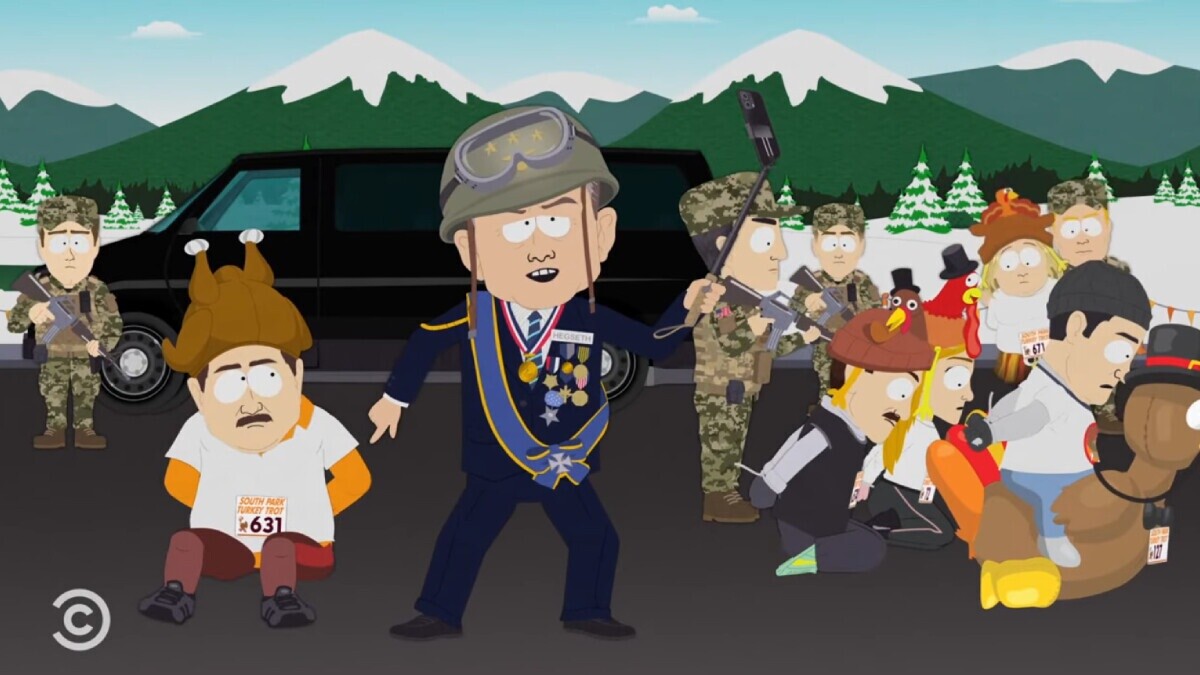
Some pop-culture moments arrive like a well-timed drum fill. Others enter the room wearing aviator sunglasses, holding a flamethrower of satire, and blasting a familiar 1980s soundtrack anthem while everyone asks, “Wait, is Kenny Loggins okay?” That is roughly the emotional weather around South Park Season 28, Episode 4, “Turkey Trot,” a Thanksgiving-themed installment that turned a small-town fun run into a full-scale political roast, complete with a “Danger Zone”-style parody aimed at Pete Hegseth.
The headline “Kenny Loggins Either Laughed Or Cried At Latest South Park” works because it captures the strange comedy of seeing one of America’s most recognizable movie songs pulled into yet another culture-war tornado. “Danger Zone,” originally tied to Top Gun, fighter jets, swagger, and the immortal art of looking serious while wearing reflective sunglasses, has lived many lives. It has been an action-movie adrenaline button, a karaoke dare, a sports-arena staple, a meme, and a recurring joke in animated comedy. Now, thanks to South Park, it has become the soundtrack-shaped punchline to a political parody about branding, online performance, and the absurd theater of toughness.
For Kenny Loggins, the timing was especially loaded. Before the episode aired, Loggins had publicly objected to the unauthorized use of his recording of “Danger Zone” in an AI-generated political video shared by Donald Trump. In his statement, Loggins said nobody had asked for his permission and that he would have denied it. He also argued that music should unite people rather than be used as a tool for division. Then along came South Park, which did what South Park does: it grabbed the cultural mess, put a paper crown on it, shoved it onto a treadmill, and made everyone watch the sparks fly.
Why “Turkey Trot” Put “Danger Zone” Back in the Comedy Crosshairs
“Turkey Trot” centers on South Park’s annual Thanksgiving race, a local tradition that becomes chaotic when sponsorship problems, political parody, and Cartman’s terrible ideas collide. The official episode description says the town’s annual Turkey Trot turns chaotic when Cartman uses “questionable cutting-edge science” to win the race. That mild description is like calling a fireworks factory explosion “a bright evening.” The episode expands into a broad satire of public image, performative masculinity, racial stereotypes, foreign sponsorship, and the way modern politics sometimes feels like a live-streamed commercial for itself.
The Kenny Loggins connection arrives through the episode’s parody of “Danger Zone.” Rather than using the song as heroic fuel, South Park bends the style into mockery. The joke is not just that a big 1980s action sound is funny when paired with incompetence. The deeper gag is that certain public figures seem to imagine themselves inside a patriotic action trailer, even when the reality looks more like a badly planned content shoot.
That is why the parody lands. “Danger Zone” has always carried the emotional scent of jet fuel, confidence, and very expensive sunglasses. It tells your brain, “Something dramatic is happening.” South Park flips that switch and points it at a character behaving like a self-promoting action hero in a situation that does not deserve action-hero treatment. The result is comedy by contrast: epic music energy, deeply unserious behavior.
Kenny Loggins and the Strange Afterlife of “Danger Zone”
Kenny Loggins did not merely sing a hit song. He helped define an entire category of pop culture: the 1980s movie soundtrack banger. His catalog includes songs associated with Caddyshack, Footloose, and Top Gun, which is why people often call him the unofficial king of movie soundtracks. “Danger Zone,” composed by Giorgio Moroder with lyrics by Tom Whitlock, became permanently linked with the speed, danger, and military-gloss fantasy of Top Gun. When Top Gun: Maverick revived the song decades later, it proved that the track still had a direct line to the audience’s nostalgia engine.
But iconic songs are complicated assets. Once a song becomes bigger than a single moment, everyone wants a piece of it. Sports broadcasts want the adrenaline. Commercials want the recognition. Memes want the instant joke. Politicians and political influencers want the emotional shortcut. Animated comedies want the cultural baggage. The more famous the song becomes, the harder it is for the artist to control what the public associates with it.
That is the tension at the center of the Loggins story. “Danger Zone” can still make people grin, pump their fists, and remember Tom Cruise launching into the sky. But it can also be dragged into contexts the artist never approved. When Loggins objected to the Trump AI video, his complaint was not only about copyright or permission. It was about association. He did not want his performance attached to a divisive political image. That makes the South Park parody especially sharp because it comments on the same cultural battle: who gets to control the meaning of a famous song once the internet has eaten it?
Did South Park Defend Kenny Loggins or Drag Him Deeper Into the Chaos?
The funniest answer is: yes. Somehow, both.
On one hand, South Park arguably sides with the basic idea that “Danger Zone” has been hijacked by people who misunderstand what makes it cool. The show’s parody does not present the song’s action-movie energy as sincere glory. It uses that energy to puncture fake toughness. In that sense, Loggins might have laughed. The episode takes the macho fantasy attached to the track and turns it against a character who seems desperate to look powerful.
On the other hand, the parody also means “Danger Zone” gets pulled even further into the political comedy machine. If you are Kenny Loggins, maybe you enjoy the joke. Maybe you appreciate that satire is different from unauthorized campaign-style use. Maybe you also sigh deeply into a cup of tea and wonder how a song from 1986 became a recurring hostage in America’s content wars. That is where the “laughed or cried” headline earns its keep. It understands that the situation is funny precisely because it is also exhausting.
Why South Park Loves Turning Pop Culture Into a Weaponized Mirror
South Park has always been at its best when it treats pop culture as both material and evidence. The show does not simply reference famous things; it asks why those things have power. A celebrity cameo, a viral trend, a political slogan, a streaming controversy, a tech panic, or a famous song becomes a mirror. The reflection is usually unflattering, and sometimes it looks like Cartman wearing confidence he absolutely did not earn.
In “Turkey Trot,” the “Danger Zone” parody works because the audience already knows the emotional code. We hear that style of music and expect heroism. The show gives us vanity instead. We expect discipline and courage. The show gives us content creation. We expect a mission. The show gives us a Thanksgiving fun run spiraling into absurdity. That gap between expectation and reality is where the comedy lives.
The episode also reflects a broader trend in modern satire: politics is now entertainment, and entertainment is now political whether it wants to be or not. A song from an action movie can become part of a dispute over AI, copyright, protest, and presidential social media. A cartoon can then parody that dispute by turning the same musical language into a joke about government image-making. The loop is dizzying, but it is also very 2020s. Culture no longer moves in straight lines. It ricochets.
The Pete Hegseth Parody and the Comedy of Performative Toughness
The episode’s Hegseth parody is built around a simple comic idea: what if someone wanted the aesthetics of war more than the responsibilities of leadership? The character is portrayed as obsessed with looking decisive, producing content, and turning serious situations into personal branding opportunities. That makes the “Danger Zone” parody a perfect match. It is the sound of someone trying to edit himself into a heroic montage, even when the story around him refuses to cooperate.
This is classic South Park construction. The show exaggerates a public persona until the exaggeration reveals something recognizable. It is not subtle, but subtlety has never been the main dish at South Park. The series prefers a satire buffet where the gravy is on fire and the mashed potatoes are arguing with cable news.
In the context of “Turkey Trot,” the parody also comments on the social-media age of leadership. The old political photo op has evolved into the always-on personal broadcast. Every crisis can be a clip. Every statement can be a brand extension. Every action can be packaged for followers. South Park mocks that instinct by making the character’s obsession with content part of the joke. The “Danger Zone” musical style becomes a fake halo around fake heroism.
Why the Joke Works Even If You Do Not Follow Every Political Reference
A good topical joke has two levels. The first level rewards people who know the news. The second level still works for people who only understand the human behavior being mocked. “Turkey Trot” does both. Viewers who followed the Loggins controversy, the Trump AI video, the Hegseth headlines, and the broader South Park season arc get the full package. But even viewers who know only “Danger Zone” as that famous Top Gun song can still laugh at the mismatch.
The reason is simple: everyone understands the person who tries too hard to look cool. Everyone has seen someone turn a small moment into a dramatic performance. Everyone knows the difference between actual confidence and costume confidence. The episode uses an instantly recognizable song style to expose that difference.
That is also why Kenny Loggins remains central to the joke without needing to appear in it. His song carries the cultural meaning. The show borrows that meaning, twists it, and lets the audience do the rest. In comedy, familiarity is gasoline. South Park strikes the match.
The Bigger Issue: Artists, Permission, and the Meme Machine
The Loggins controversy raises a serious point beneath the jokes. Artists have long objected when politicians use their music without permission or in ways that imply support. The AI era makes the problem even stranger. A song can now be attached to synthetic images, fake scenes, and viral political messages that move faster than traditional legal or public-relations responses.
For musicians, this creates a nightmare scenario. A recording is not just a sound file; it is part of an artist’s identity. When that recording is used in a political stunt, audiences may form associations the artist never intended. Even if people understand that the artist did not approve the use, the emotional connection can still stick. Music is powerful because it bypasses the boring hallway of rational thought and kicks open the door marked “feelings.” That is exactly why campaigns, influencers, brands, and satirists want it.
South Park is different from a campaign video because parody and commentary have their own cultural and legal context. Still, the episode shows how quickly a song can become a public battlefield. “Danger Zone” is no longer only about Maverick, jets, and blockbuster nostalgia. It is now also about AI clips, artist consent, political trolling, and animated satire. That is a lot of luggage for a three-and-a-half-minute rock song to carry. Someone get that track a chiropractor.
So, Did Kenny Loggins Laugh or Cry?
No public evidence tells us exactly how Loggins reacted to the South Park parody. The headline is a comic guess, not a confirmed report. But the emotional possibilities are easy to imagine.
He may have laughed because the show turned the macho misuse of “Danger Zone” into a joke at the expense of the very kind of political performance he had criticized. He may have cried, metaphorically speaking, because even a parody keeps his song tied to the same noisy political cycle he seemed eager to avoid. Most likely, the reaction would be complicated. Artists can appreciate satire while still feeling tired of seeing their work repurposed by the internet’s endless remix machine.
That complexity is what makes the story interesting. This is not only about one episode of South Park. It is about how old songs acquire new meanings, how satire feeds on current events, and how modern fame turns every cultural object into a potential weapon, shield, meme, or punchline.
Experience Section: Watching “Danger Zone” Become a Generational Joke Machine
There is a particular experience that comes with hearing “Danger Zone” in public. You do not simply hear it; you recognize it before your brain has finished the paperwork. The opening energy hits, and suddenly the room becomes 12 percent more cinematic. Someone may straighten their posture. Someone may pretend to fly a jet with their hands. Someone may make a joke about volleyball, sunglasses, or needing speed. Even people who have never sat down and studied Kenny Loggins’s catalog understand the signal: big action energy has entered the chat.
That is why the South Park parody feels so instantly readable. The show does not need to explain the reference. It trusts the audience’s cultural muscle memory. Many viewers have encountered “Danger Zone” through Top Gun, Top Gun: Maverick, sports montages, radio nostalgia blocks, TV comedy references, or the long-running internet habit of using dramatic music to mock very undramatic behavior. By the time South Park gets to it, the song is already both sincere and ridiculous. That is a rare achievement. Not every hit can survive long enough to become a parody of itself and still sound cool.
For viewers, the experience is almost layered. First comes recognition: “Oh, they are doing that song.” Then comes the joke: “Oh no, they are using that song for this guy.” Then comes the cultural aftertaste: “Wait, didn’t Kenny Loggins just complain about another political use of this?” That third layer is what turns a normal parody into a newsy pop-culture moment. The joke has context. It is not floating in space. It is attached to a real public argument about music, permission, AI, politics, and the strange destiny of old hits in new media.
Anyone who writes about entertainment for the web knows this kind of story is sticky because it gives readers several doors into the same room. Music fans care because Kenny Loggins is involved. TV fans care because South Park is still producing headline-making episodes. Political junkies care because the episode mocks current public figures. SEO people care because “Kenny Loggins,” “South Park,” “Danger Zone,” and “latest episode” are a keyword smoothie with extra caffeine. Casual readers care because the whole thing sounds absurd, and absurdity is the internet’s native language.
The most enjoyable part, though, is how the story reminds us that pop culture never really retires. A song from 1986 can come roaring back through a 2022 blockbuster sequel, a political controversy in 2025, and an animated Thanksgiving episode shortly afterward. That is not a normal life cycle; that is a pop-cultural triathlon. “Danger Zone” has gone from soundtrack hit to nostalgia object to meme engine to satire device, and it still has enough fuel left to make people click. If Kenny Loggins did laugh, he had reason. If he cried, he also had reason. Either way, the song remains undefeated in its ability to show up exactly when America gets weird.
Conclusion: South Park, Kenny Loggins, and the Never-Ending Danger Zone
“Kenny Loggins Either Laughed Or Cried At Latest South Park” is more than a funny headline. It is a perfect summary of how modern entertainment works. A classic song becomes a political controversy. A cartoon turns that controversy into satire. Audiences laugh because they recognize the music, the ego, the absurdity, and the exhaustion. Somewhere in the middle sits Kenny Loggins, whose “Danger Zone” remains so culturally powerful that everyone keeps trying to borrow its thunder.
The South Park episode proves that a great song can outlive its original context, but it also shows the downside of becoming iconic. Once the public owns the feeling of a song, the artist may still own the recording, but the meaning becomes harder to fence in. “Danger Zone” will always belong to Kenny Loggins in the musical sense. In the cultural sense, it now belongs to fighter jets, movie fans, meme accounts, animated chaos, and every joke that needs instant macho energy with a wink.
That may be the real danger zone: not the sky, not the battlefield, not the Thanksgiving racecourse, but the internet itself. Once a song becomes a symbol, there is no eject button.