Note: This article contains spoilers for multiple Futurama finales and finale-style season closers. It is written as original, publication-ready editorial content based on publicly available episode information, official streaming/press materials, entertainment reporting, and critical coverage.
Good News, Everyone: Futurama Has Ended More Times Than Most Shows Begin
Most TV shows get one finale. Futurama, being Futurama, looked at that rule, put it in a jar, attached a tiny Nixon head to it, and asked, “What if we did this repeatedly?” Since its 1999 debut, Matt Groening and David X. Cohen’s sci-fi comedy has survived cancellation, direct-to-DVD movies, Comedy Central revival, Hulu revival, and enough “final” emotional goodbyes to make even the Robot Devil ask for a contract revision.
That strange history is exactly why ranking the last scenes of every Futurama “finale” is so much fun. These endings are not just closing shots. They are tiny thesis statements about what the show thinks matters: love, time, memory, found family, cosmic absurdity, and the possibility that the universe is either a simulation, a joke, or both. Preferably both.
For this ranking, we are looking at the big finale-style endings: the original Fox goodbye, the DVD movie send-off, the Comedy Central could-have-ended-here episodes, and the Hulu-era season closers that deliberately play with the show’s own legacy. Ordinary season endings that do not feel like self-aware goodbyes are left outside the airlock.
Ranking Criteria: What Makes a Great Futurama Final Scene?
A great Futurama final scene needs more than a spaceship flying away while Bender says something criminal. The best endings combine emotional payoff, character closure, sci-fi imagination, and one last joke that does not puncture the feeling too much. Fry and Leela matter a lot here, because the show’s heart has always been hidden inside their awkward, time-bent romance. But the wider Planet Express crew matters too. A true Futurama ending should feel like a goodbye to New New York, not just a kiss under the sci-fi disco ball.
| Rank | Finale | Why It Matters |
|---|---|---|
| 7 | “The White Hole” | Huge cosmic idea, lighter emotional landing |
| 6 | “All the Way Down” | Smart simulation finale with a warm philosophical twist |
| 5 | “Overclockwise” | Beautiful ambiguity, but slightly incomplete as a goodbye |
| 4 | Into the Wild Green Yonder | Classic open-ended adventure finale |
| 3 | “Otherwise” | A melancholy echo of “Meanwhile” with real romantic weight |
| 2 | “The Devil’s Hands Are Idle Playthings” | Simple, musical, intimate, and nearly perfect |
| 1 | “Meanwhile” | The show’s most complete emotional farewell |
7. “The White Hole” A Cosmic Joke With a Slightly Smaller Heart
Futurama Season 13’s finale, “The White Hole,” has a wonderfully ridiculous premise: the Planet Express crew is sent on a ten-million-year mission to witness the birth of a new universe. Because the trip is too long for normal bodies and too expensive for normal workplace benefits, the crew sleeps in storage while temporary duplicates are created to keep the mission running. Naturally, these disposable duplicates eventually realize they are doing all the work while the originals plan to wake up just in time for the applause. That is not a labor dispute. That is a sci-fi unionization speedrun.
The final scene lands on a very Futurama-style joke: the originals return to Earth and get celebrated, even though they missed the actual miracle. The duplicates saw the newborn universe, but they are not the ones history remembers. The real crew receives medals, Nixon barks at everyone to accept the honor, and the white hole disappears. It is funny, bleak, and clever.
So why rank it last? Because as a “finale” last scene, it feels more like a sharp season closer than a goodbye. The idea is big, the satire is sturdy, and the cosmic scale is deliciously oversized. Still, the final emotional chord is more “Ha, existence is unfair” than “Please do not leave us again.” For a show with such legendary endings, that puts it at the back of a very strong line.
6. “All the Way Down” Simulations, Sacrifice, and Bender Being Weirdly Noble
“All the Way Down,” the finale of Hulu’s first revival season, is one of the smartest modern Futurama episodes. Professor Farnsworth creates a simulated universe, that simulated universe creates another simulation, and soon the episode becomes a nesting doll of existential panic. It asks a classic science-fiction question: if your world is artificial, does that make your love, fear, friendship, and terrible workplace safety record any less real?
The last scene gives the episode its emotional snap. Bender makes a one-way trip into the simulation to warn its inhabitants, only for the story to suggest that reality may be layered endlessly. When Bender appears to return in the “real” world with a line that mirrors his simulated self, the episode quietly hints that our familiar Planet Express crew may also exist inside someone else’s machine.
This is a strong finale because it does what Futurama does best: it turns a nerdy idea into a feeling. The final scene is not devastating in the way “Meanwhile” is, and it is not as elegant as “The Devil’s Hands Are Idle Playthings.” But it is philosophical without becoming homework. It says that meaning is not cancelled just because the universe might be running on somebody’s cosmic laptop. That is comforting, assuming the laptop is plugged in.
5. “Overclockwise” Fry and Leela Read Their Future
“Overclockwise” is one of those strange Futurama endings that becomes more interesting when you know the production history. It was written at a time when the show’s future was uncertain, so it had to function as a possible goodbye without slamming the door shut. The plot centers on Bender becoming super-intelligent after being overclocked. In that heightened state, he can predict future events with mathematical precision. Before returning to normal, he leaves Fry and Leela a written account of what will happen to their relationship.
The last scene is mostly silent, and that is its magic. Fry and Leela read Bender’s prediction together. Their faces shift through joy, worry, confusion, tenderness, and surprise. They react as if they are seeing a whole life together compressed into a few pages. The audience never gets the full text, which is exactly the point. The show lets us imagine their future instead of turning it into a checklist.
As a last scene, this is lovely. As a series finale, it is slightly too coy. It does not give the whole crew a sendoff, and it was not even positioned as the absolute final broadcast moment of that run. Still, Fry and Leela silently absorbing their possible future is emotionally smarter than a dozen loud farewell speeches. Sometimes the best punchline is letting the audience fill in the blank.
4. Into the Wild Green Yonder The Ship Flies Into the Unknown
The fourth direct-to-DVD movie, Into the Wild Green Yonder, ended the DVD-movie era and could have been the final Futurama story. Its last scene goes big: Fry, Leela, Bender, and the rest of the crew escape toward a wormhole while being chased by Zapp Brannigan’s Nimbus. The Professor warns that the wormhole could send them trillions of light-years away. The crew decides to go for it anyway. Fry and Leela share a kiss as the Planet Express ship vanishes into the unknown.
That is an excellent image for Futurama: love in the foreground, cosmic nonsense in the background, and a spaceship making a questionable decision at high speed. The ending has a classic adventure-serial feeling. Instead of saying, “This is over,” it says, “The story continues somewhere you cannot follow.”
The downside is that Into the Wild Green Yonder has a lot of movie-sized plot machinery to wrap up before it reaches that final shot. The last scene itself is strong, but the road there is busier than the cleanest Futurama endings. It works best as a wide-open sendoff rather than an intimate goodbye. Still, seeing the crew choose uncertainty together is deeply satisfying. When your delivery company has survived aliens, time loops, robot organized crime, and Zapp Brannigan, a wormhole is basically a company retreat.
3. “Otherwise” A Wedding, a Ghost Ship, and an Old Memory
“Otherwise,” the Season 12 finale, is one of the Hulu era’s most emotionally ambitious episodes. It plays like a sequel, echo, and gentle repair job for “Meanwhile.” The Planet Express ship appears to be destroyed. Fry is haunted by flashes of a life he does not consciously remember. He proposes to Leela, they are nearly destroyed again, and the episode twists reality through the multiverse river in a way that lets the show touch its old finale without fully undoing it.
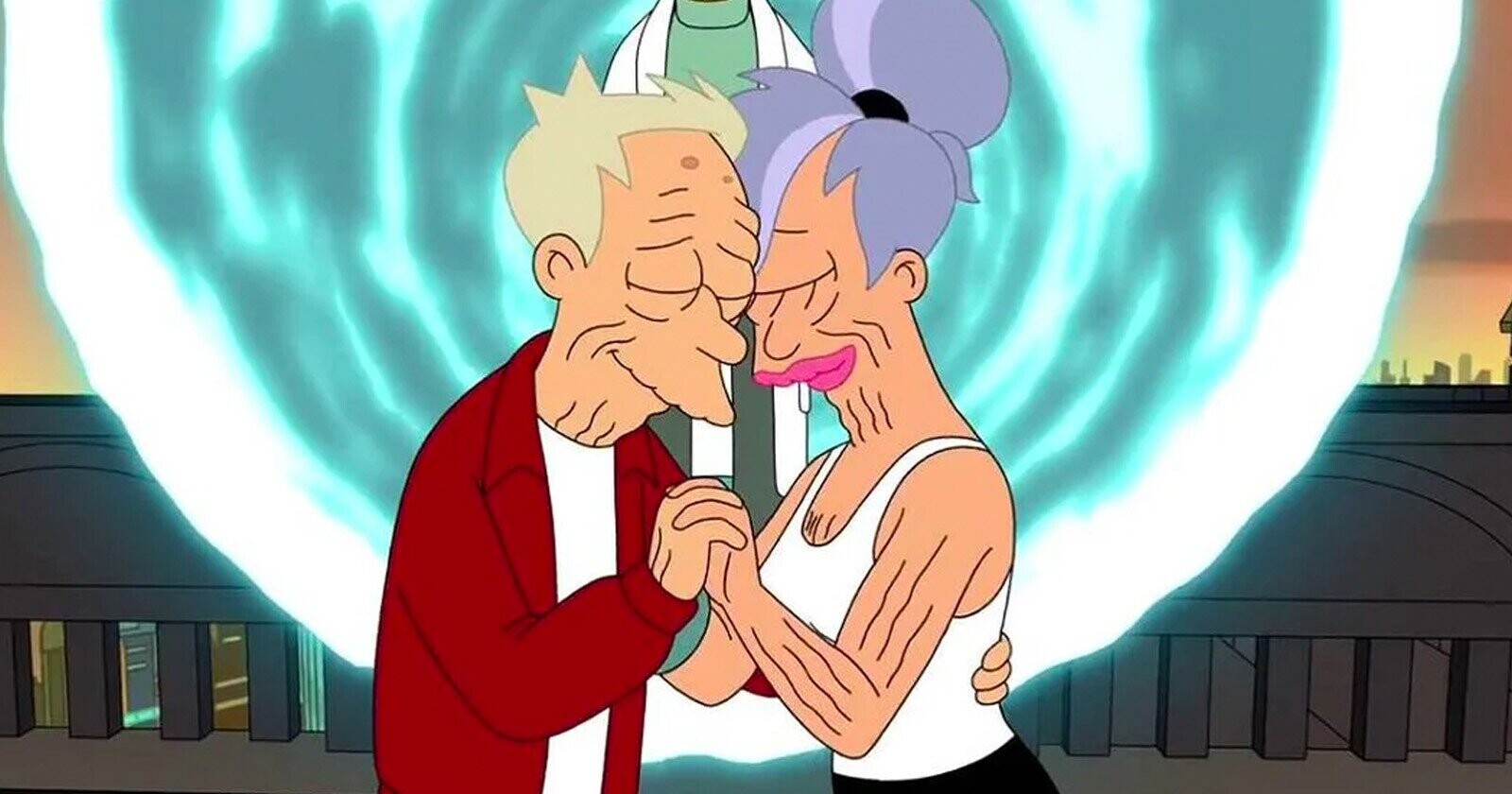
The last scene is beautifully understated. Fry sketches an image of himself and Leela as an elderly couple, a memory-like echo of the lifetime they spent together in “Meanwhile.” Leela sees the drawing and says they look awful but happy. Fry does not know exactly what it means. Then comes the emotional point: they want to find out.
This ending ranks high because it understands the burden of revival. When a show comes back after a beloved finale, fans worry that the return will cheapen the goodbye. “Otherwise” responds by turning that anxiety into text. It does not erase “Meanwhile.” It lets the emotional residue remain. The episode says that even if time is reset, love leaves fingerprints.
Is it a perfect ending? Not quite. It is a little twisty, and some of its mechanics feel like the Professor explaining a tax loophole during a space funeral. But the final emotional image lands. Fry and Leela do not need to remember every detail of their old life together. They just need to keep choosing the possibility of one.
2. “The Devil’s Hands Are Idle Playthings” Fry Keeps Playing
The original Fox finale remains one of the show’s finest half-hours. In “The Devil’s Hands Are Idle Playthings,” Fry trades hands with the Robot Devil so he can finally play the holophonor well enough to express his feelings for Leela. The result is a full operatic farce involving contracts, body parts, musical numbers, and the kind of romantic desperation that only Fry can make sweet instead of alarming.
The last scene strips everything down. Fry loses the Robot Devil’s hands and returns to his own clumsy human ones. His playing becomes rough and imperfect. The audience leaves. The spectacle collapses. But Leela stays. She asks Fry not to stop. He continues playing, and the holophonor produces a simple, fragile image of the two of them walking together. They hold hands as the screen fades out.
That is almost impossible to beat. The brilliance of the scene is that Fry fails at the grand gesture but succeeds at the honest one. He cannot perform perfection anymore. He can only offer himself, awkward hands and all. Leela accepting that imperfect music is more romantic than any flawless opera.
As a final scene, it captures the soul of Futurama: comedy first, sincerity sneaking in wearing a fake mustache. If the series had ended there forever, it would have been remembered as one of animation’s most graceful exits. Of course, it did not end there forever, because apparently the show’s cancellation notices were printed on boomerangs.
1. “Meanwhile” Want to Go Around Again?
“Meanwhile” is the gold standard. Originally aired as the Comedy Central finale, it uses a time button that sends the universe ten seconds into the past. Fry plans a proposal to Leela, chaos erupts, and eventually time freezes for everyone except the two of them. The world becomes a still-life museum. Fry and Leela are alone together, wandering through a paused universe and growing old as the only moving people in existence.
The last scene is devastating in the gentlest possible way. After a lifetime together, the Professor finally appears and explains that he can reset everything to the moment before he invented the button. Fry and Leela will lose the life they just lived, but they can begin again. Fry turns to Leela and asks if she wants to go around again. Her answer, “I do,” works as both a wedding vow and a cosmic yes.
This is the best Futurama finale because it balances everything: sci-fi mechanics, romantic closure, humor, mortality, and a reset button that feels poetic instead of cheap. Fry and Leela get a full life together. Then they choose the mystery of living it again. It is sad, hopeful, and perfectly circular. The episode even makes revival feel built into the ending. If the show returns, the loop continues. If it never returns, Fry and Leela still had forever.
That is why “Meanwhile” remains number one. It is not just a great last scene. It is the kind of ending that makes the entire series feel more meaningful in retrospect. For a comedy about a frozen pizza guy, a cyclops pilot, and a beer-powered robot, that is a pretty serious achievement. Somebody give the writers a medal. Preferably one Nixon has not yelled at.
Why Futurama Finales Keep Working
The secret to Futurama finales is that they rarely act like traditional finales. They do not spend twenty minutes arranging everyone into sentimental poses. Instead, they create a science-fiction problem that forces the characters to confront an emotional truth. Time freezes, simulations collapse, futures become readable, universes are born, and wormholes open. Underneath all of that, the question is usually simple: what do we mean to each other while we are here?
This is why Fry and Leela’s romance carries so much of the finale weight. Their relationship is not perfect, and early episodes often treat Fry’s crush as a joke. Over time, however, the show lets that joke mature into something sincere. Fry is still dumb enough to endanger reality, but he is also loyal enough to wait, learn, and try again. Leela is still tough enough to kick a monster through a wall, but she becomes more willing to accept love that arrives in strange packaging.
The best finales also understand Bender’s role. He is often the loudest, worst, and funniest person in the room, but he is not just comic relief. In “Overclockwise,” his future predictions become a love letter to Fry and Leela’s possibility. In “All the Way Down,” his simulated sacrifice turns an abstract question into a personal act. Even when he is being terrible, Bender reminds the show not to become too soft. He is the emotional smoke alarm that only goes off when someone tries to hug for too long.
Experience Section: Rewatching the Finales Feels Like Time Travel With Snacks
Rewatching the last scenes of every Futurama finale is a surprisingly emotional experience, especially if you first saw the show when cancellation felt final. The funny thing about Futurama is that it ages in two directions at once. Some jokes are very tied to their era, but the emotional beats feel fresher the older you get. A teenager might watch “The Devil’s Hands Are Idle Playthings” and think, “Nice, Fry learned an instrument badly.” An adult watches it and thinks, “Oh no, imperfect love is still love,” and then pretends there is dust in the room.
The endings also change depending on your mood. If you want adventure, Into the Wild Green Yonder feels like the perfect escape: the ship, the kiss, the wormhole, the reckless optimism. If you want comfort, “Meanwhile” is almost unbeatable, because it imagines love as something that can survive even the end of time. If you want a modern existential panic with jokes, “All the Way Down” will make you question reality while still enjoying Bender’s commitment to being Bender.
What stands out most is how often Futurama refuses to make endings feel final in a depressing way. Even its saddest goodbyes have movement. Fry keeps playing. The ship enters the wormhole. Fry and Leela go around again. The crew survives another cosmic disappointment. The show’s message is not “nothing ends.” It is more interesting than that. It says endings happen all the time, but people keep building meaning before, during, and after them.
That is probably why fans keep coming back. Futurama has always been about displacement. Fry wakes up a thousand years away from everything he knew. Leela spends years believing she is alone. Bender is a machine with the ego of a lounge singer and the ethics of a raccoon in a bank vault. The crew is full of people who should not fit anywhere, yet they fit together. Every finale returns to that idea. The universe can be huge, stupid, cruel, or simulated, but the people beside you still matter.
There is also a special pleasure in comparing the finales because each one shows a different version of what the series thinks closure can be. Closure can be a song. It can be a future you never get to read. It can be a kiss before a wormhole. It can be an old couple deciding to restart. It can even be a medal ceremony where nobody saw the thing they were supposed to see. In true Futurama fashion, closure is both profound and ridiculous, like a philosophy lecture delivered by a lobster doctor.
For viewers, these scenes become little emotional bookmarks. You remember where you were when you thought the show was gone. You remember the surprise of getting more episodes. You remember the worry that a revival might ruin a perfect ending, followed by the relief that the writers still knew how to find the soft spot under the metal shell. That is the rare magic of Futurama: it can make you laugh at a dumb visual gag, then quietly remind you that time is limited, love is strange, and going around again is sometimes the bravest answer.
Conclusion
The last scenes of every Futurama “finale” prove that the show has never treated goodbye as a single event. Goodbye is a loop, a song, a wormhole, a sketch, a simulation, a medal nobody deserves, and a question asked at the end of a lifetime: want to go around again?
“Meanwhile” takes the top spot because it gives Fry and Leela the fullest emotional ending while leaving the door open to begin again. “The Devil’s Hands Are Idle Playthings” remains a masterpiece of intimate romantic closure. “Otherwise” shows that a revival can honor an old ending instead of robbing it. Even the lower-ranked finales have something valuable to say, because Futurama understands that endings are not only about stopping. Sometimes they are about choosing what still matters before the next impossible delivery.