Note: This article is written as a personal-style photo essay for publication, using realistic school-event photography practices, Christmas service traditions, and low-light shooting principles.
There are some places you expect to outgrow: your locker, your cafeteria table, that one hallway where the floor squeaked like it was auditioning for a haunted house. But then you walk back into your old high school for the annual evening Christmas service, camera in hand, and suddenly the building has the emotional range of a holiday movie with a decent lighting budget.
This year, I returned not as a student trying to remember whether my tie was straight, but as a photographer trying to capture something far more slippery: memory in motion. The service was called Lessons & Lights, and the name fit perfectly. There were readings, carols, candles, nervous student performers, proud parents, glowing windows, and the unmistakable smell of polished wooden pews mixed with winter coats. In other words, Christmas had arrived wearing school shoes.
Photographing an evening Christmas service at an old high school is not like shooting a regular holiday party. You cannot barge around with a flash like a paparazzo chasing Santa. You have to move quietly, anticipate emotion, respect the room, and make peace with darkness. Low light is not your enemy here; it is the entire point. The soft shadows, candle glow, and deep blue evening windows are what make the story feel sacred, nostalgic, and very human.
Why An Evening Christmas Service Feels Different
Daytime school events often run on energy: applause, announcements, squeaky sneakers, and someone asking where the extension cord went. An evening Christmas service has a different rhythm. It begins slowly. People arrive in hushed clusters. Students straighten collars. Choir members pretend they are not nervous. Teachers take on that calm, all-knowing expression that usually means they have solved six minor emergencies before anyone noticed.
The tradition of Christmas services built around readings and carols has deep roots. Many Lessons and Carols services follow a pattern of Scripture readings, hymns, choral music, and congregational singing. The format gives the evening a natural structure: a reading, a response, a song, a pause, a breath. For a photographer, that rhythm is a gift. It tells you when to stand still, when to move, and when to lift the camera before the moment disappears.
At my old high school, the service was not trying to be grand in a cathedral-sized way. Its beauty came from familiarity. The choir stood where morning assemblies used to happen. The lectern had probably survived decades of speeches, awards nights, and slightly too-long announcements. The Christmas tree leaned just enough to prove it had character. And the lightswarm, low, forgivingmade everyone look a little more thoughtful than they probably felt while searching for their programs.
The Challenge Of Photographing Candlelight Without Ruining The Mood
Low-light photography is a balancing act, especially in a room where the atmosphere matters. The goal is not to make the service look like it happened under supermarket fluorescents. The goal is to preserve the mood while keeping faces sharp enough that parents do not ask, “Is that my child or a festive blur?”
For this event, I worked mostly with available light. That meant raising the ISO, using a wide aperture, watching shutter speed carefully, and accepting a little grain as part of the atmosphere. Modern cameras handle higher ISO settings much better than older models, but there is still a limit. Push too far, and the shadows begin to look like they were sprinkled with digital pepper.
I avoided flash during the readings and carols. A sudden burst of light in a candlelit service is the photographic equivalent of sneezing during a solo. It breaks the spell. Instead, I looked for pockets of light: a student reader standing beneath a warm lamp, a row of candles reflected in a window, the choir’s faces lit from below by sheet music stands, and the soft glow around the Christmas tree.
My Practical Camera Approach
I kept the setup simple because school services move faster than they appear. A quiet camera body, a fast lens, and a spare battery were enough. A 35mm or 50mm lens is excellent for this type of indoor storytelling because it captures context without making everyone look like they are being observed through a telescope from another county.
My general settings shifted throughout the evening, but the core idea stayed the same: keep the aperture wide, keep the shutter fast enough to avoid hand-shake and performer movement, and adjust ISO as needed. For still moments, slower shutter speeds worked. For choir entrances, candle processions, and students turning pages, I needed more speed. Photography, like high school, rewards preparation but still enjoys throwing quizzes.
The 9 Pictures That Told The Story
The best photo essays are not just collections of pretty images. They create a path. For Lessons & Lights, I wanted the nine pictures to feel like walking into the service, sitting through it, and leaving with the afterglow still attached to your coat.
Pic 1: The Front Doors At Dusk
The first image showed the school entrance just after sunset. The windows were warm, the sky was deep blue, and a small crowd was gathering near the doors. It was not flashy, but it established the whole mood: people returning to a familiar place, drawn by music, memory, and possibly the promise of mince pies.
Pic 2: The Program In Someone’s Hands
Close-up details matter. The second photograph focused on a printed service program held by a parent wearing wool gloves. You could see the title, the order of readings, and the slight bend in the paper. It reminded me that events are built from small objects: programs, hymn sheets, candles, name badges, and the pen someone always forgets to return.
Pic 3: The Choir Waiting To Begin
This was one of my favorite frames. The choir stood in two rows, pretending to be relaxed. One student stared straight ahead with heroic seriousness. Another whispered something and tried not to laugh. The image had the perfect mix of ceremony and teenage reality. Christmas may be timeless, but teenagers remain wonderfully, predictably human.
Pic 4: The First Lesson
The first reader stepped up to the lectern, and the room settled. This photograph worked because of the light: a warm pool on the reader’s face, darkness behind, and the edge of the Christmas tree just visible in the frame. It captured the “Lessons” half of Lessons & Lightsquiet, focused, and sincere.
Pic 5: Candles Along The Aisle
The candle image could have become a cliché, so I tried to make it specific. Instead of photographing a single flame, I framed the aisle with several candles leading toward the choir. The shallow depth of field turned the background into a soft glow. It looked peaceful, even though I was crouched near the end of a pew trying not to step on anyone’s scarf.
Pic 6: A Teacher Singing From The Back Row
One of the strongest images was not of a student performer at all. It was a teacher standing at the back, singing quietly from the program. Teachers often hold school traditions together without demanding the spotlight. This frame felt like a thank-you note in photographic form.
Pic 7: The Brass Ensemble Under The Balcony
Holiday music changes the air in a room. The brass ensemble added brightness without overwhelming the service, and the photograph caught the reflection of instrument bells under the balcony lights. Brass instruments are basically Christmas ornaments that learned to make noise, and I mean that as a compliment.
Pic 8: The Candlelit Final Carol
The final carol was the emotional peak. Students, families, staff, and alumni stood together, candles raised. From the side aisle, the frame showed rows of tiny lights fading into the back of the hall. It was the kind of photograph that does not need everyone’s face visible to feel personal.
Pic 9: The Empty Hall Afterward
The last picture was taken after people had left. A few programs remained on pews. The tree lights were still on. The hall looked both empty and full, which is the strange magic of places where people have gathered with intention. This final image gave the photo essay a quiet ending instead of a dramatic curtain drop.
Respect Matters More Than The Perfect Shot
Photographing a school Christmas service is not only a technical job. It is also an ethical one. Schools often have policies about student images, public events, and photo permissions. A photographer should understand those rules before the first shutter click. That means checking where photos may be used, whether any students should not be photographed, and how images will be shared online.
In practice, respect shows up in simple choices. Do not photograph a student in an embarrassing moment. Do not block a parent’s view. Do not treat worship, reflection, or remembrance like a stage show. If a moment feels too private, lower the camera. The best photographers know that not every beautiful thing belongs in a frame.
I also tried to photograph the community, not just the performers. A service like this belongs to everyone present: the student holding a candle, the parent mouthing every word of a carol, the alum smiling at a hymn they had forgotten they knew, the caretaker quietly checking the side door. These are the details that turn event coverage into storytelling.
What The Service Taught Me About Nostalgia
Nostalgia can be a tricky editor. It softens the edges, improves the lighting, and conveniently deletes awkward memories like failed math tests and cafeteria mystery sauce. Walking back into my old high school reminded me that the past is not perfect; it is simply layered. The same building can hold stress, laughter, boredom, ambition, embarrassment, and joy.
The annual evening Christmas service made those layers visible. Current students were creating memories in the same place where former students once sat, sang, whispered, worried, and wondered what came next. The event connected generations without making a speech about it. That is the power of school traditions: they let time overlap for an evening.
As I photographed the service, I noticed how often people looked up. They looked toward the choir, toward the candles, toward the old windows, toward the ceiling during the music. In a world that spends a heroic amount of time looking down at screens, that alone felt meaningful.
Tips For Photographing A School Christmas Service
Arrive Early And Read The Room
Get there before the audience arrives. Look for strong angles, safe walking paths, light sources, and places where you can stand without becoming part of the performance. The best event photographers are visible only when needed and invisible the rest of the time.
Use The Light That Already Exists
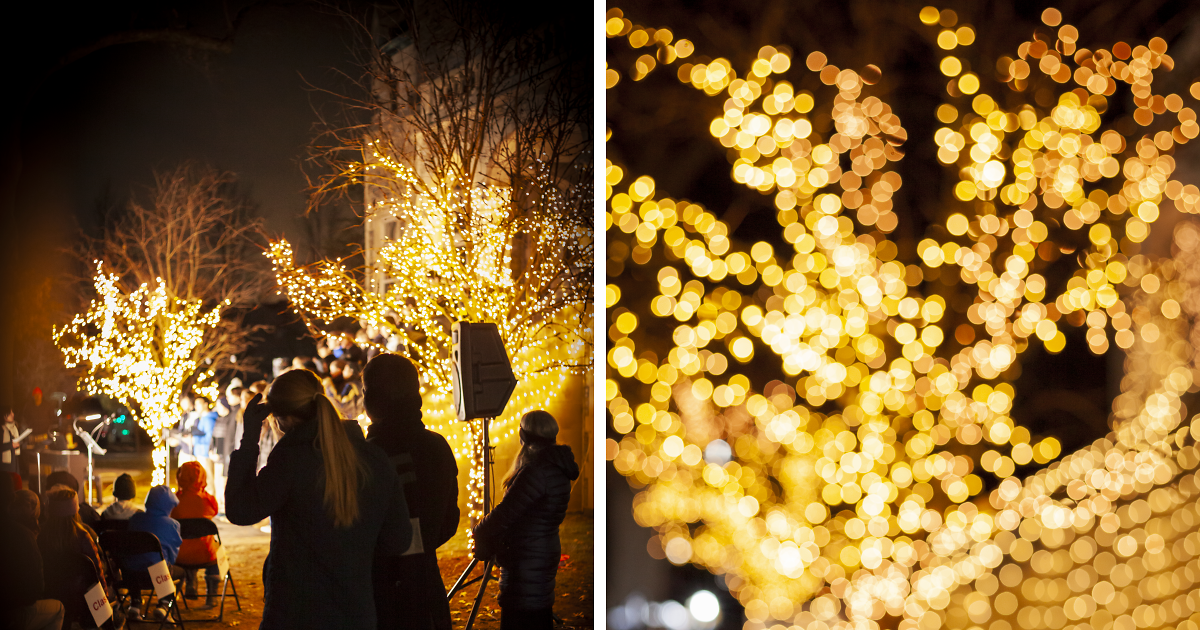
Candlelight, tree lights, music-stand lights, window glow, and overhead lamps can all help shape the story. Do not fight the atmosphere. Work with it. Warm light is part of the emotional language of Christmas service photography.
Capture Transitions
Some of the best images happen between official moments: choir members lining up, readers returning to their seats, candles being passed carefully from one person to another, and families greeting teachers afterward. Transitions reveal personality.
Think In Sequences
A strong nine-picture story needs variety. Include wide shots, medium scenes, close details, emotional moments, and a quiet ending. If every photo is a close-up of a candle, the essay starts to look like a wax catalog with feelings.
Edit For Mood, Not Perfection
In post-processing, I kept the warmth and shadows intact. It can be tempting to brighten everything, remove every grain, and polish the images until they look like a brochure. But the service happened in evening light. The photos should remember that.
Why These 9 Pics Stayed With Me
The photographs were not dramatic in the breaking-news sense. No one leapt through the air. No confetti cannon exploded. No wise-looking dog wandered into the choir, though I would absolutely have photographed that. Instead, the images mattered because they were quiet. They showed people participating in something gentle and familiar.
That kind of photography asks for patience. You wait for a glance, a candle flame, a hand on a program, a singer taking a breath. You pay attention to what the room is saying before deciding what the camera should say. And sometimes, if you are lucky, you leave with pictures that feel less like evidence and more like memory.
Extra Reflections: What It Felt Like To Come Back With A Camera
Returning to my old high school for Lessons & Lights felt like opening a book and discovering someone had kept writing chapters after I left. The building was familiar, but not frozen. There were new notice boards, new staff faces, new students, and a few changes that made me briefly suspicious of progress. The old trophy case had moved. The hall chairs were nicer. The sound system, miraculously, no longer behaved like it had been assembled during a thunderstorm.
But the emotional geography was the same. I still knew which doorway made people bunch up. I still remembered the corner where students used to wait before performances. I still felt the strange pressure of the main hall, a place that could make a casual announcement feel official. Carrying a camera through that space gave me permission to observe it differently. I was not there to relive school. I was there to see what the school had become.
The experience also reminded me that photography is partly about humility. You can plan your settings, choose your lens, and imagine your dream shots, but the strongest moments often arrive quietly and without asking your permission. A student adjusting another student’s candle. A grandparent closing their eyes during a carol. A teacher smiling at the choir with the unmistakable expression of someone who remembers the first rehearsal and is relieved everyone survived. Those moments cannot be ordered like coffee. You have to be ready when they appear.
I was also surprised by how emotional the sound was. Photographs are silent, but the act of taking them was full of music: the opening notes of a carol, the rustle of programs, the tiny click of candles being passed along, the collective inhale before a familiar hymn. When I later edited the images, I could still remember where the music swelled. That helped me choose frames with feeling, not just frames with good exposure.
The funniest part was how quickly I reverted to old school instincts. When a staff member walked briskly down the aisle, I automatically straightened up, despite being a fully grown adult with permission to be there. Apparently, some reflexes graduate with you. At one point, I nearly apologized to a portrait of a former headmaster because my camera bag brushed the wall beneath it. That is the kind of authority old school buildings keep in their bricks.
By the end of the evening, I realized the service was not only about Christmas. It was about continuity. Schools are noisy, imperfect, stressful places, but they are also memory machines. Every year, a new group of students stands under the lights and sings the songs. Every year, families sit in the dark and feel proud. Every year, teachers quietly make the whole thing work. And every year, someone returns and sees the place with older eyes.
Photographing the annual evening Christmas service taught me that light does not have to be bright to be powerful. Sometimes it is strongest when it is small: one candle, one music stand, one window glowing against December dark. The lesson, if I had to name it, is simple. The places that shaped us do not stop shining when we leave. They keep the lights on for the next group, and sometimes, if we are lucky, they let us come back and take pictures.
Conclusion
Lessons & Lights: I Photographed The Annual Evening Christmas Service At My Old High School (9 Pics) is more than a nostalgic photo essay. It is a reminder that school traditions matter because they gather people around shared memory, music, and meaning. The camera helped me notice what I might have missed as a student: the care behind the service, the beauty of low light, the dignity of quiet participation, and the emotional power of a familiar place seen again.
For photographers, the lesson is practical: prepare well, move gently, respect privacy, and let the existing light tell the truth. For alumni, the lesson is warmer: going back does not have to mean getting stuck in the past. Sometimes it means recognizing how much life has continued, and how a few candles in an old hall can make time feel beautifully connected.