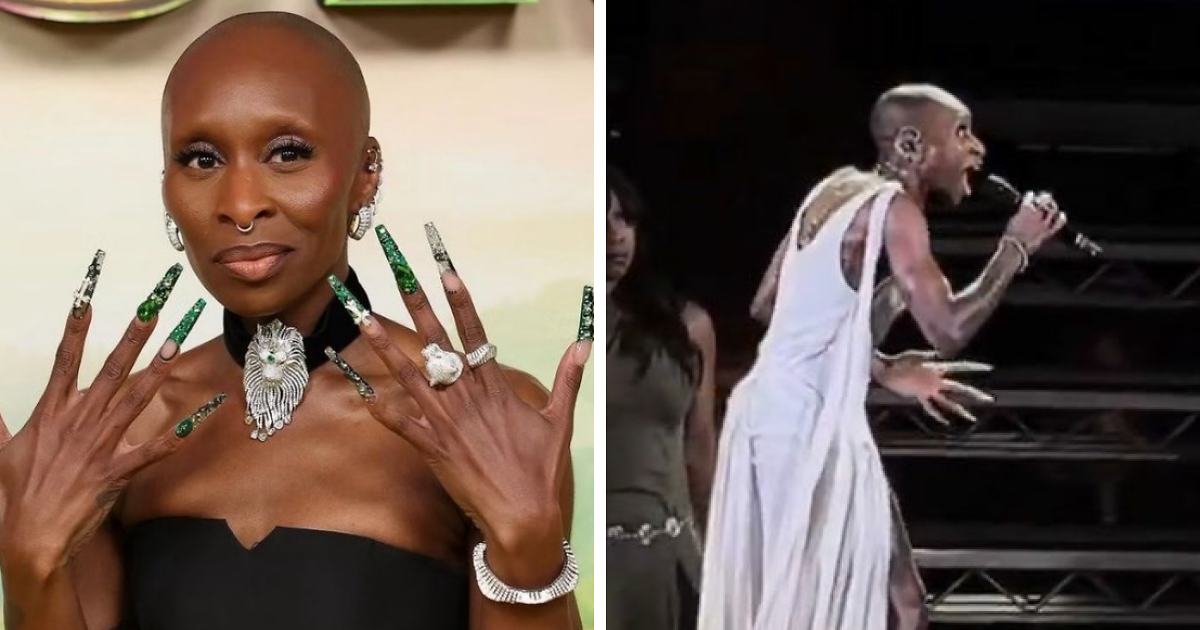
Every awards season, press tour, and celebrity red carpet comes with an unofficial side quest: the internet zooming in on one detail and deciding it deserves a congressional hearing. This time, the target is Cynthia Erivo, whose dramatic nails, expressive hands, and fearless fashion choices have sparked another noisy debate online. The phrase "oddly large hands" has been thrown around in viral posts, while one especially harsh comment claimed she "makes herself look like a demon."
That is a lot to put on a manicure.
Erivo, the Tony, Grammy, and Emmy-winning actress and singer best known recently for playing Elphaba in Wicked, has never been a background-character dresser. Her style is theatrical, architectural, and often intentionally sharp. She wears nails like tiny sculptures, gowns like stage lighting, and accessories that look as if they were designed after someone said, "What if the jewelry had its own agent?" So when social media users began debating her hands, the conversation quickly became bigger than anatomy. It became a messy little case study in celebrity culture, fashion literacy, fandom, criticism, and the internet’s habit of confusing personal taste with moral judgment.
Why Cynthia Erivo’s Hands Became A Viral Talking Point
The latest wave of discussion appears to have been fueled by resurfaced images and clips tied to Erivo’s high-profile performances and appearances, including her bold turn as Jesus in Jesus Christ Superstar at the Hollywood Bowl and her ongoing Wicked-related press visibility. In those images, her long, sharply shaped nails naturally draw attention. They extend the line of her fingers, exaggerate gestures, and make her hands read larger on camera.
That is not exactly a mystery worthy of a detective board with red string. Long nails change proportions. Rings change proportions. Wide-angle photos can change proportions. Dramatic posing changes proportions. Stage lighting changes proportions. Screenshots captured mid-gesture can make anyone look like they are either casting a spell, summoning a cab, or explaining taxes to a confused pigeon.
But online, nuance often arrives late and without snacks. Some users mocked Erivo’s hands. Others argued that her nails were the real reason her hands looked bigger. Many fans defended her, pointing out that her style is deliberate and deeply connected to her artistic identity. The result was a familiar digital pile-on: one part fashion commentary, one part fandom defense, and one part people forgetting that celebrities are still human beings, not Halloween decorations with press agents.
The Real Conversation Is About Style, Not Hand Size
Calling Cynthia Erivo’s hands "oddly large" misses the more interesting point. The visual drama is not accidental. Erivo has long treated nails as part of her performance language. Her manicures are often elaborate, jewel-toned, pointed, textured, and coordinated with whatever role, event, or creative era she is embodying. During the Wicked era, her nails became an extension of Elphaba’s story: green, sharp, powerful, and visibly alive with character.
That matters because Erivo is not simply dressing for prettiness. She is dressing for narrative. Her looks often say, "I understand the assignment, and I brought extra credit in a crystal-encrusted folder." The nails are not random accessories; they are punctuation marks. Sometimes they are exclamation points. Sometimes they are question marks. Occasionally, they are the whole paragraph.
Her Nails Are Part Of The Elphaba Language
In Wicked, Elphaba is a character defined by misunderstanding. She is looked at, judged, feared, labeled, and eventually mythologized. Erivo’s physical interpretation leans into that tension. Her hands matter because Elphaba’s power often moves through gesture. A raised hand, a hesitant reach, a clenched finger, or a hovering palm can say as much as a line of dialogue.
That is why Erivo’s use of her hands has been discussed in interviews and fan analysis. She has treated Elphaba’s gestures as emotional storytelling. The hands show restraint, vulnerability, fear, control, and eventually command. When you add long nails to that performance vocabulary, every movement becomes more visible. The hands do not merely move; they announce themselves.
Of course, on the internet, "announcing itself" can quickly turn into "please report to the comments section for sentencing."
From Red Carpet Art To Comment-Section Combat
Celebrity fashion has always invited opinion. That is part of the game. A red carpet is not a grocery run. It is a curated visual event, and viewers are allowed to love, dislike, question, and critique the clothes. But there is a difference between saying, "The nail length overwhelms the look," and saying, "She looks like a demon." One is style criticism. The other is a personal insult wearing a cheap hat.
Erivo’s style sits at the intersection of fashion, theater, and character work. She is not chasing the safest version of glamour. She often chooses sharp silhouettes, high contrast, symbolic colors, and accessories that would make a minimalist clutch their beige throw pillow in distress. That boldness is precisely what makes her visually memorable. It is also what makes her a magnet for strong reactions.
There is a reason her appearances keep going viral. She understands image-making. She knows that a hand placed near the face with a sculptural manicure will photograph differently than a bare hand in a hoodie sleeve. She knows that fashion can be armor, signal, costume, diary, and billboard all at once. Whether someone loves or dislikes the result, it is difficult to argue that it is careless.
Why The "Demon" Comment Hit A Nerve
The word "demon" is doing a lot of work in this debate, and not all of it is about nails. Erivo has recently been associated with two roles that attract symbolic reaction: Elphaba, the so-called Wicked Witch of the West, and Jesus in Jesus Christ Superstar. Both roles come with cultural baggage. One is a misunderstood figure turned villain by public narrative. The other is one of the most recognizable religious figures in history. Add dramatic styling, strong opinions, and social media’s appetite for outrage, and suddenly a manicure becomes a battlefield.
Some criticism of Erivo’s Jesus casting came from people uncomfortable with gender, race, or reinterpretation in religious theater. Some criticism of her Elphaba styling came from viewers who prefer a more traditional or softer celebrity image. And some comments, frankly, appeared to be less about thoughtful disagreement and more about finding a viral insult before someone else got there first.
That is the internet’s least charming talent: turning a person into a prompt.
What Fans Say In Her Defense
Erivo’s defenders have made several fair points. First, long nails are part of her signature look and have been for years, not a sudden stunt invented for attention. Second, the appearance of her hands in viral images is affected by camera angles, nail length, rings, lighting, and pose. Third, the reaction says more about how uncomfortable some viewers are with unconventional beauty than it does about Erivo herself.
Fans also point out that Erivo is a performer with a strong visual identity. She is not obligated to make herself smaller, softer, or more digestible so that every scroll-by critic can feel calm before lunch. Her aesthetic is dramatic because her artistic world is dramatic. Broadway is not exactly famous for whispering politely in beige.
There is also a larger cultural pattern here. Women in entertainment, especially women of color and queer women, are often judged more harshly for being visually assertive. A man can wear a weird hat and be called a genius. A woman wears long nails and suddenly people are filing emergency reports from the manicure department.
When Criticism Becomes Body Commentary
Here is where the debate gets less fun. Style can be discussed. Fashion can be reviewed. Public looks can be analyzed. But comments about body parts can slide quickly into cruelty. Saying that a manicure changes the visual balance of an outfit is one thing. Mocking someone’s hands as inherently strange is another.
That distinction matters because online commentary has a way of turning specific style choices into broad personal attacks. Today it is hands. Yesterday it was weight. Tomorrow it will be posture, teeth, eyebrows, or the way someone breathes during an interview. The machine is always hungry, and it rarely asks whether the meal is fair.
With Erivo, the smarter conversation is not "Are her hands too big?" It is "Why do her hands become such a focal point in her image?" The answer is visual design. She uses them. She frames them. Her nails emphasize them. Her roles give them meaning. Her styling invites attention. That is worth discussing without pretending a human being’s body is a public suggestion box.
Cynthia Erivo’s Fashion Strategy: Controlled Drama
One reason Erivo stands out is that she rarely looks accidental. Her red-carpet and press-tour outfits often feel like chapters in a larger style story. During the Wicked era, she leaned into Elphaba-coded greens, blacks, metallics, witchy shapes, and powerful silhouettes. At other moments, she has moved toward sleek tailoring, sculptural gowns, and beauty looks that balance elegance with edge.
This is not new in Hollywood. Method dressing has become a major promotional tool. Zendaya did it for Dune and Challengers. Margot Robbie did it for Barbie. Jenna Ortega leaned into gothic styling around Wednesday. Erivo’s version is more theatrical because her source material is theatrical. She is not only promoting a movie; she is carrying a mythology.
Her nails operate like costume pieces even when she is technically offscreen. They remind viewers of Elphaba’s magic, defiance, and otherness. They also connect to Erivo’s own long-standing love of nail art. That blend of personal style and character symbolism is exactly why the look works. It is also why people notice it so intensely.
The Internet Loves A Detail It Can Argue About
The funny thing about the "oddly large hands" debate is that it follows the same template as countless other celebrity micro-controversies. First, someone posts a photo. Then someone zooms in. Then someone makes a dramatic claim. Then fans respond. Then critics respond to the fans. Then everyone insists they are simply "asking questions," even though the question is usually, "Can I be rude if I phrase it like anthropology?"
Social platforms reward this behavior because tiny visual details are easy to react to. A complex performance review requires time. A comment about nails takes three seconds. The more exaggerated the reaction, the faster it travels. That is why celebrity discourse often becomes less about the celebrity and more about the audience performing its own taste, values, and irritations.
Erivo’s hands became a debate because they are visually distinctive, but also because the internet loves a symbol. For some fans, her nails represent confidence and artistry. For critics, they represent excess. For meme-makers, they are easy material. For fashion people, they are part of a coherent look. Everyone is looking at the same image and seeing a different little movie.
What The Debate Reveals About Celebrity Beauty Standards
The reaction to Erivo shows how narrow mainstream expectations can still be. Celebrities are encouraged to be unique, but only in ways that remain safely flattering. They are told to take risks, but not risks that confuse people. They are praised for authenticity, unless that authenticity includes a manicure that could open mail from across the room.
Erivo’s style challenges the idea that beauty must always be soft, symmetrical, and universally pleasing. Sometimes beauty is sharp. Sometimes it is strange. Sometimes it is theatrical. Sometimes it makes half the internet clap and the other half behave as if a nail extension personally ruined their weekend.
That does not mean every look is above criticism. Fashion is subjective, and not everyone has to love Erivo’s aesthetic. But good criticism explains what does or does not work visually. Lazy criticism reaches for insults. Great criticism understands context: the role, the styling, the history, the camera, the performance, and the person behind the image.
Specific Examples: When The Hands Became The Story
One of the clearest examples came during the viral Wicked press-tour moment in which Ariana Grande gently held Erivo’s long fingernail during an emotional interview exchange. The gesture became a meme almost instantly because it was oddly tender, visually funny, and extremely theater-kid coded. It was not just hand-holding. It was nail-holding. The internet had no choice but to clock in.
Another example is Erivo’s Elphaba-inspired red-carpet manicures, which often feature pointed shapes, green tones, crystals, and dramatic length. In photos, those nails extend the visual reach of her hands and make each pose feel more intense. A simple hand-on-hip becomes a spell. A wave becomes a production number. A close-up becomes content.
Then there are the Jesus Christ Superstar images, where religious symbolism, stage costume, and Erivo’s own visual identity collided. Some viewers saw bold casting and theatrical reinvention. Others saw provocation. The hands and nails became part of that larger reaction because they were visually impossible to ignore.
Why Cynthia Erivo Does Not Need To Shrink Her Style
The most refreshing thing about Erivo’s public image is that she seems uninterested in shrinking herself into a safer package. Her career has been built on enormous vocals, emotionally demanding roles, and a willingness to take up space. Her fashion follows the same logic. It is big because the work is big. It is sharp because the characters are sharp. It is memorable because forgettable was never the goal.
That confidence is part of why she inspires such strong admiration. Fans do not only respond to the clothes or nails; they respond to the refusal to sand down every edge. In a celebrity culture where many stars are styled into the same glossy blur, Erivo looks specific. You may not like every outfit, but you usually know exactly who you are looking at.
And in branding terms, that is powerful. Cynthia Erivo’s nails are not a side note anymore. They are part of her visual signature, as recognizable as a vocal riff or a green spotlight. When people debate them, they are also proving their effectiveness. The look landed. Maybe not gently, but it landed.
Experiences Related To The Cynthia Erivo Debate
Anyone who has ever tried a bold style choice knows a tiny version of this debate. You wear a new jacket, a daring lipstick, a dramatic haircut, or shoes that look like they were designed by a very stylish spaceship, and suddenly everyone becomes a critic. Some people compliment you. Some people stare. Some people ask, "Is that on purpose?" which is one of the most dangerous sentences in the English language.
The Cynthia Erivo conversation feels familiar because it reflects a common experience: the moment personal expression becomes public property. Long nails are a perfect example. To the person wearing them, they may feel glamorous, creative, protective, feminine, powerful, or simply fun. To outsiders, they can become a puzzle. How do you type? How do you button shirts? How do you pick up coins? How do you survive soup? The questions arrive as if the nails are not accessories but an unsolved engineering crisis.
But people adapt. Anyone who has worn long acrylics knows there is a learning curve, and then life continues. You learn new angles. You use your knuckles. You type differently. You open soda cans with strategy. You become, in a small way, the CEO of your own hands. That is part of the appeal: dramatic style changes how you move through the world, and sometimes that change feels empowering.
There is also an emotional side to it. Bold beauty choices can be a form of ownership. A person might wear long nails after growing up in a family where beauty rituals were bonding moments. They might choose a dramatic look because it connects them to culture, creativity, or memory. They might simply enjoy being seen. Not every style choice needs a dissertation, but many have roots deeper than "attention-seeking," the internet’s favorite insult for anyone having more fun than expected.
Erivo’s debate also brings to mind the experience of being photographed from a bad angle. Most people have at least one photo where their hand looks huge, their face looks confused, or their posture suggests they have just received news from a haunted printer. Now imagine that photo being shared to millions of people who treat it like forensic evidence. Celebrity images are often frozen mid-motion, stripped of context, and judged as if they represent the person’s entire existence.
That is why the kinder reading matters. A viral image is not a full person. A manicure is not a moral failure. A dramatic hand gesture is not proof of anything except maybe good stage training. With Erivo, the better experience for viewers is to ask what the styling is trying to communicate. Is it power? Otherness? Glamour? Character continuity? Personal joy? Once you ask those questions, the conversation becomes richer than "big hands" or "demon."
For writers, editors, and pop-culture fans, this debate is also a reminder to separate observation from insult. You can say, "Her sculptural nails create a striking silhouette." You can say, "The styling is too severe for my taste." You can even say, "I prefer her softer looks." All of that is fair. What is less useful is turning someone’s body into the punchline. The internet already has enough punchlines. It could use more actual thought.
Conclusion: The Hands Are Not The Problem
The debate over Cynthia Erivo’s "oddly large hands" is really a debate over how much individuality audiences will tolerate from famous women before calling it strange. Her hands became the headline because her nails, styling, and performances are visually bold. But the deeper story is about control: who gets to define beauty, who gets to be theatrical, and who gets mocked for refusing to look ordinary.
Erivo’s aesthetic may not be for everyone, and that is fine. Fashion would be boring if every red carpet looked like a corporate conference with better lighting. But reducing her look to insults misses the artistry behind it. Her nails are part of her storytelling. Her gestures are part of her acting. Her fashion is part of her public language.
So yes, the hands sparked debate. But maybe the real question is not why Cynthia Erivo’s hands look so dramatic. Maybe the question is why the internet still acts surprised when a performer performs.
Editorial note: This article discusses public reactions to celebrity styling and does not endorse body-shaming, harassment, or personal attacks. The focus is on fashion, performance, media framing, and online culture.