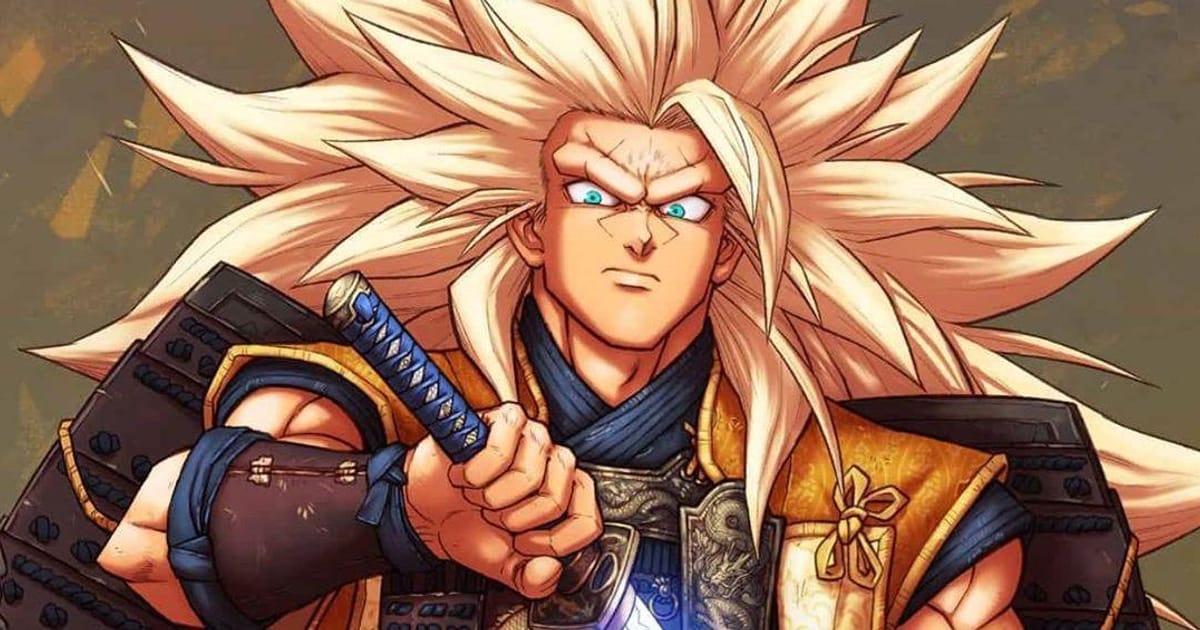
Dragon Ball Z has always been loud, explosive, and gloriously impossible. Hair becomes lightning. Aliens yell hard enough to shake planets. A fight can last long enough for viewers to grow a mustache, pay taxes, and still come back before the final punch lands. But every so often, a fan artist looks at this already over-the-top universe and says, “Nice. Now give everyone swords.”
That is the magic behind the samurai-inspired Dragon Ball artwork by digital artist Guillem Daudén, widely known online as Kenji_893. His series reimagines famous DBZ and Dragon Ball characters as warriors from a feudal Japanese fantasy world, blending Saiyan power, villainous swagger, and samurai iconography into portraits that feel both familiar and completely new. Goku becomes a wandering blade master. Vegeta looks like a proud warlord who would absolutely refuse to ask for directions. Frieza becomes less “space tyrant” and more “shogun of nightmares.” Honestly, it works almost too well.
The appeal is not just that DBZ characters look cool in armorthough, yes, they very much do. The deeper reason the concept lands is that Dragon Ball has always been a martial arts story at heart. Akira Toriyama’s world may include space travel, androids, gods, and wish-granting dragons, but its emotional engine is still training, discipline, rivalry, honor, and self-improvement. Samurai imagery adds a historical and mythic layer to themes that were already hiding in plain sight.
Why DBZ Characters Fit the Samurai Aesthetic So Well
The samurai concept clicks because Dragon Ball characters are already built around warrior identities. Goku is not simply strong; he is devoted to improvement. Vegeta is not merely arrogant; he is obsessed with pride, lineage, and proving his worth. Trunks carries a sword and lives with the burden of a ruined future. Piccolo begins as a villain but evolves into a disciplined mentor. These are not random fighters wearing Halloween costumes. They are characters whose personalities can be translated into armor, weapons, silhouettes, and posture.
Samurai history also carries a visual language that artists love: layered armor, helmet crests, flowing robes, clan-like symbols, elegant blades, braided cords, and dramatic stances. When Daudén applies that language to DBZ, he does more than swap a gi for a kimono. He redesigns the character’s identity. Goku’s katana can echo the Kamehameha. Vegeta’s armor can emphasize royal severity. Broly’s huge blade can communicate uncontrolled force before he even moves. That is strong character design: the viewer understands the personality before reading a single caption.
The Artist Behind the Samurai Dragon Ball Redesigns
Guillem Daudén, or Kenji_893, is known for detailed manga-style illustration and concept art. His “Samurai Redesign” work has circulated widely among anime fans because it scratches a very specific creative itch: it lets people imagine Dragon Ball as if it had been filtered through historical fantasy, Japanese war epics, and high-end character design.
The project has included many fan-favorite characters, such as Son Goku, Super Saiyan 3 Goku, Vegeta, Trunks, Gohan, Piccolo, Bardock, Broly, Perfect Cell, Frieza, Majin Buu, Android 17, Android 18, Vegito, and Gogeta. The range matters. A lazy crossover would stop at “Goku with a sword.” Daudén’s version feels more like an alternate universe with its own rules, hierarchy, and battlefield legends.
One of the strongest details appears in his samurai Goku concept, where the katana is described as representing the Kamehameha. That idea neatly explains why the series feels so clever. It does not simply add weapons to characters who normally fight with energy blasts. It translates one visual vocabulary into another. A glowing beam becomes a blade. A power aura becomes cloth, smoke, and motion. A transformation becomes ceremonial presence.
Standout Samurai DBZ Character Redesigns
Samurai Son Goku: The Wandering Warrior
Goku has always had the soul of a roaming martial artist. He trains, travels, eats everything in sight, and somehow saves the world between meals. As a samurai, he naturally becomes a cheerful but dangerous wandererthe kind of warrior who smiles politely before cutting through a mountain because someone asked for a “light warm-up.”
The samurai Goku redesign works because it keeps his openness and innocence while adding discipline. His sword does not make him darker; it makes him feel mythic. The orange gi energy can be reinterpreted through robes, sashes, and warm tones, while his spiky hair still screams “main character spotted from three valleys away.”
Vegeta: The Prideful Prince as Warlord
Vegeta may be the easiest DBZ character to imagine as a samurai lord. He already carries himself like someone born into a military dynasty, and he treats pride like a sacred family heirloom. Samurai armor gives his personality a perfect frame: sharp, formal, severe, and slightly terrifying.
A samurai Vegeta does not need to shout “I am elite.” The silhouette says it first. A rigid stance, ornate armor, and carefully controlled expression communicate his entire worldview. He is not just fighting to win; he is fighting to prove that every ancestor in the imaginary Saiyan castle was correct about him.
Future Trunks: The Blade Was Already There
Future Trunks is the bridge between Dragon Ball and samurai imagery because he already carries an iconic sword. In his original story, that sword represents survival, trauma, and hope. In a samurai redesign, it becomes even more central to his identity.
The best Trunks redesigns lean into the lonely-warrior angle. He is not a polished court fighter. He is a battlefield survivor from a broken timeline. Samurai armor and ninja-like details can make him feel like a messenger from a ruined province, still carrying the last promise of his world on his back.
Broly: The Ronin Berserker
Broly as a samurai warrior is pure visual thunder. He is too wild to feel like a polished retainer or noble swordsman. Instead, he reads as a destructive roninmassive, scarred, and difficult to control. His weapon should look less like a delicate katana and more like something forged when a blacksmith lost a bet with a volcano.
That is why Broly’s samurai treatment is so satisfying. It captures the character’s enormous physical presence without reducing him to muscle alone. The armor makes him look ancient and tragic, as if he has been wandering battlefields for centuries, accidentally winning wars by sneezing too aggressively.
Frieza: From Galactic Emperor to Shogun of Doom
Frieza is already royalty, tyrant, aristocrat, and nightmare rolled into one polished villain. Recasting him as a shogun is a brilliant move because it shifts his power from outer-space empire to feudal authority. He no longer needs a spaceship to look dangerous. Give him a commanding pose, imperial garments, and a cold stare, and suddenly the entire battlefield should consider moving to another country.
The samurai version also highlights Frieza’s elegance. Unlike Broly, who overwhelms through raw force, Frieza intimidates through control. He is the villain who would sign an execution order with beautiful handwriting.
Piccolo: The Monk-Warrior Mentor
Piccolo’s samurai redesign works best when it leans toward the monk-warrior archetype. He is disciplined, quiet, strategic, and spiritually intense. His cape and turban already give him one of Dragon Ball’s most recognizable silhouettes, so the challenge is not replacing that look but translating its calm authority into armor and robes.
As a samurai-inspired figure, Piccolo feels like the guardian of a mountain temple who has absolutely no patience for foolish studentsbut will still train them because, unfortunately, he has developed a heart.
Why Fans Love Alternate Universe Anime Art
Fan art has become one of the most active forms of modern pop culture conversation. Fans do not only consume stories; they remix them, reinterpret them, and ask “what if?” in thousands of visual languages. What if Dragon Ball were a samurai epic? What if superheroes lived in the Edo period? What if villains became medieval kings? What if Yamcha finally caught a break? Some questions are more realistic than others.
Alternate universe art succeeds when it respects the source material while adding a new lens. The DBZ samurai concept does exactly that. It does not mock Dragon Ball or flatten it into a costume gimmick. It recognizes that the franchise’s core themestraining, rivalry, loyalty, discipline, transformation, sacrificealready overlap with the mythology people associate with warrior tales.
This is also why samurai redesigns often feel more substantial than random fashion swaps. Streetwear Goku can be fun. Cyberpunk Vegeta can look stylish. But samurai DBZ touches the bones of the franchise. It brings the martial arts roots back to the surface, then dresses them in armor.
The Cultural Blend: Saiyans, Samurai, and Storytelling
Dragon Ball began as an adventure inspired by classic Asian storytelling and martial arts cinema, then grew into one of the world’s most recognizable action franchises. Samurai culture, meanwhile, has a long history in Japanese art, theater, literature, film, and popular imagination. When an artist combines these worlds, the result can feel surprisingly natural because both traditions use larger-than-life warriors to explore values and conflict.
Of course, samurai history is more complex than pop culture often suggests. Real samurai were not simply sword-swinging superheroes. They were members of a warrior class tied to politics, land, service, status, and culture. Their armor and weapons communicated identity as much as function. That is exactly why the aesthetic is so useful for character design. Every helmet crest, blade, robe, and color choice can become a storytelling tool.
In Daudén’s redesigns, the visual details invite viewers to imagine clans, rival schools, forbidden techniques, cursed provinces, and legendary duels. The art does not need to provide a full manga chapter. The viewer’s brain starts writing one automatically. That is the sweet spot for fan art: one image that feels like the cover of a story you suddenly wish existed.
What Makes These Redesigns More Than a Gimmick?
The strongest part of the samurai DBZ series is that it understands character hierarchy. Goku, Vegeta, Trunks, and Broly should not all look like the same warrior with different hair. A good redesign asks: What social role would this character occupy in a new world?
Goku becomes the wandering champion. Vegeta becomes the proud noble. Trunks becomes the tragic swordsman. Frieza becomes the ruler. Cell becomes the perfected weapon. Buu becomes a yokai-like supernatural menace. Bulma can become a strategist, inventor, or noblewoman whose intelligence shapes the battlefield from behind the scenes. These choices give the series narrative texture.
The art also benefits from contrast. Dragon Ball is famous for speed, energy, and bright attacks. Samurai imagery often emphasizes patience, stance, and the moment before action. Put them together, and you get tension. The viewer imagines that still second before Goku draws his blade and the entire horizon turns blue.
How This Concept Could Work as a Full Anime Spin-Off
A Dragon Ball samurai universe would almost write itself. Imagine seven sacred dragon crests scattered across rival provinces. Goku is a cheerful swordsman trained in a mountain school. Vegeta is heir to a fallen Saiyan clan. Frieza is a shogun-emperor ruling through fear. Trunks arrives from a devastated future province where artificial warriors destroyed everything. Piccolo guards an ancient temple. Broly is the wandering demon of the northern battlefield. Krillin is still brave, loyal, and somehow underpaid.
The transformations could be reinterpreted as secret sword forms, divine breathing techniques, or ancestral battle states. The Kamehameha could become a legendary draw-cut. Fusion could be a forbidden ritual performed by two warriors synchronizing spirit and blade. The Dragon Balls could become relics hidden in shrines, castles, forests, and haunted ruins.
Would fans watch it? Absolutely. Would they argue online about power scaling within 11 minutes of episode one? Also absolutely. Some traditions are sacred.
Personal Experience: Why This Kind of Fan Art Stays With Viewers
There is a particular feeling that happens when you see a great redesign of a character you already love. At first, your brain recognizes the basics: the hair, the expression, the colors, the attitude. Then the new details start arriving one by one. The armor changes the posture. The sword changes the rhythm of the imagined fight. The clothing suggests a different world. Suddenly, you are not just looking at fan art; you are mentally pitching yourself an entire series.
That is why the DBZ samurai concept is so memorable. Many fans grew up with Dragon Ball Z as a loud, emotional, after-school ritual. The show was not subtle, and that was part of its charm. Characters trained in impossible gravity, screamed through transformations, and solved many problems by becoming blonder. But beneath the spectacle, the story created strong emotional symbols. Goku meant perseverance. Vegeta meant pride and growth. Gohan meant hidden potential. Trunks meant hope under pressure. Piccolo meant redemption. Those symbols are flexible enough to survive a complete aesthetic transformation.
Seeing those characters as samurai warriors feels like discovering an old song played on different instruments. The melody is still there, but the mood changes. Goku with a katana feels calmer and more legendary. Vegeta in armor feels more severe and aristocratic. Trunks looks as if he has stepped out of a tragic war scroll. Broly becomes less like a typical powerhouse and more like a myth people warn children about when the wind gets strange at night.
The best experience with this art is not simply saying, “That looks cool,” although that reaction is immediate and completely valid. The better experience is noticing how each redesign makes you rethink the character. What would Vegeta value in a feudal clan system? Would Goku obey a lord, or would he wander from dojo to dojo looking for stronger opponents and better rice bowls? Would Piccolo run a temple school? Would Bulma invent battlefield technology centuries ahead of everyone else and then complain that no one appreciates proper engineering?
That imaginative aftertaste is the sign of a successful crossover. It gives fans room to play. It encourages discussion, speculation, and storytelling. It also reminds us why Dragon Ball has remained so durable for decades. The characters are simple enough to recognize instantly but strong enough to survive endless reinterpretation.
In a crowded internet full of quick edits and disposable trends, Daudén’s samurai DBZ artwork stands out because it feels crafted rather than slapped together. The designs show affection for the source material and respect for the visual power of samurai tradition. They do what fan art does at its best: open a door to a world that does not officially exist, then make fans wish they could walk through it with snacks, subtitles, and at least three seasons confirmed.
Conclusion
One artist reimagining DBZ characters as samurai warriors may sound like a simple fan-art premise, but Guillem Daudén’s work proves how powerful a smart visual remix can be. By blending Dragon Ball’s martial arts energy with samurai armor, blades, symbolism, and mythic atmosphere, the series gives familiar characters a fresh sense of history and drama. Goku becomes a wandering legend, Vegeta a proud warlord, Trunks a tragic swordsman, Frieza a terrifying ruler, and Broly a battlefield demon with enough rage to make the scenery nervous.
The result is more than “DBZ, but with swords.” It is a reminder that great characters can travel across genres when their core identities remain intact. Dragon Ball has always been about warriors chasing strength, testing limits, and finding meaning through battle. The samurai lens simply sharpens those ideaspreferably with a very stylish katana.