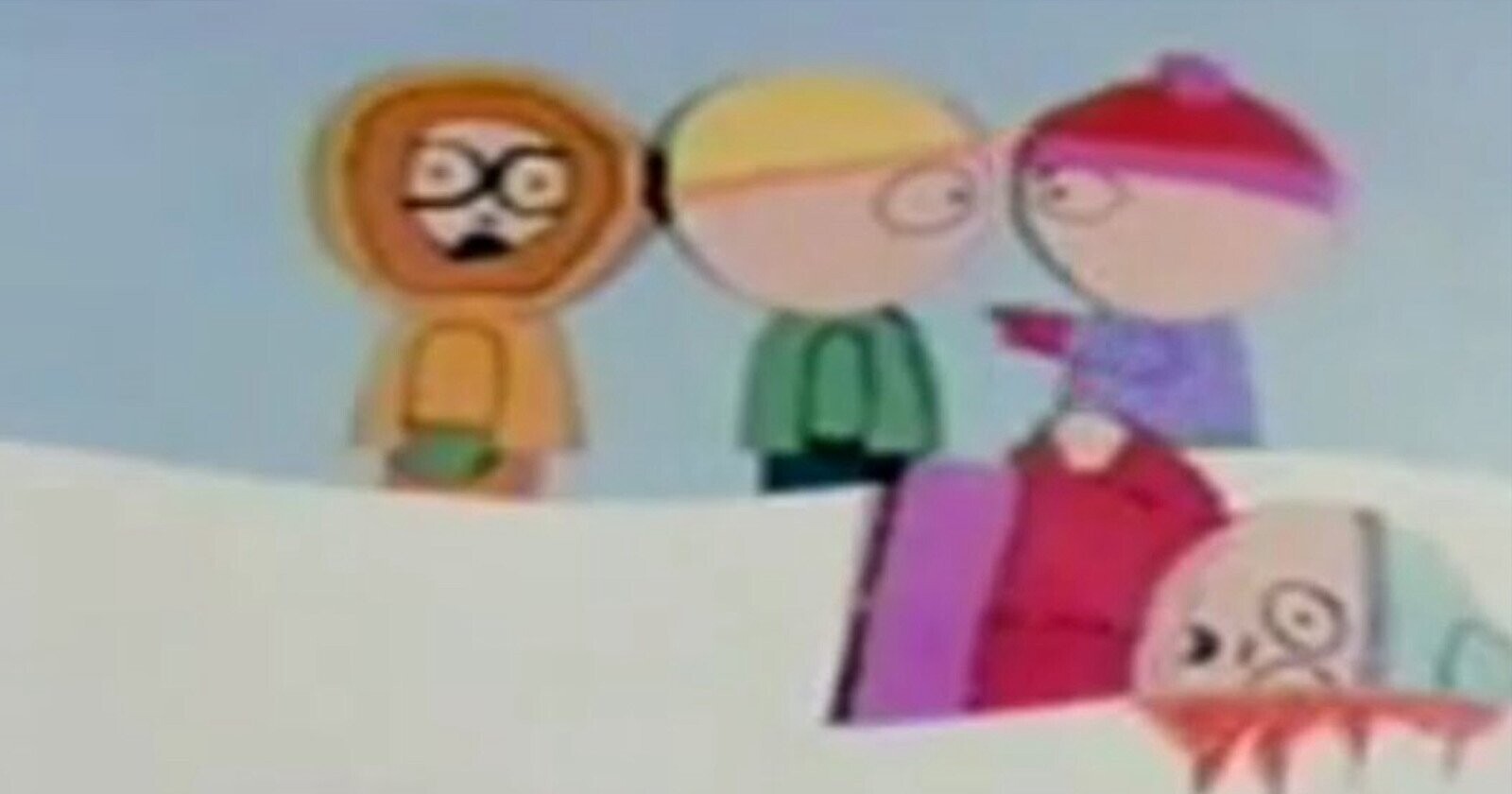
Before South Park became a cable-TV institution, before Cartman demanded respect, before Kenny’s orange hood became a tiny muffled death sentence, there was construction paper, an 8 mm camera, two film-school friends, and a short Christmas cartoon that looked like it had been assembled during a snow day with scissors, glue, and dangerous amounts of caffeine.
That short was The Spirit of Christmas, the scrappy animated project by Trey Parker and Matt Stone that eventually became the strange little snowball rolling downhill into one of the most recognizable animated comedies in American television history. Years later, a raw, pre-pitch-shifted audio track from the original short gave fans a weirdly fascinating peek behind the curtain: the early South Park kids did not always sound like squeaky cartoon fourth-graders. Under the digital magic, they sounded much closer to Parker and Stone’s real adult voicesstill performed, still exaggerated, but much lower, rougher, and funnier in a completely different way.
For longtime fans, hearing that raw audio is like finding a childhood photo of Cartman with a mustache. It is unsettling, hilarious, and oddly educational. It shows how much of South Park’s identity comes not just from writing, animation, or profanity, but from voice performance and audio manipulation. The show’s famous sound was not discovered fully formed. It was built, warped, sharpened, and pitch-shifted into comedy history.
The Strange Little Christmas Short That Started Everything
The Spirit of Christmas was not originally a grand launchpad for a television empire. It began as an underground student-film oddity. Parker and Stone met at the University of Colorado, where they developed a shared comic language built around crude animation, absurd violence, and the kind of “kids talking like adults” humor that would later define South Park.
The earliest version, commonly known as Jesus vs. Frosty, was created in 1992. It featured four bundled-up Colorado boys who build a snowman, bring it to life, and quickly discover that holiday magic can be a terrible workplace hazard. The snowman turns murderous, the kids panic, and Jesus eventually arrives to save the day. The animation was rough, the voices were silly, and the comedy was already unmistakably Parker and Stone: cheerful blasphemy wrapped in paper-cutout innocence.
A second version, often called Jesus vs. Santa, followed in 1995 after Fox executive Brian Graden commissioned Parker and Stone to make a video Christmas card. That version looked and felt much closer to what would become South Park. The boys had clearer personalities, the snowy Colorado setting was more defined, and the short’s holiday satire was sharper. It spread through VHS copies and early internet sharing long before “going viral” became a marketing department’s favorite verb.
Why the Raw Audio Matters
The raw audio from The Spirit of Christmas is important because it strips away one of the most recognizable layers of the South Park formula: pitch shifting. Fans are used to hearing Stan, Kyle, Cartman, and Kenny as high-pitched children. But the unprocessed track reveals that the original performances were recorded in adult male voices, then altered to create a childlike sound.
That does not mean Parker and Stone simply talked normally and let a computer do all the work. The raw track still contains performance choices: rhythm, attitude, timing, character energy, and comic emphasis. Parker and Stone were already acting like the boys. The pitch shift simply pushed those performances into the vocal range that made the characters feel like children instead of sarcastic college roommates trapped in parkas.
This is the magic trick hidden in plain sight. The comedy depends on contrast. The characters look like children, sound like children, and live in a kid-sized world of school buses, snow forts, and parental confusion. Yet they speak with the cynicism, rage, panic, and moral exhaustion of adults. The processed voices make that contradiction work. Without the higher pitch, the lines can feel stranger, darker, and more obviously adult. With the pitch shift, the same lines become absurdly funny because they appear to be coming from tiny paper kids who should probably be asking for hot chocolate, not debating religion and violence.
How Trey Parker and Matt Stone Created the Early South Park Voices
One of the most interesting details about the early South Park voice style is that Parker and Stone had been playing with those voices before the show existed. At the University of Colorado, they reportedly amused each other by doing childish voices during film shoots. Those improvised voices became the seed of the characters.
In the series, Trey Parker became strongly associated with Stan Marsh, Eric Cartman, Randy Marsh, Mr. Garrison, and many others. Matt Stone became closely linked to Kyle Broflovski, Kenny McCormick, Butters Stotch, and a long list of supporting characters. The raw Spirit of Christmas audio reminds listeners that the voices began as two friends cracking each other up, not as a polished studio system.
Cartman’s Early Voice
Cartman is especially fascinating because his voice is one of the most famous in animation. In the earliest short, the character who resembles Cartman is actually named Kenny, while the hooded boy who resembles Kenny is not yet the fully familiar Kenny McCormick. That small naming confusion is part of the charm. The DNA is there, but the characters are still mutating.
In raw audio, the Cartman-like voice sounds heavier and more adult. The attitude is recognizable before the pitch is. That matters because Cartman’s comedy is not simply “funny voice equals funny character.” His voice works because of entitlement, timing, and emotional inflation. He sounds like a tiny tyrant who believes the universe has personally inconvenienced him. Pitch shifting makes that tantrum childlike, but the performance gives it personality.
Stan and Kyle Before the Polish
Stan and Kyle also become more interesting when heard without processing. Their voices are less cartoonishly bright and more grounded in Parker and Stone’s natural vocal range. The raw versions make the dialogue feel closer to a student comedy sketch. The final processed versions turn it into a strange animated world where children can discuss death, religion, and snack foods with equal seriousness.
Kyle’s voice, in particular, demonstrates how pitch can change emotional meaning. A lower Kyle can sound like an irritated adult. A higher Kyle sounds like a frustrated kid who has somehow become the only sane person in a town that lost the instruction manual for civilization. That difference is huge. It is the difference between a line being simply sarcastic and a line becoming classic South Park.
Pitch Shifting: The Tiny Audio Choice With a Giant Impact
Pitch shifting is often treated as a technical afterthought, but in South Park, it is part of the storytelling. The characters’ voices help sell the show’s central joke: innocent-looking children are dropped into wildly inappropriate adult situations, and somehow they are often more rational than the grown-ups around them.
In animation, sound design can define a character as strongly as appearance. Imagine Cartman with a calm baritone, Kenny with crystal-clear diction, or Stan sounding like a radio host. The jokes would not land the same way. The high-pitched voices soften the darkness just enough to keep the show playful. They make brutal jokes feel like playground gossip. They make satire feel like recess gone horribly wrong.
The raw audio shows the machinery behind that effect. Parker and Stone were not hiding weak performances behind digital tricks. They were using technology to exaggerate a comic idea. The pitch shift takes adult performances and places them inside child bodies, creating the strange tension that makes South Park instantly identifiable.
Why Fans Love Hearing the “Real” Voices
Fans are fascinated by raw audio because it feels forbidden, like sneaking into the kitchen of a restaurant and discovering that the secret sauce is mostly timing, instinct, and a suspiciously old blender. Hearing the unprocessed Spirit of Christmas track gives viewers a new appreciation for how the show is made. It also makes the early shorts feel more handmade and human.
Modern South Park is famous for its fast production cycle, topical satire, and polished workflow. But the raw short comes from a different era: students cutting paper, recording voices, and hoping their friends laughed at a ridiculous Christmas cartoon. The unprocessed audio preserves that garage-band energy. You can hear the creators experimenting, discovering tone, and accidentally building a voice style that would survive for decades.
There is also simple comedy in the mismatch. When a familiar line comes out in a lower, more adult voice, it feels wrong in the best possible way. It is like watching Mickey Mouse remove his gloves and reveal tax documents. The illusion breaks, but the broken illusion becomes funny too.
From Crude Short to Comedy Landmark
The journey from The Spirit of Christmas to South Park is one of the great examples of outsider comedy sneaking into the mainstream. The shorts were cheap, offensive, and visually primitive. They also had something that expensive pilots often lack: a point of view.
Parker and Stone understood the comic potential of children who see adult hypocrisy clearly. In South Park, kids are not pure little angels. They are selfish, confused, cruel, loyal, emotional, and occasionally wise. That mix was present from the beginning. The raw audio makes it easier to hear the creators finding that balance. The boys are not voiced as cute cartoon mascots. They are voiced like kids who have absorbed too much adult nonsense and are now trying to survive it with snow boots and profanity.
The success of the 1995 short helped open doors. The video passed from person to person, circulated through Hollywood, and eventually helped convince Comedy Central that the concept could work as a series. South Park premiered in 1997 and quickly became one of the most talked-about animated shows on television.
The Real Lesson Hidden in the Raw Track
The biggest lesson from the raw audio is that iconic creative work often begins in an unfinished state. The early voices were not yet the exact polished voices fans know today. The animation was not smooth. The character names were not all settled. The mythology was barely there. But the core was strong.
That core included four things: a distinctive setting, a fearless comic attitude, a simple visual style, and voices that could turn childish chaos into adult satire. Once those pieces clicked, South Park had a foundation sturdy enough to support decades of jokes, controversies, musical numbers, video games, specials, and cultural arguments at dinner tables where someone’s uncle definitely missed the point.
The raw audio also reminds creators that imperfection can be an asset. The early South Park style worked partly because it looked and sounded rough. The crudeness was not a bug; it was branding. It told viewers, “This is not trying to be Disney. Please keep your hands inside the ride and your expectations low.” That attitude gave Parker and Stone freedom to be fast, strange, and brutally direct.
Experience Section: What Listening to the Raw Audio Feels Like
Listening to raw audio from The Spirit of Christmas is a strange little time-machine experience. At first, the brain rejects it. You know the characters. You know their rhythms. You know the familiar squeaky panic of the boys reacting to something horrible, stupid, or both. Then the unprocessed voices arrive, and suddenly the whole scene feels as if it has been moved from a cartoon snowbank into a college dorm room at 2 a.m.
The first reaction is usually laughter, but not the same kind of laughter that comes from watching a normal South Park episode. It is more of a behind-the-scenes laugh. You are not only laughing at the joke; you are laughing at the construction of the joke. You can hear the bones before the skin goes on. That makes the comedy feel less mysterious and more impressive.
For anyone who has recorded a podcast, edited a video, played with audio software, or even made a silly voice note for friends, the raw track is surprisingly relatable. It shows that performance often starts awkwardly. A voice may sound too deep, too flat, too weird, or too obviously like “a grown man pretending to be a child in a room full of cables.” Then editing, pacing, pitch, and confidence turn that awkward material into something memorable.
The experience is also a reminder that voices carry character even before technical processing. You can hear irritation before the pitch shift. You can hear panic before the final mix. You can hear Parker and Stone discovering how fast a line should move and how blunt a reaction should be. The final childlike sound may be added later, but the comic intention is already there.
There is a nostalgic thrill too. The raw audio connects fans to the handmade origins of South Park. Today, the show is a giant brand with streaming deals, specials, games, and a permanent spot in pop-culture argument history. But the raw track brings everything back to two young creators trying something ridiculous because it made them laugh. That is refreshing. It cuts through the mythology and returns the show to its most basic creative spark: friends doing dumb voices until dumb voices become art.
For writers, animators, voice actors, and content creators, the experience is encouraging. A polished final product can make success look inevitable. Raw audio proves the opposite. The beginning is messy. The voices are lower. The timing is being tested. The characters are not fully born yet. But somewhere inside that rough material is the sound of a future audience laughing.
That is why the raw Spirit of Christmas audio remains so compelling. It does not ruin the illusion of South Park. It deepens it. Once you hear the real voices underneath, the finished voices become even more interesting. You understand that the joke was not created by a button. It was created by performance, friendship, experimentation, and a willingness to make something that looked completely ridiculous before the world realized it was brilliant.
Conclusion
The raw audio from Trey Parker and Matt Stone’s The Spirit of Christmas is more than a curiosity for hardcore South Park fans. It is a small but revealing artifact from the birth of a comedy empire. By hearing the voices before pitch shifting, fans can better understand how Parker and Stone shaped Stan, Kyle, Cartman, Kenny, and the larger sound of South Park itself.
The track proves that the show’s voice acting was never just about squeaky effects. The performances already had rhythm, attitude, and character. The pitch shift simply completed the illusion, turning adult comic instincts into the unmistakable sound of foulmouthed Colorado kids stumbling through satire, Christmas chaos, and whatever horrible thing was about to happen to Kenny.
In the end, The Spirit of Christmas remains special because it captures Parker and Stone before the machine of fame arrived. It is crude, bold, imperfect, and weirdly alive. The raw audio makes that origin story even better. It lets us hear the moment before South Park became South Parkwhen the voices were still low, the paper was still rough, and comedy history was quietly clearing its throat.