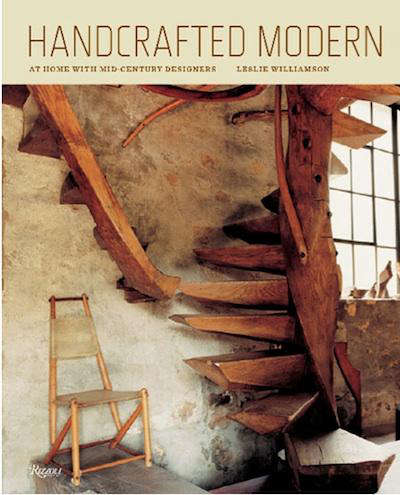
If your idea of mid-century modern design is a showroom full of perfect chairs arranged like museum suspects under interrogation lights, Handcrafted Modern by Leslie Williamson is here to gently pull you back to reality. Real modernism had books stacked on tables, tools within reach, ceramics on shelves, and the occasional corner that looked like a brilliant person had just left the room to make coffee.
Published by Rizzoli in 2010, Handcrafted Modern: At Home with Mid-century Designers is a 224-page hardcover by San Francisco-based photographer Leslie Williamson. The book opens the doors to the homes of influential designers, architects, and makers, including Charles and Ray Eames, George Nakashima, Harry Bertoia, Eva Zeisel, Russel Wright, Wharton Esherick, Walter Gropius, Albert Frey, and others. But this is not just another glossy design book created to make your living room feel underdressed. It is a quiet, intimate study of how creative people actually lived with the things they made, collected, repaired, loved, and probably dusted only when absolutely necessary.
That is why Handcrafted Modern still feels like required reading for interior designers, architecture students, vintage collectors, furniture lovers, and anyone who suspects that a home should have more soul than a luxury hotel lobby.
What Is Handcrafted Modern About?
At its heart, Handcrafted Modern is a photographic journey through domestic modernism. Instead of focusing only on famous buildings or collectible furniture, Williamson studies the private homes of mid-century designers. These are not spaces decorated to impress a client. They are personal laboratories, workshops, shelters, and self-portraits.
The book’s full subtitle, At Home with Mid-century Designers, says a great deal. Williamson is less interested in presenting design as a frozen historical style and more interested in showing how design behaves when it is allowed to live. A chair is not just an object; it sits beside a desk, near a window, under a lamp, next to a stack of papers. A handmade staircase is not just a sculptural achievement; it is something people climbed every day, perhaps half-awake, perhaps carrying tea.
This approach makes the book feel warm, almost conversational. It invites the reader to notice the relationship between architecture, furniture, craft, landscape, and habit. The result is a portrait of modernism that feels handmade, human, and refreshingly free of design-snob fog machines.
Why Leslie Williamson’s Photography Works So Well
Leslie Williamson’s strength as a photographer is restraint. She does not flatten the homes into sterile magazine spreads. She lets texture, shadow, patina, and imperfection remain visible. Her images make wood feel like wood, steel feel like steel, and a room feel like someone once put down a cup and forgot where it went.
This matters because mid-century modern design is often marketed today as a sleek shopping category. Search for the phrase online and you may find hundreds of sofas with tapered legs, many of them looking as though they were assembled by a committee that had once seen a walnut credenza from across a parking lot. Williamson’s book reminds us that the original spirit of modernism was more thoughtful, more experimental, and far more personal.
The homes in Handcrafted Modern show modern design as a way of living, not a set of products. They are filled with evidence of making: hand-carved surfaces, custom storage, built-in furniture, collected objects, woven materials, ceramics, tools, and books. These details give the rooms emotional gravity. The book does not scream, “Buy this look.” It whispers, “Pay attention.” That is much more dangerous, because it might actually change how you see your own home.
The Designers and Homes That Give the Book Its Power
Wharton Esherick: The House as Sculpture
One of the most memorable presences in the book is Wharton Esherick, the Pennsylvania artist and craftsman often associated with the Studio Furniture Movement. His home and studio near Valley Forge are legendary because nearly every element seems touched by hand. The famous staircase, with its organic carved form, looks less like a standard architectural feature and more like something that grew indoors after reading poetry.
Esherick’s world is important because it breaks the lazy assumption that modern design must be cold or industrial. His work proves that modernism can be fluid, tactile, irregular, and deeply connected to craft. In Williamson’s lens, his house becomes a reminder that a home can be designed from the inside out, object by object, gesture by gesture.
Charles and Ray Eames: Play, Order, and the Art of Living
The Eames House, also known as Case Study House No. 8, is one of the most influential homes in American modern design. Built in Pacific Palisades, California, it served as both residence and studio for Charles and Ray Eames. What makes the Eames home so beloved is not only its architecture but its spirit: disciplined structure filled with playful abundance.
In many images of the Eames world, one sees toys, textiles, folk art, books, prototypes, shells, masks, and carefully arranged objects from many cultures. Their home suggests that modern living does not require emptiness. It requires curiosity. This is excellent news for anyone whose shelves are currently “curated” by gravity and emotional attachment.
George Nakashima: Wood With a Soul
George Nakashima’s furniture is famous for honoring the natural character of wood. Rather than hiding knots, cracks, and live edges, he transformed them into central features. His New Hope, Pennsylvania, complex remains an important landmark of American craft and modern design.
In the context of Handcrafted Modern, Nakashima represents a philosophy as much as an aesthetic. His work suggests that materials have their own voice. The designer’s role is not to dominate the material but to collaborate with it. That idea feels especially relevant today, when many homes are filled with disposable objects pretending to be timeless. Nakashima’s furniture does not pretend. It simply stands there, quietly outclassing everything with particleboard in its family tree.
Walter Gropius: The Bauhaus Comes Home
Walter Gropius, founder of the Bauhaus, designed his family home in Lincoln, Massachusetts, after coming to teach at Harvard. The Gropius House is modest in scale but enormous in historical meaning. It brings European modernist principles into an American domestic setting, combining efficiency, clarity, and an alertness to everyday life.
What Williamson helps readers see is that even the home of a major modernist thinker was not merely an abstract statement. It was a lived environment. Desks, objects, textiles, and personal arrangements soften the intellectual edges. The house becomes not just a lesson in architecture but a record of daily living.
Eva Zeisel, Harry Bertoia, Russel Wright, and the Domestic Imagination
Other figures in the book expand the meaning of modern design beyond buildings and chairs. Eva Zeisel’s ceramics bring elegance, curve, and sensuality into the conversation. Harry Bertoia’s work connects furniture, sculpture, and sound. Russel Wright’s designs helped shape the American table and the idea that everyday objects deserve beauty.
Together, these designers show that modernism was never only about architecture. It touched plates, textiles, studios, gardens, shelves, and dinner tables. Handcrafted Modern understands this beautifully. It treats domestic life as the real exhibition space.
The Big Lesson: Modernism Was Never Supposed to Be Soulless
One of the greatest myths about modern design is that it must be cold, minimal, and allergic to personality. Handcrafted Modern argues the opposite without needing to argue at all. Page after page, it shows homes where modern thinking coexists with craft, collecting, repair, experimentation, and warmth.
The rooms Williamson photographs are not blank. They are edited, but not empty. They contain handmade furniture, natural materials, meaningful clutter, and objects gathered over time. This is a useful distinction for anyone designing a home today. Minimalism can be beautiful, but when it becomes fear of personality, it starts to feel like a very expensive waiting room.
The book encourages a better question: not “How do I make my home look modern?” but “How do I make my home reflect what I value?” That shift changes everything. It moves design away from imitation and toward authorship.
Design Lessons Readers Can Take From Handcrafted Modern
1. Let Materials Be Honest
Wood does not need to be disguised. Metal does not need to apologize. Stone, clay, paper, leather, wool, and glass all bring their own character to a room. The homes in Handcrafted Modern celebrate materials that age, mark, and develop personality. A scratch is not always a tragedy. Sometimes it is just your coffee table keeping a diary.
2. Choose Fewer Things, But Better Things
The book is not about shopping less because shopping is morally suspicious. It is about choosing objects with enough presence to stay. The best rooms in the book feel accumulated, not consumed. They suggest a slower relationship with furniture and decor: buy carefully, repair when possible, and avoid anything that looks tired before the receipt cools down.
3. Mix Function With Feeling
Mid-century design is often praised for function, but Williamson’s book shows that function alone is not enough. A home also needs tenderness, humor, memory, and surprise. The Eameses understood this beautifully. So did Esherick, Nakashima, and Zeisel. Their spaces solve problems, but they also invite wonder.
4. Allow the Handmade to Interrupt the Perfect
A handmade object carries evidence of time and touch. It may not be perfectly symmetrical. It may not match the sofa. It may even make a guest ask, “What is that?” Congratulations: your room has started a conversation. Handcrafted Modern celebrates these interruptions because they keep interiors alive.
5. Design Around How You Actually Live
The most persuasive homes in the book are not staged fantasies. They are rooted in daily patterns. There are work surfaces, reading corners, shelves, studios, and windows placed in meaningful relation to life. A beautiful home that does not support your habits is not a home; it is a photo shoot with plumbing.
Who Should Read This Book?
Handcrafted Modern is ideal for readers who love mid-century modern interiors, handmade furniture, architecture books, artist homes, and the history of American design. It is also useful for interior designers who want to move beyond trend-based styling. The book provides visual evidence that timeless rooms are not created by copying a period. They are created by understanding proportion, material, light, and personality.
Vintage collectors will appreciate the book because it shows iconic pieces in natural environments. Architecture students will find it valuable because it reveals how theory becomes domestic experience. Homeowners will love it because it gives permission to build rooms slowly. And anyone with a weakness for beautiful books will enjoy simply leaving it on a table and pretending they are the kind of person who never loses their keys.
Why the Book Still Feels Relevant Today
More than a decade after publication, Handcrafted Modern feels surprisingly current. In fact, it may be more relevant now because so many homes are designed under the influence of algorithms. Social media has made it easy to recognize trends and harder to develop taste. Rooms begin to look the same: same curved sofa, same beige rug, same vase shaped like it has unresolved feelings.
Williamson’s book offers an antidote. It returns readers to homes shaped by conviction rather than content strategy. The designers inside did not live according to a trending color palette. They lived among experiments, prototypes, heirlooms, tools, natural materials, and objects that meant something to them.
This is why Handcrafted Modern is more than a coffee table book. It is a quiet manifesto for personal design. It says: make your home useful, make it beautiful, make it yours, and please do not let a catalog have the final word.
Experience Section: Living With the Lessons of Handcrafted Modern
The most useful way to experience Handcrafted Modern is not to race through it. This is not a book to “finish” like a thriller, unless your thrillers involve excellent joinery and emotionally intelligent shelving. It is better read slowly, one home at a time, preferably with a notebook nearby and a strong cup of coffee that understands visual culture.
One practical experience the book offers is the ability to look at your own home with kinder but sharper eyes. After spending time with Williamson’s photographs, you may begin noticing which parts of your space feel authentic and which parts feel like they were chosen in a panic after typing “modern living room ideas” into a search bar. The book does not shame you for owning ordinary things. Instead, it encourages you to ask whether your objects have purpose, beauty, memory, or at least enough charm to justify the dusting.
For example, a reader might look at a mass-produced side table and realize the problem is not that it is inexpensive. The problem is that it has no relationship to anything else in the room. Then the same reader might notice a handmade bowl from a trip, a worn wooden stool from a grandparent, or a stack of art books that actually gets opened. Suddenly, the room’s direction becomes clearer. The best design move may not be buying something new. It may be giving the meaningful objects more authority.
The book also changes how one thinks about imperfection. In many contemporary interiors, imperfection is treated like a small household emergency. But in the homes Williamson photographs, age and use are part of the atmosphere. Wood darkens. Leather softens. Ceramics vary. A room becomes richer because it has been lived in. That lesson is deeply freeing. It means your home does not need to look untouched to be beautiful. In fact, untouched beauty can feel suspicious, like a cake no one is allowed to eat.
Another experience inspired by the book is the pleasure of arranging objects by personal logic rather than retail logic. The Eameses were masters of this. Their collections did not feel random, even when they were abundant, because curiosity held them together. A shell, a textile, a toy, a print, and a chair can share a room if the owner sees a connection. This gives readers permission to display what they love, not just what matches.
Finally, Handcrafted Modern encourages patience. The homes in the book were not completed in a weekend. They evolved through work, travel, making, collecting, and daily use. That may be the most important design lesson of all. A real home takes time. It becomes better when it is allowed to gather evidence of a life. Fast decorating can produce a nice room, but slow living produces a memorable one.
Conclusion: A Modern Design Book With a Human Pulse
Required Reading: Handcrafted Modern by Leslie Williamson is not just a recommendation for fans of mid-century modern design. It is a reminder that the best homes are not assembled from trends; they are grown from values. Leslie Williamson’s photographs reveal the private spaces of designers who understood that modern living could be inventive, warm, practical, handmade, and deeply personal.
The book deserves its place in the modernist library because it makes design feel alive again. It shows that a room can be disciplined without being stiff, crafted without being precious, and beautiful without behaving like it knows it is beautiful. For readers seeking inspiration beyond polished perfection, Handcrafted Modern remains a generous, thoughtful, and quietly powerful guide.
Note: This article is an original, fully rewritten synthesis based on real publisher information, author materials, design coverage, bookseller descriptions, and historic home context related to Leslie Williamson and Handcrafted Modern.