Note: This web-ready article is based on verified reporting from Formula 1, the FIA, Reuters, AP, ESPN, and the Formula 1 Exhibition, with factual details cross-checked for accuracy.
Some Formula 1 cars become famous because they win championships. Others become famous because they look beautiful, sound angry, and make collectors stare at them like they are rare museum dinosaurs. Then there is Romain Grosjean’s burnt Haas VF-20, a car remembered not for victory, but for survival.
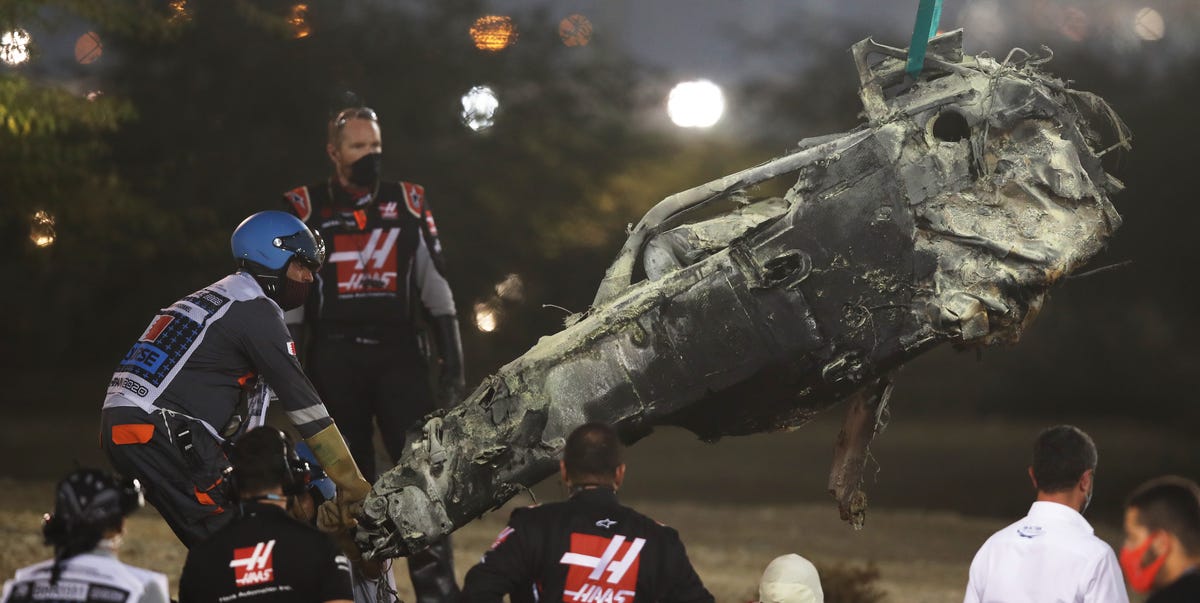
The remains of Grosjean’s Formula 1 car from the 2020 Bahrain Grand Prix were announced for public display as part of the Formula 1 Exhibition in Madrid. For fans, it was not just another racing artifact under dramatic lighting. It was a physical reminder of one of modern F1’s most frightening moments, and more importantly, of how far motorsport safety has come. Formula 1 said the chassis would be shown in a room called “Survival,” alongside a video installation connected to the crash.
That is the unusual power of this exhibit. It is not shiny. It is not restored. It does not ask visitors to admire aerodynamic elegance or carbon-fiber wizardry like it is a supermodel in racing boots. Instead, it asks a quieter question: how did a driver walk away from that?
Why Romain Grosjean’s Burnt F1 Car Matters
Romain Grosjean’s burnt Formula 1 car matters because it turns an abstract safety story into something people can see. Fans often hear phrases like “survival cell,” “halo,” “impact structure,” and “fire-resistant race suit,” but those terms can sound like a technical brochure written by someone who thinks excitement means alphabetizing spare parts.
The Bahrain crash changed that. On November 29, 2020, Grosjean’s Haas was involved in a first-lap accident at the Bahrain Grand Prix. According to the FIA investigation, Grosjean’s car was traveling at 241 km/h before contact with Daniil Kvyat’s AlphaTauri sent it toward the barrier. The car struck the barrier at 192 km/h, at a 29-degree angle, with a peak force measured at 67g.
Those numbers are not just dramatic trivia for F1 fans to quote at parties, right before everyone else slowly moves toward the snack table. They help explain why the accident became one of the most analyzed crashes in recent racing history. The Haas car split apart, fire broke out, and the survival cell came to rest beyond the barrier. Yet Grosjean remained conscious and escaped with injuries far less severe than many feared in the moment.
The Formula 1 Exhibition Gives the Car a New Purpose
The car’s display at the Formula 1 Exhibition changed its role from wreckage to witness. Formula 1 announced in February 2023 that fans visiting the Madrid exhibition would be the first in the world to see the remains of Grosjean’s car from the Bahrain crash. The exhibit was developed with Haas and the show’s producers, placing the chassis inside a dedicated “Survival” space.
This matters because race cars are usually presented as symbols of speed, innovation, and competitive obsession. Grosjean’s chassis does something different. It shows the cost of racing at the limit, while also highlighting the engineering that protects drivers when everything goes wrong.
The Formula 1 Exhibition later described the display as a tribute to safety innovation, placing the burnt Haas in a broader story about how the sport evolves. In other words, the car is not displayed as disaster tourism. It is displayed as evidence. It is the motorsport version of a black box, except bigger, louder, and made of carbon fiber with a very stressful résumé.
The Halo Went From Controversial to Heroic
No discussion of Grosjean’s crash can avoid the halo. Introduced to Formula 1 in 2018, the halo cockpit protection device was controversial at first. Some fans said it looked ugly. Some drivers questioned it. Traditionalists complained that it interrupted the clean silhouette of an open-wheel car, as if aerodynamic beauty should get a vote in driver survival.
After Bahrain 2020, the conversation changed. Drivers across the grid praised modern F1 safety systems, especially the halo, after Grosjean escaped. Formula 1 reported that several drivers saw the accident as proof of major safety progress, while also emphasizing that the sport must keep improving.
The halo did not act alone. Grosjean’s survival also involved the survival cell, helmet, HANS device, fire-resistant clothing, medical response, marshals, and the driver’s own ability to escape under extreme pressure. Still, the halo became the symbol of the incident because it was visible, memorable, and easy to understand. It protected the cockpit area during a crash where every inch mattered.
What the FIA Investigation Revealed
The FIA’s investigation was extensive. It examined the cars involved, chassis integrity, barrier performance, fuel system behavior, safety equipment, fire response, and medical intervention. Before the final findings were published, the FIA stated that it would review systems including the helmet, HANS device, harness, protective clothing, survival cell, headrest, extinguisher system, and halo.
The final report found that the car suffered major damage during impact. The power train separated from the survival cell, and parts of the fuel system were compromised, which contributed to the fire. The report also described how the barrier deformed and how the survival cell became lodged beyond it.
For everyday fans, the technical details may sound heavy. But the big takeaway is simple: safety in Formula 1 is not one magic part. It is a chain. If one link fails, another must help. In Grosjean’s case, many links were tested at once, and enough of them held.
Why Displaying the Burnt Haas Is Not Just for Shock Value
There is always a fine line when displaying wreckage from a serious accident. Done poorly, it can feel sensational. Done responsibly, it can educate. The Grosjean chassis display works because the focus is not on horror; it is on survival, learning, and progress.
The exhibit gives fans a chance to understand the physical reality behind a moment many only saw on television. A broadcast clip lasts seconds. A museum-style display makes people slow down. It lets visitors look at what remains and connect it to the systems that helped Grosjean live to tell the story.
That is especially important for newer F1 fans who arrived during the streaming era. Formula 1 is now a global entertainment product, complete with glamorous race weekends, celebrity guests, team drama, and enough strategy arguments to power the internet for several fiscal quarters. But beneath the spectacle, it remains a dangerous sport. The burnt Haas reminds fans that safety is not boring. Safety is why racing can continue.
Grosjean’s Story After the Crash
The Bahrain crash ended Grosjean’s Formula 1 racing career sooner than expected, but it did not end his racing life. He later moved into IndyCar and built a second chapter in the United States. Formula 1 reported in 2026 that Grosjean had been reunited with the helmet he wore during the Bahrain accident, a personal moment connected partly to his children wanting to understand what happened.
In 2025, Grosjean also returned to a Formula 1 car with Haas for a test at Mugello, driving a 2023 Haas VF-23. Reuters reported that members of his original crew were expected to be present, including Ayao Komatsu, who had worked with Grosjean before becoming Haas team principal.
That return gave the story a kind of emotional symmetry. The burnt VF-20 represents the day everything stopped. The later Haas test represented a chance to reconnect with the machine, the team, and perhaps a piece of unfinished business. Motorsport can be strange like that. One car becomes a scar. Another becomes a handshake.
What Fans Can Learn From Seeing the Car
1. Formula 1 Safety Is Built Through Hard Lessons
Motorsport safety has never improved by accident. It improves because people study accidents, gather data, argue about solutions, redesign parts, and test again. The Grosjean crash became part of that long process. The FIA’s accident analysis fed into broader safety learning, including barrier design, fire response, and car construction.
2. The Driver Is Only One Part of the Survival Story
Grosjean’s calm and determination mattered, but so did the medical car crew, marshals, protective equipment, and years of safety regulation. Formula 1 is a team sport even when a driver is alone in the cockpit. The rescue response showed that preparation is not glamorous, but it is priceless.
3. Technology Needs Time to Earn Trust
The halo is now widely respected, but it was not universally loved when introduced. Grosjean’s crash became one of the clearest examples of why safety devices should not be judged only by appearance. A race car does not need to win a beauty contest if it helps a driver come home.
The Emotional Weight of a Burnt Race Car
Standing before a damaged racing chassis is different from looking at a photo. Photos flatten reality. Video turns it into a sequence. A physical object has weight. It occupies the same space as the viewer. It makes the story harder to treat as content and easier to treat as history.
That is why Grosjean’s burnt Formula 1 car is such a powerful display piece. It is not simply “the car from the crash.” It is a reminder of family members waiting for news, engineers watching years of design face the ultimate test, marshals running toward danger, and a driver fighting to escape.
It also forces fans to hold two truths at once. Formula 1 is thrilling because it is fast, precise, and extreme. Formula 1 is also only acceptable because it constantly works to reduce the risks created by that extremity. Speed sells the tickets. Safety makes sure the show has a future.
Experience Section: What It Feels Like to See Grosjean’s Burnt F1 Car on Display
For many fans, the experience of seeing Romain Grosjean’s burnt Formula 1 car on display is not like viewing a normal racing exhibit. A championship-winning car makes you think of champagne, podium flags, and mechanics hugging each other like they just survived tax season. Grosjean’s Haas makes the room quieter.
The first feeling is usually disbelief. Formula 1 cars are often described as strong, advanced, and almost spaceship-like. Seeing one damaged so severely breaks that illusion. The car suddenly looks less like a futuristic machine and more like proof that physics does not care how expensive your steering wheel is.
Then comes respect. Not just for Grosjean, though his escape remains extraordinary, but for the people behind every invisible safety layer. The engineers who designed the survival cell. The regulators who pushed for stronger cockpit protection. The teams that adapted to the halo even when it was unpopular. The medical crews and marshals who train for moments they hope never happen. Looking at the car, visitors can understand that safety is not one invention. It is a culture.
Parents visiting with children may experience the display differently. Younger fans might know Grosjean from clips, highlight reels, or dramatic retellings. Adults who watched the race live may remember the silence before relief arrived. The exhibit becomes a bridge between generations of fans. It allows a parent to say, “This is why safety matters,” without turning the lesson into a lecture that sounds like it came free with a school assembly.
There is also a strange sense of gratitude. That may seem odd when looking at a burnt car, but the feeling is real. Visitors are not grateful for the crash. They are grateful for the outcome. Grateful that Grosjean survived. Grateful that the sport learned. Grateful that modern Formula 1 did not have to add another tragedy to its history.
For longtime motorsport followers, the display may bring back memories of earlier eras when racing was far more dangerous and safety often improved only after painful lessons. Grosjean’s Haas stands in contrast to that past. It shows that modern F1 still carries danger, but it also shows that decades of research, regulation, and stubborn engineering have made survival more possible.
For newer fans, the exhibit can deepen appreciation for the sport. It is easy to fall in love with radio messages, qualifying laps, tire strategy, and team rivalries. It is harder, but more important, to understand the human stakes. This car makes those stakes visible. It says: enjoy the racing, enjoy the drama, enjoy the memes, but do not forget what drivers risk when the lights go out.
In the end, seeing Grosjean’s burnt F1 car is less about fear than perspective. It does not make Formula 1 smaller. It makes the bravery, science, and teamwork behind the sport feel bigger.
Conclusion
Romain Grosjean’s burnt Formula 1 car going on display is one of the most meaningful motorsport exhibits of the modern era. It is not there to celebrate a crash. It is there to explain survival. The Haas VF-20 remains show what happened when speed, impact, fire, engineering, and human response collided in one unforgettable moment.
For Formula 1 fans, the display offers more than a dramatic artifact. It offers a deeper understanding of the halo, the survival cell, fire-resistant equipment, medical response, and the relentless safety culture that defines modern racing. Grosjean’s story is frightening, yes, but it is also hopeful. It proves that progress matters, even when it arrives through difficult lessons.
The burnt Haas is not a trophy. It is a reminder. And in a sport obsessed with going faster, sometimes the most important object in the room is the one that tells everyone why coming back safely matters most.