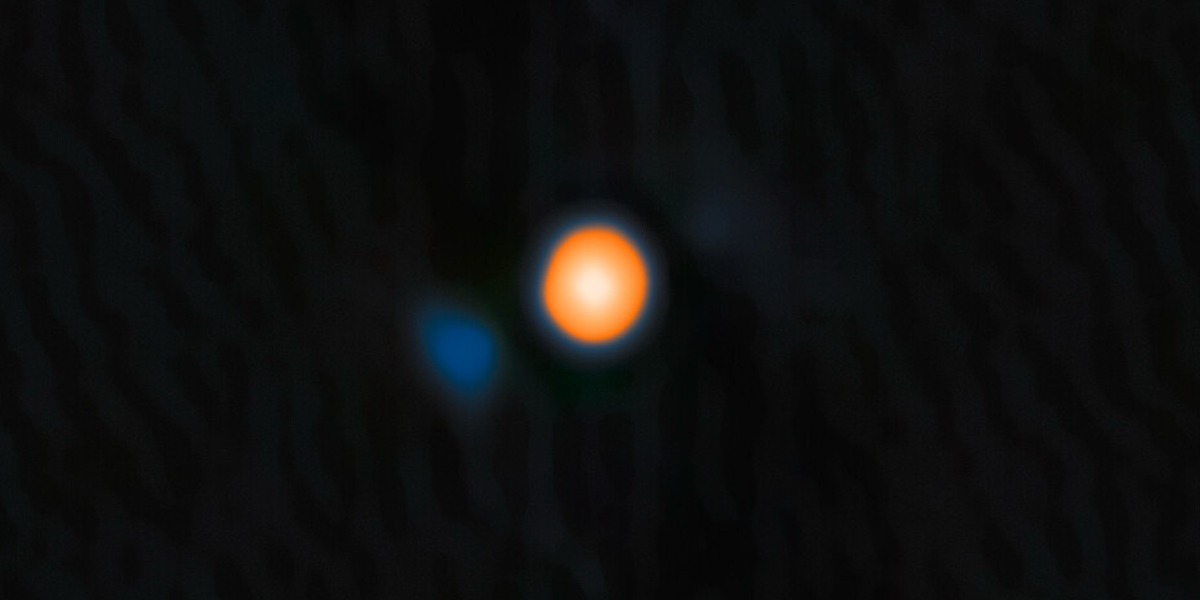
Betelgeuse has spent centuries acting like the celebrity of the winter sky: huge, bright, temperamental, and seemingly incapable of changing its appearance without starting a rumor. Now astronomers have gathered compelling evidence that the famous red supergiant may not be alone. A much smaller star appears to be orbiting inside Betelgeuse’s extended atmosphere, leaving behind a trail of disturbed gas and possibly helping create the star’s mysterious six-year brightness cycle.
What Has Betelgeuse Been Hiding?
The suspected secret is a stellar companion commonly called Betelbuddy and more formally nicknamed Siwarha, an Arabic name meaning “her bracelet.” That name is fitting because Betelgeuse’s traditional name is associated with the “hand” of a figure in old Arabian astronomy, while the smaller object appears to circle it like a bracelet.
This is not another enormous red star tucked discreetly behind the curtains. The proposed companion is dramatically fainter than Betelgeuse and may be a young star that has not yet fully settled onto the main sequence. Depending on which analysis proves most accurate, its mass could range from roughly that of the Sun to nearly twice the Sun’s mass. Those estimates remain uncertain because observing anything next to Betelgeuse is like trying to photograph a candle beside a stadium floodlightwhile the floodlight is boiling, pulsating, shedding dust, and occasionally throwing pieces of itself into space.
Astronomers now have several independent clues pointing in the same direction: a persistent six-year cycle, changes in radial velocity, possible astrometric motion, a tentative direct image, and spectral evidence of a gaseous wake moving through Betelgeuse’s atmosphere. Together, these findings make the hidden-companion theory increasingly persuasive, although scientists still want to observe unmistakable orbital motion before declaring the case permanently closed.
Why Betelgeuse Is So Difficult to Understand
Betelgeuse is a red supergiant located in the constellation Orion, where it marks one of the hunter’s shoulders. It is an evolved massive star with a surface hundreds of times wider than the Sun’s. If placed at the center of our solar system, its visible surface would extend roughly to the region of Jupiter’s orbit, depending on the radius estimate used.
Unlike the Sun, Betelgeuse does not have a neat, stable surface. Its outer layers are dominated by enormous convection cells. Hot gas rises, cooler gas sinks, and sections of the star can brighten or darken independently. The star also pulsates, expands, contracts, loses mass, forms dust, and produces irregular atmospheric activity. In other words, Betelgeuse is less like a polished light bulb and more like a simmering pot with no lid.
The Familiar 400-Day Pulsation
One of Betelgeuse’s best-known rhythms lasts approximately 400 to 420 days. Astronomers generally associate this cycle with pulsation: the star’s outer layers repeatedly swell and contract, changing its temperature and brightness.
The Stranger Six-Year Cycle
Superimposed on the shorter pulsation is a long secondary period lasting roughly 2,100 days, or close to six years. Long secondary periods are seen in many luminous red giants, but their physical cause has remained one of stellar astronomy’s most stubborn puzzles. Proposed explanations have included giant convection cells, rotation, magnetic activity, unusual pulsation modes, dust clouds, and unseen companions.
Betelgeuse’s longer cycle appears not only in its brightness measurements but also in observations of its motion toward and away from Earth. The persistence of that rhythm across many decades made a binary companion particularly attractive as an explanation. Random convection can produce spectacular chaos, but it is not famous for keeping a six-year appointment with the punctuality of an accountant.
How Astronomers Predicted Betelbuddy
In 2024, two independent research groups analyzed Betelgeuse’s long-term behavior and reached broadly similar conclusions. One team examined the phase relationship between the star’s brightness and radial velocity. The other studied more than a century of radial-velocity measurements, visual observations, and positional data.
Both teams found that the approximately six-year signal behaved like the gravitational signature of an orbiting body. Their estimates of the companion’s mass differed because Betelgeuse’s turbulent atmosphere makes its true orbital motion difficult to separate from pulsation and convective noise. Nevertheless, both models placed the object only a few astronomical units from Betelgeusejust over twice the giant star’s measured radius in some calculations.
That means the companion would not be orbiting peacefully through empty space. It would travel within Betelgeuse’s extended chromosphere and outer atmosphere, plowing through gas expelled by the red supergiant. It is a bit like discovering that a small speedboat has been circling inside a hurricane for years and somehow neglected to file a weather complaint.
The models also explained why the companion had remained invisible. Betelgeuse is enormously luminous, spatially complex, and variable. A small star near it could be hundreds of times fainter at visible wavelengths and buried in glare, atmospheric distortion, dust, and the red supergiant’s changing surface features.
The Image That Nearly Gave the Game Away
The prediction gave astronomers something extremely useful: a time and place to look. Researchers calculated when the suspected companion should reach its greatest apparent separation from Betelgeuse. A team led by NASA scientist Steve Howell then turned to the 8.1-meter Gemini North telescope in Hawai‘i and its high-resolution ‘Alopeke speckle-imaging instrument.
Speckle imaging works by taking thousands of extremely short exposures. Each exposure is brief enough to freeze much of the blurring caused by Earth’s atmosphere. Computers then combine the snapshots to reconstruct a sharper view. This approach is especially valuable when the target is so bright that ordinary long exposures would overwhelm the detector.
Observations from 2020 showed no companion when orbital models predicted that it should be hidden behind or aligned with Betelgeuse. Images obtained in 2024, near the predicted point of greatest separation, revealed a faint source approximately 52 milliarcseconds away. It was about six magnitudes fainter than Betelgeuse at the observed wavelength, and its position closely matched the prediction.
That sounds wonderfully conclusive until one reaches the statistical fine print. The signal was detected at only about 1.5 sigma, far below the confidence normally required for a definitive astronomical discovery. The imaging team carefully investigated possible detector defects, cosmic rays, atmospheric artifacts, and unrelated background stars, but the result remains tentative. It is impressive evidence, not a celestial notarized affidavit.
Then Astronomers Found Something Even More Persuasive
A weak image can be questioned. A repeating physical disturbance in Betelgeuse’s atmosphere is harder to dismiss.
Using nearly eight years of ultraviolet observations from the Hubble Space Telescope together with ground-based spectroscopy, researchers studied how gas around Betelgeuse changed during different phases of the proposed companion’s orbit. They identified variations in absorption and outflow signatures associated with elements such as iron, silicon, magnesium, and manganese.
The changes were consistent with a dense, expanding wake trailing an object as it moved through Betelgeuse’s outer atmosphere. Researchers compared the effect to a boat producing ripples as it travels through water. In this case, however, the “water” is extremely hot stellar gas and the “boat” may be a young star orbiting one of the largest stars visible to the naked eye.
The atmospheric features strengthened after the suspected companion passed across Betelgeuse from our viewing angle and weakened later in the cycle. This repeating pattern closely followed the proposed orbital period. NASA and the Space Telescope Science Institute described the observations as firm or direct evidence that a companion is disrupting Betelgeuse’s atmosphere.
What Kind of Object Is Siwarha?
One early possibility was that the companion might be a compact stellar remnant, such as a white dwarf or neutron star. Such objects can produce X-rays when they pull material from a nearby star. Deep observations with NASA’s Chandra X-ray Observatory, however, did not detect the expected high-energy emission.
The X-ray limits strongly disfavor an actively accreting white dwarf or neutron star. Far-ultraviolet observations with Hubble also failed to isolate a clear spectrum from the companion and ruled out some of the brighter, more massive possibilities.
The remaining candidate is probably a relatively low-mass young stellar object or pre-main-sequence star. The tentative Gemini image suggested a mass near 1.6 times that of the Sun, while dynamical studies produced lower and broader estimates. This disagreement is not necessarily fatal to the theory; it illustrates how difficult it is to determine the properties of a faint object embedded in the atmosphere and glare of a convulsing supergiant.
Future observations must measure the object’s motion, color, spectrum, and brightness more accurately. Until then, Siwarha’s stellar résumé still contains several blank lines.
How Could a Small Star Change Betelgeuse’s Brightness?
The companion is much too small to eclipse a meaningful fraction of Betelgeuse by itself. Even if it passed directly across the giant star’s face, the effect would be lost among Betelgeuse’s ordinary pulsations and surface changes.
The more promising explanation involves dust and gas. Betelgeuse is surrounded by material it has expelled. A companion orbiting through this environment could concentrate gas into a wake, alter where dust forms, heat or destroy dust grains, or clear a temporary path through material that blocks visible light.
Intriguingly, Betelgeuse appears brightest during an orbital phase when simple eclipse models might predict the opposite. Researchers have therefore suggested that the companion may reduce obscuration rather than create it. In that scenario, Siwarha acts less like a lampshade and more like a tiny cosmic windshield wiper, disturbing dust and allowing additional blue light to escape toward Earth.
The wake observations provide a mechanism for connecting the orbit with changing atmospheric absorption. Still, astronomers do not yet have a complete physical model explaining every detail of the six-year light curve. The companion theory has graduated from clever speculation to evidence-supported science, but its homework is not finished.
The Hidden Companion Did Not Cause the Great Dimming
Betelgeuse’s six-year cycle should not be confused with the dramatic Great Dimming of 2019 and 2020. During that event, the star lost roughly 60% or more of its usual visible brightness, briefly inspiring worldwide speculation that it might be preparing to explode.
Hubble observations instead indicated that Betelgeuse experienced an enormous surface mass ejection. Hot material was launched away from the star, expanded, cooled, and formed a dust cloud that blocked light from a substantial portion of the visible surface. Betelgeuse returned to a more normal brightness by April 2020.
The proposed companion may influence Betelgeuse’s atmosphere and regular long-term variability, but the Great Dimming appears to have been a separate, unusually violent mass-loss event. Betelgeuse is apparently capable of maintaining more than one mystery at a time. Overachievement is not always admirable.
Why Scientists Still Use Cautious Language
The wake, the predicted position, the six-year timing, and the faint Gemini source form an impressive package. However, science advances by attempting to break its favorite explanations, not by giving them commemorative mugs after the first promising result.
The direct image remains statistically weak, and astronomers have not yet tracked the source moving along the predicted orbit. Hubble and Chandra did not directly isolate a companion spectrum. Betelgeuse’s convective atmosphere can imitate velocity shifts and positional changes, making any measurement more complicated.
In April 2026, a broader Gaia-based study of luminous red giants found that low-mass companions probably do not explain long secondary periods in most such stars. The expected astrometric wobble was generally absent, suggesting that many stars with long secondary periods are single. That research did not directly disprove a companion around Betelgeuse, which is an unusually bright red supergiant with its own specialized evidence. It does, however, warn astronomers not to assume that every long secondary period must be orbital.
For Betelgeuse, the companion hypothesis must therefore stand on its full collection of evidenceespecially the candidate image and atmospheric wakenot merely on the existence of a six-year cycle.
November 2027 Could Provide the Decisive Test
Orbital models predict that Siwarha should reach another point of greatest apparent separation from Betelgeuse on or around November 26, 2027. That will give astronomers their best near-term opportunity to determine whether the faint source moves exactly where a bound companion should.
Researchers hope to combine speckle imaging, ultraviolet spectroscopy, optical spectroscopy, interferometry, and possibly additional X-ray observations. A successful detection at the predicted location would dramatically strengthen the case. Measuring orbital motion over multiple epochs would be more valuable still.
A non-detection would not automatically destroy the theory because the companion may vary in brightness or remain hidden by Betelgeuse’s atmosphere. Nevertheless, the 2027 observing window will be a major test. Astronomy rarely gets to schedule a mystery’s next appearance on the calendar, so telescopes are unlikely to ignore the invitation.
Why Betelgeuse’s Hidden Companion Matters
Understanding Siwarha would reveal far more than the private life of one famous star. Red supergiants are the immediate ancestors of many core-collapse supernovae. Their mass loss, rotation, atmospheric structure, and interactions with companions influence how they evolve and what remains after they explode.
A companion orbiting inside a supergiant’s atmosphere could transfer angular momentum, alter stellar winds, organize dust, and accelerate the loss of material. It might even help explain why Betelgeuse appears to rotate faster than expected for a star of its age and size.
The system may also become a laboratory for understanding long secondary periods in other evolved stars. Betelgeuse may prove to be an exceptional binary rather than a universal model, but even exceptions are scientifically useful. They show researchers which mechanisms nature is willing to build, no matter how inconvenient the arrangement looks on paper.
The suspected companion faces an unpleasant future. Drag and tidal forces may cause it to spiral inward and merge with Betelgeuse within roughly 10,000 years in some models. Alternatively, Betelgeuse could explode first. Either outcome makes the phrase “long-term relationship” somewhat optimistic.
Does This Mean Betelgeuse Is About to Explode?
No. The companion evidence does not indicate that a supernova is imminent. Betelgeuse will eventually exhaust its nuclear fuel, collapse, and explode, but current evolutionary estimates commonly place that event tens of thousands to roughly 100,000 years in the future. Astronomers cannot provide an exact date because the internal condition of a distant star is not available through a convenient online countdown.
When Betelgeuse finally does explode, it could become extraordinarily bright in Earth’s sky, potentially visible during the daytime. At its distance, it is not expected to threaten life on Earth. For now, the more immediate spectacle is subtler: scientists are watching a possible companion carve a path through the atmosphere of a dying giant.
An Observer’s Experience: Watching Betelgeuse After Learning Its Secret
Learning about the hidden companion changes the experience of looking at Orion. Before reading the research, Betelgeuse may seem like a simple orange dot decorating one corner of a familiar constellation. Afterward, it becomes difficult to see it as a dot at all. The eye still sees one star, but the mind begins reconstructing an entire physical system: a swollen red atmosphere, continent-sized convection cells, expanding shells of gas, forming dust, violent eruptions, and a faint companion cutting through the chaos.
Finding Betelgeuse Without Special Equipment
On a clear Northern Hemisphere winter evening, Orion is one of the easiest constellations to identify. Begin with the three evenly spaced stars of Orion’s Belt. Betelgeuse appears above the belt and toward the left when Orion is upright. Its orange-red color distinguishes it from the whiter or bluish stars nearby, particularly Rigel on the opposite side of the constellation.
No telescope is required. In fact, binoculars or a small telescope will not reveal Siwarha because the companion is far too close to Betelgeuse and buried in its glare. The useful experience is not attempting an impossible backyard detection. It is learning to notice how Betelgeuse compares with nearby stars over time.
Comparing Brightness From Night to Night
A casual observer can compare Betelgeuse with Rigel, Bellatrix, Aldebaran, or other bright stars. Atmospheric conditions, moonlight, altitude, and personal vision make precise estimates difficult, but repeated observations can reveal broad changes. Amateur astronomers often record the date, time, sky conditions, and estimated brightness in a notebook or observing app.
The process teaches patience. Betelgeuse does not perform on command. One night it may appear noticeably brighter than Bellatrix; another night the difference may seem smaller. Then clouds arrive for two weeks, because Earth’s atmosphere enjoys participating in astronomy mainly by standing in front of it.
Following the Science Instead of the Supernova Rumors
The Great Dimming demonstrated how quickly an unusual observation can become an online apocalypse. Seeing Betelgeuse with your own eyes provides a useful antidote to sensational headlines. A change in brightness is real and scientifically exciting, but it does not automatically mean the star will explode next Thursday.
Following the companion research offers an even better lesson. The story developed in stages: long-term patterns suggested an unseen object; models predicted where it should appear; a telescope found a faint signal near that location; ultraviolet spectra revealed a repeating atmospheric wake; and newer research reminded everyone that alternative explanations must still be tested. This is science as it normally worksnot a single dramatic “Eureka!” moment, but an accumulating argument with occasional objections from the back row.
Revisiting Orion Over Several Seasons
An especially rewarding experience is returning to Orion every year. The constellation disappears into the Sun’s glare for part of the year and returns to the morning sky before becoming prominent again during winter evenings. Each reappearance provides a natural checkpoint.
By late 2027, professional astronomers expect the suspected companion to reach another favorable position for observation. Backyard observers still will not separate the pair, but they can watch the same patch of sky while major observatories attempt the decisive measurements. There is something satisfying about seeing Betelgeuse directly while knowing that telescopes in space and on mountaintops are dissecting light from the same object.
The Most Memorable Part of the Experience
The lasting impression is scale. Siwarha may orbit several times farther from Betelgeuse than Earth orbits the Sun, yet it can still be traveling through the supergiant’s extended atmosphere. A distance that would feel enormous in our solar system becomes cramped beside a red supergiant.
That realization turns Betelgeuse from a textbook illustration into a dynamic place. It is losing material, changing shape, pulsing, and possibly interacting with a younger star that will eventually be swallowed or caught in a supernova. Looking up at that calm orange point while imagining the violence around it is the real observing experience: the sky appears quiet only because it is very far away.
Conclusion: Betelgeuse Is Probably Not Alone
Scientists have not obtained a flawless portrait of Siwarha or watched it complete a clearly measured orbit. Even so, the companion hypothesis now explains an impressive collection of observations: Betelgeuse’s stable six-year cycle, radial-velocity changes, possible positional wobble, a faint source found near the predicted location, and a repeating wake of dense gas moving through the star’s atmosphere.
The most accurate conclusion is not that the mystery has been solved beyond all doubt. It is that Betelgeuse probably has been hiding a stellar companion in one of the most observationally inconvenient places imaginable. The next major observing opportunity in November 2027 could reveal whether Betelbuddy truly follows the predicted orbitor whether Betelgeuse has prepared another plot twist.