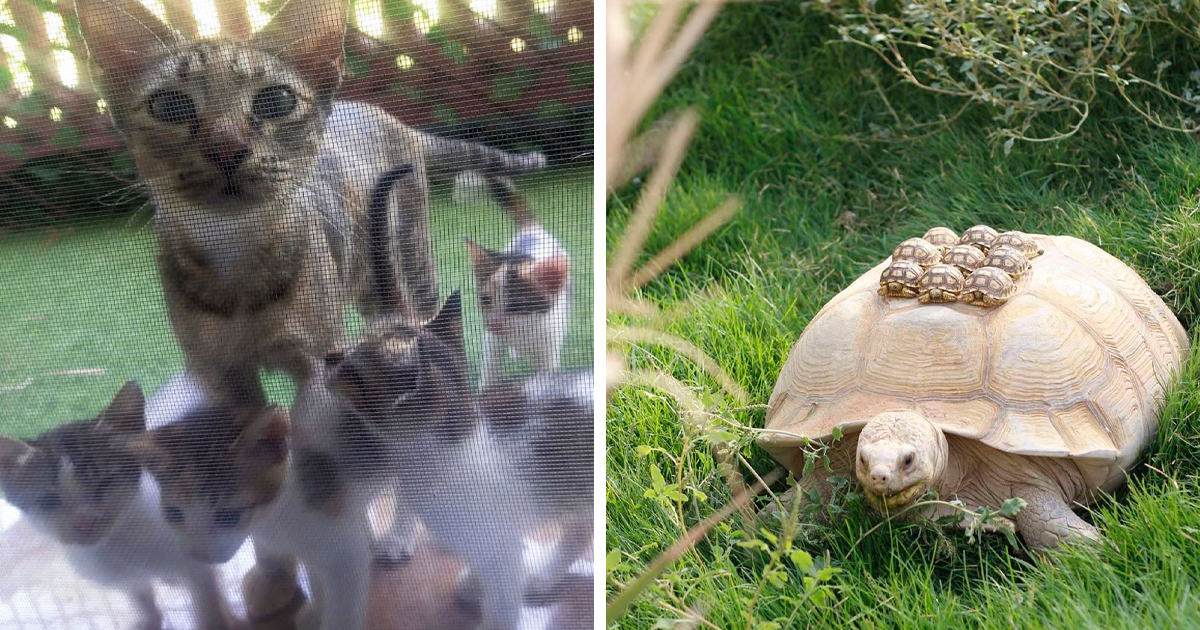
There are ordinary animal pictures, there are cute animal pictures, and then there are photographs of animal parents meeting, feeding, carrying, protecting, or quietly tolerating their babies. That final category operates on an entirely different emotional frequency. One minute, you are casually scrolling. The next, you are staring at a tired mother cat hugging a newborn and wondering why your eyes have suddenly become suspiciously damp.
The collection behind “She Wasn’t Fat After All”: 50 Wholesome Pics Of Animal Parents And Their Babies gathers the kinds of family moments that rarely need captions. A dog lies surrounded by nursing puppies. A swan tucks cygnets beneath her feathers. A newly adopted cat family settles into its home as though it has always belonged there. Elsewhere, a cow meets her first calf while humans nearby experience the delightful realization that she was not simply gaining weight. Surprise: the “extra pounds” had hooves.
The original photo collection includes domestic pets, farm animals, birds, and wildlife families, with memorable submissions such as a mother cat embracing one of her four newborn kittens, an entire feline family adopted after appearing at someone’s door, and a first-time cow mother standing beside her calf. The combination of recognizable family behavior and unexpected animal expressions is what gives the gallery its irresistible charm.
Why Animal Parents and Babies Melt Us Instantly
Baby animals arrive with an unfair collection of visual advantages: large eyes, small noses, round faces, clumsy feet, oversized ears, and the general appearance of having misplaced the instruction manual for their own bodies. Scientists often describe this cluster of infant features as a “baby schema.” These traits tend to attract attention and encourage protective responses, even when the baby belongs to another species. In other words, your desire to gently boop a puppy’s nose is not necessarily a character flaw. Your brain has been professionally ambushed by cuteness.
Pictures of parents and babies add another layer. A tiny animal alone may look adorable, but a tiny animal pressed against a protective parent tells a complete story. The viewer immediately recognizes warmth, dependence, patience, exhaustion, and trust. Those emotions require no translation.
Many of the photographs are funny because the parents appear so relatable. A mother cat looks proud but desperately in need of uninterrupted sleep. A dog nursing a crowded litter seems to be reconsidering every decision that led to this moment. A bird parent arrives with food while several open mouths demand immediate service. Apparently, “What do you want for dinner?” is a question that has haunted families across the animal kingdom.
Animal Parenting Is More Diverse Than It Looks
The tender scenes in these 50 wholesome animal pictures may seem similar, but the biology behind them varies dramatically. Some newborns require months or years of close supervision. Others are ready to walk, swim, or follow their parents within hours. In certain species, mothers provide nearly all the care. In others, fathers, siblings, unrelated females, or entire social groups help raise the young.
Some Babies Stay Close for Years
Orangutan youngsters have one of the longest childhoods among great apes. They may remain with their mothers for seven or eight years, learning where to find food, how to move through the forest, and how to handle the complicated business of becoming an independent orangutan. That is a long apprenticeship, although the dress code is refreshingly relaxed.
Marine mammals also form long-lasting mother-and-calf relationships. Humpback whale calves generally remain near their mothers for months and may stay with them for up to a year before weaning. Killer whale calves nurse for at least a year and remain closely associated with their mothers for at least the first two years. In some killer whale communities, family relationships continue far beyond infancy and help maintain group cohesion.
These extended childhoods are not prolonged vacations. Young animals are learning migration routes, feeding strategies, social rules, communication signals, and the fine art of avoiding things that would like to eat them.
Other Newborns Hit the Ground Running
Some species take the opposite approach. Precocial young are born relatively developed, often with open eyes and enough coordination to move soon after birth. Agouti babies, for example, may be able to run within about an hour. They still remain with their parents, but they enter the world looking less like helpless newborns and more like miniature adults who have an urgent appointment.
Many shorebirds, waterfowl, and hoofed mammals also produce mobile young. Their parents may not need to deliver every meal directly, but they still provide protection, guidance, warmth, and warnings about danger. Independence is a gradual process, even when a baby can walk before the family photographer has found a good angle.
The Mothers Who Make Parenthood Look Heroic
Animal mothers perform some astonishing physical and behavioral feats. Giant panda cubs are exceptionally small compared with their mothers, weighing only a tiny fraction of an adult female’s size at birth. A panda mother must keep her nearly helpless cub warm, stimulate basic bodily functions through grooming, and move it carefully with her mouth. Photos of a giant panda cradling a cub may look peaceful, but they represent constant, delicate work.
Wallabies offer another remarkable example. A female may care for young at different developmental stages simultaneously. She can produce milk with different nutritional compositions for an older joey and a newborn still developing in the pouch. Human parents may prepare separate meals for a picky toddler and a hungry teenager; wallabies accomplish a comparable trick through biology.
Sea otter mothers turn their own bodies into floating nurseries. A pup may rest on its mother’s chest while she grooms its dense fur and keeps it buoyant. Young sea otters must learn grooming and foraging skills before they can survive alone. At the Monterey Bay Aquarium, non-releasable female otters have even served as surrogate mothers, raising stranded pups and teaching them skills needed for life in the wild.
The result is one of nature photography’s most dependable masterpieces: a fluffy pup balanced on a floating mother who somehow looks serene while performing childcare in cold ocean water.
Animal Fathers Deserve a Spot in the Family Album
Although many popular animal-parenting images focus on mothers, fathers can be equally involved. Among marmosets and tamarins, males frequently carry infants on their backs, protect them, and deliver them to the mother for nursing. Since these primates often have twins or triplets, the arrangement is practical. Mom handles the milk bar; Dad becomes public transportation.
Many birds divide parenting responsibilities. Both parents may incubate eggs, guard a nest, gather food, and feed chicks. Albatross parents can alternate between guarding their chick and making long foraging trips. As the chick grows, both adults spend more time searching for food, sometimes traveling considerable distances before returning to the nest.
Flamingo parenting is especially memorable. Both parents can produce a nutritious substance commonly called crop milk, which they feed to their chick. Young flamingos may gather in large nursery groups, yet parents can identify and feed their own offspring. That is impressive considering the nursery may resemble a noisy pink daycare center without name tags.
Sometimes It Takes an Entire Herd, Pride, or Colony
Parenthood is not always a two-animal operation. In social species, relatives and other group members may guard, carry, feed, or teach young animals. Female lions in the same pride sometimes give birth around the same period, creating groups of cubs that grow and play together. Meerkat helpers may babysit, protect, and even help nourish pups. These systems spread the workload and give youngsters additional opportunities to learn.
Cooperative care also produces some of the warmest photographs. A baby may be surrounded by several watchful adults, tucked safely in the center of a herd, or passed between trusted group members. To human eyes, the scene resembles a family gathering where everyone insists on holding the baby, except the relatives have tails and nobody has brought an unnecessary casserole.
Not every adult pictured beside a baby is necessarily its biological parent. Surrogates and adoptive caregivers occur in both managed care and natural settings. The Monterey Bay Aquarium’s sea otter program demonstrates how experienced females can provide orphaned pups with maternal care while minimizing the pups’ dependence on humans. Some bird parents have also been observed responding to the begging calls of chicks that are not their own, particularly when their nurturing instincts are already strongly activated.
Domestic Animal Families Bring the Drama Home
Cats and dogs are responsible for many of the funniest images in collections like this one because people can observe their family lives closely. A pregnant cat may gradually become rounder while her household debates whether she is expecting kittens or simply enjoying too many snacks. Feline pregnancy averages roughly nine weeks, which means an uncertain guess can become a box full of squeaking evidence surprisingly quickly.
After birth, a mother cat spends much of her time nursing, warming, cleaning, and watching her kittens. Newborn kittens cannot regulate their body temperature effectively, so staying close to their mother is essential. The mother’s nutritional needs also increase significantly while she supports the litter. Her expression in a family photograph may communicate love, vigilance, and an urgent desire for room service.
Dogs create equally memorable scenes. A small mother may disappear almost completely beneath a pile of puppies. Larger dogs sometimes stare at their newborns with an expression that falls somewhere between wonder and confusion. Meanwhile, the puppies eat, sleep, squeak, climb over one another, and contribute nothing to household expenses.
Farm animals add another kind of charm. A cow licking her newborn calf, a goat standing beside tiny kids, or a hen sheltering chicks beneath her wings shows familiar parental behavior in settings many people rarely see. These images remind us that livestock are not simply background characters in rural landscapes. They form relationships, respond to their young, and display individual temperaments that become obvious when someone takes the time to watch.
What the 50 Wholesome Pictures Reveal
Protection Can Be Gentle or Fierce
A parent may protect a baby by covering it with a wing, carrying it away from danger, hiding it in vegetation, standing between it and a threat, or sounding an alarm. The quietest photographs often contain the strongest message. A baby sleeping against a parent appears completely vulnerable, yet its relaxed posture shows that it feels secure.
Teaching Is Part of Parenting
Animal babies must learn what to eat, where to travel, how to communicate, and which situations require immediate retreat. A sea otter pup watches foraging behavior. A young predator experiments with stalking. A bird follows its parents’ calls. A calf learns how to move with the herd. What looks like play may also be practice for adulthood.
Parents Get Tired Everywhere
One of the collection’s greatest pleasures is recognizing universal exhaustion. The parents look proud, attentive, and occasionally flattened by responsibility. A mother surrounded by eight sleeping babies may be experiencing a beautiful family moment, but she is also clearly trapped beneath eight sleeping babies.
Babies Rarely Respect Personal Space
They climb onto backs, sit on heads, sleep across faces, pull feathers, chew ears, and occupy the exact spot where a parent would prefer to rest. The adults frequently tolerate this behavior with astonishing patience. Perhaps nature’s strongest parental instinct is the ability to remain still while someone small uses your spine as playground equipment.
Enjoy Wildlife Families Without Disturbing Them
Wholesome wildlife photographs can inspire people to approach young animals, but distance is essential. A baby that appears alone is not automatically abandoned. Deer may leave fawns hidden while feeding, marine mammals may leave pups on shore, and fledgling birds may spend time on the ground while their parents remain nearby.
The U.S. Fish and Wildlife Service advises that most healthy young wildlife should be left where it is unless there are clear signs of injury, immediate danger, or a confirmed dead parent. Moving or handling an animal can separate it from the adults already caring for it.
Marine mammals require even greater caution. People and pets should remain well away from seals, sea lions, whales, and other marine wildlife so normal resting, nursing, and feeding behavior can continue. The best wildlife family portrait is one taken from a respectful distance with a long lens and absolutely no attempt at a group hug.
My Experience Viewing Animal Parents and Their Babies
Looking through a long collection of animal family photos feels different from viewing random cute pictures. The emotional effect builds gradually. At first, the images are simply entertaining: a kitten asleep beneath its mother’s chin, puppies lined up for dinner, or a baby goat standing on an adult as if the adult were a conveniently placed hill.
After several photographs, patterns begin to emerge. The species change, but the body language remains strangely familiar. Parents curve themselves around newborns. Babies push toward warmth. Adults watch while youngsters explore, intervening only when necessary. Even without assigning human thoughts to the animals, it is difficult not to recognize attention, dependence, comfort, and protection.
The photographs involving first-time mothers are especially memorable. Their expressions often invite humorous interpretations. A cow may appear amazed that the small, damp creature beside her has suddenly become her responsibility. A cat looks pleased with her kittens but mildly offended that labor did not come with a complimentary nap. A dog stares at a large litter as though she ordered one puppy and received the warehouse package.
Humor does not weaken the emotional impact. It makes the scenes more approachable. We laugh because the animals’ situations resemble familiar family experiences: crowded sleeping arrangements, impatient children, exhausted caregivers, and babies who have no interest in boundaries. The joke is affectionate rather than dismissive. It acknowledges the effort visible in the image.
I also find that these pictures encourage closer observation. A quick glance reveals cuteness, but a longer look reveals details: the way a parent positions its body between the baby and open space, the tiny foot gripping fur, the adult’s eyes tracking movement, or the difference in size between a newborn and its enormous caregiver. A photograph becomes more meaningful when we understand that these positions and gestures may serve practical purposes such as warmth, transport, feeding, or defense.
The collection also challenges the idea that there is one standard form of animal family. Some babies are raised primarily by mothers. Others receive extensive paternal care. Some grow within herds, colonies, prides, or cooperative groups. Surrogates may step into parental roles. Certain youngsters remain dependent for years, while others begin moving independently almost immediately.
That variety makes the gallery more than a stream of adorable faces. It becomes an informal tour of survival strategies. Every cuddle, ride, feeding session, and protective stance exists because it helps a new generation make it through a vulnerable stage of life.
The strongest photographs are often the simplest. There may be no dramatic rescue, rare species, or professionally arranged composition. Sometimes the image shows only an ordinary animal lying beside its ordinary babies. Yet the moment feels extraordinary because the parent is completely focused on them.
By the end of the collection, the title’s joke“she wasn’t fat after all”feels like the perfect introduction. It begins with a harmless misunderstanding and ends with new life. The surprise is funny, the babies are irresistible, and the parent’s response supplies the heart. It is difficult to finish 50 such pictures without feeling at least slightly more optimistic about the world.
Conclusion
These wholesome pictures of animal parents and their babies capture more than cuteness. They show the work behind survival: feeding, guarding, carrying, teaching, grooming, warming, and occasionally accepting that a baby will be sitting directly on your face for the foreseeable future.
From cats and cows to flamingos, pandas, whales, primates, and sea otters, animal families solve the challenges of raising young in wonderfully different ways. Some rely on devoted mothers, some recruit hardworking fathers, and others turn parenting into a group project. Together, the images offer an uplifting reminder that care can take many formsand that nearly every species produces at least one baby capable of destroying human productivity with a single photograph.
Note: Observe wild animal families from a safe distance. A young animal that appears alone may still be receiving care from a parent nearby; contact a licensed wildlife professional when an animal is visibly injured or clearly orphaned.