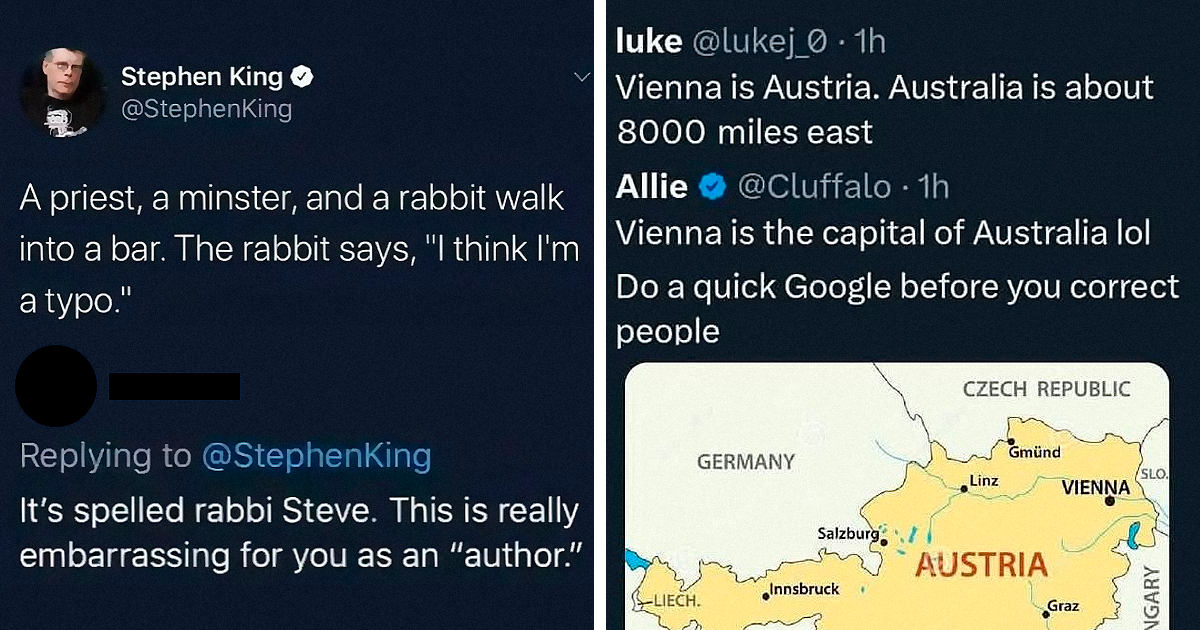
There is a special kind of confidence that only exists in an internet comment box. It is the confidence required to read half a sentence, misunderstand it completely, type “Actually…” and then confidently correct someone with information that could have been disproved by a 12-second Google search.
Welcome to the glorious world of internet correction fails, where punctuation becomes a blood sport, geography is apparently optional, scientific facts are negotiated by popular vote, and somebody always arrives to explain a subject to the person who literally works in that field.
These moments are funny, but they also reveal something important about online misinformation. Research into digital literacy and social media behavior repeatedly suggests that people often react before checking accuracy. Professional fact-checkers tend to do something very different: they leave the original page, compare sources, look for primary evidence, and investigate who is making the claim. In other words, they perform the revolutionary internet activity known as “checking first.”
The 50 examples below represent recurring types of mistakes seen across social media discussions, comment sections, forums, and fact-checking communities. Usernames are intentionally absent. The goal is not to publicly roast one unfortunate commenter forever. The internet has already taken care of that.
Why Are Internet Correction Fails So Satisfying?
A normal mistake is rarely hilarious. Someone says Wednesday when they meant Thursday, gets corrected, and everyone continues living.
The comedy begins when certainty enters the room wearing sunglasses.
The classic correction fail usually contains three ingredients: an incorrect claim, extraordinary confidence, and an unnecessary attempt to embarrass somebody else. When the correction itself turns out to be wrong, the entire structure collapses beautifully.
Social media makes these situations especially common because speed and engagement are rewarded. Pausing to verify a claim rarely feels as exciting as firing off a devastating reply. Unfortunately, devastating replies work better when they are correct.
50 Internet Geniuses Who Were Almost Ready to Correct Someone
Language Experts Reporting for Duty
- The Your/You’re Sheriff: Corrects someone’s “your” to “you’re” even though the original sentence was already grammatically correct. Grammar police immediately open an internal investigation.
- The Apostrophe Architect: Insists that every plural noun requires an apostrophe. Suddenly the world is filled with banana’s, car’s, dog’s, and English teachers quietly staring into the distance.
- The Dictionary Denier: Announces that a word “isn’t a real word” despite the inconvenient existence of several major dictionaries containing it.
- The Literally Literalist: Claims that “literally” can never be used for emphasis or figuratively, apparently unaware that dictionaries document that usage and writers have been doing it for generations.
- The Irregardless Emergency: Says dictionaries cannot contain “irregardless” because they personally dislike it. Dictionaries, tragically, document usage rather than request permission.
- The Oxford Comma Warrior: Declares that omitting an Oxford comma is objectively incorrect instead of recognizing that major style guides simply have different conventions.
- The British English Detector: Corrects “colour” to “color” without considering the radical possibility that countries besides the United States use the internet.
- The Name Pronunciation Professor: Corrects someone on how to pronounce their own surname. This is an advanced technique requiring truly elite levels of confidence.
- The Acronym Investigator: Tells the creator of a project what its acronym “actually” means after reading a random comment written three minutes earlier.
- The Typo Philosopher: Finds one typo and concludes that every argument surrounding it must therefore be wrong. Peer review has apparently been replaced with spell-check.
Science Has Entered the Comments
- The Bat Bird Specialist: Corrects someone for calling bats mammals because bats fly. By this reasoning, airplanes may soon qualify as migratory birds.
- The Whale Fish Department: Insists whales are fish because they live in water. Dolphins and seals are presumably awaiting reassignment.
- The Penguin Mammal Theory: Claims penguins cannot be birds because they do not fly. Chickens are watching this discussion nervously.
- The Lightning Rule: Announces that lightning never strikes the same location twice, a claim familiar to tall buildings that get struck repeatedly.
- The Seasonal Expert: Corrects an Australian for talking about summer in December. The Southern Hemisphere responds by continuing to exist.
- The Pluto Funeral: Says Pluto “stopped being a planet and disappeared.” Pluto remains physically present; astronomers merely classified it as a dwarf planet.
- The Coldest Number Contest: Argues endlessly about whether Fahrenheit or Celsius gets colder while missing the delightful fact that both scales meet at minus 40.
- The Tomato Tribunal: Shouts that tomatoes cannot be fruit because nobody puts them in fruit salad. Botany and culinary classification quietly request separate attorneys.
- The Evolution Ladder: Demands to know why monkeys still exist “if humans came from monkeys,” confusing common ancestry with one modern species transforming directly into another.
- The Oxygen Ownership Dispute: Corrects someone by claiming plants are the only meaningful source of atmospheric oxygen, forgetting about the enormous contribution of ocean-dwelling photosynthetic organisms.
Geography: The Final Boss of Comment Sections
- The Africa Country Correction: Someone mentions traveling between African countries and receives the helpful response, “Africa is already a country.” Geography has left the chat.
- The Europe Country Correction: A similar genius explains that France and Germany are “cities in Europe.” Several sovereign governments would like a word.
- The Washington Situation: Corrects Washington, D.C. to Washington state because apparently one Washington was not already confusing enough.
- The Georgia Problem: Encounters the country Georgia and confidently explains that Georgia is actually an American state. Tbilisi sighs deeply.
- The Greenland Map Expert: Assumes Greenland is approximately the size of Africa because some common map projections dramatically distort areas near the poles.
- The Alaska Placement Committee: Thinks Alaska is located southwest of California because that is where many U.S. maps place an inset of it.
- The New Mexico Immigration Debate: Treats New Mexico as a foreign country despite its admission to the United States in 1912.
- The Hemisphere Surprise: Explains to someone in Argentina that Christmas cannot happen during summer because December is obviously winter everywhere.
- The Time-Zone Detective: Accuses someone of lying about the time because their own phone shows a different hour. Planet Earth once again becomes important evidence.
- The Great Wall Astronaut: Repeats the familiar claim that the Great Wall of China is easily visible from the Moon with the naked eye. Space is considerably farther away than many viral facts suggest.
History Corrections That Needed Five More Minutes
- The Frankenstein Specialist: Corrects somebody by insisting Frankenstein is the monster. Victor Frankenstein is the scientist; the creature famously goes unnamed.
- The Century Calculator: Announces that the year 1900 belongs to the 20th century without realizing centuries begin with year one rather than year zero.
- The Historical Photography Expert: Calls an old photograph fake because “cameras didn’t exist then,” having dramatically underestimated how old photography is.
- The Medieval Electricity Department: Sees a modern object in a historical joke and explains at great length why the meme is historically inaccurate. The joke survives.
- The Quote Attribution Machine: Corrects the source of a famous quote using another unsourced quote image as evidence. The internet performs peer review on itself.
Technology Experts With 4% Battery Remaining
- The Wi-Fi Equals Internet Expert: Insists a device cannot be connected to Wi-Fi if the internet connection is down. Local networking professionals develop headaches.
- The Browser/Search Engine Merger: Corrects somebody for calling Chrome a browser because they believe Chrome and Google Search are exactly the same product.
- The Cloud Meteorologist: Explains that cloud storage means files are “floating around wirelessly” rather than residing on physical computing infrastructure.
- The Incognito Invisibility Cloak: Announces that private browsing makes a user completely anonymous to websites, employers, network operators, and internet providers. It does not.
- The Megabyte Mathematician: Treats megabits and megabytes as identical units and wonders why a download does not finish eight times faster.
- The Screenshot Authentication Lab: Declares that a screenshot must be genuine because “you can’t edit screenshots.” Somewhere, Photoshop opens itself out of pure spite.
- The Deleted Internet Theory: Claims removing a social media post guarantees all copies have vanished. Screenshots, archives, reposts, and cached versions collectively clear their throats.
- The Algorithm Psychic: States with certainty exactly why a platform recommended one particular post despite having no access to the system, data, or ranking model.
- The AI Omniscience Department: Treats an AI-generated answer as automatic proof rather than something that may still require source verification.
- The Google Result Championship: Assumes the first search result must automatically be the most accurate. Search ranking and factual accuracy are related far less neatly than that.
Everyday Confidence Achievements
- The Professional Explainer: Corrects a veterinarian about basic animal care after watching three short videos and reading half a Facebook thread.
- The Local Expert From 3,000 Miles Away: Tells a resident that a road, store, neighborhood, or landmark in their own city does not exist.
- The Recipe Constitutional Lawyer: Announces that modifying one ingredient means a dish is legally forbidden from keeping its familiar name. The culinary Supreme Court declines the case.
- The Personal Experience Auditor: Responds to “this happened to me” with “no it didn’t” despite possessing absolutely no information about the stranger involved.
- The Ultimate “Actually”: Corrects someone, receives direct evidence showing the correction was wrong, and replies, “Well, you know what I meant.” A timeless internet classic.
Why Smart People Still Make Terrible Online Corrections
It is tempting to look at these social media arguments and conclude that the internet simply contains an unusually large number of fools. Reality is more interesting.
Knowledge and verification are different skills. A person can be highly intelligent in one field and still evaluate an unfamiliar website poorly. Digital-literacy research has repeatedly found that apparently impressive websites, official-looking logos, citations, and polished presentation can mislead readers who remain on the page instead of checking outside sources.
Professional fact-checkers commonly use lateral reading: instead of staring harder at the original claim, they open other sources, investigate the publisher, locate primary material, and compare independent reporting.
There is also the problem of speed. Online discussions reward instant responses. A sarcastic correction posted now may collect attention; a carefully verified response posted 20 minutes later may arrive after everyone has moved on to a video of a raccoon stealing cat food.
That environment creates the perfect conditions for confident mistakes.
How To Correct Someone Without Becoming Number 51
You do not need professional investigative training to dramatically improve your online fact-checking. Most embarrassing corrections can be prevented with a few boring habitswhich is unfortunate because boring habits rarely go viral.
Search Before You Send
If your response begins with “Actually,” perform one search first. Search the exact claim rather than a version designed to confirm what you already believe.
Look for the Original Source
A screenshot of a headline is not the same as an article. An article describing a study is not the same as the study. A random account describing an official announcement is not the announcement.
Moving closer to primary evidence dramatically reduces the opportunities for context to disappear.
Read Outside the Page
Do not ask only, “Does this website look professional?” Ask, “What do reliable independent sources say about this website?”
This simple shift is one of the most useful digital literacy habits a reader can develop.
Distinguish Facts From Conventions
Some internet fights happen because people mistake preferences for universal laws. Grammar style, spelling conventions, date formats, measurement systems, recipe traditions, and terminology can vary by country, profession, publication, and context.
Sometimes two people can use different forms without either one being wrong. The comment section may find this emotionally disappointing.
Allow Yourself to Say “I Was Wrong”
This is the most powerful feature available on the internet and somehow remains hidden from millions of users.
Try: “You’re right. I checked it.”
No subscription required.
Experiences From the Comment-Section Trenches
Anyone who spends enough time online eventually develops a sixth sense for an incoming correction disaster. You can almost recognize the structure before the reply arrives.
First comes a perfectly ordinary statement. Someone might explain that it is winter where they live, mention a scientific term, use British spelling, describe their profession, or post a photograph of their hometown.
Then the stranger appears.
The reply often begins with the digital equivalent of somebody clearing their throat at a dinner party: “Umm, actually…”
At this moment, three futures are possible.
In the first, the correction is accurate. Everyone learns something. Civilization advances approximately four millimeters.
In the second, both people are partly correct because the issue depends on context. This can lead to an interesting discussion if neither participant treats the exchange like a medieval duel.
The third future is why screenshots exist.
The corrector has misunderstood something spectacularly basic.
One of the funniest patterns involves geography. People naturally view the world from their own location, which produces wonderful exchanges about seasons and time zones. Somebody in North America sees a December beach photo from Australia and assumes it must be old because “December is winter.” Someone posts at 9 a.m. from Europe and is accused of lying because it is still nighttime in California.
These mistakes are harmless, but they demonstrate how easily personal experience becomes confused with universal reality.
Language creates similar chaos. American English dominates large parts of the web, so perfectly correct British, Canadian, or Australian spellings occasionally attract unsolicited repairs. Someone changes “favourite” to “favorite,” only to discover that the writer lives in London. The correction may technically match American spelling while completely missing the fact that American spelling is not an international software update.
Professional expertise produces another classic scenario. Doctors, programmers, mechanics, photographers, scientists, lawyers, pilots, teachers, and tradespeople regularly describe meeting strangers who confidently explain their own profession back to them.
Expertise does not make someone automatically correct, of course. Specialists can make mistakes too. But there is something wonderfully internet-specific about reading two paragraphs, watching a video, and immediately challenging somebody who has worked with the subject for 20 years.
The most useful lesson from these experiences is not “never correct anybody.” Corrections matter. False claims can spread quickly, and good corrections can improve the information available to everyone reading the conversation.
The lesson is simpler: verify before correcting.
Searching first does not weaken your argument. Checking multiple sources does not mean you lack confidence. Changing your mind does not mean you lost.
In fact, the person willing to check evidence and revise a claim is practicing the exact behavior everyone claims to want from everybody else.
And if you discover that your devastating correction was wrong while the reply box is still open, there is another surprisingly effective technique.
Delete it.
Nobody needs to know.
Conclusion: Google Is Free, Public Humiliation Is Forever
The internet has given humanity instant access to dictionaries, scientific papers, satellite maps, historical archives, government records, university research, encyclopedias, news databases, and more collective knowledge than previous generations could have imagined.
Naturally, we use this miraculous infrastructure to argue with strangers about whether penguins are birds.
The 50 internet correction fails above are funny precisely because they are so relatable. Almost everyone has confidently remembered something incorrectly. The difference between an ordinary error and legendary comment-section material is often whether somebody takes a few seconds to verify the claim before attempting a public intellectual victory lap.
So the next time your fingers begin typing “Actually…,” consider opening another tab first. Check the source. Compare the evidence. Look for context.
You might discover that the other person is wrong.
Or you might experience the considerably cheaper alternative to becoming a viral screenshot: quietly learning something new.
SEO Metadata
Note: The examples are anonymized, representative internet scenarios synthesized from recurring online correction patterns and established research on misinformation, fact-checking, digital literacy, and social media behavior rather than accusations directed at specific individuals.