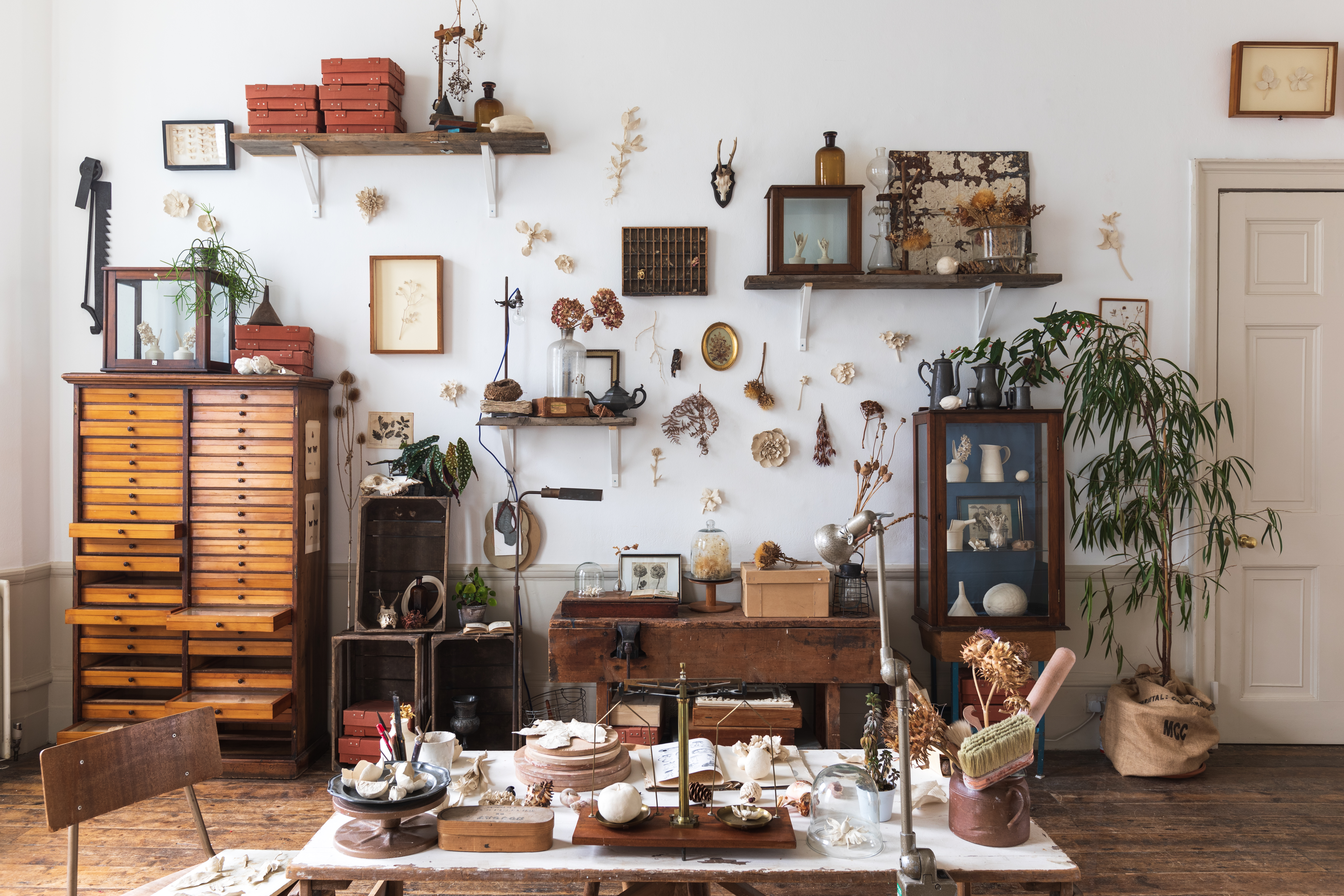
Walk into Kaori Tatebayashi’s world and you do not get the usual ceramic-artist starter pack of mugs, bowls, and someone saying the word “earthy” like they just invented soil. Instead, you step into a botanical universe made from clay: ghost-pale cardoons, twisting brambles, ferns that seem to climb walls on their own, and flowers so delicately observed they look as if they might still be deciding whether to bloom or wilt. It is sculpture, yes, but it also feels like a séance for the garden.
Tatebayashi, a Japanese-born artist who lives and works in London, has built a remarkable practice around a simple but powerful idea: clay can preserve what nature refuses to keep. A blossom fades. A stem bends. A weed appears where it was absolutely not invited. Tatebayashi watches these changes closely, then hand-models them in unglazed white stoneware, transforming fleeting plant life into objects that feel both fragile and permanent. That tension is what makes her work so magnetic. Her flowers are not sugary decorative replicas. They are meditations on time, memory, seasonality, and the strange beauty of things that do not last.
And that is what makes a studio visit into Tatebayashi’s practice so compelling. You are not just visiting a maker of lovely objects. You are entering an artistic system where gardening, Japanese ceramic history, London urban nature, and intensely patient handwork all collide. The result is botanical art from clay that feels otherworldly, but never disconnected from real life. In fact, it is rooted so deeply in observation that the uncanny effect comes from accuracy. Her plants look dreamlike because real plants are already a little dreamlike. Tatebayashi simply pays closer attention than the rest of us.
From Arita to London: A Clay Language Shaped by Two Worlds
To understand Tatebayashi’s art, it helps to start with where she comes from. She was born in Arita, Japan, a place synonymous with ceramics and porcelain. Growing up around pottery was not some romantic hobbyist scenario involving one handmade teacup and a lot of wistful staring. Ceramics were part of the family atmosphere and part of the local identity. That early immersion matters because Tatebayashi’s work still carries the deep material intelligence of someone who understands clay not as a trend, but as a lifelong language.
She later studied ceramics in Kyoto and then at the Royal College of Art in London. That educational path is more than a résumé line. It helps explain the distinctive balance in her work: Japanese craft sensitivity on one side, and on the other, an openness to sculptural experimentation that moves beyond function. She has spoken about the appeal of nonfunctional ceramics and the way clay can hold contradictions at once. It begins soft, responsive, and almost alive in the hand. Then it is fired and becomes fixed, durable, and strangely ghostly. For Tatebayashi, that transformation is not just a technical step. It is the emotional core of the work.
Her artistic journey also reflects a broader shift in modern ceramics, especially in Japan, where sculptural clay practice expanded far beyond vessels and domestic wares. Tatebayashi’s work sits inside that larger story, but it never feels academic or over-explained. Instead, the history is quietly present in the discipline of her making and in her refusal to separate craft from contemporary art. She does not seem interested in arguing whether ceramics belong in one camp or the other. She simply makes the argument unnecessary.
Why Her Botanical Sculptures Feel So Alive
The first surprise of Tatebayashi’s work is how alive it feels despite being the color of moon dust. She works in hand-formed white stoneware, usually unglazed, which gives the pieces a matte, chalky, spectral presence. Color is largely stripped away. That means the eye moves to structure: the arch of a stem, the curl of a petal, the slight droop of a leaf that has had a long week. It is botanical realism, but not the kind that shouts, “Look, I copied a flower.” It whispers, “Look how a flower behaves.”
That distinction is everything. Tatebayashi does not appear obsessed with mere likeness. She studies how plants move, how they occupy space, how they age, and how they feel. Some works have the poised elegance of a specimen drawing turned three-dimensional. Others sprawl, creep, and weave through a wall like nature politely ignoring architecture. In both cases, the sculptures preserve not only the form of a plant but its mood.
Her choice to model directly from real plants, often in season, gives the work a living rhythm. These are not generic floral symbols. They are observed things with individual personality. A cardoon can look proud and prickly. Bramble feels unruly. Iris becomes stately and theatrical. Ivy behaves like the friend who says they are just stopping by for five minutes and then practically moves in. Tatebayashi understands these differences, and that is why her work feels less like decoration and more like portraiture.
Clay as a Time Capsule
There is another reason the sculptures feel emotionally charged: they embody a moment that has already passed. Before firing, clay is workable and responsive, almost biological in its vulnerability. After firing, it becomes fixed. Tatebayashi leans into that transformation. Her flowers look preserved, but not embalmed. They hold a sense of life interrupted, or perhaps life translated into another state. The pieces can feel like fossils from a very elegant parallel universe.
This is where the “otherworldly” quality of her work really comes from. Not fantasy for fantasy’s sake, but the eerie stillness of arrested change. Her sculptures allow viewers to dwell in that uncanny threshold between bloom and memory, growth and artifact, life and afterlife. That is a lot for a ceramic stem to carry, and yet somehow it does.
The Studio: Part Workshop, Part Herbarium, Part Cabinet of Curiosities
Descriptions of Tatebayashi’s studio and studio-style installations reveal a space that feels deeply personal and carefully tuned to looking. There are plant references, drawers, specimens, tools, shelves, and the sort of orderly visual abundance that suggests a mind constantly cataloging shape. This is not chaos masquerading as genius. It is an ecosystem of attention.
One of the most fascinating aspects of her practice is how little theatrical fuss she needs in order to create an atmosphere. A single handmade metal knife, used again and again, says more about her process than a wall of fancy equipment ever could. Tatebayashi’s studio language is built on repetition, care, and close observation. You get the sense that she is not “producing content.” She is studying, translating, adjusting, and waiting for form to tell the truth.
That patient intensity became especially visible when her exhibition The Walled Garden incorporated a recreation of her working environment. By bringing the studio setup into the gallery, Tatebayashi and her gallery made a smart curatorial move: they showed that the atmosphere surrounding the work is part of the work. Her sculptures do not emerge from nowhere. They come from a life of collecting visual information, tending a garden, handling clay, and observing what plants do when nobody is trying to make them inspirational.
Gardening Changed Everything
If clay is Tatebayashi’s medium, gardening is one of her great teachers. Her passion for plants has increasingly shaped her artistic direction, and that shift matters because it gives the work a lived intimacy. She is not making flowers because flowers are universally pretty and easy to love. She is making them because she grows them, watches them struggle, sees them succeed, and understands that the garden is both a place of beauty and a place of chaos.
That lived knowledge gives her work unusual honesty. Cultivated plants appear in her sculptures, but so do wild spreaders, invasive tangles, and forms that remind us nature is not a tidy mood board. In her later installations, Tatebayashi has turned toward plants such as brambles and ivy, species that climb, colonize, and reclaim. That choice broadens her practice beyond the preciousness some viewers might assume from delicate ceramic flowers. Her art is not only about fragile blooms. It is also about force, persistence, and the intelligence of growth.
Even more interesting, gardening seems to sharpen her understanding of time. A gardener knows that control is always partial. Soil decides things. Climate decides things. Seasons decide things. Plants you adore may refuse to cooperate, while the unruly volunteer in the corner thrives with zero encouragement. Tatebayashi brings that lesson into her work. Her sculptures do not flatten nature into perfection. They preserve irregularity, asymmetry, and the quiet drama of real growth.
Otherworldly, But Never Abstracted from Nature
It would be easy to describe Tatebayashi’s art as fantasy botanical sculpture and leave it there, but that would miss the deeper achievement. Her work feels otherworldly precisely because it stays so close to the physical world. The pale surfaces, the suspended movement, and the wall-mounted compositions create a dreamlike effect, yet the dream is grounded in exact looking. She does not escape nature. She intensifies it.
That is also why her installations work so beautifully in interior spaces. They resonate with the broader design appetite for biophilic environments and nature-inflected interiors, but they do so without becoming generic plant décor. Tatebayashi’s ceramics bring the outdoors in, yes, but in a form that is more reflective than literal. They ask viewers to consider what it means to preserve nature in an indoor setting. Is it celebration? Memory? Control? Mourning? Maybe all four.
In wall works inspired by irises, cardoons, brambles, and seasonal stems, the pieces can read like botanical illustrations escaping the page. In still-life arrangements, they feel like remnants from a table after everyone has left and time has paused. Her art lives in that beautifully unstable zone where domestic space, gallery space, and garden space overlap.
Specific Works That Show Her Range
Several projects help explain why Tatebayashi’s reputation keeps growing. The Walled Garden made a strong case for her ability to transform a gallery into an environment rather than merely a room full of objects. Her ceramic plants climbed through the architecture and created an atmosphere that felt both cultivated and haunted, elegant and slightly feral.
Her later exhibition Still Life pushed further into the expressive power of wild plants. Instead of focusing only on cultivated beauty, Tatebayashi embraced brambles, ivy, and other species with a will of their own. This shift made the work feel more physical and more mischievous, as though the gallery itself might soon be overtaken by ceramic growth. It is one thing to sculpt a flower. It is another to sculpt the idea of nature reclaiming space, politely but firmly.
She has also created site-responsive installations tied to specific places and their surrounding plant life, including works based on flowers growing around exhibition settings. Those projects show how flexible her practice is. Tatebayashi does not impose a fixed style on every site. She reads a place, studies what grows there, and lets the work emerge from that relationship. That responsiveness is one reason her sculptures feel so grounded, even when they look like they floated in from a dream.
Then there are the smaller moments: a single rose stem, a hyacinth arrangement, a leaf with just enough bend to suggest yesterday’s weather. These quieter works are important because they prove Tatebayashi does not need scale to make an impact. She can fill a wall, yes, but she can also break your heart with one stem.
Why Tatebayashi’s Art Matters Now
Contemporary audiences are especially receptive to work that reconnects art, craft, and the natural world. Tatebayashi lands in that sweet spot without feeling calculated. Her sculptures respond to several current interests at once: slow making, material intelligence, botanical imagery, interiors that feel alive, and art that encourages close looking. But the work does not depend on trend language to succeed. It stands because it is disciplined, strange, and emotionally resonant.
There is also something quietly radical about her commitment to handwork. In a culture that rewards speed, Tatebayashi’s process insists on attention. Reports on her studio practice emphasize just how painstaking the work is, down to shaping individual leaves, petals, and stems by hand. That labor is visible in the finished pieces, but it never reads as labor for labor’s sake. Instead, the slowness becomes part of the meaning. These sculptures ask for time because they were made with time.
And maybe that is the best way to understand her work overall. Tatebayashi is not just making ceramic botanicals. She is making encounters with duration. Her art gives material form to the kind of looking that modern life often discourages: patient, seasonal, observant, and unhurried. It is not loud art. It does not need to be. It has the confidence of a flower growing through a crack in the pavement and somehow stealing the whole scene.
Extended Reflection: What a Studio Visit Like This Actually Feels Like
There is a special kind of experience that comes from spending time with work like Tatebayashi’s, and it is worth naming because it goes beyond admiration. At first, you notice craftsmanship. The petals are precise, the stems are believable, the compositions are balanced. Then your eye slows down. You begin to notice the tiny shifts in curvature, the subtle sag in a leaf, the way a wall-mounted spray of clay flowers seems to move upward even though it is completely still. That is the moment the work stops being simply impressive and starts becoming immersive.
A studio visit, whether literal or reconstructed through exhibitions and artist profiles, invites you into the pace behind the work. You start imagining the hours it takes to study one plant properly. You think about the discipline required to choose observation over shortcut, form over flourish, patience over performance. In Tatebayashi’s case, the studio feels less like a production zone and more like a place where the artist negotiates with time. The flowers outside are moving toward decay. The flowers inside are moving toward permanence. Clay sits in the middle, making the deal.
What makes that experience so memorable is that it changes the way you look at ordinary plant life afterward. You leave her work and suddenly the weeds near the curb seem more dramatic. The ivy on a brick wall appears more theatrical. A dying tulip in a kitchen glass becomes, unexpectedly, a serious sculptural event. Tatebayashi’s art sharpens attention in the best possible way. It does not just show you her vision. It upgrades your own.
There is also an emotional softness to the experience. Her pale stoneware does not hit you with color or spectacle. It draws you in through restraint. The absence of glaze, the near-monochrome surface, and the fragile silhouettes create a hush around the work. You feel invited to move closer, to look harder, to notice more. And in a world where plenty of visual culture is basically yelling, that quiet is powerful.
At the same time, the work is not timid. It has backbone. Brambles climb. Ivy spreads. Cardoons stand like botanical royalty wearing armor. Even her gentlest flowers carry a strange authority because they have survived transformation. They were soft matter once. Now they are fired, fixed, and enduring. That emotional contradiction stays with you. The sculptures feel delicate, but they have already been through fire. Honestly, that is a pretty good life lesson disguised as a flower.
So the lasting experience of Tatebayashi’s studio world is not just visual pleasure, though there is plenty of that. It is a recalibration of value. You come away reminded that close observation is a creative act, that slowness can be a strength, and that nature is not only beautiful when it is lush and blooming. It is beautiful when it is awkward, invasive, fading, unruly, and brief. Tatebayashi captures all of that in clay and somehow makes it feel light. That is no small trick. That is art with roots.
Conclusion
Kaori Tatebayashi makes botanical art from clay, but that description barely covers it. Her sculptures are part garden study, part memory device, part meditation on transformation. Drawing on her upbringing in Arita, her training in Kyoto and London, and her lived relationship with gardening, she creates unglazed white-stoneware flowers and plants that feel both real and unreal, intimate and uncanny. They are rooted in direct observation, yet they seem to hover outside time.
That is why a studio visit into Tatebayashi’s world feels so rewarding. It reveals an artist who understands that craft can carry philosophy without becoming heavy-handed, and that a single stem can say as much about life, fragility, and endurance as any oversized concept piece trying very hard to be important. Her work reminds us that nature is never static, and that art, at its best, can hold on to a moment just long enough for us to truly see it.