Adobe did something unusually brave for a successful software company: it disrupted its own cash machine before someone else could. For years, customers bought expensive boxed editions of Photoshop, Illustrator, Premiere Pro, and other Creative Suite applications. Adobe collected a large payment, released periodic upgrades, and then tried to persuade everyone to buy the next version.
That model was profitable, but it was also becoming a strategic anchor. Revenue depended heavily on product-release cycles. Many customers skipped upgrades, software piracy remained widespread, and Adobe had limited visibility into how people used its products between purchases. Meanwhile, cloud computing, mobile devices, and rapidly changing creative workflows were reshaping the software industry.
Creative Cloud changed that relationship. Adobe introduced the service in 2012 and announced in 2013 that future Creative Suite applications would be available primarily through subscriptions. The decision initially irritated customers, depressed reported revenue, and required Adobe to explain some awkward-looking financial statements. Then the recurring-revenue engine began to turn.
The result was more than a pricing adjustment. Adobe’s SaaS transformation expanded its addressable market, made revenue more predictable, accelerated product development, strengthened customer relationships, and created a platform for services ranging from Adobe Stock to generative AI. Calling the switch a “generational accelerant” is not Silicon Valley confetti. The financial and strategic evidence supports it.
Adobe’s Boxed-Software Model Had Reached Its Limits
Before Creative Cloud, Adobe primarily sold perpetual software licenses. A customer might spend hundreds of dollars on one application or more than $2,000 on a complete Creative Suite package. The software could then be used indefinitely, although major upgrades generally required another purchase.
This produced attractive revenue whenever Adobe released a popular new version. Unfortunately, it also created a corporate roller coaster. Sales rose around launches and slowed between them. Management had to predict how many customers would upgrade, while investors had to separate lasting demand from the temporary excitement surrounding a new box.
Upgrade cycles worked against continuous innovation
The traditional model encouraged Adobe to package improvements into major releases every year or two. Developers could build useful features in March, but customers might not receive them until the next grand unveiling. Software innovation began to resemble waiting for a bus while carrying a very expensive camera bag.
The system also divided Adobe’s user base across multiple versions. Supporting older editions consumed engineering resources, while compatibility problems multiplied. Customers who skipped upgrades did not receive the newest capabilities, security improvements, or performance enhancements.
High upfront prices restricted the customer funnel
Creative Suite was aimed largely at established professionals and organizations that could justify a substantial capital expense. Students, freelancers, hobbyists, and new businesses often faced an uncomfortable choice: spend heavily, use an outdated version, choose a rival, or obtain the software illegally.
A monthly subscription lowered that entry barrier. It did not necessarily make Adobe cheaper for every long-term customer, but it made the first purchase easier. Someone could begin with a single application or a discounted photography plan instead of financing a digital toolbox large enough to require its own mortgage.
The Creative Cloud Transition Was Painful by Design
Adobe launched Creative Cloud commercially in 2012 while Creative Suite 6 was still available. In May 2013, it committed fully to the new direction by announcing that the latest versions of its flagship creative applications would be delivered through Creative Cloud subscriptions.
Despite the name, programs such as Photoshop and Premiere Pro remained primarily desktop applications. Creative Cloud combined locally installed software with subscription licensing, regular updates, online storage, fonts, collaboration tools, and other connected services. It was a cloud-enabled software ecosystem rather than a collection of browser tabs wearing artistic berets.
The accounting transition made success look like failure
Under the perpetual-license model, Adobe recognized much of a sale when the license was delivered. Subscription revenue, however, was recognized gradually over the service period. Replacing a large upfront payment with smaller monthly payments therefore reduced near-term reported revenue even when customer adoption was healthy.
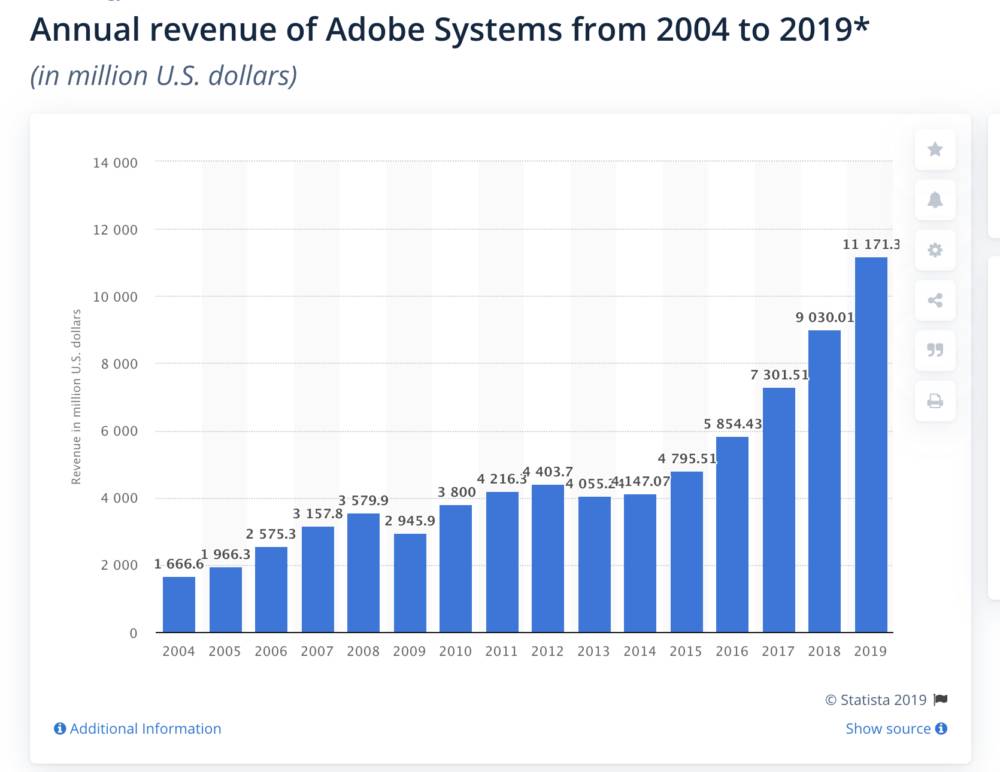
Adobe’s fiscal 2012 revenue was approximately $4.4 billion. In fiscal 2013, as Creative Cloud adoption accelerated, revenue declined to roughly $4.1 billion, while net income and operating margins also came under pressure. Adobe’s own regulatory filings explained that this was an anticipated consequence of recognizing subscription revenue over time.
The company had to tolerate a transition trough: old license revenue disappeared quickly, while the replacement subscription revenue accumulated slowly. Expenses could not fall at the same rate because Adobe still needed engineers, sales teams, data infrastructure, customer support, and an aggressive product roadmap.
This is one reason many legacy companies flirt with subscription pricing but refuse to commit. Executives must accept weaker short-term results while asking investors to believe in revenue that has been contracted but not yet fully recognized. Adobe crossed the canyon instead of decorating the near side.
Why SaaS Became an Accelerant Rather Than a Safety Net
Predictable revenue was an important benefit, but it was not the entire story. Adobe’s subscription model changed the speed and scope of the business.
Recurring revenue improved financial visibility
Subscriptions gave Adobe a large base of revenue scheduled to repeat, provided customers continued renewing. Management could analyze annualized recurring revenue, renewal rates, customer cohorts, product adoption, and account expansion. Investors gained a clearer view of future performance than boxed-software sales could provide.
Digital Media annualized recurring revenue reached about $3 billion by the end of fiscal 2015. By the end of fiscal 2024, Creative ARR alone was approximately $13.85 billion, while Document Cloud ARR was about $3.48 billion. In fiscal 2025, Digital Media ARR grew to roughly $19.2 billion, and Adobe reported record total revenue of approximately $23.77 billion.
Adobe’s fiscal 2025 Digital Media and Digital Experience subscription revenue totaled about $22.8 billion. The contrast with the roughly $4.4 billion company Adobe was in fiscal 2012 illustrates how dramatically the recurring model expanded the enterprise.
Continuous delivery made the products more valuable
Creative Cloud removed the need to save improvements for a numbered release. Adobe could ship features, fixes, compatibility updates, and security patches throughout the year. Customers stayed on current versions, reducing fragmentation and allowing new capabilities to reach the market faster.
This became increasingly important as creative production spread across cameras, phones, tablets, websites, social platforms, and collaborative teams. File formats and publishing requirements changed too quickly for an 18-month upgrade parade. Continuous delivery let Adobe respond while a trend was still a trend, not after it had become a nostalgic documentary.
Subscriptions created a direct customer relationship
A boxed license was mostly a transaction. A subscription became an ongoing relationship. Adobe could observe which tools were being adopted, identify friction, recommend relevant products, and improve onboarding. It could also communicate directly with individuals instead of relying as heavily on retail distribution and periodic upgrade campaigns.
This direct connection supported a broader range of plans for individuals, students, educators, photographers, teams, and enterprises. Adobe could use trials and entry-level offers to attract new customers, then expand accounts through additional applications, services, storage, stock assets, and collaboration features.
The portfolio became more powerful than its individual apps
Photoshop was already formidable, but Creative Cloud made Adobe’s collection of products more strategically valuable as a connected suite. A designer could move an asset among Photoshop, Illustrator, InDesign, After Effects, Premiere Pro, and Acrobat while using shared fonts, libraries, storage, templates, and review workflows.
This integration raised customer value and made the ecosystem harder to replace with a patchwork of competing tools. Adobe also incorporated services such as Behance, Adobe Fonts, and Adobe Stock, turning Creative Cloud into a platform for creating, managing, sharing, and sourcing content.
The Subscription Model Expanded Adobe’s Market
A lower initial price invited more people into Adobe’s ecosystem. Instead of demanding a four-figure decision, Adobe could offer monthly access to one application, a photography bundle, or the complete collection.
This pricing flexibility helped Adobe reach independent creators and small companies that previously could not justify Creative Suite. It also supported enterprise deployment because organizations could manage licenses more consistently, add or remove seats, and keep teams on supported versions.
The model did not eliminate piracy overnight. Cracked Creative Cloud applications appeared quickly after Adobe’s subscription-only announcement. However, subscriptions made legitimate access more affordable upfront and tied more value to connected services that pirated copies could not fully reproduce. The advantage was not simply stronger license enforcement; it was making the legitimate product more convenient and useful.
Why Customers Did Not Immediately Celebrate
Adobe’s success should not turn the story into a corporate fairy tale in which every designer applauded and a friendly blue cloud handed out cupcakes. Many customers strongly disliked the change.
Perpetual licenses offered a sense of ownership. Customers could stop paying and continue using the version they had purchased. With Creative Cloud, ending the subscription generally meant losing access to the applications. People who upgraded infrequently could also pay more over a long period under the subscription model.
There were additional concerns about price increases, internet-based license verification, access to proprietary files, service outages, and dependence on one vendor. Public petitions opposing the transition attracted thousands of signatures, and competing products used the backlash as a marketing opportunity.
Subscription success creates a responsibility to reduce friction
The model also exposed Adobe to scrutiny over plan disclosures, early termination fees, and cancellation procedures. In 2024, the U.S. government sued Adobe over allegations involving its annual-paid-monthly plans and the difficulty some consumers encountered while canceling. Adobe denied wrongdoing, and in 2026 it agreed to a proposed $150 million resolution consisting of a civil payment and free services for affected customers, subject to court approval.
The broader lesson is straightforward: recurring revenue is strongest when renewal reflects continuing value, not confusion or inconvenience. A company can optimize a cancellation flow so aggressively that it eventually optimizes its way into regulatory attention. Clear prices, understandable commitments, easy cancellation, and portable customer data are essential to maintaining trust.
Adobe’s SaaS Economics Created a Strategic Flywheel
The Creative Cloud transformation produced a self-reinforcing system. Lower entry costs attracted more users. More users generated additional recurring revenue and product data. That revenue funded faster development and new services. Better products improved retention and supported broader adoption.
Recurring revenue also allowed Adobe to plan investments with greater confidence. The company could pursue acquisitions, develop enterprise experience tools, expand document services, and invest in artificial intelligence without depending on the timing of the next major desktop release.
The transition also changed how Adobe measured progress. Unit shipments and upgrade sales became less important than ARR, renewals, engagement, new subscriptions, account expansion, and customer lifetime value. Those metrics encouraged the company to keep earning the relationship after the initial sale.
Creative Cloud Prepared Adobe for the AI Era
Adobe’s subscription infrastructure has become especially valuable as generative AI changes creative work. Firefly features can be introduced directly inside Photoshop, Illustrator, Express, and other applications instead of waiting for another boxed edition. Adobe can test tools, learn from usage, refine safeguards, and distribute improvements to millions of current subscribers.
The company can also combine subscription access with consumption-based pricing through generative credits. This hybrid approach offers a possible next stage of SaaS monetization: a predictable base subscription plus variable revenue tied to computationally expensive AI usage.
There is no guarantee that Adobe will dominate the next era. Canva, Figma, specialized creative applications, and AI-native startups have changed customer expectations. Generative models can reduce the time needed for certain design tasks and may weaken demand for traditional interfaces.
Still, Adobe enters that competition with a large recurring customer base, decades of professional workflow knowledge, widely used file formats, extensive enterprise relationships, and the ability to distribute new features rapidly. The SaaS model did not solve every strategic problem, but it gave Adobe a much faster vehicle for confronting them.
What Other Companies Can Learn From Adobe’s Transformation
Do not confuse subscription billing with transformation
Charging monthly does not automatically create a SaaS business. Adobe changed product delivery, customer analytics, financial reporting, sales incentives, engineering practices, and support operations. The recurring charge was only the visible part of a much larger organizational redesign.
Expect financial turbulence during the transition
Companies moving from upfront licenses to subscriptions should model the temporary revenue and margin decline honestly. They need sufficient cash, investor communication, and board support to survive the period when the old model is shrinking faster than recurring revenue is being recognized.
Use packaging to enlarge the market
Adobe did not rely on one universal plan. It created options for different applications, customer types, and organization sizes. Effective SaaS packaging reduces the cost of entry while preserving logical routes to higher-value products.
Make continuous value visible
A subscription is a promise that tomorrow’s service will remain worth paying for. Regular improvements, useful integrations, reliable support, and transparent communication help customers understand what their recurring payment funds.
Experience-Based Reflections: What Adobe’s Journey Feels Like in Practice
Adobe’s transformation becomes clearer when viewed through the experiences of people who buy, build, or manage software. For an independent creative professional, the initial appeal of Creative Cloud was practical: professional tools no longer required one enormous payment. A freelance designer could subscribe for a project, access current applications, and include the monthly cost in operating expenses.
The trade-off emerged over time. A perpetual license felt like equipment sitting safely in the studio. A subscription felt more like electricity: useful every day, but available only while the bill was paid. Creators who relied on Adobe professionally could justify the expense because frequent updates, compatibility, fonts, storage, and integrated workflows saved time. Occasional users often found the value equation less comfortable.
For a software executive, Adobe’s experience demonstrates the emotional difficulty of replacing a successful product model. The obvious spreadsheet may show that recurring revenue will eventually be larger and steadier. The first few income statements, however, can look like someone drove the spreadsheet into a lake. Sales teams worry about smaller initial contracts. Finance leaders watch deferred revenue accumulate. Customers complain, and competitors eagerly provide megaphones.
Managing that period requires consistent communication. Adobe repeatedly explained why reported revenue would decline, highlighted subscription adoption, and trained investors to follow ARR. This was not accounting theater; it gave stakeholders measurements suited to the new business.
Product teams experienced a different shift. Under the boxed model, a major release could become the finish line. In SaaS, there is no finish lineonly Tuesday. Teams must continuously improve performance, reliability, onboarding, security, and customer outcomes. That cadence can produce faster innovation, but it also requires disciplined testing and operational maturity. Shipping more frequently is helpful only if each update does not introduce a fresh opportunity for users to shout at their laptops.
Customer-success teams also become more important. When most revenue arrives after the initial sale, adoption and retention are financial priorities. A feature that helps a new subscriber complete a first project may be as economically important as a flashy capability used in a product demonstration. Support quality, cancellation transparency, and billing clarity directly influence trust and lifetime value.
For investors, Adobe illustrates why a temporary decline in recognized revenue can coexist with improving business quality. Contracted recurring revenue may initially be hidden across future periods, but as subscription cohorts accumulate, the model becomes increasingly durable. The essential questions are whether customers renew, whether the market is expanding, and whether the company can continue adding value without relying on coercive switching costs.
The most transferable experience is that a successful transition requires commitment. If Adobe had preserved every old licensing option indefinitely, customers would have delayed migration, engineering resources would have remained divided, and the recurring model might never have achieved sufficient scale. Going all-in created pain, but it also created momentum.
That does not mean every business should copy Adobe. A subscription must match an ongoing customer need. Products that deliver value once may be better sold once. But when software requires continuous updates, evolving services, collaboration, security, and regular innovation, recurring revenue can align the vendor’s incentives with long-term product usefulness.
Adobe’s experience ultimately shows that the greatest benefit of SaaS was not predictable billing. It was organizational speed. The company could reach more customers, learn faster, release improvements continuously, and fund the next generation of products. That is why the move became a generational accelerant rather than merely a smoother method of collecting money.
Conclusion
Adobe’s shift from perpetual software licenses to Creative Cloud subscriptions was risky, unpopular in some corners, and financially uncomfortable at first. It was also one of the most consequential business-model transformations in modern software.
The SaaS model converted irregular upgrade sales into recurring revenue, lowered the initial barrier to adoption, connected Adobe directly with its users, and enabled continuous product delivery. It turned a mature desktop-software franchise into a platform capable of supporting creative applications, document workflows, enterprise experiences, marketplaces, collaboration services, and AI.
The lesson is not that subscriptions are magical. Adobe succeeded because it paired recurring billing with sustained product investment, intelligent packaging, ecosystem integration, and the willingness to endure a difficult transition. The cloud supplied the engine, but conviction kept the vehicle moving until the economics caught up.
Note: Financial figures and historical events in this article are based on Adobe’s public filings, earnings materials, corporate announcements, and reporting from established U.S. business and technology publications. Figures are rounded for readability.