Note: This article is written for web publication in standard American English and is based on real technical ideas, experiments, and documentation. It has been fully rewritten in a natural editorial style with no source links included.
At first glance, teaching a computer to play Super Mario Bros. sounds simple. The little guy runs right, jumps on turtles, avoids lava, and occasionally finds himself in a situation that makes a human shout, “Why did you do that?” But once you try to automate the whole thing, Mario turns into a tiny mustached graduate seminar in artificial intelligence.
This is why the whole process can feel less like computer science and more like ritual magic. You feed a machine thousands upon thousands of frames. You invent rewards for behaviors you like. You punish it for face-planting into a Goomba. You shrink images, stack frames, skip steps, store memories in replay buffers, and whisper sweet hyperparameters into the void. Then, after what feels like an unhealthy amount of experimentation, the machine suddenly jumps a gap correctly and you look at your screen like you’ve accidentally summoned a plumber-shaped ghost.
Of course, there is no actual voodoo here. What looks like sorcery is mostly reinforcement learning, a branch of machine learning in which an agent learns by interacting with an environment, collecting rewards, and gradually improving a policy for choosing actions. That sounds tidy on paper. In practice, it is a glorious mess involving delayed rewards, partial information, exploration problems, and a game world that delights in punishing impatience.
Still, Mario has become one of the most charming examples of how game AI works. It is visual, fast, unforgiving, and weirdly educational. If you want to understand how a computer learns through trial and error, Mario is one of the best places to watch the drama unfold.
Why Mario AI Looks Like Black Magic
Humans are good at smuggling common sense into games. We look at a green pipe and instantly understand it is probably not decorative. We see a pit and know that falling into it would be bad for our long-term happiness. A reinforcement learning agent does not begin with any of that. It starts with observations, actions, and a reward signal. That is it. No childhood. No Nintendo nostalgia. No grandmother telling it not to sprint into turtles.
That is the first reason this process feels spooky: the machine is not “thinking” about Mario the way you do. It is grinding through a decision problem. The screen becomes data. Jumping becomes an action. Moving right becomes a choice that sometimes leads to survival and sometimes leads to a hilarious digital funeral. The agent’s job is to discover patterns that raise long-term reward, even when the reward does not show up until much later.
That delayed-reward problem is a big deal. In Mario, the right action now might only make sense ten seconds later. A cautious pause before a jump may lead to clearing a pit. A backward step might avoid an enemy. A greedy little dash for a coin might get you flattened. From the computer’s perspective, cause and effect are separated by a long trail of chaos. So yes, when the agent eventually learns something sensible, it can look less like logic and more like it has negotiated with forest spirits.
The Core Idea: Reward the Machine Until It Stops Embarrassing Itself
The basic reinforcement learning loop is beautifully simple. The agent looks at the environment, picks an action, receives a reward, sees the next observation, and repeats. Over time, it updates a policy so it can choose better actions more often. In games, that means the agent gradually learns which behaviors tend to produce success.
Observations, Actions, and Rewards
Mario gives the agent a stream of visual observations. Depending on the setup, that might be raw frames from the game or a more compact representation engineered by researchers. The action space can be large because the controller technically allows many button combinations, but practical systems often reduce that space so the model is not wasting half its life discovering nonsense button mashing.
Rewards are where the “seemingly through voodoo” part really kicks in. If you reward only the final objective, such as finishing the level, the agent may struggle because the signal arrives too late and too rarely. If you reward everything in sight, the agent may become a tiny reward lawyer that optimizes the wrong thing. Give too much credit for moving right and Mario might charge into every monster like an overcaffeinated intern. Reward coins too aggressively and your agent may turn into the world’s least efficient treasure hunter.
So the real craft lies in designing rewards that encourage useful behavior without creating absurd loopholes. This is less like writing strict instructions and more like setting up incentives for a chaotic employee who has infinite patience and no common sense.
Memory Helps the Agent Stop Living in the Eternal Present
One classic trick is experience replay. Instead of learning only from the most recent thing that happened, the agent stores past experiences and samples from them later. That helps stabilize training because the model is not being whipsawed by highly correlated, moment-to-moment data. In plain English: the machine keeps a diary and studies for the exam instead of improvising its entire life in real time.
Another common trick is the target network, which provides a more stable estimate of future value during training. Without that extra stabilizer, the model is basically trying to hit a moving target while it is also carrying the target and occasionally setting the target on fire. Reinforcement learning already has enough personality problems. It does not need more.
Why Mario Is Harder Than He Looks
Mario is a side-scroller, but it is not a simple one. The world is dynamic. Enemies move. Timing matters. Jumps require momentum. The best decision depends on recent motion, not just the current frame. If the agent sees only one image at a time, it may not know whether Mario is rising, falling, accelerating, or one bad decision away from being pancaked by bad judgment.
That is why many Mario agents do not use a single frame. They often use several frames stacked together so the model can infer motion. Suddenly, the machine is not just seeing a still image of Mario near a gap. It is seeing a short visual history, enough to guess where he is going and whether that jump is heroic or terminally optimistic.
Mario is also a nasty test of long-horizon reasoning. Some choices make sense only if you care about the future instead of the next half-second. Earlier work on Mario benchmarks showed this clearly: if you bias the agent too strongly toward short-term reward, it may simply rush right because moving right is usually good, right up until it becomes a very efficient method of self-destruction.
The Tricks That Make the “Magic” Work
Modern Mario-playing agents often rely on a handful of practical preprocessing tricks that make the learning problem less brutal. None of them is glamorous, but together they turn “impossible mess” into “difficult but survivable.”
Shrink the World
A full-color game screen contains a lot of information, but not all of it is equally useful. Many tutorials and research setups convert frames to grayscale, resize them to something smaller, and stack several recent frames together. That cuts computational cost while preserving enough structure for the agent to recognize platforms, enemies, and motion. It is the machine-learning version of cleaning your room so you can find the floor again.
Skip Frames
Games move fast. Consecutive frames often look similar. By skipping intermediate frames while summing rewards across them, the system reduces redundancy and speeds up learning. The agent still experiences the consequences of an action, but it does not have to obsess over every microscopic animation twitch like a caffeinated squirrel.
Reduce the Action Space
Technically, a controller can produce a ridiculous number of button combinations. Practically, Mario does not need to explore every cursed possibility to become competent. Many systems simplify the action space to a smaller, more useful set of movements. This is not cheating. It is mercy.
Use Better Learning Algorithms
Early Mario experiments often used tabular or hand-engineered approaches. Later systems shifted toward deep reinforcement learning with convolutional neural networks, replay buffers, and improved variants such as Double DQN. The reason is simple: raw-pixel Mario is a huge state space. If you ask a naive method to handle that directly, it may spend the rest of recorded time staring into the abyss.
When Rewards Are Too Sparse, Curiosity Enters the Chat
Now we arrive at the most “voodoo” sounding idea of all: curiosity-driven learning. Researchers found that in many environments, relying only on external rewards is not enough. If the game gives meaningful feedback only rarely, the agent may fail to explore enough to discover progress at all. It is like trying to raise a scientist by only congratulating them when they win a Nobel Prize.
Curiosity changes that. Instead of rewarding only task progress, the system can reward novelty or prediction error. In other words, the agent gets an internal bonus for encountering things it cannot easily predict. Suddenly exploration becomes attractive. Instead of standing still or repeating safe habits, the agent starts poking at the world. That is how you get “curious Mario,” which sounds adorable until you realize the little man is being powered by formalized uncertainty.
This approach has produced striking results in research. Curiosity-based methods helped agents make progress in difficult exploration settings, and some work showed that learned features could generalize better to new Mario levels than simpler alternatives. That matters because a system that memorizes one level is a trick. A system that adapts to unfamiliar layouts is starting to look like a genuine game-playing agent.
But curiosity is not a free miracle. Too much of it can make the agent chase interesting but useless behavior. It may bounce around because novelty is fun, not because it is helping. Researchers have even worked on methods that increase curiosity when guidance is sparse and suppress it when ordinary rewards already provide enough supervision. In other words, the agent needs the right amount of chaos. Too little and it never discovers anything. Too much and it becomes a weird digital tourist.
Where the Magic Breaks
Here is the less glamorous truth: teaching a computer to play Mario is still fragile. Agents can overfit to specific levels. They can exploit bad reward functions. They can learn policies that look smart until the environment changes slightly. A model that dominates one training setup may suddenly behave like it has never seen stairs before when you move it to a new level.
That is why generalization matters so much in this space. Real progress is not just “can the agent finish World 1-1 after endless training?” The better question is whether it can transfer what it learned to unfamiliar situations. Benchmarks, competitions, and environment wrappers have pushed researchers toward that harder and more interesting goal.
So no, the machine is not doing literal voodoo. But it is learning from a bizarre stew of incentives, abstractions, and approximations. From the outside, that can look magical. From the inside, it is a delicate engineering negotiation between what the game shows, what the reward encourages, and what the model can actually learn before everyone involved loses patience.
The Real Experience of Training Mario AI: Equal Parts Science, Comedy, and Mild Despair
If you spend enough time around Mario reinforcement learning projects, you begin to recognize a very specific emotional cycle. First comes confidence. You think, “It’s Mario. The character literally runs to the right. How hard can this be?” This is the stage where optimism wears a lab coat and makes poor decisions.
Then comes the first training run. The agent walks into a wall. Or a Goomba. Or a hole. Or perhaps it discovers a deeply creative sequence of movements that appears to have been designed by a malfunctioning shopping cart. You watch several minutes of this and begin bargaining with reality. Surely the model is almost learning. Surely this random hopping means something. Surely the universe would not let you waste an evening on digital slapstick. The universe, naturally, is unbothered.
After that, you start adjusting things. Maybe the reward is too sparse. Maybe the observation is too noisy. Maybe the action space is too large. Maybe the machine does not need sixteen ways to press buttons badly. So you simplify. You crop. You resize. You stack frames. You skip frames. You add replay memory. You tune exploration. You rerun the experiment. The agent gets a little farther. Suddenly it clears one enemy and you react as if your child has been accepted to medical school.
That emotional overreaction is part of the experience. Tiny improvements feel enormous because the baseline is usually chaos. A successful jump is not just a jump. It is evidence that the model has begun to connect observation, timing, and consequence. It is the first hint that the swamp of random motion might someday become strategy.
Then the project plays another joke on you. The agent looks fantastic on one level and embarrassingly clueless on another. It has not “learned Mario” so much as it has learned a negotiation with one narrow slice of Mario’s reality. This is where researchers start talking about transfer, generalization, and exploration with the energy of people who have seen things. The agent is not malicious. It is simply taking your setup very literally, and literal systems are excellent at finding the exact boundaries of your assumptions.
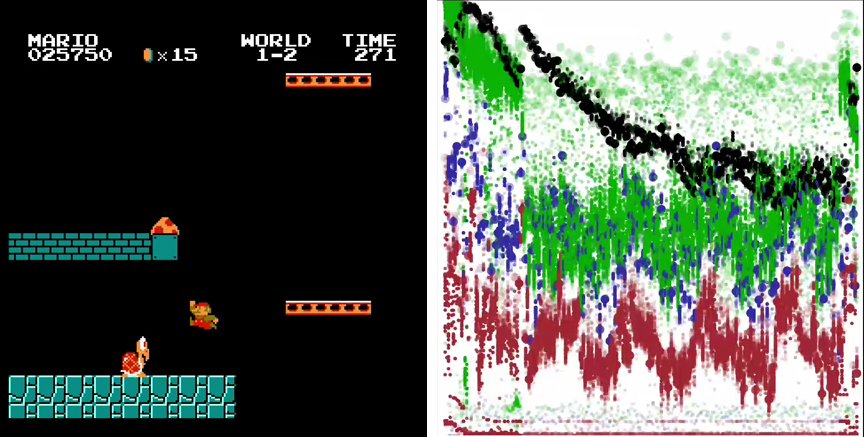
There is also a strangely theatrical quality to watching training logs scroll by. Reward curves twitch upward. Epsilon decays. Episode length changes. Loss values wobble around like they are trying not to make eye contact. You pretend to be calm and objective, but deep down you are reading tea leaves. The whole enterprise can feel suspiciously mystical for something built on matrices.
And yet this is exactly why the topic is so compelling. When a Mario agent finally strings together a run that looks intentional, it is incredibly satisfying. Not because the computer has become a tiny human, but because you can see the shape of learning emerging from repetition and feedback. The machine is not gifted with intuition. It builds behavior from incentives, memory, and statistical pressure. Watching that happen is weirdly beautiful.
So yes, from a distance it can look like voodoo. Up close, it is trial and error, careful system design, and a lot of humble respect for just how difficult “simple” games really are. Mario is cheerful. Mario is colorful. Mario is also a ruthless instructor in how intelligence must be engineered, not merely wished into existence.
Conclusion
Teaching a computer to play Mario is one of the clearest demonstrations of how artificial intelligence learns through feedback rather than common sense. The process blends reinforcement learning, reward design, visual preprocessing, memory systems, exploration strategies, and a healthy tolerance for failure. What looks mystical is really a chain of disciplined approximations that gradually turns random motion into meaningful play.
The best part is that Mario makes the whole story visible. You can literally watch the agent go from clueless chaos to something that resembles skill. That makes the subject not only technically rich, but also fun to explain. It is a perfect meeting point between deep learning theory and the universal joy of seeing a plumber survive a jump he absolutely had no business landing ten thousand episodes earlier.