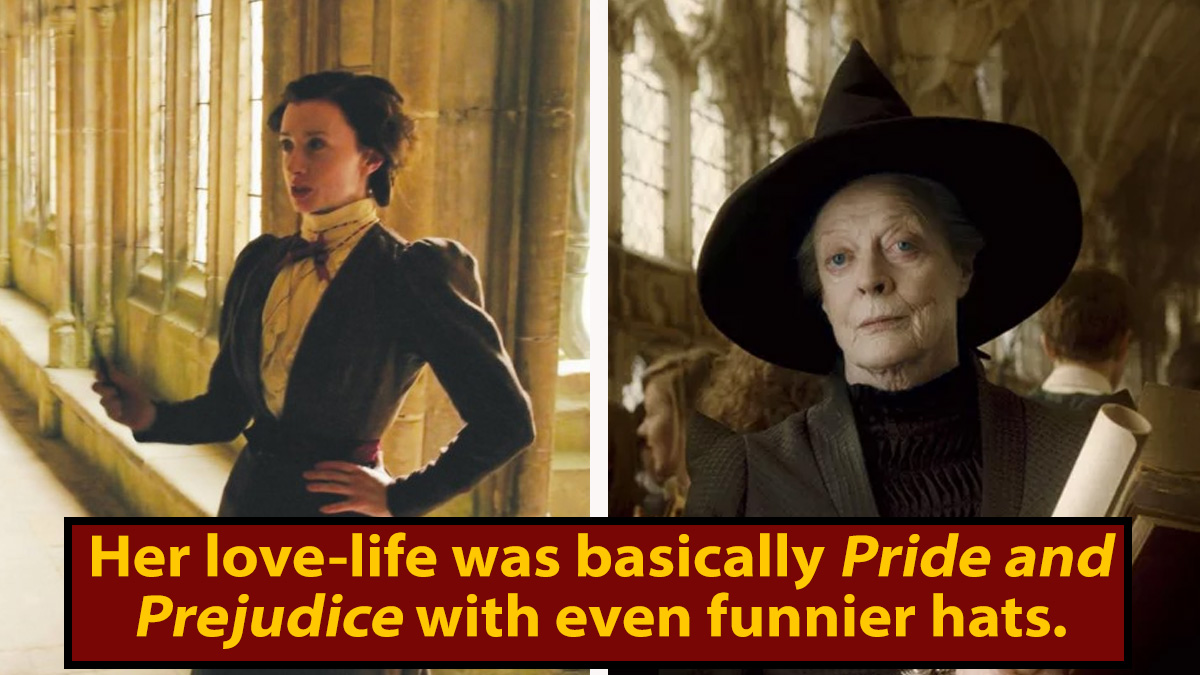
Professor Minerva McGonagall has spent decades being introduced to audiences as the human equivalent of a steel ruler: straight-backed, sharp-eyed, and not especially interested in your excuses. She is the professor who can freeze a classroom with one look, terrify a rule-breaker with one sentence, and still somehow make you feel safer the minute real danger walks through the door. In a franchise full of flashy heroes, moody antiheroes, and people who clearly should not be trusted with magical authority, McGonagall has always stood out because she is competent, moral, and gloriously unimpressed.
And yet, hidden behind that tart Scottish authority is one of the Wizarding World’s most moving romantic stories. It has heartbreak, class tension, cultural division, impossible choices, delayed devotion, widowhood, and enough emotional restraint to power three prestige dramas and one very tearful awards campaign. If the Harry Potter universe insists on revisiting old corners of Hogwarts, then the love life of Professor McGonagall is not just good material. It is the material.
A Professor McGonagall movie would not need louder spells or a bigger dragon. It would need to trust what the best stories in this franchise already know: the deepest magic is often emotional. Minerva’s romantic history gives us exactly that. It turns a beloved supporting character into the center of a sweeping, mature, deeply cinematic story about love, duty, identity, and what it costs to choose the right life instead of the easiest one.
McGonagall Already Has the Kind of Backstory Most Franchises Would Kill to Invent
One reason a McGonagall romance movie feels so obvious is that the groundwork is already there. Minerva is not just a stern professor who materialized one day with a pointy hat and impeccable posture. She grew up in a divided household, the daughter of a Muggle Presbyterian minister and a witch who had already learned the cost of loving across worlds. That matters because McGonagall’s whole romantic life is shaped by what she saw at home: love can be real, love can be noble, and love can still come bundled with secrecy, compromise, and pain.
That is not a side note. That is a thesis statement. It means Minerva’s later decisions are not random acts of self-denial; they are the product of lived experience. She is not rejecting happiness because she enjoys suffering like a Victorian governess in a thunderstorm. She is making a brutal adult calculation based on the emotional damage she watched her parents absorb. That is complex, human, and far more interesting than another prequel that treats “lore” like a substitute for character.
The beauty of this setup is that it immediately makes McGonagall more than “the strict teacher.” It makes her the child of a love story who becomes trapped inside the consequences of that love story. Right there, before we even get to her own romance, you already have the emotional architecture of a great film.
Her Romance With Dougal McGregor Is Basically a Ready-Made Period Drama
Now let’s get to the part that should already have a composer writing violins. As a young woman, Minerva falls in love with Dougal McGregor, a Muggle farmer’s son. He is clever, funny, grounded, and entirely outside the magical world that will define her future. He proposes. She accepts. For one brief moment, the famously composed McGonagall is not Professor McGonagall at all. She is simply Minerva: brilliant, young, in love, and foolish enough to believe that happiness might arrive without a footnote.
Then reality barges in wearing muddy boots.
Minerva realizes that marrying Dougal would mean repeating her mother’s life in all the worst ways. She would either have to live in secrecy, hide her wand, and build a marriage around a foundational lie, or reveal the truth and risk consequences that would destroy the future she has worked for. She also knows Dougal’s life is rooted in the land, while hers is opening toward London and the Ministry of Magic. This is not a cute “opposites attract” setup. It is a collision between two entire ways of being.
So she does the most McGonagall thing imaginable: she breaks her own heart on purpose.
That choice is the spine of the movie. Not the proposal. Not the flirtation. The refusal. The devastating, mature, unspectacular decision to walk away from the person she loves because she understands the future more clearly than he does. Hollywood spends a lot of time telling us love conquers all. McGonagall’s story is far more interesting because it argues that love does not always win, even when it is real. Sometimes duty wins. Sometimes identity wins. Sometimes fear wins. And sometimes the person making the sacrifice is still right.
Then the Story Gets Even Better Because Life Refuses to Be Neat
If McGonagall’s relationship with Dougal were the entire story, that would already be enough for a lovely, bittersweet film. But her romantic arc does something richer: it keeps going. Minerva throws herself into work. She joins the Ministry, dislikes the anti-Muggle bias around her, and eventually finds her way back to Hogwarts. There, the woman we know begins to take shape: disciplined, exacting, brilliant, and guarded. But she is not “over it.” She keeps Dougal’s letters. She learns he has married someone else. She carries the wound forward without turning it into melodrama.
That last part is crucial. McGonagall is not written as a woman who becomes icy because she was “broken by love,” which is the kind of lazy character shorthand that deserves detention. She becomes more herself. More formidable. More contained. More useful to others. Her heartbreak does not erase her warmth; it simply teaches her where to place it. That is one reason students trust her even when they fear her. She feels like someone who understands pain but refuses to perform it.
And then comes Elphinstone Urquart, the plot twist that makes the whole thing richer.
Elphinstone Urquart Turns McGonagall’s Love Life Into a Story About Second Chances
Elphinstone is not the dazzling first love. He is something better for the second half of a life: patient, loyal, steadfast, and willing to keep showing up. He is older, already fond of Minerva during her Ministry years, and he continues to propose over time, even as she repeatedly turns him down. In lesser hands, that could feel gimmicky. In McGonagall’s story, it feels quietly profound. He loves her without demanding that she become someone else. He waits without making her grief into a test she has to pass.
Eventually, after the death of Dougal and after years of emotional endurance, Minerva says yes. This matters not only because it gives her happiness, but because it proves her story is not frozen in youthful tragedy. She is allowed growth. She is allowed joy. She is allowed a love that arrives later, differently, and perhaps more gently than the first one.
Even better, she keeps her own name after marriage. That little detail is vintage McGonagall: romantic, but never absorbed; devoted, but never diminished. She can choose partnership without surrendering identity. A movie built around that idea would feel refreshingly adult in a fantasy landscape that too often confuses destiny with personality.
And because the universe clearly cannot let Minerva McGonagall have one uninterrupted stretch of peace, the marriage is cut short when Elphinstone dies after a Venomous Tentacula bite. It is tragic, yes, but not cheap. Their marriage is described as happy. That is the point. McGonagall is not denied love forever. She gets it, loses it, and goes on. That is not just sad. That is epic.
Why This Story Would Make a Better Movie Than Another Nostalgia Parade
A McGonagall movie works because it would not be built on mystery-box plotting or cameo hunting. It would be built on character. The best parts of the Harry Potter world are not just the spells and school feasts. They are the emotional contradictions: courage mixed with regret, loyalty mixed with secrecy, and love mixed with sacrifice. Minerva’s romantic history contains all of that in concentrated form.
It also offers something rare in franchise storytelling: an adult woman’s emotional life treated as the main event. Not as a subplot. Not as “additional background.” Not as something to explain why she is stern. The whole point is that her love story deserves full dramatic weight. There is room here for romance, yes, but also for ambition, politics, prejudice, class expectations, feminism, grief, and the strangely lonely dignity of becoming the person everyone depends on.
There is another advantage: tone. A McGonagall film could blend wistful romance, Hogwarts wonder, and grounded emotional realism without feeling like a genre mess. It could open in the Scottish Highlands, move through the Ministry, linger in the early halls of Hogwarts, and end with the mature McGonagall fans know. It would feel both intimate and expansive. Think less “world-ending magic beam in the sky,” more “one woman builds a life strong enough to survive loss.” Frankly, that is the better magic trick.
Maggie Smith Proved the Character Could Hold Humor, Authority, and Heart All at Once
Part of the reason audiences are still so attached to McGonagall is that the films, through Maggie Smith, made her unforgettable even when the scripts only gave her slices of the meal. She could be funny without becoming silly, stern without becoming cruel, and moving without begging for applause. That balance is exactly why fans respond so strongly to the idea of exploring her inner life. The emotional depth was always there. We were just rarely invited all the way inside it.
McGonagall has the rare franchise quality of feeling larger every time you rewatch. At first she is the severe authority figure. Then she becomes the teacher who sees talent quickly. Then the defender. Then the woman who keeps the institution moral when others lose their nerve. Once you know the outline of her romantic life, every clipped remark and every protective instinct gains new texture. She is not just disciplined by nature. She is disciplined by history.
That is why a movie about her love life would not feel like scraping the barrel. It would feel like finally opening the good bottle everyone forgot was in the cellar.
How the Movie Should Be Structured
The ideal version practically writes itself. Act one: childhood in a mixed magical-Muggle household, intellectual promise at Hogwarts, and the intoxicating arrival of Dougal McGregor. Act two: the impossible engagement, the break, London, the Ministry, and the emotional migration back to Hogwarts under Dumbledore’s quiet guidance. Act three: the long ache of adulthood, Elphinstone’s patient devotion, a late-in-life marriage, brief happiness, devastating widowhood, and Minerva choosing work not as escape, but as purpose.
That is not a footnote. That is a full character saga. It even has the ideal emotional ending: not a grand battle, but a woman returning to Hogwarts with a broken heart and an unbroken spirit, becoming the professor generations of students will remember forever. The audience already knows what she becomes. The thrill would come from finally understanding what it cost.
The Viewer Experience: Why This Story Hits So Hard
What makes McGonagall’s love life so compelling is not just the plot. It is the feeling it creates. For many fans, discovering her backstory is like finding a hidden room inside a house you thought you knew perfectly. Suddenly the strict professor who seemed almost mythic becomes achingly human. You realize that the woman handing out discipline, defending students, and standing firm in chaos is also someone who once stood in a field and said yes to love, then woke up the next morning and chose heartbreak instead. That emotional shift changes the whole character.
It also changes the reading experience of the larger Harry Potter story. McGonagall becomes more than comic timing and moral backbone. She starts to feel like the patron saint of everyone who has learned to function beautifully while carrying private sadness. That lands because it is true to life. Most people do not walk around announcing their deepest regrets. They go to work. They keep promises. They protect younger people from mistakes they themselves understand too well. McGonagall’s romance makes her not smaller, but bigger, because it reveals how much lived experience sits behind her control.
There is also something deeply satisfying about seeing a fantasy franchise acknowledge that mature love stories can be just as thrilling as teenage destiny. The Harry Potter series is full of firsts: first train ride, first wand, first crush, first war. McGonagall’s story gives us something rarer and, for many viewers, even more moving: the second chance, the delayed yes, the late happiness, the grief that follows real fulfillment rather than unrealized longing. That emotional architecture is richer than simple tragedy because it contains both loss and reward.
Fans who grew up with the books and films would likely feel this story in layers. Younger viewers might see a sharp, romantic drama about impossible choices. Older viewers might recognize something more tender and devastating: the knowledge that a person can build an extraordinary life while still mourning the roads not taken. That is why a McGonagall movie would not just be fan service. It would be one of the few franchise projects capable of speaking across generations without dumbing itself down for anybody.
And then there is the teacher factor. So many people remember McGonagall because she resembles the best authority figures they have ever known: demanding, fair, emotionally restrained, and unexpectedly protective. Learning that someone like that had a full, wounded, passionate inner life is strangely comforting. It reminds us that the adults who seemed immovable when we were young were never statues. They were people. They had losses, impossible choices, and private tenderness too. A film about Minerva’s love life would tap into that universal recognition with force.
Most of all, the story lingers because it feels earned. Nothing about McGonagall’s romantic journey is easy. Nothing is wrapped with a magical ribbon. She does not get the fairy-tale version of love, and that is exactly why her story matters. She gets something more durable: a life shaped by principle, sharpened by sorrow, warmed by real affection, and redeemed by purpose. That is cinematic. That is emotionally intelligent. And that is why the love life of Professor McGonagall does not just deserve a movie. It practically demands one, preferably with misty Highlands scenery, devastating silence, and at least one scene where somebody realizes far too late that the strictest woman in the room has always had the biggest heart.
Conclusion
If the Wizarding World wants a story that feels fresh without abandoning what fans love, Professor McGonagall is standing right there, probably with folded arms and a look that suggests the filmmakers are late. Her love life offers romance, tragedy, resilience, and the kind of emotional intelligence blockbuster franchises too often skip in favor of noise. She is already one of the most beloved figures in Harry Potter. Giving her a movie would not be a sentimental extra. It would be a smart creative choice.
Because once you know the truth about Minerva McGonagall, you stop seeing a secondary character and start seeing the heroine of an entirely different masterpiece.