Very Low Frequency radio, or VLF, has always had a slightly dramatic personality. Its signals travel across huge distances, slip between Earth and the ionosphere, react to lightning, and occasionally reveal what the Sun is doing several million miles away. Yet for years, actually receiving VLF felt like a hobby reserved for people with long backyards, patient spouses, and enough wire to accidentally knit a sweater for a giraffe.
That is changing. The modern VLF transformation is not about making physics take the day off. Long wavelengths are still long, antennas are still important, and electrical noise still behaves like an uninvited guest who refuses to leave. The transformation is about using compact loop antennas, matching transformers, software-defined radios, filtering, and better digital tools to make VLF listening more practical, affordable, and surprisingly useful.
For radio hobbyists, educators, citizen scientists, and curious people who enjoy hearing the invisible world, VLF is becoming less of a distant technical frontier and more of a hands-on experiment. You do not need a secret military bunker, a field full of towers, or a beard long enough to qualify as an antenna. You need a thoughtful setup, realistic expectations, and a willingness to chase down electrical noise like a detective in a very low-budget science-fiction movie.
What Is VLF Radio?
VLF stands for Very Low Frequency, generally referring to radio frequencies from about 3 kHz to 30 kHz. These frequencies correspond to wavelengths ranging from roughly 10 to 100 kilometers. That scale is the source of both VLF’s charm and its headaches.
At higher frequencies, antennas can be relatively compact. A Wi-Fi antenna can fit inside a router. A car radio antenna can fit on a roof. A practical VLF antenna, however, would ideally be enormous if it were designed as a traditional resonant antenna. Most people do not have the zoning approval, yard space, or emotional energy to install a 10-kilometer antenna behind the garage.
Fortunately, VLF reception does not require a full-size antenna. Instead, listeners often use magnetic loop antennas, active antennas, preamplifiers, and carefully designed matching systems. These tools do not eliminate the laws of electromagnetics. They simply make the laws more cooperative.
Why VLF Signals Travel So Far
One of VLF’s most interesting features is its ability to travel through the natural waveguide formed between Earth’s surface and the lower ionosphere. Instead of behaving like a signal that quickly disappears over the horizon, VLF energy can propagate over vast distances. This has made the band important for long-range communication, scientific monitoring, navigation history, and specialized military systems.
VLF is also influenced by conditions in the ionosphere. Changes caused by sunrise, sunset, lightning, solar flares, and geomagnetic activity can alter how signals behave. That means a VLF receiver is not just a radio. It can become a tiny environmental observatory with wires attached.
The Sounds Hidden in the Band
VLF listening is often less about hearing conventional radio stations and more about detecting natural or engineered signals. Depending on the receiver and processing method, listeners may observe lightning-generated radio bursts, distant transmitters, solar-flare-related signal changes, atmospheric noise, whistlers, and other unusual patterns.
Some VLF recordings sound like clicks, pops, chirps, falling tones, hisses, or electronic birds auditioning for a haunted forest soundtrack. These sounds are not always mysterious alien transmissions, although the first time someone hears a whistler, that conclusion may feel emotionally reasonable.
The Old VLF Problem: Big Signals, Bigger Antennas
Traditional VLF listening often relied on long-wire antennas, large loops, sensitive analog receivers, and a fair amount of experimentation. The problem was not that VLF signals were impossible to receive. The problem was that they were often weak compared with local interference.
Modern homes are packed with electrical noise generators. LED lights, laptop chargers, televisions, Wi-Fi routers, solar inverters, refrigerators, dimmer switches, phone chargers, and inexpensive power supplies can all create interference. At VLF, electrical noise can become the loudest thing in the room, even when the room is technically silent.
This is why the VLF transformation matters. The biggest change is not simply that receivers have improved. It is that hobbyists can now combine better antenna design, digital signal processing, software visualization, and compact electronics to separate useful signals from the electric chaos of modern life.
The Limits of a Long Wire
A long-wire antenna can work well in some situations, especially in quieter rural locations. But long wires require physical space, safe mounting, grounding awareness, lightning protection, and a tolerance for explaining to neighbors that no, the wire is not part of a homemade weather-control machine.
In an apartment, suburban home, school classroom, or workshop, a giant outdoor antenna is usually not realistic. Compact receiving loops offer a more flexible alternative because they can be built indoors, mounted near a window, placed in an attic, or moved around to reduce interference.
The Modern VLF Transformation: Loop Antennas and Smart Matching
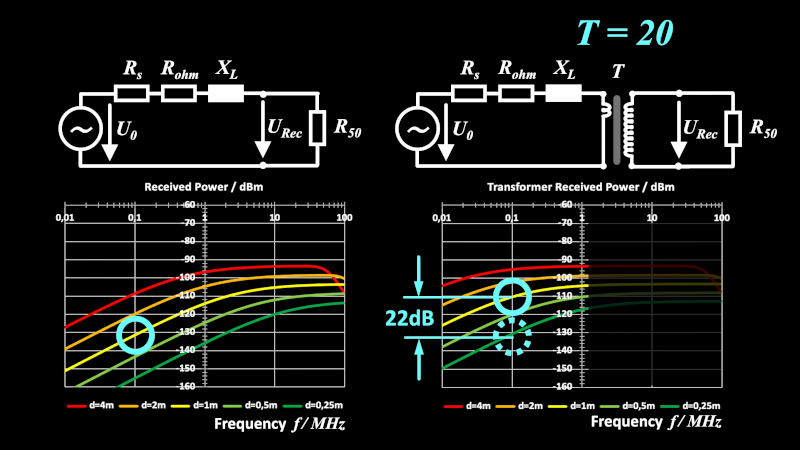
The core idea behind the VLF transformation is simple: use a compact loop antenna to capture the magnetic component of a signal, then use a matching transformer, preamplifier, filter, or software-defined receiver to make that tiny signal usable.
It sounds straightforward, but VLF systems reward careful thinking. Every component affects performance. Wire length, number of turns, loop size, cable routing, transformer ratio, receiver input impedance, electrical noise, and tuning can all change the result.
Why Magnetic Loop Antennas Work
A loop antenna is essentially a coil of wire arranged in a circular, square, rectangular, or other closed shape. When a changing magnetic field passes through the loop, it induces a small voltage. At VLF, this is useful because loops can receive signals without requiring an enormous outdoor antenna.
Many VLF loops use multiple turns of wire on a wood, PVC, or lightweight frame. The loop can be paired with a capacitor to create a resonant circuit tuned near a desired frequency. Increasing the number of turns can increase inductance, but it can also add resistance and distributed capacitance. In radio design, every improvement arrives with a small invoice.
A useful advantage of loop antennas is directionality. By rotating a loop, listeners can often reduce interference from a particular direction or emphasize a stronger signal path. This can be especially helpful in cities, where every apartment building seems to contain at least one charger determined to become a radio station.
The Role of the Matching Transformer
A matching transformer can help connect the loop antenna to the receiver more effectively. Its job is not to create energy from nowhere or turn a weak signal into a stadium concert. Instead, it helps transfer available signal power between components with different impedances.
The impedance transformation depends on the square of the turns ratio. In simplified form, the impedance ratio is approximately equal to the turns ratio squared. This matters because a loop antenna, preamplifier, receiver input, or SDR may not naturally operate at the same impedance.
A well-chosen transformer can improve voltage transfer and make a compact loop more compatible with a receiver. However, transformers can also introduce losses, resistance, bandwidth limits, and noise. The best design is not automatically the one with the most turns, the fanciest core, or the highest price tag. It is the design that performs well in the actual environment where it will be used.
Software-Defined Radio Changes the Game
Software-defined radio, commonly called SDR, has made VLF exploration far more accessible. Instead of relying only on a fixed analog receiver, an SDR allows the user to view signals on a waterfall display, record data, zoom into narrow frequency ranges, apply filters, compare signal levels, and analyze changes over time.
Not every SDR supports VLF directly. Some require direct-sampling capability, an upconverter, or an external receiver stage. Before buying hardware, confirm that it can cover the frequencies you want to monitor. A receiver that begins at a much higher frequency will be about as helpful as binoculars pointed at your own shoes.
Once the hardware is working, software becomes a major advantage. A VLF listener can record an overnight signal, inspect changes at sunrise, compare days with different solar activity, or watch lightning-related bursts appear as patterns across the screen.
How to Build a Practical VLF Receiving Setup
You do not need to build a laboratory-grade station on day one. A good beginner setup can be modest, inexpensive, and expandable. The key is deciding what you want to observe before buying parts.
Step 1: Choose Your VLF Goal
Different goals require slightly different setups. You may want to monitor a stable VLF transmitter for ionospheric changes, listen for lightning-generated radio signals, record whistlers, explore background atmospheric noise, or build a classroom science project.
A solar-monitoring system may focus on one stable transmitter frequency and record signal strength throughout the day. A lightning-monitoring setup may prioritize wide-band reception and recording. A general SDR experiment may emphasize flexibility, allowing you to scan several frequencies and compare antenna designs.
Step 2: Build or Buy a Small Loop Antenna
A simple VLF loop can be made from a square PVC frame, a wooden frame, or another nonmetallic structure. Thin insulated wire is wrapped around the frame many times to create the coil. Larger loops generally capture more signal, but even a compact loop can work when paired with a sensitive preamp and good noise control.
Keep the loop away from power strips, monitors, routers, chargers, and walls packed with electrical wiring. Moving the antenna even a few feet can sometimes make a dramatic difference. In VLF work, location is not a minor detail. It is a personality trait.
Step 3: Add Filtering and Gain Carefully
A preamplifier can boost weak signals, but more gain is not always better. Too much gain can overload the receiver, amplify local noise, or make strong nearby signals dominate the spectrum. Good VLF reception depends on signal-to-noise ratio, not simply signal size.
Filters can be valuable when power-line hum, nearby broadcast signals, or switching noise is overwhelming the system. In the United States, 60 Hz electrical noise and its harmonics are common challenges. In other countries, 50 Hz interference may be more noticeable.
Step 4: Test, Rotate, and Record
Once the receiver is running, experiment with loop orientation, cable routing, gain settings, and physical placement. Rotate the antenna slowly and watch the signal display. Move power supplies farther away. Turn off LED lamps one at a time. A surprising number of VLF breakthroughs begin with the sentence, “Wait, was that lamp doing all of this?”
Record your data whenever possible. A signal that seems ordinary during a five-minute listening session may reveal useful daily patterns across several days or weeks.
Step 5: Put Safety First
VLF receiving projects should remain passive unless you are properly licensed, trained, and authorized for transmission. Never connect experimental antennas directly to electrical outlets, utility wiring, telephone lines, or unknown cables. Outdoor antennas should have appropriate lightning protection and should be disconnected during storms when practical.
A radio experiment should be exciting because you found a signal from the ionosphere, not because your homeowners insurance representative now knows you by first name.
What VLF Can Reveal About Earth and Space
VLF is not merely a niche hobby band. It has practical scientific value. Changes in the ionosphere can affect the strength and phase of received signals. Solar flares can alter ionospheric conditions and produce sudden changes in monitored VLF transmissions. This makes VLF monitoring useful for education and citizen-science projects related to space weather.
Lightning also produces radio energy across a wide range of frequencies, including the VLF range. Specialized receivers can detect lightning-generated impulses over long distances. In some cases, lightning energy can travel along Earth’s magnetic field lines and produce whistler-like signals that descend in pitch when converted into audio.
VLF research also reaches into near-Earth space. Scientists study how naturally occurring VLF waves and human-made VLF transmissions interact with charged particles in the magnetosphere. These interactions may influence radiation-belt dynamics, which matters for satellites, spacecraft systems, and space-weather research.
From Submarines to Solar Flares
VLF has historically been used for long-range communication with submerged submarines because low-frequency signals can travel great distances and penetrate seawater to a limited extent. The same properties that make VLF useful for communication also make it valuable for scientific monitoring.
A stable transmitter can function like a radio beacon for observing the ionosphere. When conditions change, the received signal may shift in strength or phase. With the right data logging, a small home-built receiver can help demonstrate how events on the Sun affect Earth’s upper atmosphere.
VLF in Geology and Environmental Studies
VLF electromagnetic techniques are also used in geophysical investigations. Because radio signals can induce measurable electromagnetic responses in the ground, VLF methods can help identify conductive structures, fracture zones, groundwater-related features, and geologic boundaries.
Scientists have used VLF measurements in volcanic areas, groundwater studies, and other field investigations. The technology is not a magic underground X-ray machine, but it can be an efficient reconnaissance tool when combined with other geophysical methods.
Common VLF Problems and How to Solve Them
Problem: The Receiver Only Shows Hum
Start by checking nearby electronics. Turn off chargers, LED lights, monitors, and other switching power supplies. Move the antenna away from walls, extension cords, and appliances. Rotate the loop to reduce interference. Try battery power for the preamplifier or receiver if practical.
Problem: The Signal Is Too Weak
Try increasing loop size, adjusting the number of turns, improving the impedance match, adding a low-noise preamplifier, or moving the system to a quieter location. Sometimes the best upgrade is not a new component. It is simply moving the antenna away from the router that has been shouting into the spectrum all night.
Problem: The SDR Does Not Cover VLF
Confirm your SDR’s minimum frequency range and whether it supports direct sampling. Some devices need an upconverter or dedicated VLF receiver stage. Read the specifications before purchasing accessories, because “low frequency” in marketing language can sometimes mean “not nearly low enough.”
Problem: Every Weird Sound Feels Like a Mystery
Keep a log. Compare the signal with local weather, time of day, electrical activity, and known transmitter frequencies. VLF is full of fascinating natural phenomena, but it is also full of power supplies, appliances, and poorly shielded electronics. The truth is usually interesting enough without inviting aliens to the troubleshooting session.
VLF Listening Experiences: What the Transformation Feels Like in Practice
The following examples are composite, experience-based scenarios that reflect common VLF listening challenges and observations rather than personal claims from a single operator.
The first VLF listening experience is often humbling. A beginner builds a small loop, connects it to an SDR, opens the waterfall display, and expects to see the hidden music of the atmosphere. Instead, the screen fills with thick vertical lines, repeating harmonics, and enough interference to make the spectrum look like it is wearing a striped sweater.
That moment is not failure. It is the beginning of the transformation. VLF teaches a useful lesson quickly: the antenna is not just a piece of wire. Its location, orientation, cable route, and nearby electronics can matter more than the brand name printed on the receiver.
In a typical apartment experiment, moving the loop from a desk next to a laptop charger to a window across the room can reduce noise noticeably. Rotating the loop may suppress one dominant source of interference. Turning off an LED desk lamp may remove an entire family of unwanted lines. Suddenly, a small weak signal appears where there was previously only electronic soup.
In a quieter rural environment, the experience can be even more dramatic. A loop antenna placed away from household wiring may reveal bursts from distant lightning, slow shifts in background signal strength, or long stretches of quiet atmospheric texture. The silence is not truly silent. It is full of natural radio activity that usually goes unnoticed because human ears were never designed with a VLF input jack.
Monitoring a stable VLF transmitter over several days can become addictive in the most wholesome possible way. At first, the data may look boring: a repeating curve, stronger at one time of day, weaker at another. Then a solar event, unusual ionospheric condition, or major weather pattern creates a change that does not match the normal rhythm. The listener realizes that a tiny loop antenna and a computer are detecting a change in the upper atmosphere.
That is the magic of VLF. It makes space weather feel less abstract. Instead of reading that the ionosphere changed, you can watch a signal move on your own screen. Instead of hearing that lightning occurred far away, you can record the radio fingerprint of the event.
Experienced listeners also learn patience. The best VLF setup is rarely built in one afternoon. It evolves. A loop gets moved. A cable is replaced. A transformer ratio is changed. A noisy USB charger is retired with quiet dignity. Filters are tested. Gain is reduced. Notes are compared.
Eventually, the station stops feeling like a random collection of electronics. It becomes a custom instrument tuned to a particular environment. That is the real VLF transformation: turning an apparently impossible band of giant wavelengths and tiny signals into something you can observe, learn from, and enjoy from a desk, workshop, classroom, or quiet corner of the world.
Note: In this article, VLF refers to Very Low Frequency radio technology, generally in the 3 kHz to 30 kHz range. It does not refer to an unrelated company, product, stock ticker, or organization that may use the same abbreviation.