Some career changes arrive with a five-year plan, a polished résumé, and a motivational spreadsheet. Nastasya Shuljak’s arrived in a bag of colored wool.
The unexpected New Year’s gift did not look like the opening chapter of a new profession. At the time, Shuljak was working as a theater artist and teaching art. Yet after transforming the fibers into a bear and a hare, she discovered a material flexible enough to hold her imagination and expressive enough to make adults grin like children who had just been handed dessert before dinner.
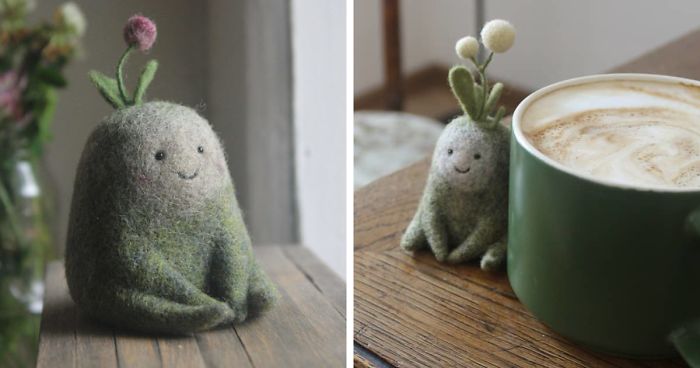
That experiment developed into Stowaways Toys, a whimsical collection of miniature felted animals, botanical spirits, smiling forest creatures, and charming beings that appear to have wandered out of a particularly peaceful fairy tale. The 35 pictures associated with her story reveal more than cute handmade toys. They document how an accidental gift, patient craftsmanship, theatrical instincts, and a deep connection to nature can combine to produce an unmistakable creative identity.
A Pack of Wool That Changed an Artistic Career
Shuljak, whose surname is also transliterated as Shulyak, says she began working with dry and wet felting techniques in 2010. The beginning was wonderfully unceremonious: friends presented her with colored wool shortly before New Year’s, she experimented with it, and the experiment refused to remain a hobby.
“`
From Theater Sets to Tiny Wool Characters
Before becoming known for felted wool toys, Shuljak worked in theater and taught at the art school she had once attended. That background matters. Theater artists learn to communicate personality through silhouette, proportion, posture, color, costume, and setting. A character must often be readable from the back row before it says a word.
Her wool figures use the same principle on a miniature scale. A slight tilt of the head suggests shyness. Two tiny arms folded over a rounded belly suggest contentment. A pair of uneven ears can turn a simple gray form into a cautious woodland animal. Nothing needs a dramatic monologue. The creature has already explained itself.
The First Bear and Hare
Using the gifted wool, Shuljak made a bear and a hare. These early figures introduced her to the unusual possibilities of fiber sculpture. Loose wool can look like little more than colorful fluff, but repeated shaping and felting allow it to become dense, structural, and surprisingly precise.
She was attracted to the material’s softness and plasticitythe way it could be compressed, layered, blended, and reshaped. Unlike carving stone, felting does not begin with a stern block daring the artist to make a mistake. Wool is more forgiving. It lets the maker add volume, remove fuzz, change a curve, or reconsider an ear that has somehow developed the personality of a satellite dish.
“`
Why the 35 Pictures Feel Like One Magical World
The figures in the photo collection vary considerably. There are recognizable animals, including foxes, bears, hares, pigs, dogs, and polar creatures. Others are harder to classify. They may have four feet, leaf-shaped ears, a mushroom on their head, or a flower growing from a softly rounded body.
Despite that variety, they all appear to belong to the same universe. That consistency is one of Shuljak’s greatest strengths as a toy designer.
“`
Minimal Faces With Maximum Personality
Most of the creatures have extremely simple faces: two small eyes, a tiny curved mouth, and occasionally a hint of rosy color. The expressions are restrained rather than cartoonishly exaggerated. They do not appear to be screaming with happiness, plotting world domination, or trying to sell anyone car insurance.
Instead, they look calm, curious, and quietly pleased to exist. Their emotional ambiguity invites viewers to project stories onto them. One person may see a bashful forest guardian. Another may see a creature that has spent the morning gardening and is now waiting politely for tea.
This is intelligent minimalism. By removing unnecessary features, Shuljak preserves the qualities that matter most: shape, texture, posture, and expression. The designs are recognizable in an instant, which is essential for memorable handmade art toys.
Nature Is More Than Decoration
Flowers, grasses, leaves, berries, mushrooms, and delicate sprouts frequently emerge from the figures. These botanical additions do not feel attached as an afterthought. The plant and creature appear to be parts of the same living form.
Shuljak has connected this visual language to her childhood. She grew up near the sea and spent considerable time visiting forests with her parents. Nature therefore enters the work as remembered experience rather than a fashionable surface treatment.
Her official biography now describes a life and studio in Georgia, or Sakartvelo, after previously working in Moscow. The local landscape, unusual plants, shoreline, and gentler climate continue to provide inspiration. Her imaginary forest has changed addresses, but apparently the tiny residents remembered to forward their mail.
A Soft, Earthy Color Palette
Muted greens, dusty browns, stone grays, warm creams, and softened pinks dominate many of the sculptures. Brighter colors appear selectively in flowers, ears, spines, or small botanical details. This controlled palette keeps the characters playful without making them visually noisy.
The colors also reinforce the natural theme. A moss-green body can suggest a forest floor, while mixed gray fibers resemble stone, bark, fog, or winter fur. Because wool can be blended before and during felting, colors merge with subtle irregularity. The result feels organic rather than factory-perfect.
“`
How Loose Wool Becomes a Miniature Sculpture
Felt is a nonwoven textile created by matting and interlocking fibers rather than weaving threads into a grid. Traditional wool is particularly well suited to the process because the microscopic scales on its fibers catch and bind together.
“`
Dry Felting and Needle Felting
Many sculptural wool figures are formed through dry felting, commonly called needle felting. The artist repeatedly pushes a specialized barbed needle into loose wool. Each movement tangles and compresses the fibers, gradually turning an airy bundle into a firm shape.
The basic idea sounds simple. The reality involves thousands of controlled needle movements, careful observation, and occasional reminders that felting needles are sharp enough to make inattentive fingers reconsider their life choices.
The artist builds the central form first, then adds smaller volumes for limbs, ears, snouts, tails, leaves, and facial features. More needling creates denser, sharper shapes; lighter felting preserves soft, fuzzy surfaces. Different colors can be layered or blended directly into the sculpture.
Wet Felting
Wet felting uses moisture, soap, pressure, and friction to encourage wool fibers to interlock. It is commonly used for sheets, coverings, clothing, vessels, and larger textile forms, although artists may combine it with needle felting when creating three-dimensional work.
Shuljak’s experience with both dry and wet techniques gives her a broad material vocabulary. A toy designer who understands how wool behaves at different densities can control whether a form feels rigid, rounded, feathery, smooth, or deliberately shaggy.
Several Days for One Small Creature
The finished toys may look spontaneous, but they are not instant creations. Shuljak has explained that she felts for several hours a day and may spend several days completing one object. Her shop is updated only periodically because each sculpture requires painstaking handwork.
This slow production is part of the appeal. Small variations in fiber, posture, color, and expression make each character feel individual. A handmade fox is not merely one unit from Production Batch Fox-472B. It carries evidence of decisions, corrections, and human touch.
“`
Theater Skills Hidden Inside the Toy Designs
Although her medium changed, Shuljak did not abandon her earlier artistic experience. Several theater-related skills are visible in the wool creatures.
“`
Character Development Without Dialogue
A stage designer helps establish who a character is before the audience hears the full story. Clothing, silhouette, color, scale, and physical surroundings create immediate expectations. Shuljak’s sculptures function similarly.
A tall figure with narrow limbs feels different from a squat creature with tiny feet. A bear facing forward may appear confident, while a little animal looking sideways feels cautious. These distinctions turn abstract forms into personalities.
Staging and Photography
The creatures are often photographed on worn tables, beside windows, on open books, among plants, or outdoors in grass. These simple environments function like miniature stage sets. They provide scale and atmosphere while allowing the textile sculptures to remain the stars.
Natural light emphasizes the fibers and creates gentle shadows. Weathered wood, old pages, peeling paint, and leafy backgrounds complement the handmade quality of the toys. The photography does not merely record an object; it suggests that the object has a private life.
Building an Ensemble
Many of the strongest images show several figures together. Their different heights, colors, and shapes produce the visual rhythm of an ensemble cast. One tall creature becomes the serious friend. A round companion appears cheerful. A tiny mushroom-headed character looks as though it was invited by accident but brought excellent snacks.
This ensemble approach encourages collecting. A single wool sculpture is charming, but a group begins to resemble a community with unwritten relationships and adventures.
“`
Why Adults Respond So Strongly to These Handmade Toys
Shuljak has described seeing a childlike spark in adults who held her creations. That reaction helped convince her to continue working with wool. She does not position the figures as grand museum statements, preferring to think of them as small pieces of joy.
The response makes sense. Adults are surrounded by smooth screens, standardized products, automated messages, and objects designed for maximum efficiency. A slightly irregular handmade creature offers the opposite experience. It is soft, slow, tactile, and unnecessary in the best possible way.
Designer toys also occupy an interesting space between sculpture, decoration, character design, and play. They may be purchased by adults who appreciate craftsmanship, limited production, independent art, or simply the emotional comfort of having a smiling forest spirit nearby during a difficult spreadsheet.
The toys’ softness is especially important. Wool invites touch, even when a delicate sculpture should be handled carefully. Texture makes the character feel physically present in a way that a digital illustration cannot duplicate.
What Makes Shuljak’s Felted Wool Toys Distinctive?
“`
A Recognizable Design Language
Strong creative brands are recognizable even when the logo is absent. Shuljak achieves that recognition through repeated visual choices: rounded bodies, tiny limbs, restrained expressions, botanical growth, natural colors, and peaceful staging.
Consistency does not mean repetition. She can create a pig, a tree spirit, a fox, or an unidentified potato-shaped philosopher while preserving the same artistic voice.
Restraint Instead of Excess
It would be easy to cover every figure with elaborate accessories, patterns, and miniature props. Shuljak usually resists that temptation. One flower, leaf, tuft, or unusually shaped ear is often enough.
That restraint gives each detail more importance. When a single red mushroom appears on a pale creature, the viewer notices it immediately. Good toy design is not about how many ideas can be attached to one body. It is about knowing which idea deserves to remain.
Emotional Accessibility
The figures do not require knowledge of textile history, theater design, or contemporary sculpture. They communicate immediately. Yet their simplicity does not make them shallow. Viewers can appreciate the craftsmanship, symbolism, natural inspiration, and character design after the first delighted reaction has settled down.
“`
Creative Lessons From an Accidental Toy Designer
Shuljak’s path offers several useful lessons for artists, makers, and anyone staring suspiciously at an unused craft kit.
First, creative breakthroughs do not always begin with a fully formed goal. The material itself may reveal the direction. Shuljak did not receive wool because she had announced a strategic plan to build an international fiber-sculpture practice. She tried something unfamiliar and paid attention to the result.
Second, previous experience is rarely wasted. Theater work, teaching, drawing, color study, composition, and observation all transferred into toy design. A career change may look dramatic from the outside while quietly depending on skills accumulated over many years.
Third, audience response can reveal purpose. The delight Shuljak observed in customers helped her understand what the figures provided. Their value was not only technical. They created a brief emotional change.
Finally, a narrow artistic language can produce a surprisingly large world. By concentrating on wool, compact forms, quiet expressions, and nature-inspired details, she developed an identity stronger than a collection that attempted every possible style.
The Experience of Turning a First Pack of Wool Into a Character
For a beginner, opening a pack of wool can be both inviting and confusing. The fibers are beautiful, but they do not provide instructions about what they want to become. A clump of gray wool might suggest a bear, a stone, a sleepy mouse, or something that looks alarmingly like dryer lint with ambitions.
The first meaningful experience is learning to think in volume. Drawing creates the illusion of depth on a flat surface, while needle felting builds an object from the inside outward. The maker rolls and compresses a loose core, testing it between the fingers. At first, it refuses to cooperate. Then the needle begins to tighten the fibers, and a vague shape slowly becomes solid.
This stage teaches patience almost immediately. Wool does not transform after three dramatic pokes accompanied by inspirational music. Progress comes through repetition. The hand turns the object, the needle enters at different angles, and the surface gradually firms. Small changes become noticeable only after several minutes. That slow feedback can be frustrating, but it also makes the process absorbing.
The next experience is discovering how little information a character needs. Two tiny eyes can instantly change a lump into a being. Their position matters enormously. Place them far apart and the figure may look innocent. Move them closer and it becomes alert. Add a curved mouth, and suddenly the maker feels responsible for the happiness of an object that did not technically exist an hour earlier.
Creating limbs and ears introduces the comedy of proportion. One arm becomes longer than the other. An intended fox acquires rabbit ears. A bear develops a tail suitable for a tropical bird. The beginner learns that correction is not failure. Wool can be added, reshaped, covered, or compressed. Many apparent mistakes become design decisions after sufficient confidence and a carefully prepared explanation.
Color adds another layer of experience. Fibers can be mixed to create mottled surfaces that resemble moss, fur, soil, or weathered stone. A bright accenta flower, mushroom, berry, or tuftcan provide a focal point without overwhelming the form. The maker begins noticing natural color combinations outside the studio, studying bark, leaves, clouds, and animal coats with fresh attention.
Finishing the first creature is satisfying precisely because the object records the learning process. It may not be perfectly smooth or symmetrical, but perfection is rarely what makes handmade toys lovable. A slightly tilted head or uneven foot can produce personality that a flawless manufactured object would lack.
Sharing the figure introduces the final and perhaps most surprising experience. Other people immediately invent stories about it. Someone decides it looks shy. Someone gives it a name. Someone asks whether it is available for adoption, as though the wool creature has already packed a suitcase.
That reaction explains much of Shuljak’s journey. The craft begins with fiber and technique, but it becomes meaningful through connection. A small handmade character can carry the memory of a forest, the training of a theater artist, several days of concentrated labor, and one viewer’s unexpected smile. A pack of wool may appear modest, but in the right hands, it contains an entire cast waiting for the curtain to rise.
Conclusion
Nastasya Shuljak’s transformation from theater artist and teacher to full-time toy designer began with curiosity rather than certainty. A gifted pack of wool led to a bear and a hare, those first figures led to years of experimentation, and that experimentation produced a recognizable family of handmade wool sculptures.
The 35 pictures are delightful because the creatures are cute, but their lasting appeal comes from deeper qualities: disciplined minimalism, tactile craftsmanship, theatrical character building, natural inspiration, and emotional generosity. They remind viewers that art does not always need to be monumental or solemn. Sometimes it can sit quietly on a windowsill with a flower growing from its head.