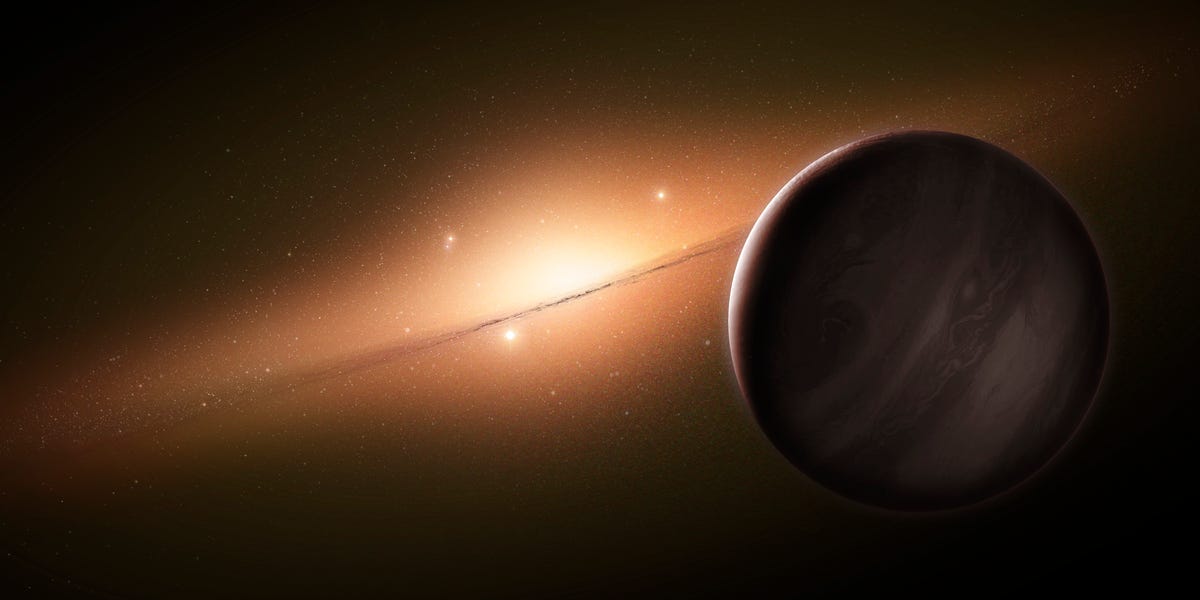
Somewhere between the glowing cities of stars in the Milky Way, there may be billions of planets drifting through darkness with no sunrise, no sunset, and absolutely no loyalty to a parent star. These are rogue planets, also called free-floating planets, nomad worlds, or, if we are feeling dramatic, cosmic runaways with excellent commitment issues.
The headline number is staggering: there may be around 50 billion rogue planets in the Milky Way. That estimate comes from computer simulations of young star clusters, where newborn planets can be kicked away from their stars by gravitational chaos. And here is the twist: 50 billion may not even be the upper limit. Newer microlensing studies suggest that rogue planets could be even more common, possibly reaching into the trillions depending on their mass range and how often young planetary systems eject worlds.
So, are we talking about frozen Earths, lonely Jupiters, failed stars, or something stranger? The answer is: yes, possibly all of the above. Rogue planets are not just science-fiction wallpaper. They are real astronomical targets, and they may rewrite what we think a “planet” is supposed to be.
What Is a Rogue Planet?
A rogue planet is a planetary-mass object that does not orbit a star. Earth orbits the Sun. Jupiter orbits the Sun. Mars orbits the Sun while looking dusty and slightly underwhelmed. A rogue planet, however, wanders through interstellar space without a host star holding it in a familiar orbit.
Some rogue planets may have formed around stars and later been thrown out. Others may have formed more like tiny failed stars, collapsing directly from gas and dust in star-forming regions. Astronomers are still debating where the line should be drawn between a planet, a brown dwarf, and a low-mass object formed alone in space. Nature, inconveniently, does not always label its products for our filing cabinets.
In practical terms, rogue planets are hard to find because they do not shine like stars. A young giant rogue planet may still glow faintly in infrared light from leftover heat, but older and smaller ones are nearly invisible. They do not pass regularly in front of a parent star, and they do not tug a star back and forth in a detectable orbit. They are the universe’s stealth mode.
Where Did the “50 Billion” Number Come From?
The famous 50 billion estimate comes from simulations of planetary systems inside young star clusters. In one widely discussed study, researchers modeled planets around stars in the Trapezium cluster, a young and crowded stellar nursery inside the Orion Nebula. The simulation included thousands of planets around hundreds of stars and found that a significant number could become unbound within the first few million years.
The basic idea is simple: young star clusters are not quiet neighborhoods. They are more like cosmic daycare during snack time. Stars pass close to one another, gravity tugs in every direction, and planetary systems that look stable at first can be disturbed. A passing star can stretch a planet’s orbit, another planet can scatter it, and eventually the unlucky world may gain enough speed to leave its system entirely.
When researchers extrapolated the simulated ejection rates to the entire Milky Way, they arrived at the possibility that roughly a quarter of stars may have lost one or more planets. If the galaxy contains hundreds of billions of stars, that can lead to tens of billions of rogue planets. Thus, the 50 billion figure became a memorable estimate: huge enough to bend the imagination, but still conservative compared with later possibilities.
Why the Real Number Could Be Even Higher
Today, astronomers are careful with the 50 billion number because it depends on assumptions: how many stars formed in clusters, how many planets each star formed, how crowded those clusters were, and how easily planets were ejected. Change the ingredients, and the cosmic recipe changes.
More recent research using gravitational microlensing suggests that free-floating planets may be far more abundant than older estimates implied. Some NASA-linked studies have suggested that the Milky Way could contain many times more rogue planets than stars, especially if small Earth-mass or Mars-mass worlds are common. That does not make the 50 billion figure wrong; it makes it a useful doorway into a larger mystery.
Think of 50 billion as the “please remain calm” version of the estimate. The “please sit down” version may be much larger.
How Do Planets Go Rogue?
1. Planet-Planet Scattering
Young planetary systems can be unstable. Giant planets can migrate, smaller planets can be pushed into stretched-out orbits, and close encounters can launch a world into space. In this scenario, planets act less like polite neighbors and more like billiard balls after someone sneezes on the table.
2. Close Encounters Between Stars
Stars are born in groups, and those groups can be dense. If another star passes close enough to a young solar system, its gravity can disturb outer planets. A distant ice giant or gas giant may be especially vulnerable because it is already weakly held by its star.
3. Binary Star Chaos
Many stars live in binary or multiple-star systems. Planets in these systems can survive, but the gravitational environment is more complicated. If the stars shift, pass near other stars, or interact with planets at the wrong angle, some planets can be expelled.
4. Star-Formation Without a Star
Some planetary-mass objects may form directly from collapsing gas clouds. These objects may look like planets in mass but form like miniature stars. This is one reason rogue planets challenge our definitions. Is a planet defined by its size, its formation history, or its current orbit? Astronomers enjoy this question because it gives them something to argue about at conferences besides coffee quality.
How Astronomers Find Worlds That Barely Shine
The most powerful technique for finding many rogue planets is gravitational microlensing. When a rogue planet passes almost directly in front of a more distant background star from our point of view, the planet’s gravity bends and magnifies the star’s light. For a short time, the background star appears brighter.
This brightening event may last only hours or days. Then it vanishes forever. There is no second orbit, no repeat transit, no neat calendar reminder saying, “Rogue planet returns Tuesday at 8:15.” Astronomers must watch huge fields of stars and catch these tiny flashes as they happen.
Microlensing is powerful because it does not require the planet to emit light. Gravity does the talking. Even a dark object can reveal itself by warping space-time just enough to leave a fingerprint in starlight.
Why NASA’s Roman Space Telescope Matters
NASA’s Nancy Grace Roman Space Telescope is expected to transform the search for rogue planets. Its Galactic Bulge Time Domain Survey will monitor dense star fields toward the center of the Milky Way, where microlensing events are more likely because there are so many background stars.
Roman is designed to observe large areas of the sky with sharp infrared vision. That is exactly what rogue-planet hunters need. The mission may detect hundreds of Earth-mass rogue planets and many more microlensing events caused by stars, brown dwarfs, black holes, and planets still bound to stars.
The key point is not just discovery. It is statistics. Finding one rogue planet is exciting. Finding hundreds lets scientists ask deeper questions: How common are they? What masses do they have? Are Earth-mass rogue planets more common than Jupiter-mass ones? Did they form alone, or were they kicked out?
Could a Rogue Planet Support Life?
At first glance, a rogue planet sounds like a terrible place for life. No star means no sunlight. No sunlight means no warm beach, no photosynthesis, and no charming little sunrise scene for the movie trailer.
But habitability is more complicated than sunlight alone. A rocky rogue planet with a thick atmosphere might trap internal heat. A world with a deep ocean under an ice shell could preserve liquid water through geothermal energy. A giant rogue planet could have moons warmed by tidal forces, similar to how Jupiter’s moon Europa may maintain a subsurface ocean.
This does not mean rogue planets are likely to host life. It means they cannot be dismissed automatically. Life on Earth depends heavily on sunlight, but some ecosystems also thrive around hydrothermal vents, using chemical energy rather than sunlight. If life can adapt to dark, high-pressure environments here, scientists are reasonable to ask whether hidden habitats might exist elsewhere.
Why Rogue Planets Matter
Rogue planets are important because they reveal the messy childhood of planetary systems. Our solar system looks orderly today, but its early history was probably violent. Planets migrated. Small bodies collided. Giant impacts shaped worlds. The Moon itself likely formed after a Mars-sized body struck the young Earth.
If other systems are even more chaotic, then ejected planets may be a natural byproduct of planet formation. In other words, a rogue planet is not necessarily an exception. It may be evidence that planet formation is doing exactly what gravity allows it to do: build, shuffle, collide, eject, and occasionally make astronomers spill coffee on their keyboards.
Rogue planets also help scientists understand how common planetary systems are. If a galaxy contains many free-floating planets, then counting only planets around stars gives us an incomplete inventory. It is like counting pets in a neighborhood but ignoring every cat currently ignoring its owner outdoors.
Specific Examples of Rogue-Planet Research
Several discoveries and candidates have shaped the field. Microlensing surveys such as MOA and OGLE have detected short-duration events that may be caused by free-floating or very wide-orbit planets. Some candidates appear to be roughly Earth-mass or Neptune-mass objects, though microlensing often leaves uncertainty about distance and exact mass.
Infrared observations have also identified planetary-mass objects in star-forming regions such as Orion. The James Webb Space Telescope has revealed unusual Jupiter-mass objects in the Orion Nebula, including pairs of planetary-mass bodies that challenge simple formation models. These discoveries do not all fit neatly into the same category, but together they show that planetary-mass objects can exist far from ordinary star-orbiting arrangements.
Recent detections are especially exciting because astronomers are improving the ability to estimate mass and distance. Once scientists can measure those properties more reliably, rogue planets become less like ghost stories and more like census entries.
The Milky Way May Be Full of Invisible Worlds
The Milky Way is often described as a galaxy of stars, but that may be only the bright version of the story. Between those stars could be a vast population of dark planets: frozen rocky bodies, gas giants still glowing faintly in infrared, icy ocean worlds, and objects that blur the boundary between planet and failed star.
Even if the 50 billion estimate is conservative, it changes how we imagine the galaxy. Space is not simply stars separated by emptiness. It may be filled with wandering worlds, each carrying a history of formation, violence, escape, and long travel through the dark.
Most of these planets will never pass close to Earth. The galaxy is too large, and interstellar distances are enormous. But statistically, they may be everywhere: between star systems, in star clusters, near the galactic bulge, and perhaps even in the solar neighborhood.
Experience Section: Thinking About 50 Billion Rogue Planets
The easiest way to feel the scale of 50 billion rogue planets is to step outside on a clear night and look at the Milky Way, if you are lucky enough to live somewhere dark enough to see it. Most people look up and notice stars. That is natural; stars are doing the visual heavy lifting. They sparkle, burn, and politely announce themselves across light-years. Rogue planets do no such thing. They are present only as an idea, which somehow makes them feel even larger.
Imagine standing under the night sky and realizing that the dark spaces between stars may not be empty. They may contain planets with mountains no one will climb, storms no one will name, oceans sealed under ice, and skies where no sun ever rises. It is a strange emotional mix: loneliness, wonder, and a tiny bit of “well, my phone battery problem seems less important now.”
One useful mental exercise is to compare rogue planets with travelers. A normal planet is like a house in a neighborhood, tied to a street, warmed by a porch light, and listed on the cosmic version of Google Maps. A rogue planet is a house that somehow rolled away from town and is now crossing the continent in total silence. It may still have rooms, history, and structure, but it no longer belongs to the system that shaped it.
For students, writers, science fans, and anyone who likes astronomy with a side of goosebumps, rogue planets are a perfect reminder that discovery is not always about bright things. Sometimes the most interesting objects are the ones that hide. A microlensing event lasting only a few hours can reveal a world that has drifted unseen for millions or billions of years. That is not just data; that is a cosmic ambush.
There is also a humbling lesson here. Our solar system feels stable because human lifetimes are short. The Sun rises, seasons turn, and Earth keeps its dependable orbit. But planet formation is not gentle. The early history of a system can include collisions, migrations, and ejections. If rogue planets are common, then many worlds did not get the calm ending Earth received. They were formed, shaped, and then thrown into interstellar exile.
That makes Earth feel more precious, not less. We live on a planet with a star, an atmosphere, liquid water, and a stable orbit. In a galaxy that may contain tens of billions of homeless planets, that is not boring. That is winning the cosmic housing lottery.
And yet, rogue planets are not simply tragic. They are also adventurous. They may travel through regions no star-bound planet ever visits. They may preserve ancient clues about the systems that expelled them. Some may even carry hidden heat beneath ice, quietly maintaining environments that scientists have only begun to imagine. In that sense, rogue planets are not failed worlds. They are worlds with different stories.
The next time you see a clean image of the Milky Way, remember that the glowing stars are only part of the galaxy’s population. The darkness may be crowded. Somewhere out there, a planet without a sun is moving through space right now, not lost exactly, just unclaimed.
Conclusion
The idea that there are 50 billion rogue planets in the Milky Way sounds outrageous until you remember how large, old, and chaotic our galaxy is. Stars are born in clusters. Planetary systems jostle and rearrange. Gravity can build worlds, but it can also evict them.
Rogue planets matter because they expand the meaning of planetary science. They show that planets are not only objects that orbit stars. They can be survivors, escapees, failed star-like objects, frozen wanderers, and possibly hidden habitats. The Milky Way is not just a galaxy of suns. It may also be a galaxy of invisible worlds traveling between them.
Fifty billion may be only the beginning. With upcoming surveys from NASA’s Roman Space Telescope and continued work from microlensing teams, astronomers may soon discover that the galaxy is far more crowded, strange, and planet-rich than we ever imagined.