Note: This article is for general science education. It is not medical advice or guidance for treating jellyfish stings.
Most people do not look at a jellyfish and think, “There goes a promising neuroscientist.” They think, “Please do not let that floating haunted bag touch my ankle.” Fair. Some box jellyfish carry venom capable of causing severe injury or death. But hidden beneath the tentacles, translucent bell, and general air of oceanic menace is something that has scientists leaning closer: a nervous system that can learn, adapt, sleep, and steer through a complicated world without anything resembling a human brain.
That does not mean jellyfish are secretly writing poetry, solving crossword puzzles, or judging your beach outfit. It does mean they are forcing researchers to reconsider a huge question in neuroscience: how much brain does an animal actually need to learn from experience?
Why “Deadly Jellyfish” Is More Than a Dramatic Headline
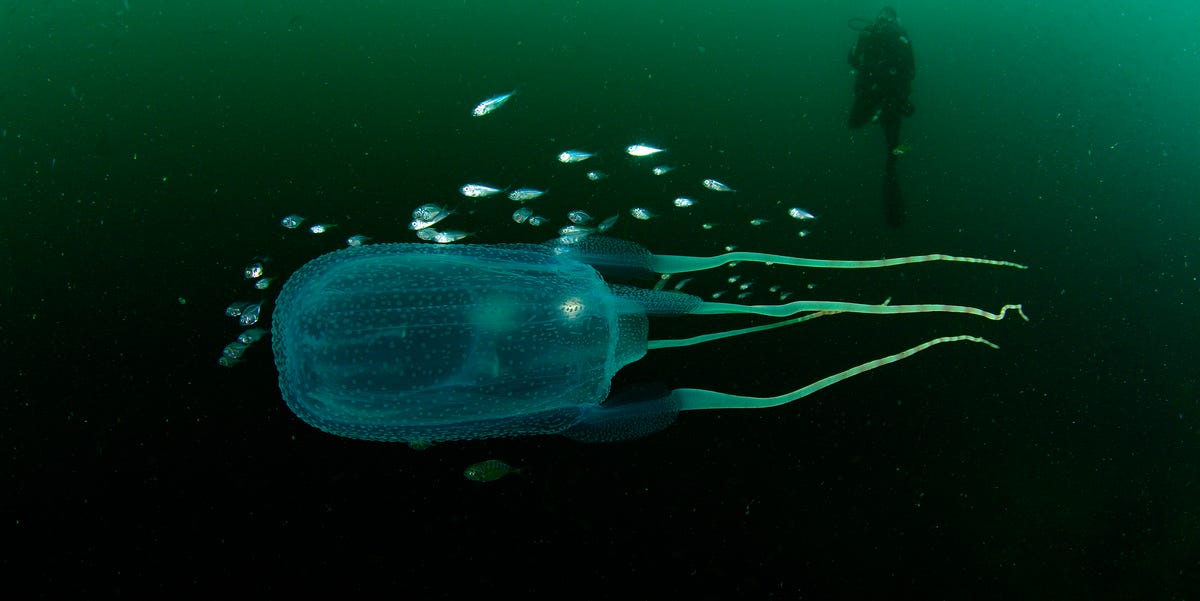
Box jellyfish, also known as sea wasps, include some of the most venomous marine animals on Earth. The Australian box jellyfish, Chironex fleckeri, is especially infamous because its sting can trigger life-threatening symptoms within minutes. Its tentacles are packed with nematocysts, tiny pressure-loaded cells that fire venom-delivering harpoons when triggered.
Fortunately, not every box jellyfish is a human nightmare wrapped in gelatin. Of the dozens of recognized box jellyfish species, only a small number are considered potentially lethal to people. Still, the dangerous reputation matters because it highlights the remarkable range of this animal group. In one branch of the family tree, scientists study venom powerful enough to disrupt vital body systems. In another, they study small Caribbean box jellyfish that can learn to avoid obstacles in murky water.
In other words, jellyfish are not simply drifting appetizers for sea turtles. They are ancient, varied, highly specialized animals with survival systems that have been evolving for hundreds of millions of years. Their bodies may look simple, but their biology has been quietly showing off for a very long time.
A Brainless Animal With Surprisingly Sophisticated Hardware
Jellyfish do not have brains, blood, hearts, or bones. Their nervous systems are often described as nerve nets: decentralized webs of neurons spread through the body. That sounds primitive until you consider what the system can accomplish. A jellyfish can detect light, react to chemicals, coordinate swimming, capture prey, respond to danger, and adjust behavior according to changing conditions.
Box jellyfish are especially fascinating because they are not built like the usual “float and hope” jellyfish stereotype. They have structures called rhopalia positioned around the edge of the bell. Each rhopalium contains sensory equipment, including eyes and neurons. Caribbean box jellyfish, Tripedalia cystophora, have multiple eyes in each rhopalium and use vision to navigate the tangled roots of mangrove forests.
That visual system is not a decorative upgrade. It is a survival tool. A jellyfish hunting tiny crustaceans in a mangrove lagoon has to avoid crashing into roots while moving through water whose clarity may change quickly. Clear water makes obstacles easier to judge. Murky water turns the whole environment into a low-contrast obstacle course, which is basically the underwater equivalent of trying to find a black suitcase in a dark airport baggage claim.
The remarkable part is that these jellyfish do not simply react in the same way every time. They can change their behavior after experience.
How Caribbean Box Jellyfish Learn Without a Central Brain
Research on Tripedalia cystophora has shown that these animals can perform associative learning. In simple terms, they can connect one event with another and use that information later. Scientists tested how box jellyfish responded to visual cues that resembled nearby mangrove roots.
At first, the jellyfish tended to ignore low-contrast visual patterns, which makes sense in clear water because faint objects may be far away. But when researchers paired those subtle visual patterns with the mechanical experience of bumping into a barrier, the jellyfish began changing their behavior. They became more likely to make evasive turns before colliding.
This was a big deal because the learning occurred without a centralized brain. The researchers found evidence that the rhopalial nervous system, the sensory hub that contains the jellyfish’s eyes and local neurons, can serve as a learning center. That does not make a rhopalium a tiny human cortex wearing a jellyfish costume. It does show that a relatively compact sensory circuit can combine information, alter future responses, and improve an animal’s chances of avoiding a bad decision.
For neuroscience, that is deliciously inconvenient. It challenges the old assumption that advanced learning must wait for a large, centralized brain with elaborate architecture. The box jellyfish suggests that learning may be a more fundamental property of neurons and circuits than scientists once believed.
What Jellyfish Can Teach Us About Human Brains
Learning May Begin With Small Circuits
Human learning involves billions of neurons, countless synapses, emotion, language, memory, attention, and the occasional inexplicable urge to reread a text message from 2018. Jellyfish learning is obviously much simpler. Yet the underlying principle is familiar: sensory information arrives, experience changes the response, and the animal behaves differently the next time.
That makes jellyfish useful for asking stripped-down questions about learning. What is the smallest neural circuit capable of storing useful information? How do sensory signals become behavioral changes? How does a nervous system decide that an ambiguous cue now deserves attention?
By studying a simpler animal, researchers can isolate parts of the problem that are nearly impossible to separate in the human brain. A jellyfish does not bring language, social media, childhood memories, or tax anxiety into the laboratory. It brings a manageable nervous system and a behavior scientists can measure.
Distributed Intelligence Is More Common Than We Thought
Humans tend to imagine intelligence as something that sits in one command center. The brain is headquarters; the body is the branch office. Jellyfish offer a different model. Their nervous systems are distributed, meaning control is spread across networks and sensory structures rather than concentrated in one central organ.
This matters because many human processes are also more distributed than they first appear. The brain constantly receives feedback from muscles, skin, internal organs, hormones, and sensory systems. Movement, emotion, pain, digestion, and attention all involve communication between the brain and body. Jellyfish remind scientists that intelligence is not always a top-down executive meeting. Sometimes it is a coordination problem solved across a network.
Simple Animals Can Reveal Ancient Rules of Nervous Systems
Jellyfish belong to Cnidaria, an animal group that branched off early in animal evolution. Their nervous systems therefore offer a window into the deep history of neurons. Researchers are interested in how early neural systems coordinated behavior before the evolution of brains like ours.
Modern jellyfish are not living fossils frozen in time. They have evolved just as long as every other living animal. Still, their body plans and decentralized networks can help scientists investigate which nervous-system features are ancient and which emerged later. The goal is not to find a tiny jellyfish version of a human brain. The goal is to identify basic principles that might have been useful long before vertebrates arrived with skulls, spinal cords, and strong opinions about coffee.
Jellyfish, Sleep, and the Mystery of Why Nervous Systems Rest
Jellyfish research has also entered the sleep conversation, which is impressive for animals that appear to have mastered the art of looking half-asleep while fully awake. Studies of upside-down jellyfish, including Cassiopea, have found sleep-like states based on behavioral features such as reduced activity, increased response thresholds, and the need to recover after deprivation.
More recent work involving jellyfish and sea anemones has added another intriguing clue. Researchers found evidence that sleep loss can increase DNA damage in nerve cells and that sleep may help support genome stability. The work suggests that some core functions of sleep may have evolved before animals developed centralized brains.
This does not mean your next night of sleep is being managed by an inner jellyfish. It does suggest that sleep may not be only about high-level cognition, dreams, or memory filing. Some parts of sleep could exist because nervous systems of many kinds need time to maintain and repair themselves.
That is a powerful idea. When scientists study sleep in jellyfish, they are not looking for proof that jellyfish dream about plankton. They are looking for clues about why rest became such a persistent feature of animal life in the first place.
Venom Research Could Also Open Doors
Box jellyfish venom is not merely a beach hazard. It is a complicated chemical toolkit shaped by evolution to act quickly on animal cells. Researchers studying jellyfish venom have identified diverse compounds that may interact with ion channels and receptors, the molecular gates and switches that help nerve cells communicate.
Ion channels are central to the nervous system. They help neurons generate electrical signals, transmit information, control muscle movement, and regulate sensation. When these channels malfunction, they can contribute to neurological, muscular, and cardiac problems. That makes venom compounds scientifically interesting, even when they are dangerous.
Laboratory research has also explored whether extracts from certain box jellyfish species may influence neuron growth and connectivity in cell models. These findings are still early-stage and should not be mistaken for a treatment for neurodegenerative disease. A promising effect in cultured cells is very far from a safe medicine for people.
Still, many medicines began as careful investigations of natural compounds that were initially frightening, inconvenient, or both. Nature has spent millions of years designing molecules for very specific jobs. Scientists are simply trying to understand the instruction manual without getting stung in the process.
Why Jellyfish Are Becoming Better Research Models
For a long time, jellyfish were difficult to study in detail because their bodies are fragile, transparent, and not especially cooperative about sitting still for a microscope. New genetic, imaging, and computational tools are changing that.
Species such as Clytia hemisphaerica are increasingly useful in laboratory research because they are transparent and can be studied with modern genetic methods. Transparency is a serious advantage when researchers want to watch cells, neurons, and developing tissues in a living animal. Human brains, inconveniently, are not see-through. Jellyfish, in contrast, are practically biological windows.
Scientists can now map cell types, observe neural activity, model swimming behavior, and compare genetic pathways across species. These tools allow researchers to connect individual cells with whole-animal behavior. That is one of neuroscience’s biggest ambitions: understanding how activity in tiny cells becomes a visible decision, movement, or learned response.
Jellyfish will not replace mice, fruit flies, zebrafish, or human studies. They do something different. They offer a simpler system in which scientists can ask foundational questions without immediately getting buried under the astonishing complexity of a mammalian brain.
What Jellyfish Cannot Tell Us Yet
It is important not to turn a fascinating jellyfish study into a headline that says, “Sea Wasp Solves Alzheimer’s by Tuesday.” Jellyfish research can illuminate basic biology, but it does not automatically translate into treatments for human brain disorders.
Humans have highly specialized brains, immune systems, blood vessels, glial cells, and lifetimes long enough to accumulate a truly impressive collection of stressors. A jellyfish does not model every part of human memory, consciousness, mental illness, or neurodegeneration.
What it can offer is perspective. If learning, adaptive behavior, and sleep-related cellular maintenance can exist in decentralized nerve nets, then the building blocks of cognition may be older and more flexible than previously assumed. That changes the questions scientists ask, and better questions are often where better science begins.
Five Science-Inspired Experiences That Make Jellyfish Brain Research Feel Real
1. Watching a Jellyfish Move Through an Aquarium
Stand in front of a jellyfish tank for ten minutes and the first thing you notice is how wrong your instincts are. The animals look like decorations. They pulse, drift, fold, and glow as though somebody put a lava lamp through a marine biology degree. But watch longer and the illusion changes. A jellyfish is not just floating. It is coordinating movement, responding to water flow, adjusting body shape, and maintaining a rhythm.
That experience makes distributed nervous systems easier to imagine. There is no obvious face, no visible head, and no skull containing a command center. Yet the animal moves with purpose. It reminds us that behavior does not always need a brain-shaped headquarters to be organized.
2. Seeing How Water Clarity Changes Everything
Picture swimming in clear tropical water where branches, rocks, and roots are easy to see. Now imagine the water clouding after rain, sediment, algae, or tides. The same obstacle may suddenly seem farther away because it has less contrast against the background.
That is close to the challenge faced by Caribbean box jellyfish in mangrove habitats. Their world changes visually, and they have to update their response. Thinking through that scenario turns associative learning from an abstract laboratory phrase into a practical survival problem: “That faint shape fooled me before. I should turn now.”
3. Noticing Your Own Automatic Reactions
Try this harmless thought experiment. When your phone buzzes, do you reach for it before deciding to? When you smell smoke, does your body become alert before you have fully explained why? Much of human behavior begins with fast sensory systems acting before deliberate thought catches up.
Jellyfish research does not say humans are just elaborate gelatin desserts. It does highlight a shared principle: nervous systems are built to connect cues with consequences. The difference is scale. A jellyfish learns which visual patterns predict a collision. A human learns that the microwave beep means dinner, danger, or somebody forgot to remove the fork.
4. Considering Why Sleep Feels Necessary
Everyone knows the experience of trying to function after too little sleep. Attention wanders. Reactions slow down. Small problems become dramatic enough to deserve a documentary soundtrack. Jellyfish studies make that familiar experience feel oddly ancient.
If animals with decentralized nerve nets show sleep-like behavior and signs that rest may support cellular maintenance, then sleep is not merely a luxury for animals with oversized calendars. It may be part of the basic maintenance plan for nervous systems themselves. The next time you feel guilty about going to bed early, remember that even animals without brains appear to need downtime.
5. Respecting the Ocean’s Most Misunderstood Researchers
Jellyfish are easy to dismiss because they are transparent, unfamiliar, and occasionally capable of ruining a vacation with one badly timed tentacle. But they occupy important roles in marine ecosystems and have become valuable scientific models.
The experience worth carrying forward is not “jellyfish are cute,” because some are absolutely not interested in your affection. It is curiosity with caution. A jellyfish can be dangerous, beautiful, evolutionarily ancient, and scientifically useful at the same time. That combination is exactly why researchers keep studying them.
Conclusion: The Brain May Be Bigger Than the Organ in Your Head
Deadly jellyfish are not about to replace neurologists, neuroscientists, or your favorite brain podcast host. But their strange biology is changing how researchers think about learning, sensation, sleep, and neural organization.
Box jellyfish show that an animal can combine sensory signals, learn from experience, and make better future choices without a centralized brain. Other jellyfish studies suggest that sleep-related maintenance may have ancient roots, while venom research offers molecular clues about how nerve cells and ion channels work.
The lesson is not that humans are secretly jellyfish with mortgages. The lesson is more interesting: intelligence and adaptation may emerge from smaller, more distributed systems than we once imagined. Sometimes the path to understanding the human brain begins not in a hospital scanner, but in a mangrove lagoon with a tiny creature trying very hard not to bump into a root.