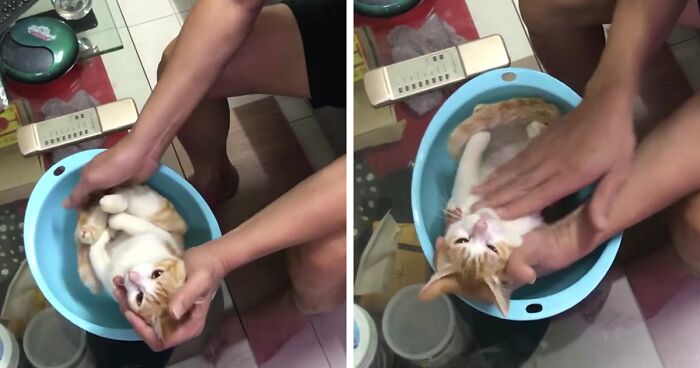
Some parenting lessons arrive in neatly organized classes with diagrams, practice dolls, and trained instructors. Others happen in the living room with Grandpa, an expectant father, and one spectacularly patient cat who appears to have accidentally enrolled in Newborn Care 101.
That was the irresistible setup behind a viral family video shared by Vinh Quang Phạm. In the clip, a Vietnamese grandpa-to-be demonstrates how to hold and bathe a newborn while using the family cat as his remarkably relaxed stand-in. He carefully supports the animal’s body, explains where the parent’s hands should go, and pantomimes washing the head and body. Meanwhile, the cat remains so calm that it seems less like an unwilling volunteer and more like a tiny professor evaluating the lesson.
The video is funny, affectionate, and unexpectedly educational. It also opens the door to a more serious conversation: Why does bathing a newborn make so many first-time parents nervous, what parts of Grandpa’s demonstration reflect real baby-care principles, and which parts should remain firmly in the category of “adorable internet momentdo not recreate without feline consent”?
A Grandpa-To-Be, a Nervous New Parent, and a Very Chill Cat
According to the original account of the video, the grandfather was preparing his son for the arrival of a newborn. Rather than simply describing the process, he turned the lesson into a physical demonstration. The cat became a conveniently baby-sized model, allowing Grandpa to show how the head, neck, back, and lower body should be supported.
One of the most memorable parts of the clip is the grandfather’s focus on maintaining a secure grip. He demonstrates supporting the neck and lower body before gently lowering the “baby” toward an imaginary basin. He then places the cat across his lap and shows how the infant’s head might be cleaned without allowing water to run directly over the face. The cat responds by lying there with the serene expression of someone who has accepted that retirement planning can wait.
The original video gained tens of thousands of reactions and comments after circulating on Facebook. Its popularity was not difficult to understand. Viewers were not merely watching a cat behave unusually well. They were watching knowledge move from one generation to the next through humor, patience, and hands-on teaching.
Why the video feels so genuine
Viral family clips often succeed because they capture something polished advertisements cannot manufacture: recognizable human behavior. The son is learning. The grandfather is confidently explaining. The cat is tolerating the entire production with the emotional range of a sleepy potato.
More importantly, Grandpa treats the lesson as something worth practicing. He does not assume that a new father will automatically know how to handle a slippery newborn. That attitude is both practical and reassuring. Caring for a baby is learned through instruction, repetition, observation, and experiencenot through a magical parenting update that installs itself the moment someone leaves the hospital.
Why Bathing a Newborn Can Feel Intimidating
A newborn may weigh only a few pounds, cannot support the head independently, and can become surprisingly slippery when wet. Add warm water, soap, a tiny bathtub, and the fear of doing something wrong, and even confident adults may suddenly feel as coordinated as someone trying to fold a fitted sheet during an earthquake.
New parents commonly worry about supporting the neck, protecting the umbilical cord, keeping water out of the eyes, maintaining a comfortable temperature, and preventing the baby from becoming cold. These concerns are reasonable. The solution is not to rush through the bath, but to prepare everything in advance and use a simple, repeatable routine.
The American Academy of Pediatrics explains that newborns generally do not need a bath every day. About three baths per week may be sufficient during the first year, since frequent bathing can dry delicate skin. Until the umbilical cord stump falls off and the area heals, sponge baths are typically recommended instead of placing the baby in a tub.
The American Academy of Dermatology offers similar guidance, recommending two or three gentle baths per week while the diaper area is cleaned carefully at every change. Dermatologists also advise starting with sponge baths and using lukewarm water with mild, fragrance-free products.
What Grandpa’s Demonstration Gets Right
Supporting the head and neck
The central lesson in the video is correct: a newborn’s head and neck require continuous support. When lowering a baby into a bath, the caregiver should maintain a secure hold around the upper body while using the other hand to guide and support the lower body.
Once the baby is positioned safely, the caregiver must continue maintaining physical contact. Nationwide Children’s Hospital recommends keeping one hand on the baby at all times and never leaving an infant alone in any amount of bathwater.
Preparing before the bath begins
A smooth bath starts before anyone removes a onesie. Gather the washcloth, towel, clean diaper, clothes, mild cleanser, and any other supplies first. This prevents the classic parenting trap of realizing the towel is across the room while holding a wet, wiggling baby.
Nemours KidsHealth recommends having all supplies ready and within reach because a baby should never be left unattended in the bath. If the phone rings, the doorbell sounds, or another interruption occurs, the safe response is to wrap the baby in a towel and take the child along.
Keeping the bath gentle
Grandpa’s slow movements are another useful part of the lesson. Newborn bathing is not a speed-cleaning competition. A soft washcloth, gentle wiping, and careful rinsing are generally enough. Scrubbing is unnecessary and may irritate sensitive skin.
Children’s Hospital of Philadelphia advises beginning with sponge baths and delaying a regular tub bath until the umbilical cord has fallen off and healed. The hospital also notes that bath time can become part of a calming evening ritual when the experience is comfortable for the baby.
Turning care into connection
Bathing is not merely a hygiene task. It can be a bonding opportunity filled with eye contact, quiet conversation, singing, and reassuring touch. Babies gradually learn that the caregiver’s hands, voice, and routine signal safety.
Johns Hopkins pediatric guidance emphasizes a simple approach to newborn skin care: babies need few products, and bathing two or three times weekly is often enough. That “less is more” philosophy allows the caregiver to focus less on elaborate products and more on gentle handling.
How to Bathe a Newborn Safely
Step 1: Choose sponge bathing at first
Before the umbilical cord stump has fallen off and healed, lay the baby on a stable, comfortable surface and use a basin of lukewarm water with a soft washcloth. Keep the baby wrapped in a towel, exposing only the area being cleaned. Begin with the face, move to the scalp and body, and clean the diaper area last.
Keep one hand on the baby whenever the child is on an elevated surface. Better yet, use a padded space on the floor when practical, eliminating the risk of a fall from a changing table or counter.
Step 2: Test the water
Once the baby is ready for a tub bath, fill the infant tub before placing the child inside. The water should feel comfortably warm, not hot, against the inside of an adult’s wrist or elbow. Nationwide Children’s Hospital recommends water around 100 degrees Fahrenheit and advises setting household water heaters no higher than 120 degrees Fahrenheit to reduce scald risk.
UCSF Benioff Children’s Hospitals similarly advises using warm rather than hot water and testing it with a thermometer, wrist, or elbow. The faucet should be turned off before the baby enters because water temperature may fluctuate while it is running.
Step 3: Lower the baby feet first
Support the head and neck with one arm while holding the baby securely around the upper body. Use the other hand to guide the legs and lower the child feet first. Keep most of the baby’s body above the water and gently pour warm water over exposed areas to prevent chilling.
Step 4: Wash from cleanest to dirtiest
Use plain water or a damp washcloth on the face. Clean around the eyes carefully, wiping outward, and avoid inserting anything into the ears or nose. Move to the scalp, neck folds, hands, arms, chest, back, legs, toes, and finally the diaper area.
Use only a small amount of mild, fragrance-free cleanser where needed. Babies do not require enough soap to create a foam party. Excessive cleanser and frequent washing may strip natural oils and contribute to dryness.
Step 5: Maintain touch supervision
Never rely on a bath seat, sling, or older sibling as a substitute for an attentive adult. The Centers for Disease Control and Prevention recommends close, constant supervision whenever children are in or near water, including bathtubs. The supervising adult should avoid phones and other distracting activities because drowning can happen quickly and quietly.
This is not a theoretical concern. CDC data indicate that bathtubs are the most common drowning location for infants younger than one year.
The U.S. Consumer Product Safety Commission has also issued warnings and recalls involving unstable infant bath seats that may tip or allow a child to slip into the water. A bath product can assist with positioning, but it does not replace an adult’s hand and undivided attention.
Step 6: Dry and warm the baby promptly
When the bath is over, lift the baby securely and wrap the child immediately in a dry towel. Pat rather than rub the skin, paying attention to creases around the neck, arms, and legs. A fragrance-free moisturizer may be useful when the skin is dry, especially when recommended by the child’s healthcare professional.
A Cat Is Not Actually a Baby-Bathing Practice Doll
The viral demonstration works as comedy because the cat appears unusually comfortable. That does not mean families should begin recruiting their pets for prenatal training sessions.
Most cats keep themselves clean and rarely need to be bathed. The ASPCA recommends gentle handling, with one hand supporting the area behind the front legs and another supporting the hindquarters. Cats should not be lifted by the front legs or scruff.
Even a normally affectionate cat may dislike restraint, unfamiliar positioning, or water. Cornell University’s Feline Health Center notes that handling, grooming, and bathing can trigger defensive behavior. Warning signs may include flattened or backward-facing ears, dilated pupils, tail lashing, hissing, crouching, or attempts to escape.
A cat that displays those signals should be released and given space. For actual parenting practice, a weighted doll, rolled towel, prenatal class, hospital demonstration, or supervised lesson with a pediatric nurse is safer and more predictable. A doll also has the major advantage of not suddenly deploying eighteen tiny knives.
Why the Grandpa-To-Be Video Became So Popular
It celebrates involved fathers
The son is not standing at a respectful distance while someone else learns childcare. He is being taught how to participate directly. The video treats bathing, holding, and comforting a newborn as shared family responsibilities rather than tasks assigned automatically to one parent.
That matters because competence grows through participation. A parent who learns how to prepare the tub, support the baby, and complete the bath safely can take ownership of the routine. This gives the other parent time to rest and allows both caregivers to build confidence.
It shows the value of grandparents
Grandparents may bring decades of practical experience, but the most helpful guidance combines that experience with current safety recommendations. Products change. Medical advice evolves. A family tradition may still be wonderful, while an old bath seat, sleep position, or home remedy may no longer be advised.
The ideal exchange is collaborative rather than competitive. Grandpa can demonstrate the secure hold. The parents can compare it with current pediatric instructions. Everyone learns, nobody needs to win, and the baby receives safer care.
It makes anxiety easier to manage
Humor lowers the emotional temperature of an intimidating task. Watching a calm grandfather explain baby bathing while a cat lies across his lap makes the process appear learnable. The message is not that newborn care is effortless. The message is that preparation, patience, and practice can turn a frightening first into an ordinary family routine.
Experience-Based Lessons for First-Time Parents and Grandparents
Families preparing for a baby often discover that the most useful practice sessions are not the most elaborate ones. A simple rehearsal with a doll can reveal practical problems before bath night arrives. One parent may realize the infant tub slides on the counter. Another may notice that the towel is stored in a cabinet that cannot be opened one-handed. A grandparent may discover that the room feels warm while fully dressed but chilly once the baby is wet.
A productive rehearsal begins with everyone pretending that the practice doll cannot be put down unexpectedly. The caregiver gathers the diaper, towel, washcloth, clean clothes, and cleanser. The phone is silenced. The tub is placed on a stable surface. The adult practices supporting the head while reaching for the washcloth without releasing the doll. This may feel theatrical, but it exposes gaps in the setup faster than reading another checklist.
Another common experience occurs during the first real bath: the baby cries immediately. Parents may interpret the crying as proof that they are doing everything wrong. Often, however, the baby is simply reacting to a new sensation, a cooler room, hunger, fatigue, or the shocking discovery that life outside the womb apparently includes washcloths.
When that happens, the caregiver can shorten the bath, speak calmly, keep the baby warm, and return to sponge bathing for a few days if necessary. A successful bath does not need to last ten minutes or produce a peacefully cooing infant. Sometimes success means the essential areas were cleaned, the baby remained safe, and nobody dropped the shampoo on their own foot.
Families also learn that timing matters. Bathing an extremely hungry baby may produce a performance worthy of a stadium concert. Bathing immediately after a large feeding may lead to spit-up. Many parents find a comfortable window when the baby is alert, calm, and not urgently hungry. The best schedule is the one that works safely for that particular household.
Grandparents can be especially helpful by managing the environment instead of taking control away from new parents. They can bring the towel, check the room temperature, talk through the steps, or stand nearby during the first bath. This provides reassurance while allowing the parent to develop muscle memory and confidence.
There can also be differences between generations. A grandparent may remember bathing babies daily, using strongly scented soap, or relying on equipment that was common decades ago. A new parent may arrive with current pediatric guidance recommending fewer baths, milder products, and constant touch supervision. The most constructive approach is to treat updated advice as additional knowledge, not criticism of how earlier generations cared for their children.
The viral grandpa’s greatest lesson may therefore be broader than hand placement. He demonstrates that caregiving skills should be shared openly. He is willing to teach, the son is willing to learn, and the family can laugh while preparing for a serious responsibility. That combinationexperience, humility, practice, and humoris far more valuable than pretending every new parent should instinctively know what to do.
As for practicing with a cat, the internet has already received its gold-medal performance. Future families can let their pets observe from a safe distance, preferably while being paid in treats.
Conclusion
The video of a grandpa-to-be teaching his son how to bathe a baby with a cat is funny because every participant seems perfectly cast. Grandpa is confident, the expectant father is attentive, and the cat displays the peaceful resignation of an employee who was not consulted about the meeting.
Beneath the humor is a meaningful example of family support. Newborn care becomes less frightening when experienced relatives demonstrate practical skills, parents ask questions, and everyone remains open to current medical guidance. Safe baby bathing depends on preparation, gentle handling, proper head and neck support, warmnot hotwater, limited use of mild cleanser, and uninterrupted adult supervision.
The cat may have made the lesson famous, but Grandpa’s patience made it valuable.