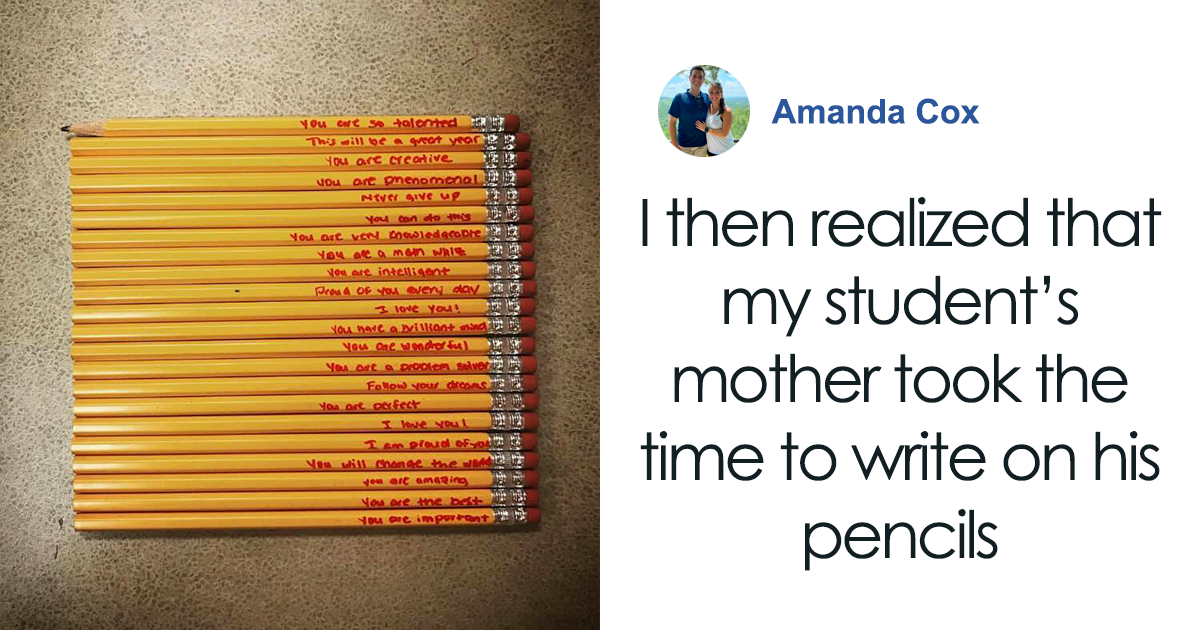
A wooden pencil is not normally an emotional heavyweight. It writes spelling words, survives math worksheets, disappears beneath desks, and occasionally returns from the sharpener looking as though a beaver handled the maintenance. Yet a collection of ordinary pencils became unforgettable when an elementary school teacher discovered the encouraging messages a mother had written on them for her son.
The moment began with a routine classroom problem: teacher Amanda Cox was running short of pencils. What followed was a touching lesson about parental encouragement, student kindness, and the enormous influence of small, thoughtful gestures. The notes required little more than a permanent marker and a few minutes, but they carried something every child needsevidence that someone believes in them.
How a Classroom Pencil Shortage Revealed Something Wonderful
In 2018, Cox, an elementary teacher from Beaumont, Texas, asked her students to check their desks for spare pencils that could be shared. One boy asked whether he could keep the pencils his mother had given him. Cox agreed without hesitation. School supplies are personal property, after all, and teachers generally prefer not to launch a courtroom drama over a No. 2 pencil.
The student then reconsidered. He offered several of his pencils so classmates who needed one would not be left empty-handed.
While sharpening the donated pencils, Cox noticed writing along their wooden sides. The words were not names, reminders, or warnings such as “Please stop chewing me.” They were short messages from the boy’s mother.
Among them were affirmations such as “You can do this,” “Never give up,” “You are important,” and “I am proud of you.” Other pencils reminded him that he was creative, intelligent, talented, loved, and capable of solving problems.
Cox asked to see the remaining pencils. The full collection moved her deeply because it revealed how intentionally the mother had prepared her son for school. She had not merely packed writing tools. She had placed confidence within his reach, one pencil at a time.
Why the Student’s Response Made the Story Even Better
The mother’s notes were touching, but the boy’s reaction gave the story an additional layer. He was not embarrassed by the messages. He valued the pencils and initially wanted to protect them, yet he ultimately chose to share several with classmates.
That decision matters. Encouragement did not appear to make him possessive or self-important. Instead, feeling supported may have made generosity easier. He knew the pencils were special, and he still wanted other students to have what they needed.
Cox reflected that the mother’s project probably took only a few minutes but brightened her son’s entire day. She urged parents and teachers to remind children that they are valued, talented, knowledgeable, and loved. Her closing thought“This is why I teach”captured the emotional core of education. Teaching is about academic skills, certainly, but it is also about noticing the human being holding the pencil.
Why Encouraging Notes Can Matter to Children
The viral story is not a controlled scientific experiment, and one should not claim that marker ink magically raises test scores. The pencil aisle has many products, but bottled academic destiny is not currently among them. Still, the gesture aligns with established research on supportive relationships, motivation, and school connectedness.
The Center on the Developing Child at Harvard University has emphasized that stable, responsive relationships with caring adults help children manage stress and develop resilience. The Centers for Disease Control and Prevention similarly describes school connectednessthe sense that adults and peers care about a student and their learningas an important protective factor associated with engagement and well-being.
A note from home can become a portable sign of that connection. When a child feels nervous before a test, struggles with a difficult assignment, or has a lonely moment, a familiar message can quietly say, “You have support beyond this desk.” The pencil cannot complete the worksheet, regrettably, but it can remind the student that a disappointing answer is not a verdict on their worth.
Effective Encouragement Is Honest and Specific
Not every compliment works in the same way. Research summarized by the American Psychological Association and Stanford psychologist Carol Dweck suggests that praise focused on effort, strategies, persistence, and improvement can encourage students to approach challenges more constructively. Constant or exaggerated praise, especially praise attached only to fixed traits, may create pressure or make children dependent on approval.
That does not mean parents must retire loving statements such as “You are amazing.” Affection should not require a performance review. However, broad affirmations become more useful when paired with observations about choices the child can control.
- “You kept trying after the first strategy did not work.”
- “I noticed how patiently you practiced.”
- “Your questions helped you understand the problem.”
- “You were kind when your classmate needed help.”
- “Mistakes are part of learning. Try another approach.”
Specific encouragement gives children information. It identifies what they did successfully and helps them repeat the behavior. It also communicates that ability can grow rather than arriving at birth in a tiny academic gift basket.
A Physical Reminder Can Arrive at the Right Moment
Spoken encouragement is valuable, but a written message can remain available after the conversation ends. Children can reread it privately, particularly when the adult who wrote it is not present.
Attaching the message to an everyday object makes it part of a routine. A pencil appears during writing, problem-solving, drawing, testing, and revisingall situations in which confidence may wobble. The object becomes a cue that connects a difficult moment with a supportive voice.
The idea can also be adapted to lunchbox cards, notebook covers, bookmarks, folders, water-bottle labels, or removable notes inside a backpack. The object is not important by itself. The repeated message of care is what gives it meaning.
The Quiet Power of Family–School Partnerships
This story also illustrates how home and school can reinforce one another. Research and guidance from the U.S. Department of Education and its Institute of Education Sciences describe family engagement as an ongoing partnership built around student learning, development, and two-way communication.
The boy’s mother supported him from home. Cox noticed the effort at school, honored its meaning, and shared the lesson with a wider audience. Neither adult needed a complicated program or a color-coded binder thick enough to qualify as furniture. They simply communicated the same idea: the child mattered.
Positive family contact can strengthen these partnerships. Teachers naturally have to call home about missing assignments, behavioral concerns, and attendance problems. When families hear from school only when something has gone wrong, communication begins to feel like an alarm system. A short message celebrating improvement, kindness, curiosity, or persistence can build trust before a difficult conversation becomes necessary.
How Parents and Teachers Can Create Meaningful Messages
For Parents and Caregivers
Choose messages that sound like something you would genuinely say. Children are excellent detectors of adult nonsense. If an affirmation feels wildly disconnected from their experience, it may sound more like advertising than encouragement.
Mix unconditional love with process-focused support. One note might say, “I love you on easy days and hard days.” Another could say, “Take your time and use what you practiced.” A third might recognize a recent success: “You showed courage when you asked for help.”
Keep the words age-appropriate and private enough that the child will not feel exposed. Some children will proudly display a message. Others would prefer it hidden inside a notebook. Respecting that preference is part of making the gesture supportive.
For Teachers
Teachers can keep a small supply of encouraging pencils or cards for students who need them. Messages should be inclusive and should not rank children against one another. “Your ideas belong here” builds community; “You are smarter than everyone else” invites a tiny classroom monarchy.
Written encouragement is most effective when supported by real relationships. Learn students’ interests, pronounce their names correctly, listen to their concerns, notice improvement, and provide useful feedback. A cheerful note cannot compensate for a classroom in which a student consistently feels ignored or unsafe.
Sample Pencil Messages That Support Growth
- Your ideas are worth sharing.
- Take it one step at a time.
- You can ask for help.
- Try a new strategy.
- Your effort is making a difference.
- Mistakes help your brain learn.
- Your kindness matters here.
- I believe in your ability to grow.
A Small Gesture With a Larger Lesson
The heartwarming pencil notes traveled far beyond one Texas classroom because they made care visible. They also reminded adults that encouragement does not need to be expensive, elaborate, or social-media-ready. It needs to be sincere.
A child may forget the worksheet completed with a particular pencil. The pencil itself will eventually become a two-inch stump with no eraser and a surprisingly long résumé. What may last is the memory of being seen, supported, and trusted during an ordinary school day.
That is why Cox’s reaction resonated with teachers and parents. Education is shaped by curriculum, instruction, and assessment, but it is sustained by relationships. Sometimes the most important lesson in the room is written in permanent marker.
Related Experiences: Five Ways Encouragement Can Change an Ordinary Day
1. The Message Before a Difficult Test
Imagine a student who understands math during practice but freezes when a test lands on the desk. A pencil marked “Slow downyou know useful strategies” does not guarantee a perfect score. It can, however, interrupt the panic long enough for the student to breathe, read the first question, and begin.
The best follow-up happens after the test. Instead of asking only about the grade, a parent or teacher can ask which strategy helped and what the student might change next time. This turns the note from a decorative slogan into part of an ongoing learning conversation.
2. The First-Day Reminder
A new school year can feel exciting to adults and suspiciously like a wilderness expedition to children. They face unfamiliar classmates, rules, rooms, and lunch procedures. A short note such as “You do not have to know everything on day one” can relieve the pressure to perform immediately.
For a child entering a new school, the message might be more specific: “Start by saying hello to one person.” That creates a manageable action instead of demanding instant confidence. Courage often looks less like a movie speech and more like choosing the seat beside someone friendly.
3. A Teacher’s Positive Message Home
Consider a student who is accustomed to adults discussing only mistakes. One afternoon, the teacher sends a brief message home: “Today, your child stayed with a challenging reading passage and asked a thoughtful question.” The family now has something specific to celebrate, and the student learns that effort is visible.
This kind of contact can also change the next parent–teacher conversation. The relationship begins with shared appreciation rather than mutual defensiveness. If a concern later arises, both sides already know they are working with people who recognize the child’s strengths.
4. Encouragement That Spreads Between Students
The most moving part of the original story may be that the boy shared his special pencils. A classroom can build on that spirit by creating a communal encouragement basket. Students might contribute appropriate messages such as “Your voice matters,” “Keep going,” or “Thank you for helping our class.”
Teachers should review the messages and ensure participation is optional. When handled thoughtfully, the activity allows encouragement to move sideways between peers rather than flowing only from adults. Students learn that kindness is not a scarce supply. Unlike the good pencils, it does not vanish mysteriously after third period.
5. When a Cheerful Note Is Not Enough
Encouraging messages are tools, not substitutes for listening. A child experiencing bullying, serious anxiety, learning difficulties, grief, or persistent low self-esteem may need direct support from caregivers, educators, counselors, or health professionals. Writing “You’ve got this” should never become a reason to ignore evidence that the child does not, in fact, have the support required.
A better response combines reassurance with action: “You are not alone, and we will work through this together.” The adult then listens, asks what happened, communicates with the appropriate people, and follows up. This is the deepest lesson behind the pencil story. The words mattered because they represented a real relationship. The marker was permanent, but the care behind it was even more enduring.
Editorial note: This article is based on verified reporting about Amanda Cox’s classroom story and a synthesis of guidance and research from ABC News, Bored Panda, Scary Mommy, TLC, CafeMom, Good News Network, InspireMore, the American Psychological Association, Stanford University, Harvard University’s Center on the Developing Child, the Centers for Disease Control and Prevention, the U.S. Department of Education, the Institute of Education Sciences, Penn State Extension, Understood, and Edutopia.